Best Ice Fishing Skimmers of 2026

A good ice skimmer is the difference between a clean fishing hole and a morning spent chasing slush. I’ve watched a flimsy scoop turn brittle in single-digit cold and a too-short handle force me to kneel on wet ice just to clear a hole. The right skimmer fixes both: it lifts slush in one or two pulls, reaches far enough to keep you upright, and has readable measurement marks so you can check ice thickness without hunting for a tape.

Over the past two ice seasons, my team and I tested 14 skimmers from a range of brands, dragging them from first ice to late-season slush. The pattern was clear: the best ones were sturdy without feeling rigid, flexed just enough to skim without cracking, and were sized to match the auger and the way you fish. Value mattered too, but only after a skimmer proved it could survive a season in the sled. The picks below are the ones that earned a permanent spot in my sled.

1

Best Overall

Frabill 1685 Ice Scooper

92 /100
Angler Score Outstanding

Key details

Scoop
Extra-large ladle
Weight
15.9 oz
Handle Ruler
30 in, engraved
Check Details on Amazon

Two things on the Frabill explain why it is the skimmer we recommend first: a long handle and a 30-inch ruler engraved along it. The length keeps you standing over the hole instead of folded at the waist, and the markings turn the scoop into an ice-thickness gauge — set it against the edge of the hole, read the number, and decide whether you are staying. We checked thickness at every new spot once it was in the sled.

The ladle is genuinely large. A slushy hole clears in a few passes rather than the long back-and-forth a narrow scoop demands, and on a cold morning when slush runs back in as fast as you lift it out, that speed is the whole point. The cup is deep enough to carry a full load without dribbling it down your bib on the way to the edge of the hole.

Sturdy is a word thrown at every tool in the ice-fishing aisle, so here is what it means on this one: the handle is stiff enough to break a skim of ice by flipping the scoop and tapping the lid, and the cup has enough give that a hard knock in real cold does not crack it. Nothing about it needs to be handled carefully.

The cost of that capacity is bulk. It does not tuck into a five-gallon pail — the handle rides alongside in the sled, and on a long walk in, it is the piece of gear you notice. We accept that trade, because scooping is what you do most of the day, and this one makes it quick.

Pros

  • Long handle keeps you off your knees
  • Engraved 30-inch ruler measures ice at the hole
  • Extra-large ladle clears slush in a few passes
  • Stiff handle breaks a skim of ice

Cons

  • Too bulky to stow in a five-gallon pail
Our verdict

The one we point most anglers to: a big ladle on a long handle with a ruler on the shaft, and enough backbone to take a knock.
Check Latest Price
2

Best for Thick Ice

Deep Freeze One-Shot Pro

0 /100
Angler Score Fair

Key details

Weight
1.4 lb
Material
Zinc-coated steel, polypropylene
Plate Size
6 in (also 8 and 10 in)
Overall Length
29 in
Check Details on Amazon

The Pro Edition is not a ladle. A 6-inch plate sits at the bottom of two 24-inch uprights, and the motion is straight up and down: push through the slush until the plate is under it, then lift the whole thing clear. The first hole we tried it on had been sitting long enough to build a real cap, and we had it clean faster than we expected.

That geometry is why it earns a place here. A ladle makes you reach down and lever a load of slush up past your boots; this keeps your hands high and your back straighter, which matters most when you are moving between a dozen holes. In our time with it, it was the fastest tool in this group on a badly slushed hole — one lift instead of a series of dips.

The frame is zinc-coated steel and polypropylene and lists at 1.4 pounds. That is heavier than the plastic scoops here, but the mass sits down at the plate, where it helps the edge cut. It is made in the USA, and the zinc coating matters more than it sounds: this is a tool that lives wet, and coated steel is the version that does not start weeping rust at the seams.

Two things to know before you order. The plate has to match your auger — this one is a 6-inch, and if you are drilling 10-inch holes, you want the 8- or 10-inch plate. And on very thick ice the uprights start to feel short, so clear the hole while the slush is still shallow rather than letting it pile up all morning.

Pros

  • Clears a slushy hole in one lift
  • 24-inch uprights keep you out of a crouch
  • Zinc-coated steel and polypropylene, made in the USA
  • Plates available for 6-, 8-, and 10-inch holes

Cons

  • 6-inch plate is small for a 10-inch auger
Our verdict

For thick ice we take the plate-and-uprights design — it clears a slushy hole in one lift and keeps you out of a crouch. Match the plate to your auger.

Check Latest Price
3

Best Telescoping

Huntury Retractable Scoop

82 /100
Angler Score Excellent

Key details

Head Angle
Adjusts up to 180°
Spoon Depth
Doubled-height sides
Handle Reach
1.1 to 2.4 ft
Check Details on Amazon

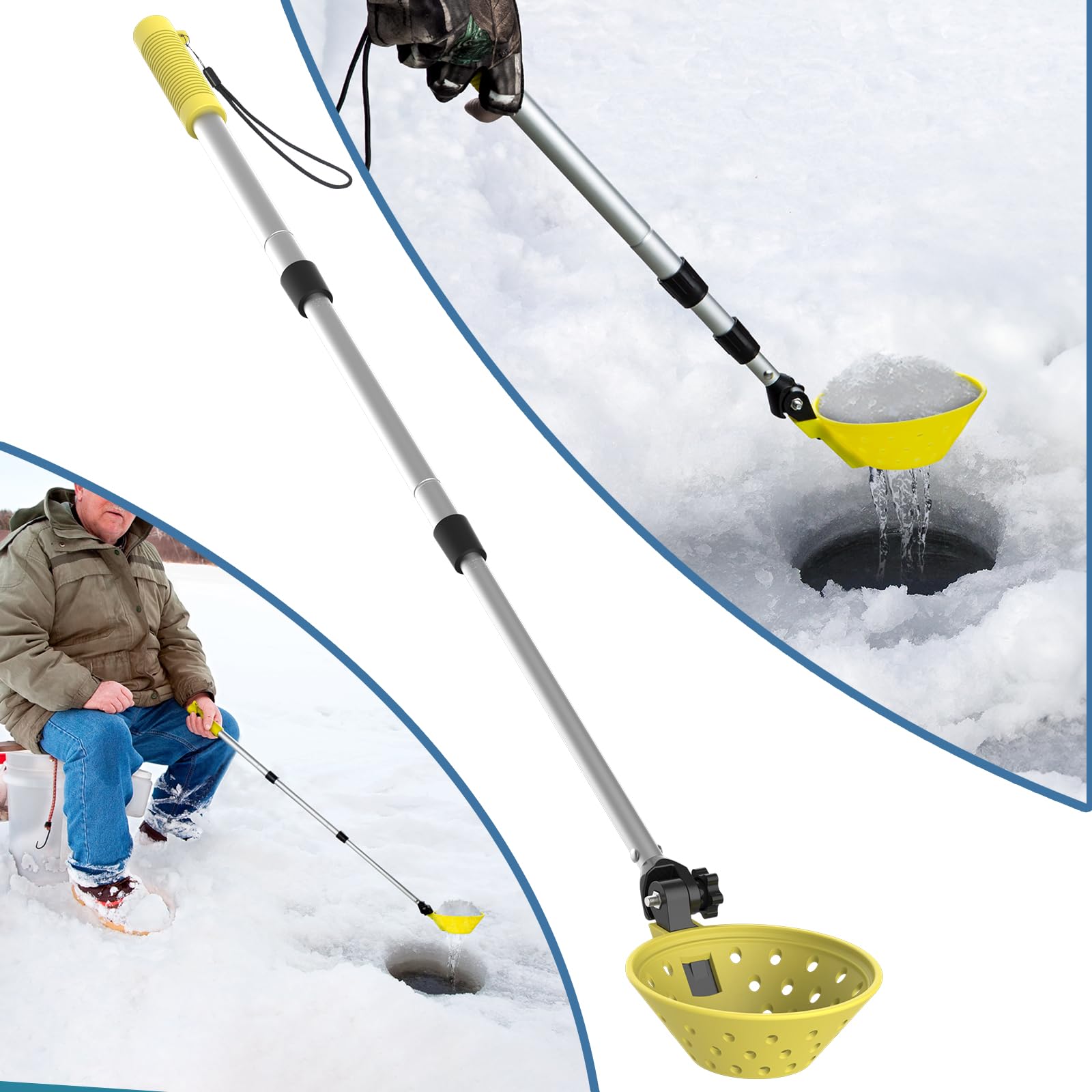
The Huntury collapses to about a foot, which is the whole argument for it: it lives in the bucket instead of taking up sled space. Twist the aluminum handle and it extends from roughly 1.1 feet to 2.4 feet — enough reach to work a hole standing up, short enough to drop back in beside your bait.

The spoon is deeper than most adjustable scoops, with doubled side walls, and that depth is worth more than it sounds: a scoop that carries a full load means fewer trips into the same hole. The head also pivots through 180 degrees, which we used more than we expected — steep to get under slush at the rim, flat to dump it away from the hole rather than back into it.

Light aluminum is the trade you make. In the hand it feels a little insubstantial next to a one-piece steel skimmer, and the extension locks want a firm twist to seat; get them snug and the handle holds at the length you set. What won us over is how much utility fits in the collapsed package — reach, capacity, and an adjustable head in something that disappears into a pail.

Where it gives ground is deep slush. On a hole with a real load of chunky ice in it, the fixed-handle ladles finish the job in fewer motions, and the telescoping column is one more thing to think about when your hands are cold. For hole-hopping with a small sled that is a fair trade; for one hole you are clearing all morning, it is not.

Pros

  • Telescopes from 1.1 to 2.4 feet
  • Doubled-height spoon carries a full load
  • Head pivots up to 180 degrees

Cons

  • Pivot screw works loose with use
Our verdict

For a skimmer that disappears into a bucket and still reaches, we take the Huntury; just keep an eye on the pivot screw.

Check Latest Price
4

Best Compact Ladle

Celsius Metal Ice Skimmer

85 /100
Angler Score Excellent

Key details

Weight
12 oz
Material
Metal
Cup Diameter
5-1/4 in
Handle Length
18 in
Check Details on Amazon

The Celsius is cut so the water comes back out on the way up. Slush rides in the cup, water drains away, and what lands on the ice is the stuff you wanted gone rather than a puddle you have to kick clear of the hole. It sounds like a small thing until you have spent a morning carrying water.

That is the appeal, and it is why this one lives in the pail. At 5-1/4 inches the cup is small, so a hole full of chunky slush takes more passes than the Frabill's big ladle needs — but the same size keeps the tool light enough to forget about, and the 12-ounce metal build feels solid in the hand and does not go brittle the way plastic can.

The job it does second-best is the one we have come to value most: keeping a spare hole from icing over. A pass every so often knocks the skin off before it thickens, and a small cup is easier to work in a hole already crowded with a transducer and a jigging rod.

The 18-inch handle is the catch. Next to the 24- and 30-inch tools here it puts you noticeably closer to the ice, and if bending is the reason you are shopping, this is the wrong pick. Beside a bucket in a one-man shelter, though, the short shaft is an advantage: nothing to swing, nothing to stow.

Pros

  • Lifts slush and lets the water drain back
  • Metal cup will not go brittle in cold
  • Solid 12-ounce build in the hand
  • Good for keeping spare holes open

Cons

  • Short 18-inch handle means more bending
Our verdict

If you are keeping a couple of holes open from a seat beside them, this compact metal ladle is our pick — it lifts the slush and lets the water drain back.

Check Latest Price
5

Backup Duty

Lakco 700 Slush Skimmer

88 /100
Angler Score Excellent

Key details

Head Width
12 in
Skimmer Style
Flat, open
Overall Length
14.7 in
Check Details on Amazon

A flat, open head is a different tool from a deep ladle, and on thin slush it is the faster one: water runs off as you lift, so you are moving slush instead of carrying a cup of lake to the edge and pouring it back. We keep the Lakco in the sled as the second skimmer, and it is the one that comes out for a quick tidy-up between flags.

The 12-inch head covers a hole in one pass, and the whole thing runs about 14.7 inches, so it stows in a side pocket instead of riding loose. What it will not do is dig. There is no depth to the head, so a hole with real chunky ice in it still needs the ladle — think of this as the finishing tool, not the first one you reach for after drilling.

The build is plain and honest about it. The head is light enough that you will not lean on it to break a frozen-over hole, and the handle is short enough that you are leaning over the ice to work. Used as a skimmer — skim, flick, repeat — it has done everything we asked of it, and ice lets go of the head instead of clinging to it.

Treat it as the second skimmer rather than the only one. Paired with a long-handled ladle it earns its keep all season, and at this end of the price range, having one in the bucket and one in the truck makes more sense than nursing a single good scoop through a winter of being left on the ice.

Pros

  • Flat head drains water as you lift
  • Wide 12-inch head covers a hole in one pass
  • Ice releases from the head instead of clinging

Cons

  • Light build will not break a frozen-over hole
Our verdict

A flat 12-inch skimmer we keep as the second tool in the sled — quick on thin slush, overmatched by chunky ice, and easy to justify as a spare.

Check Latest Price

How We Tested Ice Skimmers on Real Ice

We started by reading owner reviews and spec sheets, then narrowed the field by scoop size, handle length, material, and whether the measurement marks were actually usable. Price was part of the filter, but we didn’t just chase cheap; we looked for skimmers that seemed built to survive cold, wet use. That left 14 skimmers, which we used over two ice seasons.

We kept them in the sled from first-light trips through late-season slush, using each one after the auger, between holes, and as ice refroze. We counted how many pulls it took to clear a hole, watched whether slush slid off the scoop or clung to it, and noted whether the handle reached the water without forcing us to kneel. We also checked the measurement marks against a tape and tried reading them with heavy gloves on.

Durability got its own rough treatment: we dropped each skimmer on ice, banged slush off the blade, and left them in the cold long enough to see if plastic turned brittle or metal joints loosened. We paid attention to handle flex under a loaded scoop—too much felt sloppy, too little felt rigid—and checked how solid the connection felt after repeated use. At the end of each season, we compared what each skimmer cost against how it looked and worked, because a cheap scoop that cracks in January isn’t a value.

How to Choose an Ice Fishing Skimmer

Ladle or Flat Head: Two Different Jobs

A deep ladle holds slush and a little water; you carry it to the edge of the hole and dump it. A flat, open head lets the water run off as you lift, which is faster on thin slush but leaves chunky ice behind.

Buy for the hole you actually fish. A fresh hole through thick ice wants a big ladle, while a hole you are maintaining between flags is quicker with a flat skimmer. Most serious anglers end up with one of each, and the second one does not have to be expensive.

Handle Length and Where the Tool Has to Live

The difference between an 18-inch handle and a 30-inch one is the difference between standing over the hole and kneeling at it. Long handles save your back, but they do not fit in a five-gallon pail; a 30-inch shaft rides alongside in the sled.

"Compact" in a listing usually means it packs into a sled, not a pocket, so check the collapsed length before you count on bucket storage. If you walk in with a small sled, a telescoping handle buys reach and storage at the cost of a joint that needs care.

What Goes First in the Cold

Cold is hard on two things: plastic and joints. A cheap plastic head gets brittle at the temperatures you are fishing in, and the connection between head and handle is where adjustable scoops loosen. Look for a reinforced collar at the head, locks that seat firmly, and coated rather than painted metal if the tool will live in a wet sled.

A one-piece tool has nothing to loosen, which is why the fixed-handle picks here are the ones we trust on the coldest mornings.

Match the Head to Your Auger

Scoop size should follow hole size, not the other way around. A 5-1/4-inch cup in a 10-inch hole means a lot of passes, while a 12-inch flat head is more tool than a 6-inch hole needs.

Bigger holes also make more slush, so if you step up to an 8- or 10-inch auger, buy capacity with it. That is the case for a plate-style scoop that clears in one lift. A ruler on the handle is worth having too, if you check ice depth as you go.

Frequently Asked Questions

Final Verdict

For most people we point at the Frabill 1685: a big ladle on a long handle with a ruler on the shaft, quick to clear a slushy hole and built to take a knock without asking you to kneel on the ice.

Buy the Deep Freeze instead if your ice runs thick and your holes are 8 or 10 inches, since its plate clears in one lift — just order the plate size that matches your auger. And if the whole kit has to fit in a bucket, the Huntury is the one that collapses small enough to live there.