Best Inflatable Paddle Boards of 2026

An inflatable paddleboard makes a promise that sounds almost too good: a full-size board that folds into a backpack and lives in a closet. The catch is that a soft board can feel like a pool toy underfoot, and the difference between a good one and a bad one shows up mid-stroke, not on the product page. What you're really buying is stiffness that lasts and a package you'll genuinely carry down to the water. Get those two things right and the board goes everywhere with you; get them wrong and it spends the summer in the garage.

I've paddled fourteen of them over the past eight months, across every price point in the category, and the pattern is clear: the boards that hold their pressure are also the ones still fun three hours in. Most people under-inflate their board once, then blame the board for the wobble. What follows are the ones worth pumping up — stable enough for a first-timer, portable enough that you'll actually keep doing it.

1

Best Overall

Roc 10'6" Inflatable SUP

96 /100
Angler Score Outstanding

Key details

Warranty
3 years
Deck Dimensions
126"L x 33"W
Weight Capacity
350 lb
Check Details on Amazon

Thirty-three inches of width and a 350-pound rating are the two numbers that make the Roc our default. That deck is wide enough for a nervous beginner to stand up on flat water, and the rating leaves room for an adult plus a dry bag, a child sitting forward, or a dog that has not learned to sit still. At 10 feet 6 inches it is short enough to swing around in a cove and still holds a line well enough for a couple of miles of open lake.

The bag holds a full kit, paddle, pump, leash, fins, and backpack included, so nothing else has to arrive before your first session, and the three-year warranty is as long as anything on this page. We spent our time on the pump, where the gauge is the one part of the package that behaves inconsistently: inflate until the deck feels hard under a flat palm and treat the dial as a rough guide rather than a measurement.

Ten minutes of steady pumping is about the effort for a board this size, and an electric pump earns its money if you will be inflating in a parking lot every weekend. On the water the deck pad grips when it is wet and the board feels solid underfoot at pressure, and the whole package rolls back into a bag one person can shoulder.

Where it earns the top spot is breadth. The Skatinger is the better board for two adults at once, and the SereneLife is the cheaper way to try the sport, but neither covers a household that swaps riders every trip as neatly. If one board has to serve a beginner, a teenager, and a weekend guest without a briefing, this is the one.

Pros

  • Wide 33-inch deck steadies new paddlers
  • 350-pound rating covers a rider plus gear
  • Complete kit needs nothing extra to launch
  • Three years of warranty coverage

Cons

  • Pump gauge reads inconsistently
Our verdict

This is the board we recommend first: wide enough to steady a beginner, rated for 350 pounds, and backed by three years of coverage at midrange money.

Check Latest Price
2

Best for Families and Multiple Riders

Skatinger 11'6" x 35" SUP

95 /100
Angler Score Outstanding

Key details

Warranty
2 years
Board Weight
19.8 lb
Deck Dimensions
138"L x 35"W
Weight Capacity
450 lb
Check Details on Amazon

Two adults and a dog is the load the Skatinger is built for, and at 11 feet 6 inches by 35 inches it has the deck to make that comfortable rather than merely possible. The 450-pound rating is not unique here, but it comes attached to a 19.8-pound board, so the size does not turn the carry from car to water into a two-person job.

We think the width is where the money went, and that is the right call for this buyer. Thirty-five inches is noticeably more forgiving than a 33-inch deck when someone shifts their weight or a dog decides to stand up, and it is the version of stability that matters when you are carrying passengers rather than just balancing yourself. The trade is maneuverability: a deck this wide is slower to spin, and on a breezy crossing you will work to hold your line.

The details are sorted for family use too: three handles so a second person has something to grab, bungee at both ends for a cooler and a dry bag, a 1680D backpack that feels like luggage rather than a stuff sack, and a padded shoulder strap for the stretches where the bag is too heavy to wear. Ten to fifteen minutes of pumping goes faster with two people taking turns.

The extras are worth counting. A 5L dry bag and a phone case are usually the first things bought separately a week after the board arrives, and here they are already in the box.

Pros

  • 35-inch deck holds two adults comfortably
  • 450-pound capacity at a 19.8-pound carry
  • Three handles and bungee at both ends

Cons

  • Broad hull is slow to turn in wind
  • Two-year warranty, shorter than the three-year picks
Our verdict

We point two-adult households here: the 35-inch deck and 450-pound rating make a shared day on the water comfortable rather than cramped.

Check Latest Price
3

Best High-Pressure Ride

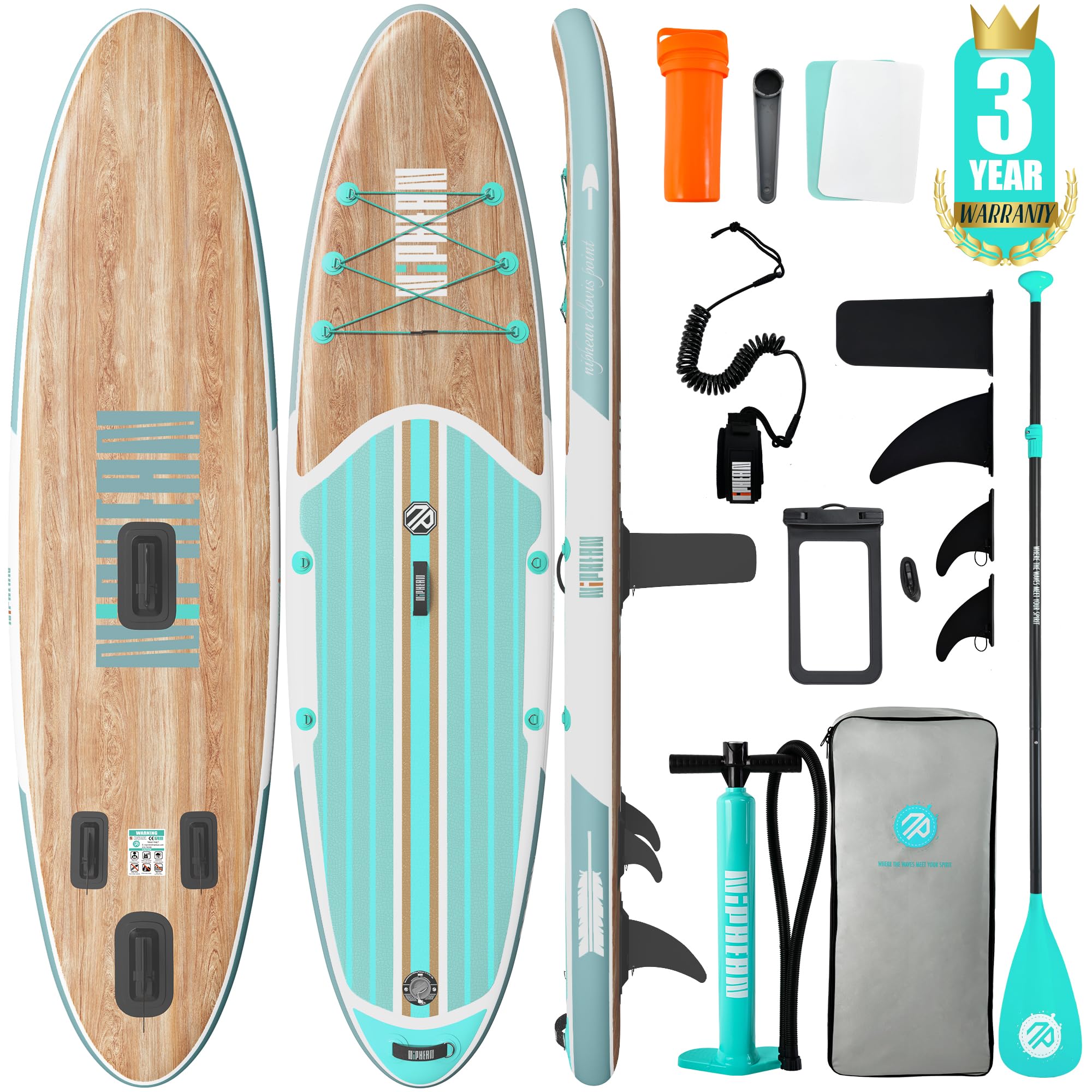
Niphean Inflatable SUP

93 /100
Angler Score Outstanding

Key details

Board Weight
19 lb
Max Pressure
20 psi
Deck Dimensions
126"L x 33"W
Weight Capacity
450 lb
Check Details on Amazon

Twenty psi is the number that separates the Niphean from most of this group. Pumped to its ceiling the deck goes hard and you stop thinking about it underfoot, which is exactly what you want when a beginner is shifting around or a heavier paddler stands mid-board.

Getting there takes more strokes than stopping at 15, and the last stretch is real work: you will be leaning on the handle with both hands. What you get for it is a 10-foot-6 deck rated to 450 pounds that still weighs 19 pounds and rolls into a bag you can shoulder.

We rate this the firmest-feeling deck in the group for the money. The kit is complete, with paddle, three fins, leash, pump, backpack, waterproof phone bag, and repair kit, and the EVA pad has enough grip to walk on when it is wet. Three years of coverage is as long as anything here, which matters on a board you will be folding and unfolding all season.

Pros

  • 20 psi ceiling gives a hard-board feel
  • 450-pound capacity at only 19 pounds
  • Complete kit with three-year coverage

Cons

  • Pump gauge and hose fitting are the weak links
Our verdict

We like the Niphean for anyone who wants a deck that feels like a hard board: 20 psi and 450 pounds without a weight penalty.

Check Latest Price
4

Best Budget

SereneLife 10' Inflatable SUP

93 /100
Angler Score Outstanding

Key details

Warranty
1 year
Max Pressure
15 psi
Deck Dimensions
120"L x 32"W
Weight Capacity
275 lb
Check Details on Amazon

The SereneLife is the cheapest complete kit in this group, and it is the one we point to when someone wants a season on the water before deciding whether the sport sticks. Nothing in the bag is filler: paddle, pump, leash, removable fin, repair kit, and backpack all come with it.

The money buys a 10-foot, 32-inch deck rated to 275 pounds, and that rating is the number to take seriously. It is the lowest capacity here, so a big adult, two people, or a child riding on the nose pushes past what the board is built for. For a single lighter paddler on a lake it does the job, and the savings leave room for a decent life vest and a dry bag.

The shorter hull shows up in how it handles. It turns quickly and feels stable underfoot at 15 psi, but the first thing we noticed on open water was how much more correction it needs than the longer boards here. It is happiest on flat water within sight of shore, where the EVA pad grips well and the whole thing deflates into a backpack that fits a hall closet.

Pros

  • Cheapest complete kit in the group
  • Turns quickly on flat water
  • Packs into a closet-sized backpack

Cons

  • 275-pound rating is the lowest here
  • One year of warranty coverage
Our verdict

We keep this one on the list as the cheapest complete kit: a sensible first board for a lighter adult or a teenager on calm water.

Check Latest Price
5

Best for Longer Paddles

Highpi 11' Inflatable SUP

92 /100
Angler Score Outstanding

Key details

Warranty
1 year
Board Weight
20 lb
Deck Dimensions
132"L x 33"W
Weight Capacity
350 lb
Check Details on Amazon

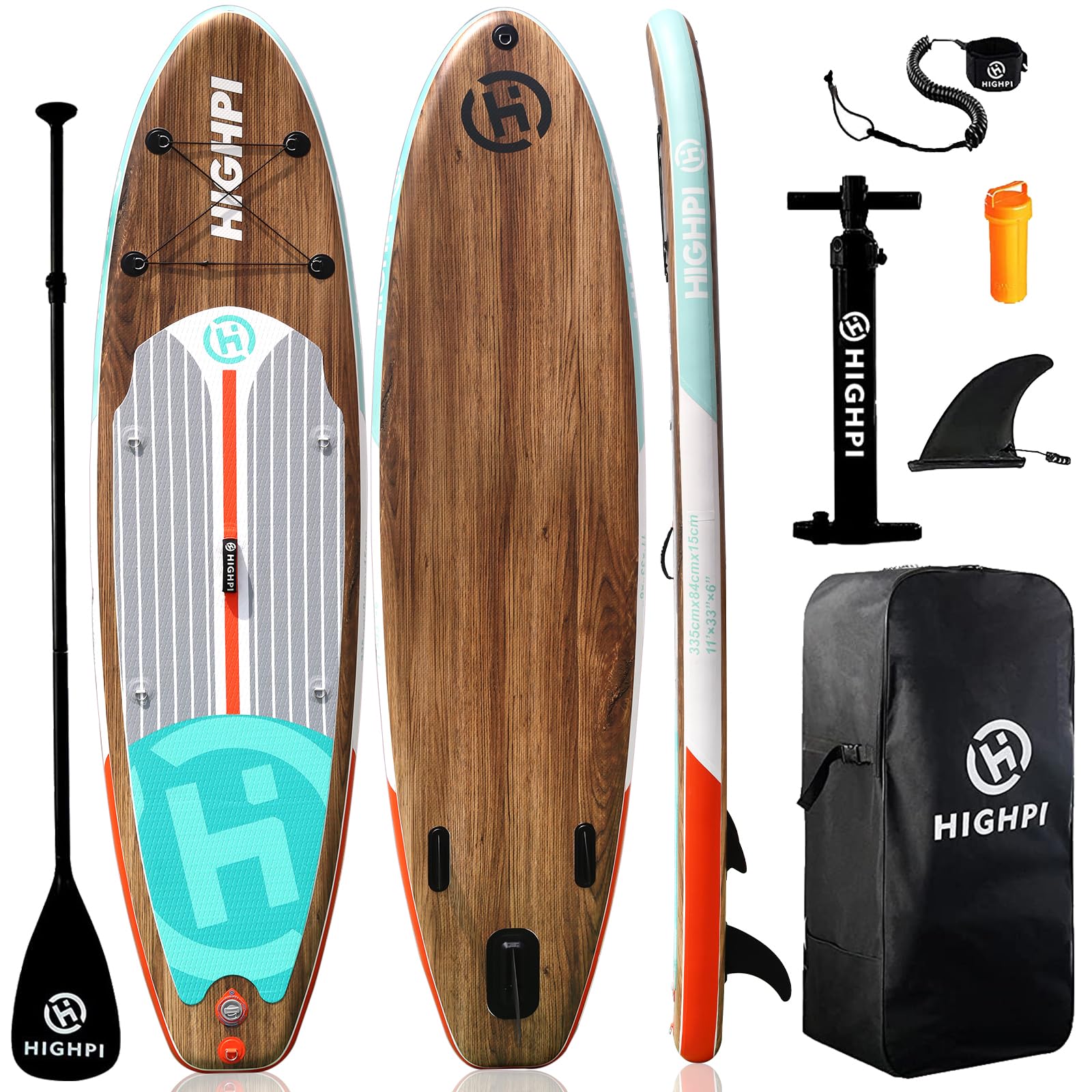
The wood-grain deck is the finish we liked best in this group, and that is not a small thing on a product you will leave sitting on a rack between trips. Under the graphic it is a straightforward 11-foot, 33-inch board rated to 350 pounds, with dual-layer PVC and a full EVA deck pad.

Length is the reason to choose it. A few extra inches of waterline buys straighter tracking and less correcting on a long lake or a slow river, and 33 inches of width keeps enough stability that the length does not become a liability for a newer paddler. It is the best cruiser in this set for someone who goes out to cover distance rather than to splash around.

The kit is complete, with paddle, pump, leash, and backpack, and 20 pounds is a fair carry for the size. What this board gives up is coverage: one year of manufacturer warranty where some picks here carry three, and that is the trade for a long hull at midrange money.

Pros

  • 11-foot hull tracks straight on long crossings
  • Wood-grain finish is the best-looking deck here
  • Complete kit with paddle, pump, leash, backpack

Cons

  • One-year warranty, shorter than the three-year picks
Our verdict

We choose the Highpi when most of the paddling is distance: an 11-foot hull tracks better than the shorter boards here and looks better doing it.

Check Latest Price
6

Best with a Seat

ATPROSS 11'6" x 35" SUP

90 /100
Angler Score Outstanding

Key details

Warranty
1 year
Board Weight
32.7 lb
Deck Dimensions
11'6" x 35"
Weight Capacity
450 lb
Check Details on Amazon

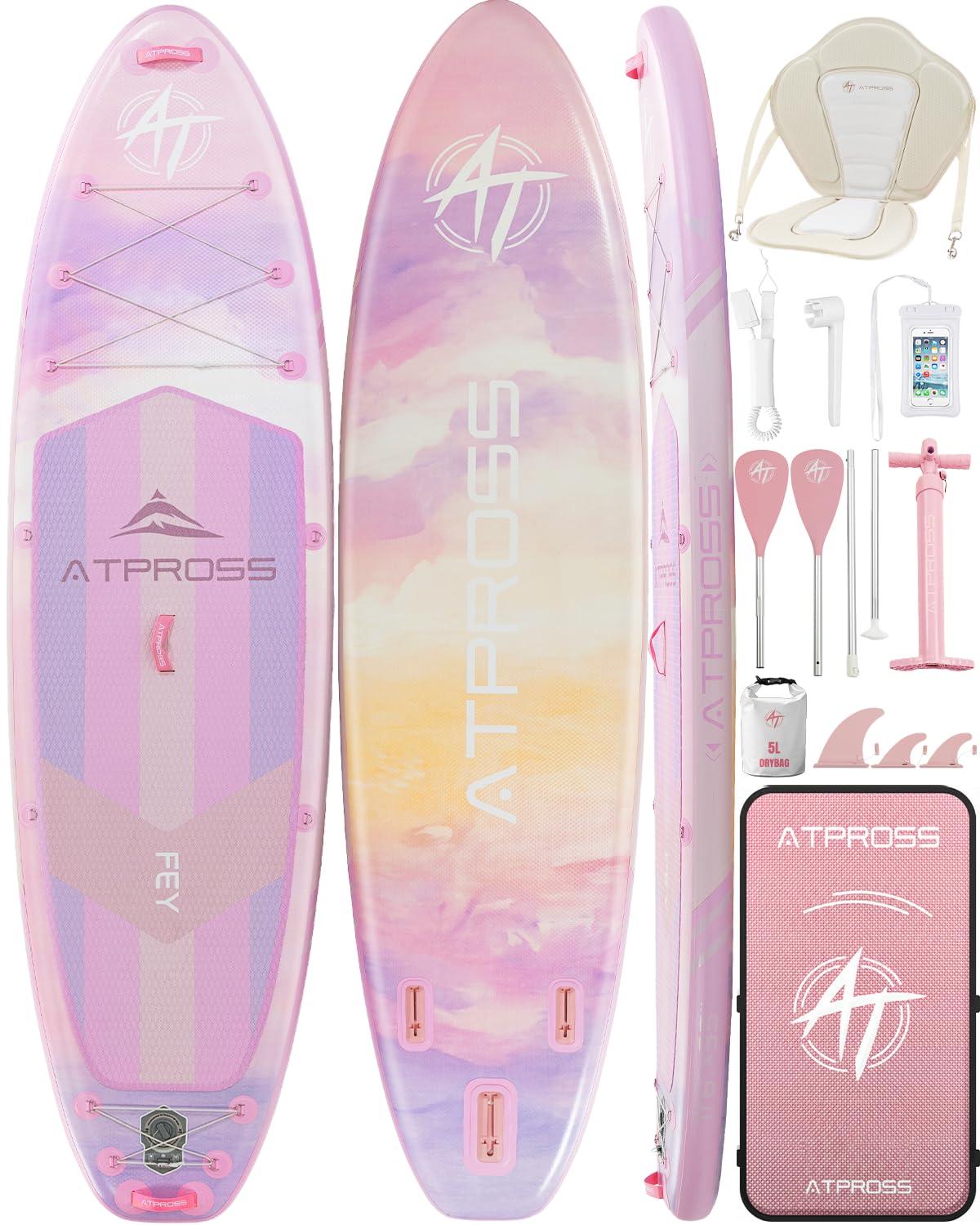
At 32.7 pounds the ATPROSS is the heaviest board here, and that is the first thing you notice hauling it out of the trunk. What the weight buys is an 11-foot-6, 35-inch platform rated to 450 pounds, with double-layer PVC and a reinforced sidewall, plus an inflatable seat that turns it into a sit-down craft.

The seat is the reason to consider it. Sitting changes what the board is for: you can fish, eat lunch, or hold a slow line along a bank without balancing, and the cushioning is shaped to keep hips and back from complaining after an hour. With the seat out of the way it is a wide, stable platform for a child or a dog to ride along.

Our read is that this is a specialist board that does its job well and is not trying to be your only board. The weight is the cost, since 32.7 pounds deflated and bagged is a genuine lift for one person, and the hand pump is slow enough on a board this size that an electric one earns its money. If your launch is a boat ramp and your day is mostly sitting, that trade is easier to take.

Pros

  • Inflatable seat converts it for fishing
  • 35-inch deck rated to 450 pounds
  • Double-layer PVC with reinforced sidewall

Cons

  • Heaviest board here at 32.7 pounds
Our verdict

Our pick if you plan to sit and fish rather than stand and cruise: a 35-inch deck, 450 pounds of capacity, and an inflatable seat in the box.

Check Latest Price
7

Accessory-Heavy Day Trips

iTAOSTAR 11' Inflatable SUP

87 /100
Angler Score Excellent

Key details

Warranty
3 years
Dimensions
131.89 x 33.07 x 5.91 inches
Board Weight
22.3 lb
Weight Capacity
410 lb
Check Details on Amazon

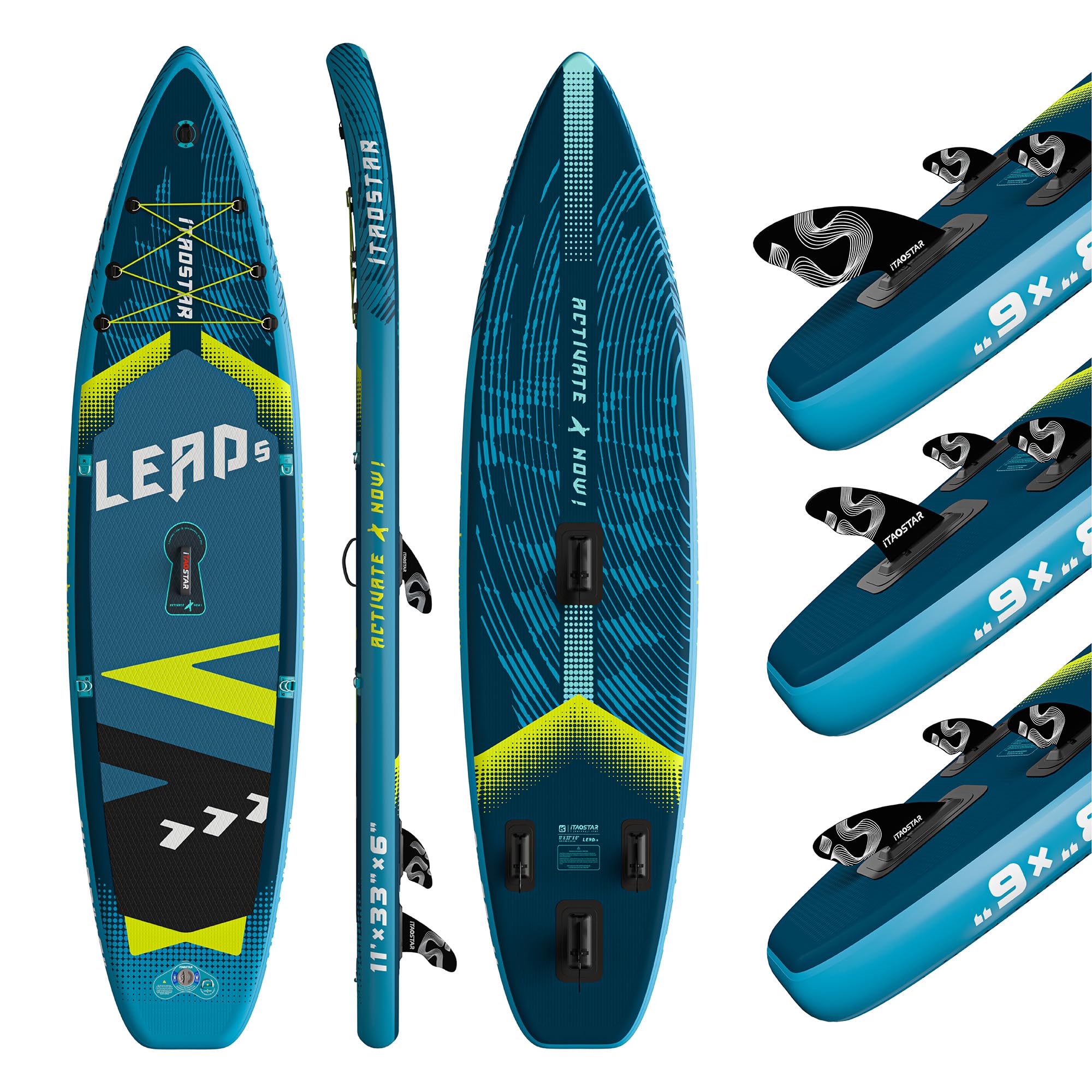
Five removable fins tells you what kind of package this is: center and side fins you can mix for different water, plus a wrench to change them. That is a novelty until you are trying to hold a line in current, and then it is the difference between a long afternoon and a short one.

The rest of the kit follows the same logic, with an action-camera mount at the nose, a small flag, a waterproof phone bag, an ankle leash, a travel backpack, and enough D-rings that you will run out of things to tie down before you run out of places to tie them.

The board is 11 feet by 33 inches and rated to 410 pounds, which puts it a step above the entry boards here without asking you to handle a 35-inch hull. At 22.3 pounds it is a heavier carry than the Roc or the Portal and noticeably lighter than the ATPROSS.

We came away thinking it is a strong value for an accessory-minded paddler, and the three-year warranty is the longest coverage in the group. Inflate it at home and leave it overnight before the first trip, because with any board that is the test that tells you more than the box did.

Pros

  • Five swappable fins for different water
  • Camera mount, flag, and generous D-rings
  • 410-pound capacity at a budget price
  • Three years of warranty coverage

Cons

  • Seams and inflator fitting are the weak points
  • Heavier than most here at 22.3 pounds
Our verdict

We rate it the best-equipped kit in this group for the money, with five fins, a camera mount, and three years of coverage.

Check Latest Price
8

Small Cars, Closets

Portal 10'6" Inflatable SUP

91 /100
Angler Score Outstanding

Key details

Warranty
1 year
Board Weight
17.8 lb
Deck Dimensions
126"L x 33"W
Weight Capacity
300 lb
Check Details on Amazon

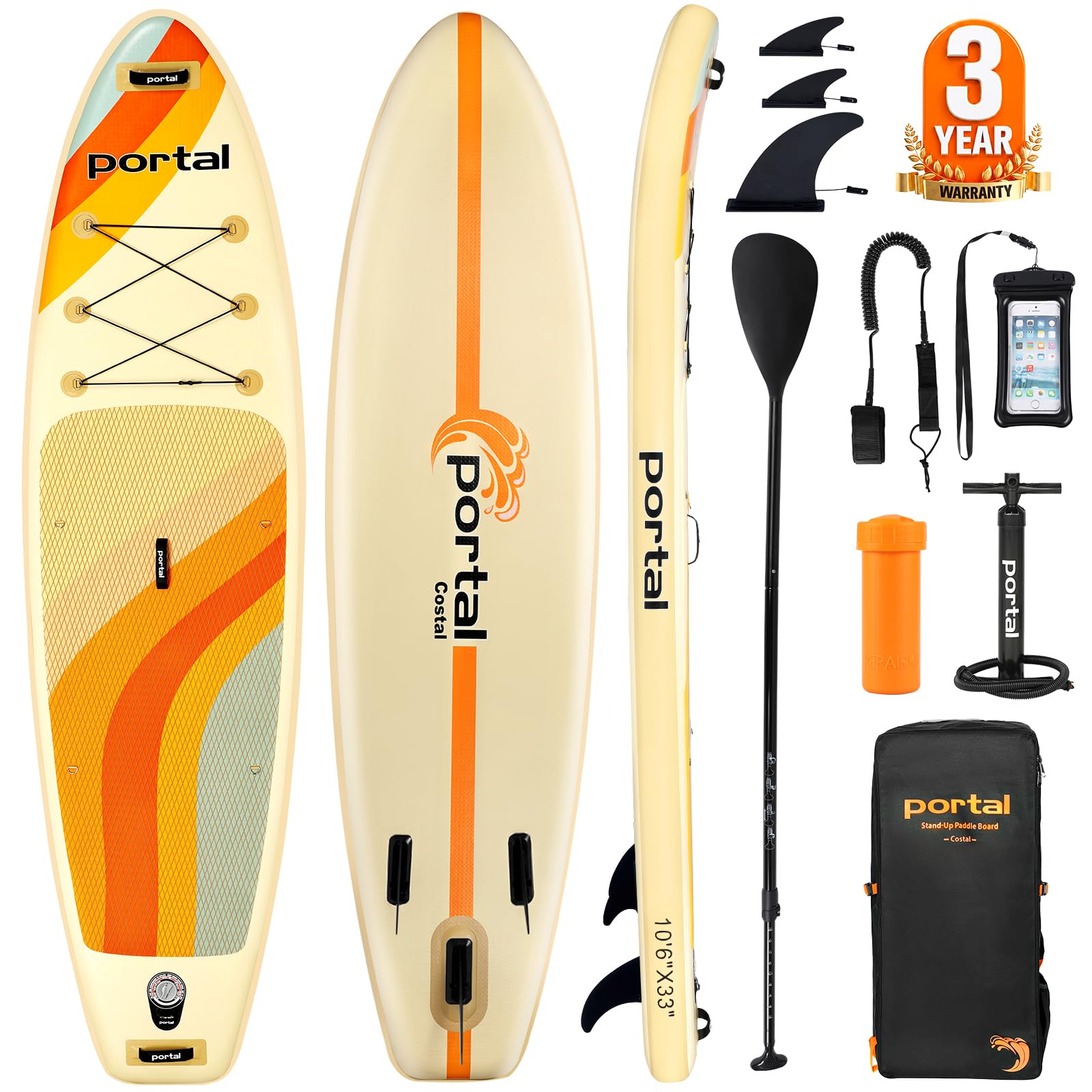
Three hundred pounds is the number that decides the Portal. It is the second-lowest rating here, which rules it out for a big adult carrying gear or anyone planning to paddle with a child on the nose, and it is also why the board weighs 17.8 pounds, less than anything else in this group.

That weight is the whole appeal. Deflated and bagged, this is a board one person can carry up a flight of stairs, stow in a hall closet, or slide into a small hatchback. Portal's own figures are about 10 minutes to inflate and 5 to deflate, and the snap-in center fin goes on without tools.

Two fixed side fins and the removable center fin give it reasonable tracking for a 10-foot-6 board, and the EVA deck is grippy enough to kneel on while you sort out a leash. The kit is complete, with paddle, pump, leash, backpack, and repair kit, and the bag takes the board, pump, and paddle without a fight.

For a lighter paddler who stores gear in a closet, we think this is the smartest buy in the group: the rating is honest about what the board is for, and nothing else here packs away as easily. Give the valve a firm close and check the paddle before your first trip, since those are the two parts to inspect on this one.

Pros

  • Lightest board here at 17.8 pounds
  • Quick to inflate and quick to pack away
  • Complete kit with repair kit and backpack

Cons

  • 300-pound capacity rules out bigger paddlers
Our verdict

We think it is the easiest board here to live with in a small apartment, as long as your paddling weight stays under 300 pounds.

Check Latest Price

How We Tested Inflatable Paddle Boards

We started with a list of more than 40 boards pulled from retailer listings and reader recommendations, then filtered hard on the things that change the experience: stated max PSI, weight capacity, packed weight and dimensions, deck pad thickness, and whether the pump and paddle in the box were usable or just filler. Fourteen boards made the cut, and I've paddled them over eight months.

Inflation came first, because it's where a lot of boards quietly lose. I timed each one from bag to its stated max PSI using the pump in the box, solo, counting strokes and noting where I had to stop and rest. Then every board stayed inflated in my garage for a full week while I checked the gauge each morning — one that dropped a couple of PSI overnight got flagged, and I kept watching it on the water afterward.

On the water, we launched from a reservoir ramp, a muddy lake put-in, and one windy afternoon that turned flat water into chop. I stood, walked the length of the deck, shifted weight onto each rail, and had a 230-pound friend climb aboard; a few boards also got a kid and a 50-pound dog. We paddled two-mile stretches, tried a couple of yoga poses, and turned hard enough to see whether the nose caught or the board skidded.

Back on shore, I weighed each packed bag, carried it the quarter mile from parking to the launch, then rolled and stuffed it back in — twice, because once tells you nothing. Boards got dragged across gravel at the put-in, left on a roof rack in the sun, and deflated along the same creases week after week. I was watching for abrasion at the rails, a sticky valve, a fin box that loosened, and any seam that went soft when the board sat hot.

How to Choose an Inflatable Paddle Board

Width Decides More Than Length

Deck width is the biggest single factor in whether a beginner stands up or spends the day kneeling. A 32-inch board is quick and lively but tippy for a new paddler; 33 inches is the sensible middle and covers most of the picks here; 35 inches, on the Skatinger and the ATPROSS, is what we point to for families, bigger paddlers, and anyone who wants to fish or carry a passenger.

Wide boards are slower to turn and harder to hold on a line in a crosswind, so pay for the extra width only if you will use it. A paddler who mostly cruises alone on a lake gets more pleasure from a narrower, longer board than from a deck they never needed.

Read the Weight Rating as a Ceiling

The stated maximum covers you, your gear, a cooler, and anything else on the deck. Ratings here run from 275 to 450 pounds, and the gap matters more than deck size: a 275-pound board carrying a 230-pound paddler and a dry bag is already working hard, and that is when a deck starts to feel soft underfoot.

Give yourself a comfortable margin rather than paddling at the limit, and count the dog, the kid, and the cooler as part of the load rather than as extras.

Pressure, Pumps, and the Part That Fails

Most boards here want 15 psi; the Niphean goes to 20, and the difference is a deck that feels like a hard board rather than a firm one. Getting there by hand is the cost, since the last few psi are slow, and an electric pump is the upgrade we recommend before any other accessory.

Pump dials are the weak point in these kits. One that sticks at zero or reads optimistically leaves you guessing, so inflate until the deck is hard under a flat palm and treat the gauge as a second opinion.

What a Complete Package Really Covers

Every pick here arrives with a paddle, pump, leash, fins, and a backpack, so the differences sit at the edges: an aluminum paddle that adjusts far enough for a tall paddler, a leash cuff that does not rub, a bag with real shoulder straps. Read the include list for the extras that usually get bought in week one, such as a dry bag, a phone case, a repair kit, or a camera mount.

None of it changes how the board paddles, but it changes what the first weekend costs.

Plan for the Carry and the Closet

An inflated board is easy to move; a deflated one is a roughly 20-pound duffel with an awkward shape. Anything at or above 22 pounds is a two-hands, short-distance proposition, and the widest boards here are the heaviest.

Compact in a listing describes the packed bag, not the board: an 11-foot board still inflates to 11 feet. Measure the closet shelf and the trunk before you choose, and if you launch solo from a lot a few minutes' walk from the water, weight deserves as much attention as width.

Frequently Asked Questions

Final Verdict

Buy the Roc. It covers the widest range of paddlers of anything here: a 33-inch deck that steadies a beginner, a 350-pound rating that handles a rider plus gear, a complete kit, and three years of coverage at midrange money.

If your usual day involves a second adult, a kid, or a dog, the Skatinger's 35-inch deck is worth the step up. And if you are a lighter paddler who stores everything in a closet, the Portal is the board you will actually take out.