
Best Kayak Hoists of 2026

The last five minutes of a good paddle are the drive home, and that's where the trouble starts — a 12-foot boat has to go somewhere, and the garage floor is already spoken for. A kayak hoist lifts the hull into ceiling space you weren't using, provided the straps cradle the boat, the rope doesn't creep overnight, and the frame clears your car's hood. Get that wrong and you've traded a floor problem for a sagging, crooked boat and a scratched roof.

I've hung boats in a garage with barely nine feet of clearance for years, and the gap between a hoist you trust and one you dread lives in the hardware and the instructions. Over the past eight months my team and I installed, loaded, and lowered 12 different hoists, and the weight capacity printed on the box turned out to be only half the story. What really decides whether a system works is where your joists sit relative to the length of your boat — a number most shoppers never check. The picks below split along exactly those lines.

1

Best Overall

Teal Triangle Pulley Hoist

86 /100
Angler Score Excellent

Key details

Mounting
Ceiling joists
Warranty
Lifetime
Strap Length
8 ft
Weight Capacity
150 lb
Check Details on Amazon

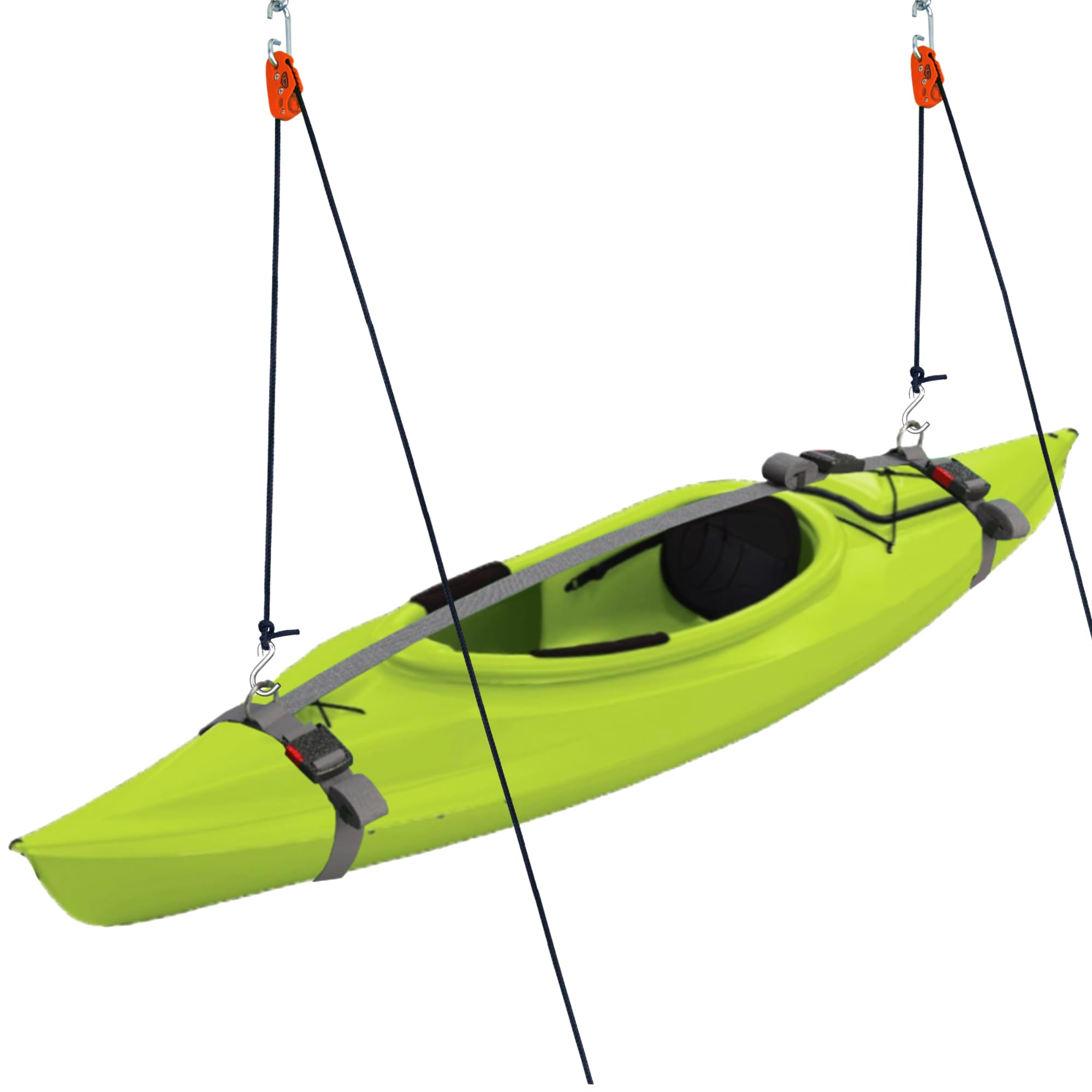
The Teal Triangle is the hoist we recommend first because it gives you the most margin where it matters: a 150-pound capacity, 8-foot adjustable straps, and mounting hardware that lets you secure the blocks to ceiling joists. That extra capacity is not just a number on a box. It means a 70- or 80-pound fishing kayak, plus a paddle and seat left in the boat, is not pressed against the limit. The 8-foot straps also give you more room to wrap a wide hull than the short slings on cheaper kits.

What sets it apart in this group is setup. The instructions are clear enough to follow without hunting for a video, and the bracket-and-pulley design keeps the boat close to the rafters once it is up. We like that for a garage with a low door or a car parked underneath. The lifetime warranty is another real advantage over the budget hoists here, which carry no warranty at all.

The catch is the pull. A pulley system gives you an advantage, but it does not turn a 90-pound kayak into a one-finger job. We don't recommend this for a heavy fishing boat if you have shoulder trouble. The lock also deserves a deliberate check: seat the rope and give the hull a small tug before you let go. For a typical recreational kayak, though, the combination of capacity, clear setup, and warranty is the best balance here.

Pros

  • 150-lb capacity leaves room for gear
  • Clear instructions simplify the first install
  • 8-ft straps fit a range of hulls
  • Lifetime warranty adds long-term support

Cons

  • Heavy kayaks still demand a strong pull
  • Costs more than the budget picks
Our verdict

We recommend the Teal Triangle for most kayaks: its 150-pound capacity, clear setup, and lifetime warranty make it the easiest hoist here to live with.

Check Latest Price
2

Best Budget

RAD Sportz Kayak Hoist

89 /100
Angler Score Excellent

Key details

Locking
Automatic rope brake
Warranty
None
Ceiling Height
Up to 12 ft
Weight Capacity
125 lb
Check Details on Amazon

The RAD Sportz is a 125-pound hoist with enough rope for ceilings up to 12 feet and an automatic rope brake that pinches the line as you pull. That brake is the reason it works for one person: you can raise the boat a few feet, stop, and reset your grip without the kayak sliding back down. The brackets can be turned parallel or perpendicular to the joists, which helps in a narrow bay.

We like the rubber-coated hooks for hulls that would otherwise get scuffed, and the low price leaves room for a better paddle or a set of straps. The kit is not a precision piece of hardware, though. The included rope can snag, and the instructions are thin on how to route it through the pulleys. Watch a video or have someone who has rigged one before help you; a better rope is the first upgrade we recommend.

The 125-pound limit is fine for most recreational kayaks, but add a seat, fishing gear, and a cart and you can get close to it. There is no warranty, which is the clearest difference between this and the Teal Triangle. For a first hoist, a second boat, or a garage where the budget is tight, though, it is hard to argue with the basic package. It does the job, and it leaves room to spend on the water instead.

Pros

  • Low price for a complete hoist
  • Automatic brake helps one-person lifting
  • Fits ceilings up to 12 ft
  • Rubber-coated hooks protect the hull

Cons

  • No manufacturer warranty
Our verdict

We recommend the RAD Sportz as the budget hoist for a typical recreational kayak, provided you're willing to upgrade the rope and take the rigging slowly.

Check Latest Price
3

Light Kayaks

Tie Boss Kayak Hanger

80 /100
Angler Score Excellent

Key details

Locking
Self-locking jam cleat
Mounting
Eye hooks not included
Warranty
Limited lifetime
Weight Capacity
150 lb
Check Details on Amazon

The Tie Boss takes a different approach: instead of a pair of pulleys and a long rope, you get two 1/4-inch Tie Boss units and a universal sling. Each unit has a self-locking jam cleat, so you pull the line and it holds where you stop. The low-profile result is the appeal: the kayak tucks up against the ceiling and wall, and there is less hardware hanging in the way than with a typical pulley kit.

That simplicity comes with a catch. There is no pulley advantage, so a heavy kayak is a straight pull, one end at a time. A 100-pound boat is a struggle; a 50- to 70-pound recreational kayak is more reasonable. The eye hooks that attach the system to the ceiling are not included, so factor in a hardware run. You also need to be comfortable working the cleat and keeping the rope seated.

The 150-pound capacity and lifetime warranty are reassuring, and the made-in-USA construction is a genuine point of difference. But we see this as a niche hoist. It is not the one for a heavy fishing kayak or anyone with shoulder trouble. It is for a light boat, a clean ceiling, and a paddler who wants a simple sling rather than a pulley cluster. If that describes your garage, the Tie Boss is a tidy solution; if not, the Teal Triangle is the better all-around choice.

Pros

  • Simple two-point sling hugs the ceiling
  • Self-locking cleat holds where you stop
  • 150-lb capacity with lifetime warranty
  • Made in the USA

Cons

  • Eye hooks sold separately
  • No pulley advantage for heavy kayaks
Our verdict

We see the Tie Boss as a niche pick for a light kayak and a simple sling setup; it is tidy overhead, but the straight pull and extra hardware make it hard to justify for a heavy boat.

Check Latest Price

How We Hung, Loaded, and Lowered 12 Kayak Hoists

We started by pulling every two- and four-point pulley system we could find, then cut the list to models rated above 100 pounds, with straps rather than bare hooks, and a mounting kit in the box. Anything that needed a separate purchase just to hang it was out. That left 12 hoists, and we lived with each one for eight months.

Installation came first, because that's where most of these systems are won or lost. I timed each one solo — drill, stud finder, ladder — from opening the box to the first full lift, noting where the instructions got vague about joist spacing or ceiling height. Then the boats went up: a 45-pound touring kayak, a 65-pound sit-on-top, and a 90-pound tandem that pushed the upper end of every capacity rating.

Each hoist got the same treatment: I pulled the loaded boat to the top, counting pulls and watching for rope stretch and dragging pulleys, then lowered it hand over hand to see whether the rope ran clean or jumped a groove. I let go at shoulder height to see whether the lock held or the boat slipped an inch, and nudged the hull while it hung to check for strap shift or tilt. Everything stayed loaded overnight, and we checked each morning for rope creep and hardware backing out. Ceiling clearance got measured with a boat in the air — the distance from ceiling to hull bottom, the number that decides whether your car still fits underneath.

Eight months of repeated lifts showed us which straps frayed, which locking mechanisms got fussy once the hardware had been outdoors, and which ropes stiffened in the cold. We weighed what came in the box, too — a hoist that needs an extra trip to the hardware store isn't the bargain it looks like.

How to Choose a Kayak Hoist

Capacity Is a Loaded-Weight Question

Kayak weights are advertised dry and bare; the number that matters is the boat plus seat, paddle, fishing crate, and anything left strapped inside. A 125-pound hoist like the RAD Sportz is fine for many recreational kayaks, but it leaves less margin once you add gear. The Teal Triangle's 150-pound rating is not a free pass to overload it, but it gives a heavier fishing kayak more breathing room. We recommend weighing the loaded boat or adding up the components, then choosing a hoist with room to spare. And check the ceiling structure, not just the capacity.

Measure the Ceiling and the Door Path

Height is the measurement people skip. A hoist needs enough rope for the floor-to-joist distance, and the kayak needs to hang clear of the garage door, tracks, and the car below. The RAD Sportz comes with enough rope for ceilings up to 12 feet; the Teal Triangle uses 8-foot straps and sits close to the rafters. In a low garage, that low-profile carry can be the difference between parking inside and leaving the car out. Measure the joist height, then raise the empty hoist and check the door's travel before you load the kayak.

Lifting Effort Is Part of the Design

Pulleys multiply your pull, but they do not make a 90-pound kayak weightless. A brake or self-locking cleat is what lets you stop mid-lift and reset your grip, which matters more than a small difference in capacity. The Teal Triangle has a lock, but heavy boats still take a strong pull. The Tie Boss is a straight pull with no pulley cluster, so it suits a light kayak better than a loaded fishing boat. If you have shoulder trouble, choose the lightest boat you can or plan to lift with a helper.

Strap Security Matters as Much as Capacity

A hoist can be rated for 150 pounds and still let a kayak slide out if the straps are wrong. Look for adjustable straps that sit under the hull, not just hooks that catch a handle, and spread them wide enough to keep the boat from rocking. A center strap or a second pair of straps adds control on a wide hull. Mount the brackets into ceiling joists with the supplied hardware or an equivalent rated fastener; drywall alone will not hold. Before you leave the boat up, give it a gentle side-to-side push and watch the straps.

Instructions and Warranty Are Part of the Value

Rigging a pulley system is the step where a cheap hoist feels cheap. Clear instructions save an afternoon, and a manufacturer who answers questions is worth something when a rope wears out. The Teal Triangle and Tie Boss both carry a lifetime warranty; the RAD Sportz has none. We do not treat a warranty as a substitute for proper installation, but it is a real difference when you are hanging a boat over a car. If the instructions are thin, watch a video before you start and replace any rope that frays.

Frequently Asked Questions

Final Verdict

For most garages, the Teal Triangle is the hoist we recommend. Its 150-pound capacity gives you room for a loaded fishing kayak, the 8-foot straps handle a range of hulls, and the clear instructions and lifetime warranty make the install less of a gamble. The RAD Sportz is the budget choice for a 50- to 70-pound recreational kayak; just plan to replace the rope and take the rigging slowly. The Tie Boss is a tidy sling for a light boat, but its straight pull and extra eye hooks make it a niche pick.