Best Kayak Bilge Pumps of 2026

A bilge pump is the one piece of paddling gear you buy hoping to leave wrapped up forever. Then a wave slaps the coaming, a roll doesn't come back the way it did in the pool, and the cockpit is ankle-deep while you scoop with a coffee cup. What separates a pump that saves the day from dead weight is unglamorous: whether it primes on the first pull, how fast it clears a flooded boat, and whether it stays in your hand while the other one holds a grab line.

We've now put 14 of them through four months of real paddling, and one thing I didn't expect is how little the biggest flow number on the box matters — a stiff, long-throw pump wears your arm out before the cockpit is dry. The ones worth carrying are the ones that kept pulling water when the level got shallow, didn't spray at the hose joint, and stowed out of the way afterward. They're the ones below.

1

Best Overall

Pelican Paddlers Floating Hand Pump

93 /100
Angler Score Outstanding

Key details

Handle
Foam sleeve, floating
Weight
0.76 lb
Pump Length
21 in
Max Lift Height
10 ft
Check Details on Amazon

Kneel in a cockpit with an inch of water over the floor and you want a pump that is already in your hand. The Pelican is the one we kept coming back to: a 21-inch body under a pound, wrapped in foam that gives cold, wet fingers something to hold and keeps the whole thing bobbing beside the boat if you drop it.

The number that separates it from the rest of this set is the 10-foot maximum lift. On a sit-on-top or a loaded canoe, that headroom lets you push water up and over a high gunwale, or into a bucket on deck, instead of dribbling it back over your knees. It manages that with the body alone, which is why you aim the whole pump over the side: simple, and one less connection to fail.

At 21 inches it isn't a pocket item, and it needs a deliberate home along the inside of the hull, out of the paddle stroke. What surprised us was how much the foam did. Bare plastic goes slick the moment spray hits it, and the sleeve keeps the pump workable in one hand when your fingers are cold and wet, which is exactly the moment you need it.

Pros

  • Floats beside the boat if dropped
  • 10-foot lift clears high gunwales
  • Foam grip stays usable with wet hands
  • Light enough to keep under the deck lines

Cons

  • Ships without a discharge hose
Our verdict

Our default pick: it floats, it grips with wet hands, and 10 feet of lift clears a high gunwale with no hose to fight.

Check Latest Price
2

Best for Debris-Filled Water

Better Boat Manual Bilge Pump

86 /100
Angler Score Excellent

Key details

Flow Rate
25 gpm
Intake Filter
Built in
Stroke Volume
115 cu in
Discharge Hose
39 in
Check Details on Amazon

Most hand pumps assume whatever is on the cockpit floor will pass through the chamber. The Better Boat puts a filter on the intake instead, so leaves, pine needles and grit stop at the end of the hose rather than jamming the works, and suction spacers hold the intake off the bottom so it keeps drawing instead of sealing itself to the hull.

That makes it our pick for the canoe that lives under trees, the dinghy with grit in the bilge, or any job where the water isn't clean. The discharge hose runs 39 inches, the longest here, which gives real reach over a gunwale without shifting your weight, and the chamber picks up within a few strokes. We also liked the T-handle: it's the pump in this group that feels most like a tool and least like an accessory, and the wider grip is easier on your palm over a long empty.

The hose is where it will test your patience. It ships coiled tight and holds that memory, so it tries to curl back into the cockpit mid-stroke; stretch it out in the sun or weight the discharge end before your first trip and it settles down. Watch the outlet joint as well. Seat the hose fully and add a clamp if it starts working loose under load, because a pump that sprays at the connection is doing half its job.

Pros

  • Intake filter blocks leaves and grit
  • Longest discharge hose of the picks here
  • Primes within a few strokes
  • Comfortable T-handle for hard pumping

Cons

  • Hose arrives coiled and resists straightening
Our verdict

The pick for dirty water: an intake filter keeps leaves and grit out of the chamber, and the 39-inch hose gives you reach.

Check Latest Price
3

Best Ultralight

Hikula Manual Bilge Pump

87 /100
Angler Score Excellent

Key details

Hose
Reversible, front or bottom outlet
Weight
0.77 lb
Pump Length
17 in
Stated Flow
20 gpm
Check Details on Amazon

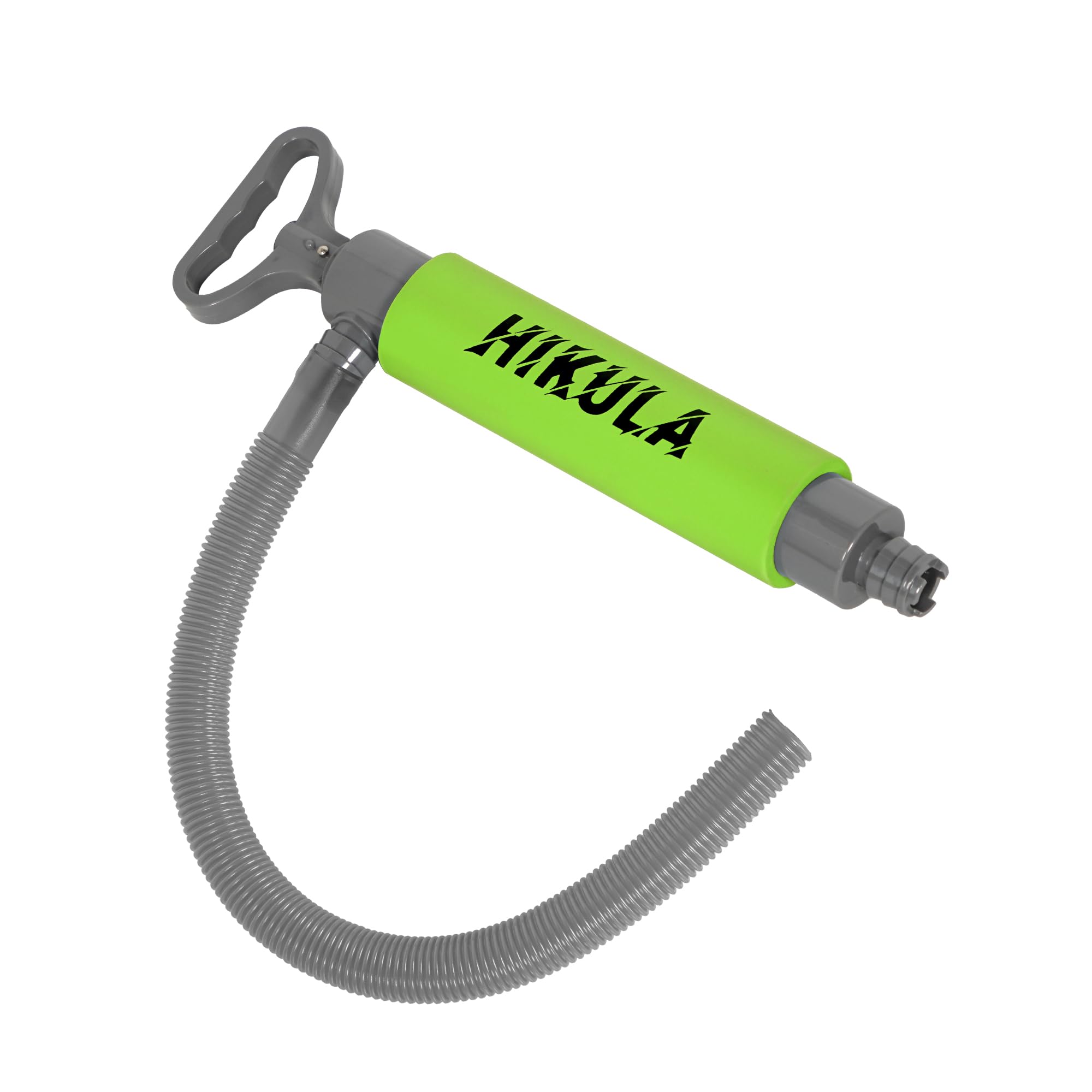
Three-quarters of a pound and 17 inches long: the Hikula is the pump that disappears into a kayak. It goes under the deck lines, into a hatch, or beside the seat where you can find it by feel without looking away from the water.

What lifts it above being a cheap spare is the hose, which moves from the front of the body to the bottom. Sitting down, that means you can discharge over either side without twisting the pump into your lap. The foam runs most of the body length, so you can choke up for short strokes or slide your hand down for leverage, and the listing claims 20 gallons a minute, the highest claim among the compact pumps here.

Where it gives ground is reach. The discharge hose is short enough that it can slip back off the gunwale and dribble into the boat, so hold it or clip it while you pump. For a few inches of water such as spray, drips and the puddle that collects under your seat, that's a fair trade for a pump you'll actually carry.

Pros

  • Light enough to forget under the deck lines
  • Hose switches from front to bottom outlet
  • Foam grip runs most of the body
  • Reasonable volume per stroke for its size

Cons

  • Short discharge hose can slip back into the boat
Our verdict

The pump that disappears until you need it: 0.77 pounds, a reversible hose, and enough volume per stroke for routine bailing.

Check Latest Price
4

Best Budget

DasMarine Kayak Hand Pump

87 /100
Angler Score Excellent

Key details

Body
EVA foam wrap
Floats
Yes
Pump Length
16 in
Outlet Fitting
1 in hose
Check Details on Amazon

Value is the whole point of this one, and the spec sheet doesn't read like a compromise: a foam-wrapped 16-inch body, a red finish you can pick out against a dark hull, and an anti-leak gasket at the inlet to stop water running back into the boat between strokes.

The outlet takes a 1-inch hose you supply, and that's the smart part. Instead of living with whatever length ships in the box, you fit the reach your boat actually needs, and the pump stays small enough to wedge beside the seat. It's where the compromise sits too: there's no hose included, and the 16-inch body is the shortest here, so a deep cockpit asks you to lean further down. For the kayak puddle and the rain-filled dinghy, neither matters much, and the EVA wrap means it stays up if you fumble it over the side.

Pros

  • Takes a 1-inch hose you already own
  • Foam wrap keeps it afloat
  • Anti-leak inlet gasket
  • Small enough to wedge beside the seat

Cons

  • Short 16-inch body means leaning deeper into a full cockpit
Our verdict

The value pick: light, foam-wrapped, and set up for a 1-inch hose you supply yourself, so you choose the reach.

Check Latest Price
5

Best for Swamped Cockpits

SeaSense Hand Bilge Pump

90 /100
Angler Score Outstanding

Key details

Hose
20 in, removable
Weight
1.5 lb
Priming
Self-priming
Pump Height
20.75 in
Check Details on Amazon

This is the biggest pump here and it looks it: a 20.75-inch barrel, 1.5 pounds, and a 20-inch discharge hose. That length earns its keep the moment a cockpit is properly full rather than damp. The intake reaches down into the water without your knuckles going under, and the wide barrel shifts a lot of water with each stroke.

We treated it as the flooding pump of the group: the one for a canoe left out in the rain, a fishing kayak sitting low, or a boat that's taken a wave. It primes itself, the plastic is described as corrosion-resistant, and the warranty runs a full year, longer than several picks here offer.

The joint at the outlet is where it can let you down. Water can escape past the hose and the washer seal while you're pushing hard, which is the worst possible moment to be sprayed in the face. Seat the hose fully before you stow it, check the seal each season, and add a clamp if it starts weeping.

Pros

  • Long body reaches deep water
  • Moves a lot of water per stroke
  • Self-priming with a full year of warranty

Cons

  • Handle is the part to watch under hard, repeated strokes
Our verdict

The pump for a cockpit that's actually full: a long body, a wide barrel, and a hose joint to check before you need it.

Check Latest Price
6

Boats with Freeboard

Attwood Manual Hand Bilge Pump

84 /100
Angler Score Excellent

Key details

Weight
16 oz
Flow Rate
8 gpm
Discharge Hose
32 in
Max Lift Height
3 ft
Check Details on Amazon

Where the Pelican is a self-contained pump you point over the side, the Attwood is halfway to a small bilge system: a 32-inch removable discharge hose, an impact-resistant body, and a stated 8 gallons a minute.

The number to weigh is the 3-foot maximum lift. That's plenty for pushing water over a low gunwale on a dinghy or a canoe, and it's why this one belongs on a boat with more freeboard than a kayak. It won't push water up to a deck or into a raised container the way the Pelican's 10-foot rating will, so it's a poor fit if you're bailing uphill.

The floating comfort-grip handle is the detail we appreciated most; the pump rides if it goes over and the grip doesn't chew your palm during a long empty. Two things to know before you commit. The discharge hose can work loose at the outlet, so check the fit and add a clamp if yours starts to slip, and the warranty runs 90 days, the shortest of the group.

Pros

  • 8 GPM moves water briskly
  • 32-inch hose reaches over the side
  • Impact-resistant body and floating handle

Cons

  • 3-foot maximum lift limits how high you can push water
  • 90-day warranty is the shortest here
Our verdict

A sensible pick for a small boat with real freeboard: 8 gallons a minute, a 32-inch hose, and a body that shrugs off knocks.

Check Latest Price
7

Long Reach

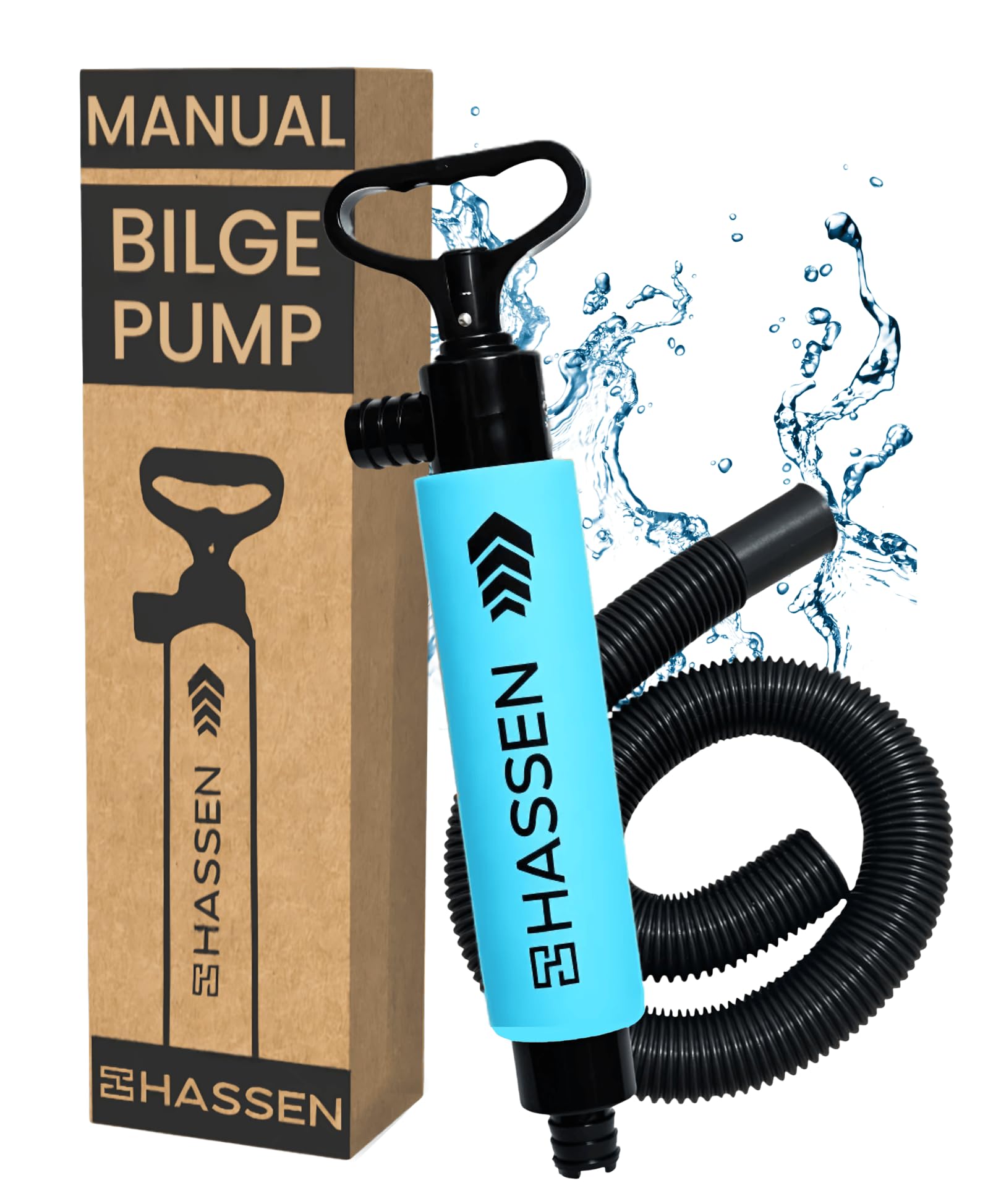
Hassen Manual Bilge Pump

81 /100
Angler Score Excellent

Key details

Floats
Yes, foam body
Weight
10.4 oz
Pump Length
16.5 in
Discharge Hose
34 in
Check Details on Amazon

Thirty-four inches of hose on a pump that weighs 10.4 ounces is the pairing that earns the Hassen a place here. You get the reach to push water well clear of the hull without carrying a heavier pump to do it.

The blue foam body floats and stands out against a dark hull or a weedy shoreline, which sounds like a small thing until you're patting around underwater for a pump that has slipped off the deck. The same foam covers the handle, so wet hands keep their grip. We noted that the hose detaches for storage: a 34-inch hose on a 16.5-inch pump is a lot of coil to manage in a hatch, and taking it off is how it stows.

The combination is what earned it a place. The other long-hose pumps here weigh more, and the light ones come with hoses short enough that you end up emptying the boat into the boat. For a kayak where the water is a nuisance rather than an emergency, that's the trade worth making.

Pros

  • 34-inch hose for real reach
  • 10.4 ounces with a floating foam body
  • Bright colour is easy to spot
  • Foam-covered handle holds a wet grip

Cons

No notable drawbacks to flag.

Our verdict

A light pump with an unusually long hose: it floats, it's easy to spot, and it reaches clear of the hull without weighing you down.

Check Latest Price

How We Tested These Bilge Pumps On (and Off) the Water

We started with roughly 40 hand pumps sold for kayaks, canoes, and small boats, then filtered on the things that actually matter in a swamped cockpit: a stated output rating, a hose long enough to reach over the coaming, a body short enough to live in a day hatch, and a price that makes sense for something you may never unwrap. That left 14, which we tested from late spring through the end of summer on a lake, a shallow rocky river, and a rain-filled canoe sitting in my driveway.

Speed and capacity we measured rather than guessed. Each pump went into a five-gallon bucket of lake water with its hose aimed at an empty cooler; we counted strokes to empty it, timed the whole job, and noted how many pulls it took before water first appeared at the nozzle. Then we let the bucket drain down to an inch and kept pumping to see which ones lost their grip on the water the moment it got shallow.

At the boat, we checked the hose connection after every session — whether water sprayed at the joint, whether the hose worked loose mid-stroke, and whether the extra length turned into a kink or dragged in the water alongside. Each pump got dropped over the side in three feet of water to see if it floated upright or sank out of reach, then dropped again with wet hands. Size was judged by whether it slid into the day hatch or behind the seat without a fight, and ease of use by whether I could work it one-handed with the other hand on a grab line.

Durability came out of a summer of abuse: sandy bilge water, grit pulled through the valve, a hot car, a drop onto gravel, and one accidental step in the cockpit. The pumps that came through all of it without cracking a handle or losing suction are the ones that made the list.

How to Choose a Kayak Bilge Pump

Hose or No Hose

Two designs cover this list. A self-contained pump like the Pelican pushes water out of its own body, so you aim the whole unit over the gunwale; there is no hose to kink, curl or work loose while you're kneeling in a puddle. A pump with a discharge hose trades that simplicity for reach and a drier lap, which matters in a canoe where you sit well above the waterline. Our rule of thumb: measure from your seat to over the far gunwale before you buy. A hose that can't clear the side just moves water from one part of the boat to another.

Lift height belongs in the same decision. The Pelican is rated to push water 10 feet up, the Attwood 3 feet. Pumping over a low gunwale needs neither figure; filling a bucket on deck or clearing a high freeboard needs the bigger one.

What a Flow Rating Really Tells You

The gallon-per-minute numbers on these listings aren't measured the same way. One is a manufacturer's best case, another is really a per-stroke displacement dressed up as a rate, and one doesn't square with the stroke volume quoted on the same page. We treat them as a rough ranking, not a stopwatch. Bore and effort are what you can actually judge: a wide barrel moves more water per stroke and takes more pull, while a slim pump is easy to work one-handed and needs more strokes to shift the same puddle.

Match that to your water. A kayak that takes spray and drips through a session is fine with a compact 16- or 17-inch pump. A canoe that sits out in the rain, or a cockpit that genuinely swamps, rewards the bigger barrel even though it costs you weight and space.

Stowed Size, Weight and the Word Compact

A pump under the deck lines is worth nothing if it's too big to stow or too heavy to bother with. The compact pumps here run 16 to 17 inches and about three-quarters of a pound; the SeaSense is over 20 inches and 1.5 pounds, which is a different commitment in a small cockpit. Watch how listings use the word compact: a 21-inch pump can still be called portable, and 21 inches doesn't vanish into a hatch.

Flotation is worth a thought too. A pump with foam in the body or the handle stays up if it goes over the side, and a bright colour is easier to spot in the water than black plastic.

Joints, Handles and Seasonal Checks

The outlet joint is where these pumps give trouble. Hoses work loose under load, washers seat badly, and the result is bilge water spraying exactly where you don't want it. Push the hose fully onto the outlet before a trip, check the seal, and add a clamp if it starts to weep. Handles take the full load of a hard stroke, so a stated warranty is worth more here than on most gear; check the term before you buy.

Rinse the pump and hose in fresh water after saltwater or muddy work, drain them, and store the hose stretched rather than coiled so it doesn't take a set.

Frequently Asked Questions

Final Verdict

If you want one pump that handles a kayak cockpit without fuss, take the Pelican. It floats, the foam grip works with wet hands, and 10 feet of lift clears a high gunwale with no hose to fight.

Buy the Better Boat instead when the water carries leaves and grit, because the intake filter is worth the hose management. And if the pump has to disappear under the deck lines of a tight cockpit, the Hikula is the one that vanishes.