
Newport Kayak Series 55 Best Overall
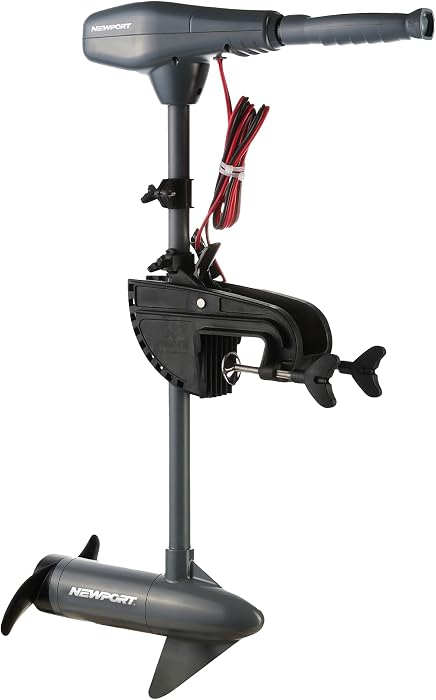
Key details
- Shaft
- 24 inches
- Speeds
- 5 forward, 3 reverse
- Thrust
- 55 lb
- Weight
- 23 lb
A 24-inch shaft and 5-foot-6 battery leads are what make this a kayak motor rather than a boat motor, and they're why it takes the top spot. A kayak's mounting point sits low and close to the water, so a long shaft leaves you with a head towering over the deck; the short one keeps the tiller within reach and the prop where it belongs. The leads are the quieter win. On a kayak the battery has to sit where it balances the hull, usually behind the seat or forward in the bow, and most motors don't give you the cable to get it there.
Fifty-five pounds of thrust is more than a kayak strictly needs, and that's the appeal: you can hold a trolling line into a headwind without running the motor flat out. Five forward speeds and three reverse, a 6-inch telescoping tiller, and an LED meter on the head cover the way you'll actually use it — nudging along a shoreline, then bumping up to cross a bay. The saltwater hardware is magnesium, zinc, and stainless, so a coastal launch won't eat it, and a 50-amp circuit breaker comes in the box instead of on a separate shopping trip.
Twenty-three pounds, plus a deep-cycle battery, is a two-trip carry from the truck, and on a short kayak that battery placement changes the trim more than the motor's own bulk does. If you fish a 10-foot sit-on-top on flat water, this is more motor than you need — the Minn Kota Endura C2 30 further down does the job with six fewer pounds to carry. For a rigged fishing kayak that sees wind, current, and the occasional salt launch, this is the one we clamp on.
Pros
- Short 24-inch shaft suits a kayak mount
- Long battery leads let you balance the hull
- 55 lb of thrust holds in wind and current
- Saltwater-rated hardware and included breaker
Cons
- Reverse gear is the weak link over time
We recommend it to anyone bolting a motor to a fishing kayak: the short shaft and long leads are built for a hull this size, and 55 pounds of thrust leaves room for wind.


