
Best Trolling Motors of 2026

Calm water at dawn is the whole point, right up until the wind picks up and you're fighting it with one oar while your buddy holds the rod. A trolling motor turns that scramble into a slow, controlled pass along a weed edge, and the gap between a good one and a cheap one shows up precisely when you're dealing with weather, current, or a battery sliding toward empty. It's the piece of gear you notice only when it lets you down.

I've run trolling motors on borrowed aluminum boats, on kayaks, and once, memorably, on a pontoon in a stiff headwind, and over the past nine months my team and I put eight of them through the same routine. Here's the thing nobody tells a first-time buyer: the thrust number on the box is measured at the prop and tells you almost nothing by itself. Shaft length has to match your transom height, and a motor that drains your battery in two hours will feel weaker than a smaller one that sips it all day. Speed, durability, and how well a motor holds a line in chop separated the leaders from the rest, and the ones that earned a spot are below.

The Best Trolling Motors

1

Minn Kota Endura Max 55 Best Overall

89 /100
Angler Score Excellent

Key details

Thrust
55 lb
Water Type
Freshwater
Shaft Length
42 in.
Speed Control
Variable speed
Check Details on Amazon

The Endura Max gives you something the cheaper motors here do not: no clicks. The tiller turns through a continuous range of speed, so you can dial in the exact pace that keeps a crankbait working instead of choosing between five notches and picking the least bad one. That sounds like a small thing until you have spent an afternoon watching a stepped motor go from too slow to steer to too fast for the fish.

Minn Kota calls the electronics Digital Maximizer and claims up to five times the run time on a charge compared with a fixed-speed motor. We cannot verify a multiplier, but the direction is clearly right: spending the day at a 30 percent setting instead of a hard-wired notch is exactly how you get back to the ramp with battery left. The 10-position lever-lock bracket is the other quiet win — one lever sets the shaft angle, and it holds where you put it.

Fifty-five pounds is the sensible middle of the thrust range: enough to push a loaded 14- to 16-foot aluminum boat into a headwind, not so much that a single 12V deep cycle empties before lunch. The 42-inch shaft is the part to point out to anyone stepping up from a 30-inch motor, because it stays in the water when the bow lifts and a short shaft will not. The composite shaft has a little give when you bump a stump, which is the behavior you want.

The limit is salt. This is a freshwater motor and nothing about the hardware is intended for a brine launch, so a coastal angler should look at the Newport L-Series instead. Otherwise the trade-offs are ordinary ones: it is a manual tiller motor with no GPS, no remote and no foot pedal, and the stepless drive costs more than a five-notch motor of the same thrust. That is the right place to spend the difference.

Pros

  • Stepless speed control for precise trolling
  • 42-inch shaft suits most 12-16 ft boats
  • Tool-free 10-position bracket adjustment

Cons

  • Freshwater only
  • Pricier than stepped motors of similar thrust
Our verdict

For freshwater boats from about 12 to 16 feet, this is the motor we point people to: stepless variable speed you can fine-tune, 55 pounds of thrust, and a 42-inch shaft that stays in the water.
Check Latest Price
2

Newport Kayak Series 55 Best for Kayaks

88 /100
Angler Score Excellent

Key details

Thrust
55 lb
Weight
23 lb
Water Type
Freshwater and saltwater
Shaft Length
24 in.
Check Details on Amazon

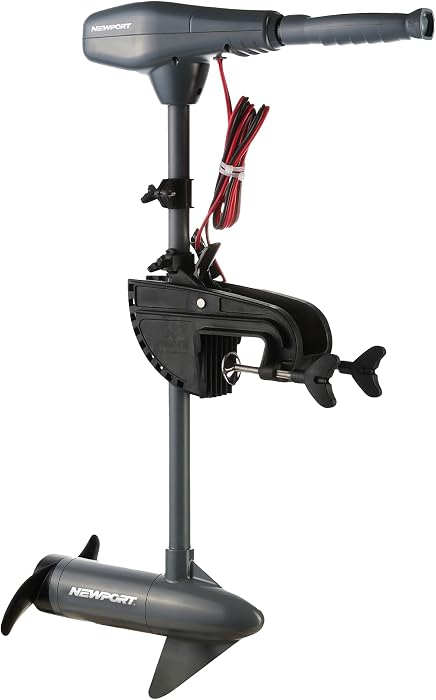
Two numbers on the Kayak Series tell you what it was built for: a 24-inch shaft and 5-foot-6 battery cables. The short shaft puts the prop right at the water under a kayak's low transom, and the long leads let you move the battery forward to level the hull — a detail that costs a manufacturer almost nothing and that most budget motors skip.

That combination is why this is the motor we recommend for kayaks, canoes and scanoes. Fifty-five pounds of thrust is more than a kayak needs at cruise, but it is the reserve that gets you home against an afternoon wind, and the 6-inch telescoping tiller shortens up so the handle is not in the way of a paddle stroke. Eight speeds, five forward and three reverse, give you enough control for working a shoreline.

Saltwater is the other half of the story. The motor head uses magnesium, zinc and stainless hardware rather than plain steel, so a freshwater rinse after a salt trip is upkeep instead of a race against corrosion. It weighs 23 pounds — light enough to hang off the stern, heavy enough that you use two hands — and a 50-amp manual-reset breaker comes in the box, which is one less thing to remember at checkout.

The 24-inch shaft is also the honest limit of this motor. On a boat with real transom height it will pull out of the water when someone shifts weight forward. Measure from the top of your transom to the waterline with the boat loaded, and if that number runs past about 20 inches, buy a longer shaft — the L-Series 62 is the step up in this group.

Pros

  • Saltwater-rated magnesium, zinc and stainless hardware
  • Long battery leads let you balance a kayak
  • Breaker included in the box

Cons

  • Tiller-only control keeps one hand busy while fishing
Our verdict

Kayak and canoe anglers should start here: a 24-inch shaft puts the prop where a low hull needs it, and the long battery leads let you balance the boat.

Check Latest Price
3

Newport L-Series 62 Best for Bigger Boats

87 /100
Angler Score Excellent

Key details

Thrust
62 lb
Water Type
Freshwater and saltwater
Shaft Length
40 in.
Speed Control
8 speeds (5 forward, 3 reverse)
Check Details on Amazon

Sixty-two pounds is the highest thrust rating in this group apart from the budget BODIOO, and it is aimed at the boats that make a 55-pound motor work hard: 17- to 19-foot fiberglass, loaded fishing rigs, and hulls that have to push home into a chop. Newport rates top speed near 4.25 mph, which tells you what this is — a trolling motor, not a substitute for an outboard.

The 40-inch shaft is the other reason it earns a place. It reaches the water from a transom with genuine freeboard and adjusts through a collar so you can reset depth in a second. The saltwater package is the same magnesium, zinc and stainless hardware as the Kayak Series, and the 10-LED meter reads in finer steps than the five-light indicators most budget motors use, so you watch a battery going off rather than discovering it is gone.

The place to spend a little extra is the mounting hardware. The motor pushes fine, but the bracket and the plastic around the tiller are the parts that flex when you run at the top of the range, and the transom screws are the first thing to replace with something heavier. That is a cheap upgrade, and it does not reach you at all if you fish at half throttle on a sheltered lake.

A 62-pound motor drinks more than a 55, and Newport's 50Ah recommendation is a floor rather than a target — plan to size the battery up if you run hard. For a trailerable boat that sees salt a few times a season, though, the mix of thrust, shaft length and corrosion hardware is hard to argue with.

Pros

  • 62 lb thrust for 17-19 ft boats
  • 40-inch shaft reaches higher transoms
  • Ten-step LED battery meter
  • 60-amp breaker included

Cons

  • Five fixed forward speeds are coarse for slow trolling
Our verdict

The L-Series 62 belongs on a heavier trailer boat that sees salt: 62 pounds of thrust, a 40-inch shaft and corrosion-resistant hardware, with one cheap upgrade to make.

Check Latest Price
4

Minn Kota Terrova 55 Best with GPS Anchoring

86 /100
Angler Score Excellent

Key details

Thrust
55 lb
Weight
48.8 lb
Shaft Length
54 in.
GPS Anchoring
Spot-Lock with Jog
Check Details on Amazon

The Terrova is the only motor here that will hold your boat on a piece of structure while you tie on a new bait. Tap Spot-Lock on the wireless remote and the GPS pins your position and heading; the jog buttons walk that pin five feet at a time, so you can slide along a weed edge without touching a tiller or throwing an anchor.

That is the feature worth paying for. The heading sensor in the box sharpens the GPS, the remote's LCD screen shows heading and speed without a squint at the motor head, and AutoPilot holds a course while you unhook a fish. The drift, follow and dodge modes will either become the reason you love this motor or the menu you never open — probably the former if you fish open water, probably the latter if you fish docks.

Stowing it is a one-handed job: fall-away ramps and a one-touch lever drop the motor and lock it, and the same lever brings it back up. The 54-inch shaft is long, which is right for a bow mount on a boat with some bow height and wrong for anything small. At 48.8 pounds it is also the heaviest motor in this group by a wide margin, worth knowing before you plan to take it on and off at the ramp.

Two things to know before ordering. This is a freshwater motor, so coastal anglers should look at the Newports. And the three-year warranty is the longest on this page, but it only applies if you register the motor — easy to skip, expensive to have skipped.

Pros

  • Spot-Lock holds position in wind and current
  • Jog moves the lock five feet in any direction
  • One-touch deploy and stow
  • Three-year warranty with registration

Cons

  • Heaviest motor in this group at 48.8 lb
Our verdict

If you fish structure in wind, Spot-Lock and jog control are the reason to buy the Terrova — it is the one motor here that anchors itself.

Check Latest Price
5

BODIOO 68 lb Trolling Motor Budget Big Thrust

50 /100
Angler Score Fair

Key details

Thrust
68 lb
Weight
20.7 lb
Warranty
Six months
Shaft Length
30 in.
Check Details on Amazon

The thrust rating is the first thing you notice about this one and the price is the second. Sixty-eight pounds of rated thrust at the bottom of this group's price range is a lot of paper performance for the money, and the motor itself weighs 20.72 pounds with a collapsible handle and a 30-inch shaft that will store inside a kayak hatch. The three-blade prop and the eight-speed control, five forward and three reverse, are the same formula the Newports use.

What the number buys you is the highest thrust rating here in the smallest package. The bracket rotates through 10 positions across a 90-degree range, so you can set the shaft angle for a low transom or a kayak's stern instead of fighting it. The ten-step LED voltage meter is the other small thing that is better than the price suggests.

What you give up is track record. The warranty is six months, the shortest on this page by a wide margin, and there is no saltwater rating on it. For a trailer boat that fishes freshwater a few times a month, that is a reasonable trade; for anything you plan to run hard in salt, it is not. One design detail we appreciated: the controller discourages slamming between forward and reverse at higher speeds, so you throttle down before you shift — fussy the first time, and exactly how cheap motor electronics survive.

Pros

  • 68 lb thrust in a 20.72 lb body
  • Collapsible handle and 30-inch shaft store small
  • Ten-step LED voltage meter

Cons

  • Six-month warranty is the shortest here
  • No saltwater rating
Our verdict

The cheapest way into big thrust: 68 rated pounds on a 20.7-pound motor, with a short warranty and no saltwater rating to go with it.

Check Latest Price

How We Tested Trolling Motors on the Water

We started by pulling together every motor we could find that met a few baseline specs: thrust matched to a realistic boat size, shaft lengths that actually fit a transom or a kayak deck, and honest freshwater versus saltwater construction. From that pool we cut the list to eight models that covered a spread of prices, mounting styles, and thrust ratings, so we weren't just comparing near-identical units against each other.

Then everything went on the water. Transom mounts went on a 14-foot aluminum boat and, in the smaller sizes, on a sit-on-top kayak; the bow-mount went onto a friend's bass boat. Each motor got a top-speed run timed with a phone GPS app, a slow troll along a weed line to see how much steering correction it needed, and a continuous run until the battery gauge dropped low so we could watch whether thrust held as voltage fell. We also noted how heavy each one felt carried one-handed from truck to ramp and how stiff the tiller or foot pedal got after two hours of constant small adjustments.

Durability was the unglamorous part: we nosed into sand, clipped submerged stumps at low speed, and rinsed the salt-rated units after every trip, then checked housings, prop nuts, and shaft collars for corrosion and play. We ran eight motors this way over nine months. The ones that stood out did it on thrust per dollar, on how little they wandered off course, and on never once leaving us paddling home.

How to Choose a Trolling Motor

Match Thrust to Your Boat, Not to the Biggest Number

Thirty pounds is enough for a kayak, a canoe or a small inflatable. Fifty-five pounds is the sensible center for a 12- to 16-foot aluminum boat with two people and gear aboard. Sixty pounds and up belongs on 17- to 19-foot fiberglass and heavy loads.

Buying more thrust than you need costs you twice: extra weight hanging off the transom and more current drawn on every trip. A 55-pound motor on the right hull will still be fishing when a 70-pound motor on the wrong battery is flat by noon.

Shaft Length Is the Spec Buyers Get Wrong

Measure from the top of your transom to the waterline with the boat loaded, then add roughly a foot. That number is close to the shaft length you want. Kayaks and low transoms take 24 inches, most small aluminum boats take 30, and a transom with real freeboard wants 36 to 42.

Too short and the prop ventilates the moment the bow lifts; too long and the head drags when you work shallow. If you are between sizes, the longer shaft is the safer error on a boat and the shorter one is safer on a kayak.

Stepped or Variable Speed

Five forward notches are the norm, and they are fine for running from the ramp to a flat. They let you down at trolling pace: notch one is often too slow to steer against wind, notch two is too fast, and there is nothing in between.

A variable-speed motor lets you dial in the exact pace and draws only the current that setting calls for. If you pull plugs along a weedline all afternoon, this is the feature worth paying for. If you mostly point the boat and go, a stepped motor is fine.

Transom or Bow, Tiller or Pedal

A transom motor hangs off the back and steers with a tiller. It is cheaper, easier to move between boats, and puts you at the stern where you may already be fishing. A bow motor pulls the boat instead of pushing it, tracks better in wind, and comes with either a cable-steer foot pedal or an electric-steer GPS head.

The bow mount costs more and weighs more. Fish alone out of a trailed boat and the transom wins; fish structure from the front deck all day and the bow does.

Freshwater, Saltwater, and What It Takes to Keep a Motor Alive

Saltwater-rated motors swap plain steel for magnesium, zinc and stainless hardware. The rating is about corrosion resistance, not power, so a saltwater motor works fine in fresh water and gives you the option later.

Whatever you buy, rinse the motor head with fresh water after a salt trip and confirm a breaker is included before you order. The Newports ship with one; a 50- to 60-amp breaker is what protects the wiring when the prop jams.

Frequently Asked Questions

Final Verdict

The Minn Kota Endura Max 55 is our pick for most freshwater boats: stepless speed control is the feature you will use on every trip, and 55 pounds of thrust with a 42-inch shaft covers a 12- to 16-foot hull with room to spare.

If you launch in salt, change the pick rather than the plan. The Newport L-Series 62 gives you more thrust, a longer shaft and corrosion-resistant hardware for the same kind of money. Kayak anglers should go straight to the Kayak Series — the 24-inch shaft is the whole point.