
Best LiFePO4 Battery Chargers of 2026

A fast charger and a gentle one are usually two different products. The unit that refills a drained LiFePO4 pack in a couple of hours tends to run hot doing it, while the maintainer that treats the cells kindly can take all weekend. What you actually want is a charger that reads the battery in front of it, picks the right profile, and eases off before heat becomes the problem — energy in, cells healthy, no standing around watching a little screen.

That's a lot to ask of one brick when it's expected to top up a 100Ah lithium house bank on Monday and a lawn mower's AGM on Saturday. In my experience the spec sheet tells you almost nothing here; chemistry lists and amperage numbers all start to blur together after the fifth tab. My team and I spent seven months putting 12 chargers through daily charging and long-term maintainer duty, and the ones that earned a spot stayed cool under load, matched the battery without fuss, and were simple enough to hand to someone who has never used a smart charger. Here's what held up.

1

Best Overall

LiTime 12V 20A LiFePO4 Charger

92 /100
Angler Score Outstanding

Key details

Output
14.6V, 20A
Warranty
2 years
Battery Type
12V LiFePO4
Deep Discharge
0V activation
Check Details on Amazon

The 14.6V output and 0V activation are the two details that separate the LiTime from a generic smart charger. A 12V LiFePO4 pack wants a 14.6V charge, not the 13.8V float a lead-acid charger settles into, and the LiTime is built around that single chemistry instead of juggling several. The 0V activation matters when a battery's BMS has shut the terminals down after a long storage spell; the charger can try to wake the pack instead of refusing to start.

That combination is why this is the first charger we recommend for most 12V LiFePO4 owners. The 20A output is enough to make a 100Ah pack useful again in a day rather than a weekend, and you do not have to remember a chemistry menu: it is a LiFePO4 charger, full stop. We also like the aluminum housing and the Anderson/M8 connections, which feel more like shop equipment than a wall wart.

The fan runs continuously, and you will hear it in a quiet garage; that is the price of 20A in a small aluminum box. The connections are sturdy, and the LED status is simple enough to read from across the shop. For a 12V trolling motor, camper, or solar bank, it is the cleanest match here.

Pros

  • Dedicated 14.6V LiFePO4 profile
  • 20A output for faster bulk charging
  • 0V activation for BMS-shut packs
  • Two-year warranty

Cons

  • Not waterproof for marine use
Our verdict

The LiTime is the charger we recommend first for most 12V LiFePO4 packs: it matches the voltage, has the amps, and can wake a BMS-shut battery.
Check Latest Price
2

Best Value 12V/24V

Haisito 20A Smart Charger

90 /100
Angler Score Outstanding

Key details

Output
12V 20A / 24V 10A
Display
Real-time LCD
Battery Types
LiFePO4, lead-acid
Temperature Compensation
Yes
Check Details on Amazon

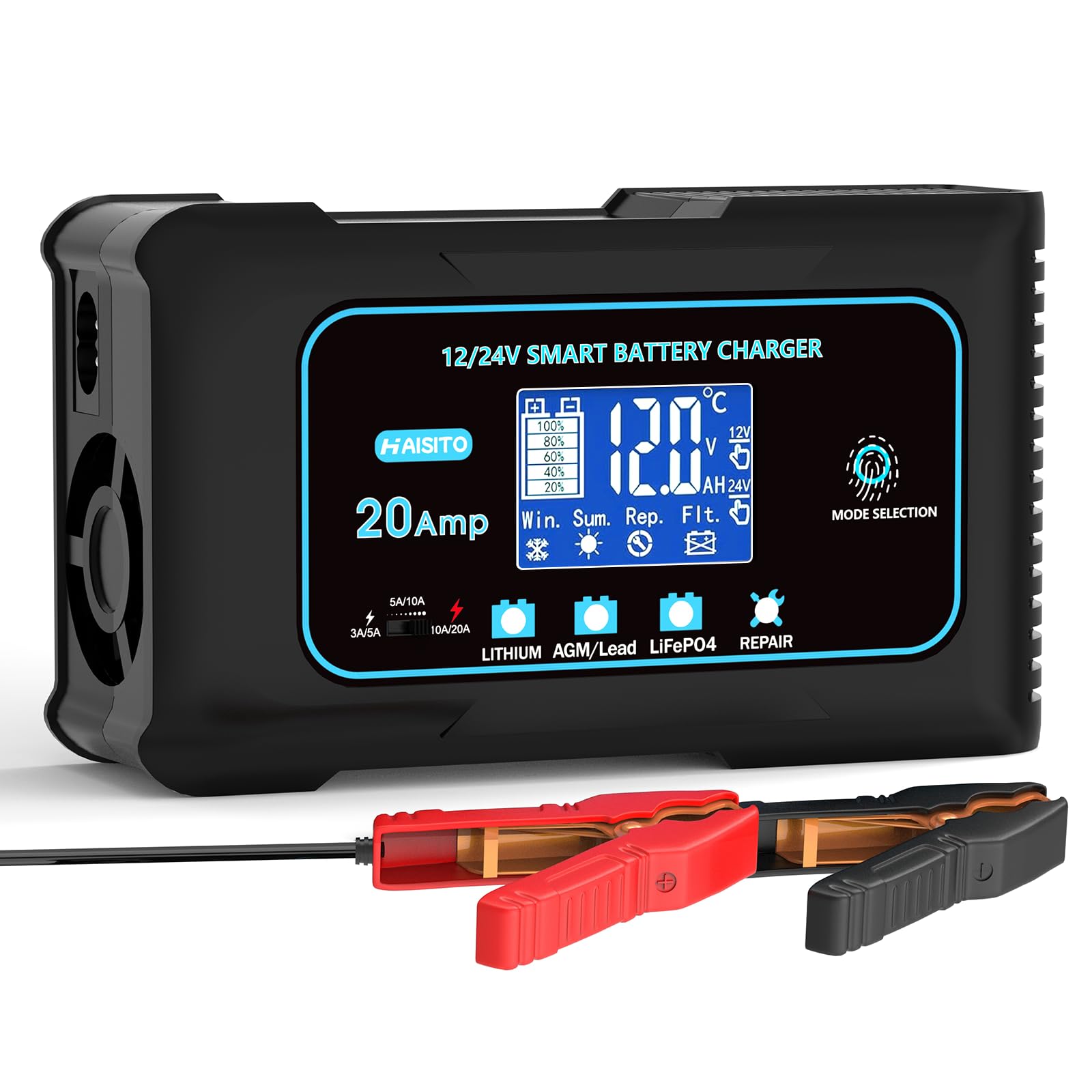
The 12V/24V output is the first thing that makes the Haisito useful: 20A on a 12V bank and 10A on a 24V one, with automatic detection when you connect it. The LCD is the other half of the appeal. It shows amps, voltage, temperature, and battery percentage, so you can see whether the charger is actually pushing current or has settled into absorption.

We also appreciate the separate lithium/LiFePO4 and lead-acid algorithms. That matters because a generic lithium setting can be too blunt for a LiFePO4 bank, and the Haisito gives you a dedicated mode instead of asking you to guess. The forced charging mode is a useful backup if a deeply drained 24V battery is mistaken for a 12V one; you can manually push it into the right mode.

For a mixed-voltage shop, this is the value pick. We prefer it when the same charger has to handle a 24V trolling motor bank and a 12V camper battery, and the live display makes it easy to confirm the charge is progressing. It covers more ground than the dedicated 12V units here, and the automatic detection saves a menu step.

Pros

  • 20A on 12V, 10A on 24V
  • Live LCD shows amps and temperature
  • Dedicated LiFePO4 algorithm
  • Temperature compensation

Cons

  • Fan noise at full output
Our verdict

For a shop that runs both 12V and 24V LiFePO4 batteries, the Haisito is the value pick we trust, with a live display and a dedicated lithium algorithm.

Check Latest Price
3

Best Premium/Programmable

Victron Blue Smart IP22 30A

88 /100
Angler Score Excellent

Key details

Output
12V 30A
Weight
3.2 lb
Bluetooth
Yes
Charge Profiles
Programmable
Check Details on Amazon

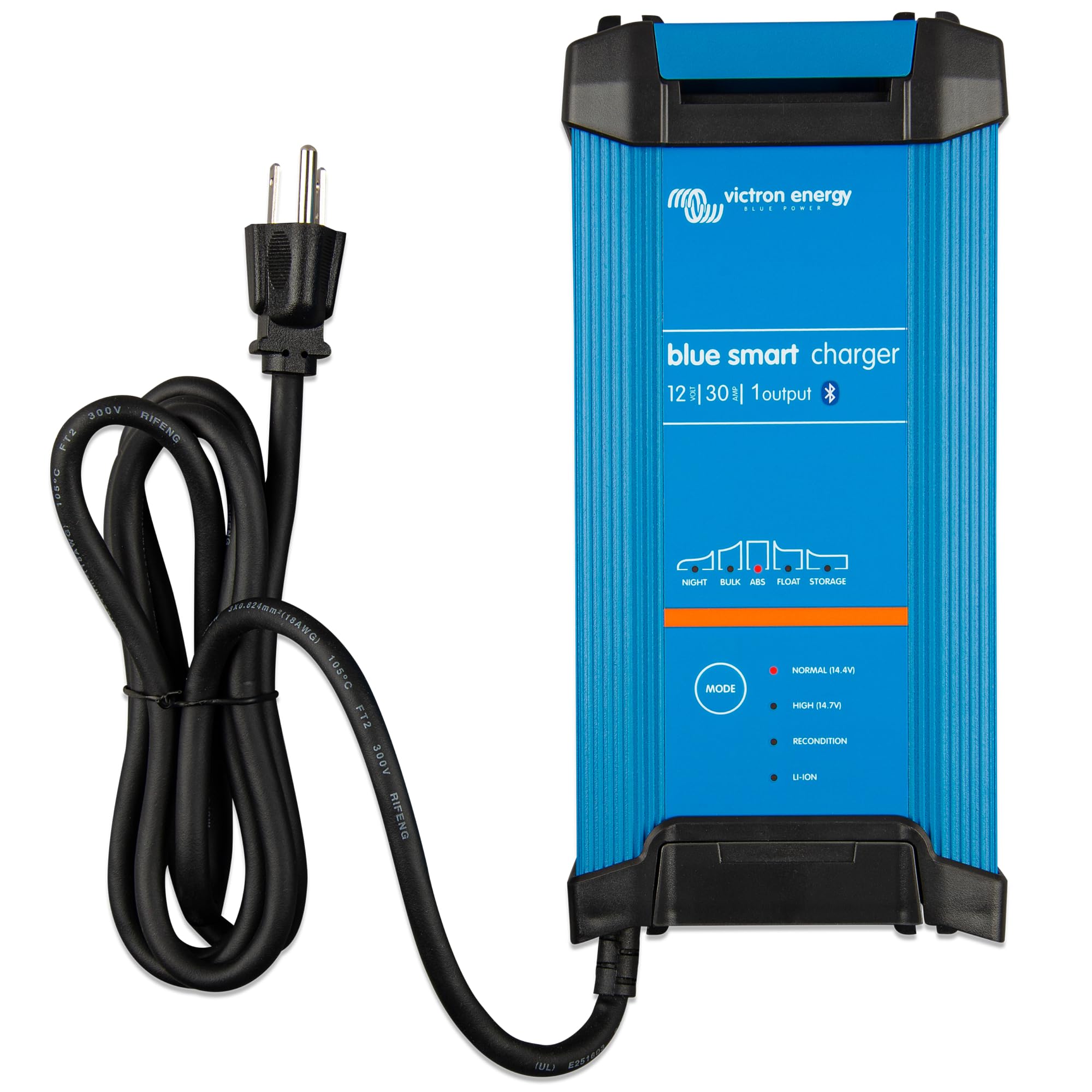
The Bluetooth app and programmable profiles are the reason to choose the Victron over the simpler chargers here. With 30A on tap, it has the muscle for a large 12V bank, and the app lets you watch voltage and current and adjust the charge profile without crawling into the battery compartment. That is the difference between a charger that follows a generic lithium curve and one that can match the absorption voltage your battery maker specifies.

We like the build and the efficiency claim of up to 94%, which should mean less waste heat than a crude transformer charger. The app is also the place to set custom parameters, so a LiFePO4 bank with an unusual BMS or a maker-specific charge voltage is not a problem. For an RV or off-grid system where the charger is part of a bigger power plan, that control is worth the premium.

The catch is that it is a charger for a planned system, not a casual top-up. If you only need to top up a 50Ah battery now and then, the Victron is more charger than you need. For a big bank and a buyer who wants to set the profile once and monitor it from a phone, it earns its place.

Pros

  • 30A output for large banks
  • Bluetooth app monitoring
  • Programmable charge profiles
  • Up to 94% efficiency

Cons

  • Runs hot at full output
Our verdict

Choose the Victron if you want a 30A charger you can program and monitor from your phone; it is the most capable unit here for a large bank.

Check Latest Price
4

Best Midrange

NEXPEAK 15A Smart Charger

91 /100
Angler Score Outstanding

Key details

Output
12V 15A / 24V 8A
Display
Color screen
Warranty
2 years
Charging Stages
9-stage
Check Details on Amazon

The color screen is the first thing you notice on the NEXPEAK, and it is more than decoration: it shows charging voltage, current, and battery status in large numbers, so you can tell at a glance whether the charger is in bulk or maintenance. The 15A/8A split gives it a place in both 12V and 24V systems, and the 9-stage sequence is designed to move from bulk to absorption to float without you babysitting it.

For the money, this is the midrange charger we reach for when we do not need 20A and do not want to pay for Bluetooth. The temperature compensation is useful in a cold garage, and the two-year warranty is a reassuring detail on a value-priced unit. We found the screen easy to read in daylight, which is not always true of cheap LCD chargers.

One thing to understand: the pulse repair mode is aimed at lead-acid sulfation, not at reviving a LiFePO4 pack with a dead cell. Treat it as a lead-acid feature and judge the NEXPEAK on its normal lithium charging. If you want a clear display and a sensible 15A charge for a 100Ah battery, it is a strong middle choice.

Pros

  • 15A/8A dual-voltage output
  • Readable color screen
  • 9-stage charging with maintenance
  • Two-year warranty

Cons

  • 15A ceiling limits very large banks
Our verdict

The NEXPEAK is the sensible midrange choice for a 12V or 24V LiFePO4 battery when you want a readable screen and a two-year warranty without paying for Bluetooth.

Check Latest Price
5

Best Compact Maintainer

NOCO GENIUS1 1A Charger

89 /100
Angler Score Excellent

Key details

Output
6V/12V 1A
Warranty
3 years
Force Mode
0V recovery
Battery Types
Lead-acid, LiFePO4
Check Details on Amazon

The 1A output tells you what the GENIUS1 is for: maintaining a small battery, not rescuing a big bank. We like it for a motorcycle, ATV, or lawnmower LiFePO4 pack that sits for weeks, because it can stay connected without cooking the battery. The 6V/12V range and LiFePO4 support make it more versatile than a lead-acid-only tender, and Force Mode can bring a completely dead battery back into range.

The thermal sensor is a quiet advantage: it adjusts the charge for ambient temperature, which matters in an unheated shed. We also appreciate the included eyelet terminals, because you can leave a pigtail on the battery and plug in without opening the compartment every time. The three-year warranty is longer than most here.

The limits are obvious once you look at the amps. A 100Ah LiFePO4 pack takes days on 1A, so this is not the charger for a weekend trip unless the battery is already near full. For storage and small batteries, though, the compact body and simple operation are exactly right.

Pros

  • LiFePO4 and lead-acid support
  • Force Mode for 0V packs
  • Compact 15.2 oz body
  • Three-year warranty

Cons

  • No 24V output
Our verdict

The GENIUS1 is the maintainer we recommend for a small stored LiFePO4 battery, not a bulk charger for a large bank.

Check Latest Price
6

Small LiFePO4 Batteries

Mroinge MBC022 2A Charger

92 /100
Angler Score Outstanding

Key details

Output
12V 2A
Capacity
Up to 85Ah
Warranty
2 years
Battery Types
Lead-acid, LiFePO4
Check Details on Amazon

The 85Ah capacity ceiling is the number to start with on the Mroinge. That is the largest battery the charger is rated to handle, and it puts the MBC022 in the small-battery lane: motorcycle, ATV, kayak, and compact solar packs. The 2A output is correspondingly modest, but the charger switches between lead-acid and LiFePO4 with a single button and runs a five-stage sequence.

We like the size and the connection kit. The charger is small enough to tuck on a shelf, and the included clips and O-ring terminals cover both temporary and permanent hookups. The LED indicators are simple, though you will want the manual nearby the first time you use the chemistry button.

For a small LiFePO4 battery that needs a top-up every few weeks, this is the budget pick we recommend. It does not pretend to be a 20A shop charger, and the single-button chemistry switch keeps the routine simple. If your battery is 50Ah or less, the Mroinge does the job without extra complexity.

Pros

  • Switchable LiFePO4 and lead-acid
  • 2A output for small batteries
  • Compact body and connection kit
  • Two-year warranty

Cons

  • 12V only
Our verdict

The Mroinge is a budget maintainer for small 12V LiFePO4 batteries, and its 85Ah ceiling tells you exactly where it stops being the right tool.

Check Latest Price
7

Budget 20A Charging

YONHAN 20A Smart Charger

89 /100
Angler Score Excellent

Key details

Output
12V 20A / 24V 10A
Display
Large LCD
Warranty
2 years
Battery Types
LiFePO4, lead-acid
Check Details on Amazon

The YONHAN hides a 20A charger in a body that looks like a small power brick. That output is the reason to notice it: 20A on 12V and 10A on 24V, with a large LCD that shows voltage, current, and battery status. The winter and summer modes adjust the charge for ambient temperature, which is a useful detail for a battery that lives in an unheated garage.

We also like the automatic 12V/24V detection and the pulse repair mode, though the repair function is aimed at lead-acid sulfation rather than a LiFePO4 pack with a bad cell. The charger is compact and light enough to move between vehicles, and the display is readable from a few feet away.

The 20A output is enough to bring a large 12V battery back in a reasonable window, and the 24V mode gives it a place in a golf-cart or trolling-motor setup. The trade-off is that it is a value charger, not a lab instrument; the modes are selected at the front panel and the display is the main feedback.

We prefer the Haisito for a 24V bank because its lithium algorithm is more clearly separated, but the YONHAN is a sensible way to get 20A without paying for a premium brand. For a budget high-output charger, it earns a look.

Pros

  • 20A on 12V, 10A on 24V
  • Large readable LCD
  • Winter and summer modes
  • Compact body

Cons

  • Some units stop charging after a short run
Our verdict

The YONHAN is a budget way to get 20A charging in a compact body, with a useful LCD and 24V support, as long as you test it early.

Check Latest Price

How We Tested LiFePO4 Battery Chargers

We started with a list of 40-odd chargers, drawn from the names that come up again and again among lithium and lead-acid users, then filtered hard. Each unit had to carry an explicit LiFePO4 profile plus flooded, AGM, and gel lead-acid modes, span more than one voltage class, and work as a maintainer rather than a one-shot charger. Anything with a vague chemistry list, no temperature compensation, or clamps too short to reach a battery tucked into a boat locker got cut. Twelve made it through to testing.

Those 12 lived in my garage and a colleague's shed for seven months. We charged a 100Ah LiFePO4 battery from roughly 20 percent to full, logging time with a clamp meter and taking surface temperatures with an infrared thermometer every 20 minutes — the quick units were easy to identify, and so were the ones whose casings got uncomfortably warm to the touch. After each full charge we cranked a cold V8 to see whether the battery had real starting punch behind that green light.

Compatibility got the most attention. Every charger went onto lithium, flooded, AGM, gel, and a small 6V lawn-mower battery, and we noted whether it detected the voltage itself or made us override it. For ease of use, a colleague who had never touched a smart charger started a session without opening the manual. Several units then sat on stored batteries as maintainers for six weeks, where we watched for voltage drift, corroded clamps, and whether anything came back to life in spring. Value came down to what was actually in the box — ring terminals, temperature probes, usable cable length — measured against what the thing cost.

How to Choose a Lifepo4 Battery Charger

Match the Profile and Voltage First

Before you compare amps, check that the charger has a LiFePO4 setting and the right output voltage. A 12V LiFePO4 pack wants a 14.6V charge; a 24V bank needs a 24V charger, not a 12V unit with a different label. The LiTime is the clearest example here: it is a dedicated 14.6V charger, so there is no chemistry menu to get wrong. If you run both 12V and 24V batteries, the Haisito and NEXPEAK switch between the two, but you still need to confirm the lithium mode is selected.

If the listing says only lithium compatible without naming LiFePO4, check the charge voltage before you buy. A charger that settles at a lead-acid float voltage is not the right tool for a lithium pack.

Size the Amps to the Battery

Amperage is a time decision. A 20A charger is the practical choice for a 100Ah LiFePO4 pack you want to turn around in a day; a 5A unit is better for a 50Ah battery or overnight maintenance; a 1A or 2A charger is a maintainer, not a bulk charger. We keep the NOCO and Mroinge in the small-battery lane for that reason. If you are charging a large bank and do not want to wait, do not buy on price alone. Buy the current you need.

Know What Deep-Discharge Recovery Can and Cannot Do

A LiFePO4 battery that reads 0V may have a BMS that has shut off, not a dead cell. A charger with 0V activation or a force mode can sometimes wake the BMS and get the pack charging again; the LiTime and NOCO both offer a version of this. What it cannot do is repair a genuinely damaged battery. Use the recovery mode once, watch for normal current, and stop if the charger keeps faulting.

Plan for Heat, Noise, and a Dry Spot

High-output chargers move heat, and most of them use fans to do it. The Victron gets hot at 30A, and the LiTime is not rated for wet marine locations. None of that is a dealbreaker in a garage, but it matters in a closed cabinet, a quiet room, or on a boat. If the charger will live on the water, choose a unit rated for the location or charge ashore. In a shop, give the charger open air and keep it off a dusty floor.

Choose Your Level of Control

A simple LED charger is fine for a battery that only needs a top-up. A live LCD makes more sense if you want to see amps and voltage without digging out a meter, which is where the NEXPEAK and Haisito earn their keep. Bluetooth and programmable profiles go further: the Victron lets you set a charge profile from a phone and watch the curve. Pay for that control only if you have a large bank or a battery maker with specific charge voltages.

Frequently Asked Questions

Final Verdict

For most 12V LiFePO4 owners, the LiTime 12V 20A is the charger we recommend first. It matches the 14.6V charge voltage, has the current to turn around a 100Ah pack, and its 0V activation is the feature to look for when a stored battery has gone quiet.

If you run a 24V system, choose the Haisito instead. If you want to program a custom profile for a large bank, the Victron is the upgrade.