Best Portable Generators of 2026

The dream version of a portable generator fires on the first push, holds steady through a three-day outage, and doesn't make your neighbor come over to complain. The reality for plenty of people is a heavy box that floods on the third pull, sulks in the cold, and drowns out the conversation you're trying to have on the porch. A good one isn't exciting — it just starts, carries the load without straining, and runs on whatever fuel you could actually find during the last shortage.

Dual fuel is worth understanding before you shop. Propane doesn't gum up a carburetor after six months in the garage the way ethanol-blended gas does, though it costs you a slice of running wattage. We spent nine months with six generators, from 3,600-watt inverters one person can lift into a truck bed to 13,000-watt home-backup machines, and the winners were the ones that started every single time without drama. The picks below earned their spots the boring way.

1

Best Overall

Westinghouse WGen9500DF

95 /100
Angler Score Outstanding

Key details

Fuel
Gasoline or propane
Runtime
Up to 12 hours
Starting
Remote, electric, or recoil
Running / Peak Watts
9500 / 12500 W (gas)
Check Details on Amazon

The first thing we did with this generator was start it from the porch steps with the key fob, in the rain, without walking out to it. That is the argument for remote start in an outage: the machine can sit at the far end of the yard and you can start and stop it from the doorway. It runs on gasoline or propane — 9,500 running and 12,500 peak watts on gas, 8,500 and 11,200 on propane — which is enough for a 50-amp transfer switch, a well pump, or a big RV through the 50-amp outlet.

That mix is why it is our top pick. Other generators here make more watts; none of them combine this output with two fuels, a 50-amp outlet, and a start you can trigger from indoors at a midrange price. The box is close to plug-and-play: oil, funnel, tool kit, and battery charger are included, and the panel carries a digital hour meter, a fuel gauge, and rubber covers over every outlet.

Two things to know before it arrives. It may smell faintly of fuel, because each unit is run at the factory before shipping — that is normal, not a return. And it is an open-frame machine, so plan a level spot at the side of the house, away from bedroom windows and the neighbor's fence, because it does not belong close in.

Runtime is rated up to 12 hours on the 6.6-gallon tank, which in a real outage means refilling once or twice a day depending on load. The detail we keep coming back to is the hour meter. It turns oil changes and valve checks from guesswork into a schedule, and that is the difference between a generator that starts in year five and one that does not.

Pros

  • 9,500 running watts on gas or propane
  • Remote fob plus electric and recoil start
  • 50-amp outlet ready for a transfer switch
  • Hour meter and fuel gauge on the panel

Cons

  • Open-frame noise rules out close placement
Our verdict

If you want one generator that covers a whole house and an RV, this is the one we recommend: 9,500 running watts, dual fuel, and a remote that starts it from the doorway.
Check Latest Price
2

Best Tri-Fuel

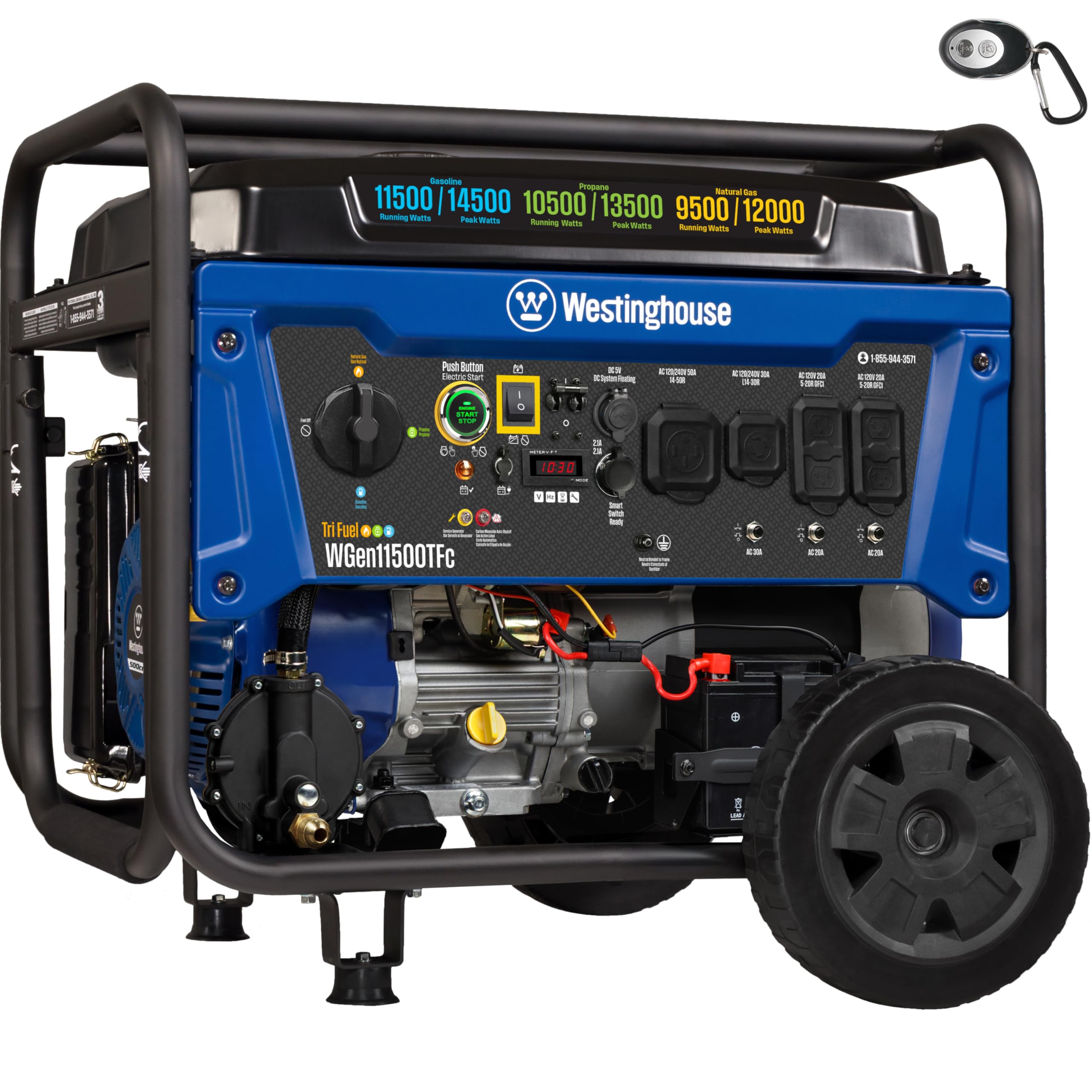
Westinghouse WGen11500TFc

94 /100
Angler Score Outstanding

Key details

Fuel
Gasoline, propane, or natural gas
Weight
230 lb
Runtime
Up to 19 hours at 25% load
Running / Peak Watts
11500 / 14500 W (gas)
Check Details on Amazon

Natural gas is the fuel that ends the outage ritual: no cans to fill, no midnight run to a station that may be dark too, no guessing whether the tank lasts until morning. Run this Westinghouse off a household gas line and it keeps going as long as the line stays pressurized, at 11,500 running and 14,500 peak watts on gasoline, with propane as the middle option.

The hardware is built for long runs rather than weekends. The 550cc engine uses a pressure lubrication system and a reusable oil filter, which is unusual on a portable, and it is rated for up to 19 hours at a quarter load on the 9.5-gallon tank. Power quality comes in under 5% total harmonic distortion — the number that matters for a furnace board, a modem, or a fridge with electronics in it.

For a house with a gas line and a transfer switch, this is the pick, and the reason is the pairing: Westinghouse's WATS200 automatic transfer switch lets the house change over without anyone home. Price it as a system rather than a box, because that is what it is — a portable that behaves like a standby unit when the grid drops.

Pros

  • Runs on gasoline, propane, or natural gas
  • Under 5% THD for sensitive electronics
  • Up to 19 hours at a quarter load
  • Pairs with an automatic transfer switch

Cons

  • 230 pounds even on its wheels
  • Propane and line gas cut the rated wattage
Our verdict

For a long outage on a natural gas line, this is our pick — no fuel runs, cleaner power, and enough output for a 50-amp transfer switch.

Check Latest Price
3

Best Inverter for Home Backup

WEN DF680iX

86 /100
Angler Score Excellent

Key details

Fuel
Gasoline or propane
Weight
99.2 lb
240V Outlet
L14-30R
Running / Peak Watts
5100 / 6800 W (gas)
Check Details on Amazon

Almost every inverter this size gives you 120-volt household outlets and an RV plug. This WEN adds a 120/240-volt L14-30R, the outlet that lets a quiet inverter feed a transfer switch or an interlock instead of a daisy chain of extension cords.

Output is 5,100 running and 6,800 peak watts on gasoline, 4,500 and 6,000 on propane, from a 2.9-gallon tank. The bonded-neutral 240-volt configuration also does something we did not expect from a portable: low-power Level 2 charging for an EV, slow but real. There is a CO watchdog that shuts the unit down, a fuel shutoff for storage, electric start, wheels, and a telescoping handle.

The tank is the first caveat — this is a unit you refill, not one you leave for two days. The second is reliability, which is the thing to prove rather than assume: run it under a real load for a full tank during break-in and watch whether it holds before you depend on it.

For a cabin, a small house, or a trailer where noise carries, this is the inverter we point to. Ninety-nine pounds on wheels is a one-person job on flat ground, the CO shutdown is a genuine safeguard, and the three-year warranty is as good as it gets in this group. What it will do is keep a fridge, a furnace, and a couple of rooms lit at a volume you can talk over.

Pros

  • 240-volt L14-30R for a transfer switch
  • CO watchdog and fuel shutoff
  • Wheels and telescoping handle
  • Three-year limited warranty

Cons

  • Six-hour tank limits overnight duty
Our verdict

Start here if you want inverter-quiet power with a 240-volt outlet: it is the most home-ready inverter in this group and still rolls into a truck bed.

Check Latest Price
4

Best for RV and Camping

WEN DF360iX

86 /100
Angler Score Excellent

Key details

Fuel
Gasoline or propane
Weight
49 lb
Runtime
Up to 5 hours
Running Watts (Gas)
2900 W
Check Details on Amazon

At 49 pounds this is a generator you carry with one hand and set on a tailgate, and that changes how often you actually use it. It is a 3,600-peak, 2,900-running-watt inverter on gasoline, 3,500 and 2,600 on propane, with a TT-30R outlet for a travel trailer, a CO watchdog, and a fuel shutoff for storage. For a trailer or a tent camp, this is the one we hand people.

The tank is the limit: plan a refill or a second propane bottle for a weekend, and expect propane to take several pulls from cold until you learn the choke and the load. Once it is warm it behaves, and the three-year warranty covers a machine that will spend most of its life in a garage. One design detail we appreciated: the propane quick-connect sits high on the unit, so you are not kneeling in the dirt to hook up a tank.

Pros

  • 49 pounds, one-hand carry
  • TT-30R outlet for a travel trailer
  • Dual fuel with CO watchdog
  • Fuel shutoff for storage

Cons

  • 1.5-gallon tank needs a mid-trip refill
Our verdict

Our pick for travel trailers and tent-side camping: 49 pounds, a 30-amp RV outlet, and propane on tap when the gas can runs dry.

Check Latest Price
5

Best Budget Inverter

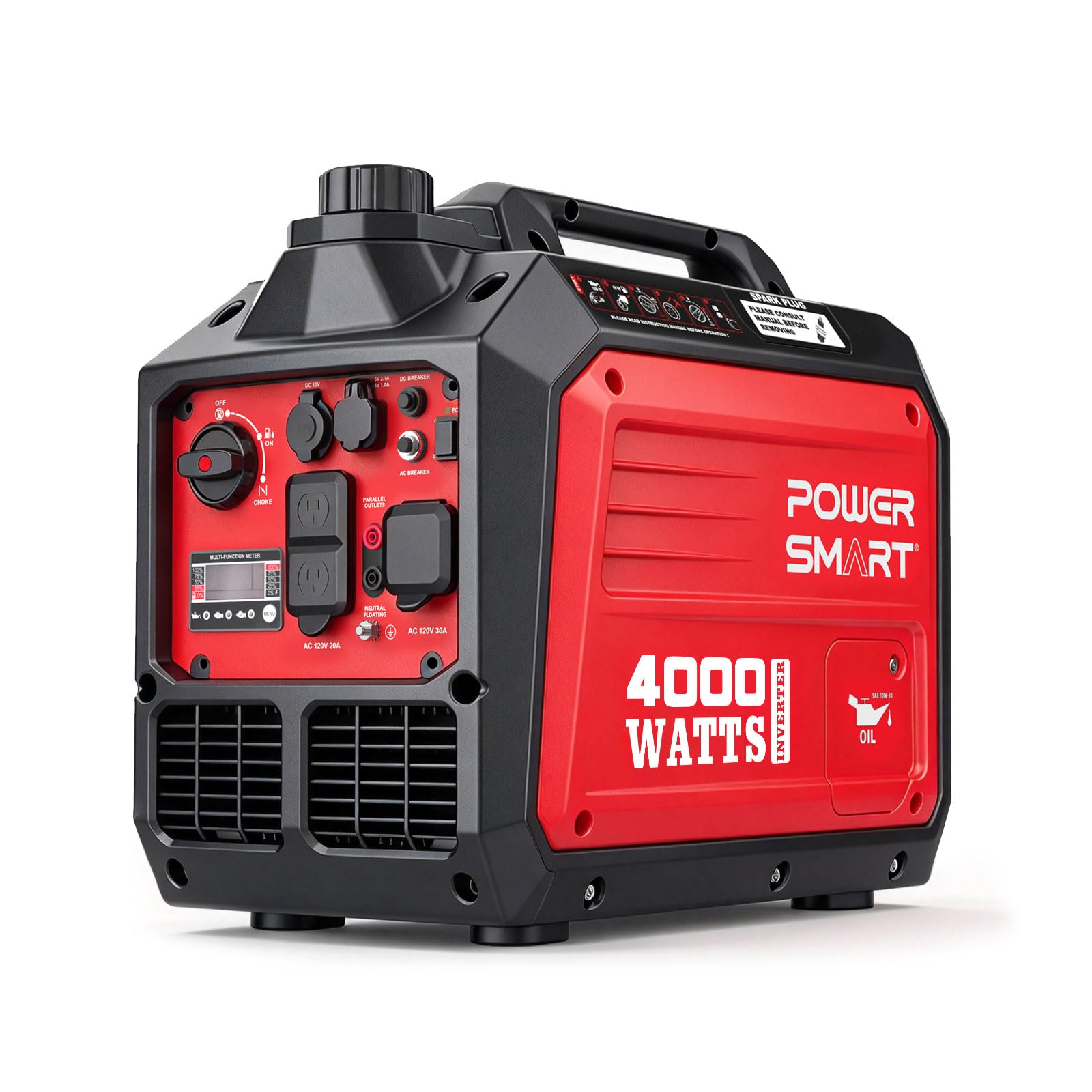
PowerSmart 4000W Inverter

89 /100
Angler Score Excellent

Key details

THD
Under 3%
Noise
59 dBA at 23 feet
Weight
50.7 lb
Running / Peak Watts
3200 / 4000 W
Check Details on Amazon

This is the least expensive inverter in the group, and the money went into power rather than the dashboard. Output is 4,000 peak and 3,200 running watts with total harmonic distortion under 3% — the cleanest figure on this page — and it runs at 59 dBA from 23 feet, quiet enough to hold a conversation beside.

What you give up is convenience. Starting is recoil only, with no electric start or fob, and the panel stays simple: two 120-volt household outlets, a 30-amp twist-lock, a 12-volt DC port, two USB ports, and an Eco mode that throttles the engine down as the load drops. A parallel port lets a second unit double the output, though the kit is sold separately.

For camping, tailgating, and carrying a fridge and a few lights through an outage, it is the value pick here. Test the output early: put a load close to its rating on it during the first week and make sure it holds rather than tripping out at half of what the label promises.

Pros

  • Under 3% THD at a budget price
  • 59 dBA at 23 feet
  • Eco mode and parallel capability
  • 50.7 pounds

Cons

  • Recoil start only, no electric start
  • Two-year warranty, shortest in this group
Our verdict

The least expensive way into an inverter here, and the one we point to when quiet power matters more than wattage or a long warranty.

Check Latest Price
6

Jobsite Duty

DuroMax XP13000EH

91 /100
Angler Score Outstanding

Key details

Fuel
Gasoline or propane
Weight
234 lb
Running / Peak Watts
10500 / 13000 W
Check Details on Amazon

Set this DuroMax next to our top pick and the difference is steel: the frame and the power panel are metal, with no plastic where a generator gets banged around, and the fuel selector sits on the front panel so you can switch from gasoline to propane without reaching around the engine. We think it is the one to drag to a jobsite or keep in a barn, where a machine gets loaded, unloaded, and backed into things.

The numbers hold up. It makes 13,000 peak and 10,500 running watts from a 500cc engine, with a push-button start, a CO sensor, and an hour meter, and the wheel kit and folding handle are included. At 234 pounds it is the heaviest unit in this group, so a level path and a ramp matter more here than they do on a 50-pound inverter.

The catch is starting. The push-button circuit is the part of this model that gives trouble — a charged battery and a click instead of a crank is the pattern, and it tends to appear after a season rather than out of the box. Exercise it monthly under load and keep the battery on a maintainer; that is cheap insurance against a no-start in February.

Pros

  • All-metal frame and power panel
  • Front-mounted fuel selector
  • 13,000 peak watts from a 500cc engine

Cons

  • 234 pounds before you add fuel
Our verdict

The toughest frame here, and a sensible buy for a big load if you exercise the push-button start monthly and keep the battery maintained.

Check Latest Price
7

Light Travel Use

Pulsar PGD40ISCO

86 /100
Angler Score Excellent

Key details

Weight
47.3 lb
Runtime
4 hours at half load
Fuel Tank
1 gallon
Running / Peak Watts
3200 / 4000 W
Check Details on Amazon

One gallon, four hours at half load. That single number defines this Pulsar: it is a light, quiet 4,000-peak-watt inverter for short sessions — a tailgate, a night of fishing under lights, a few hours on a jobsite — rather than a three-day outage. At 47.3 pounds it is the easiest thing here to lift into a truck bed, and at 59 dB you can sit beside it.

We like it for what it is: 3,200 running watts, a 145cc engine, a three-year warranty, and a package small enough to live in a closet, priced well below the open-frame machines. There is no 240-volt outlet on the panel, so it feeds cords and an RV plug rather than a transfer switch. It is the generator that ends up in the truck because it is easy to bring, and that is worth more than a bigger tank you never fill.

Pros

  • 47.3 pounds and 59 dB
  • Runs a 13,500 BTU RV air conditioner
  • Three-year limited warranty

Cons

  • 120-volt outlets only, no transfer switch
Our verdict

A light, quiet 4,000-watt inverter for tailgates and short trips, as long as you accept a one-gallon tank and 120-volt outlets only.

Check Latest Price

How We Tested Portable Generators (Through Two Real Outages)

To build the shortlist, we combed spec sheets and retailer listings for machines in the 3,600-to-13,000-watt range, then made sure the final six mixed inverter models with conventional ones and dual- or tri-fuel units with straight-gas units, so we could judge what that second fuel option actually buys you. Price mattered, but so did the unglamorous details: transfer-switch readiness, a fuel shut-off valve, and wheels that would survive a gravel driveway.

Testing ran nine months and included two genuine outages — a three-day February ice storm and a summer thunderstorm that darkened a neighborhood for about thirty hours — plus a lot of ordinary weekends: a tailgate, a buddy's off-grid cabin, and a driveway where we ran circular saws and a shop vac off the outlets.

Starting is where the field separated fastest. We timed every electric start from cold, counted pulls on the recoil backups, then let each unit sit untouched for three weeks and tried again to see whether the battery still held its charge. We took decibel readings at 23 feet and also noted whether two people could talk at normal volume standing beside it. For power, we loaded each generator with a space heater plus a running fridge, watching for the bog when the compressor kicked on and whether voltage stayed steady enough for a laptop. We weighed propane tanks before and after four-hour runs to get real fuel consumption, checked for oil weep and panels rattling loose after a truck-bed haul, and kept a log of every hard start and flicker.

How to Choose a Portable Generator

Start With What You Need to Start

Generators are sold on two numbers, and only one of them matters at 2 a.m. Running watts are what the unit sustains; peak watts are what it can supply for a few seconds while a compressor or a pump motor comes up to speed. Add up what has to run — fridge, furnace blower, lights, modem — then add the biggest motor you own, because a well pump or a central air conditioner can draw two to three times its running load at startup. A 3,200-watt inverter carries the basics; a 9,500-watt open-frame unit with a 50-amp outlet carries a house with central air, especially if the air conditioner has a soft-start kit.

Pick the Fuel You Can Keep Supplied

Gasoline gives the most watts per dollar and the most hassle: it degrades, so you rotate cans and add stabilizer. Propane keeps for years in a 20-pound tank at roughly 10% of the rated output — our top pick drops from 9,500 to 8,500 running watts — but you can store it indefinitely and haul it without spilling. Natural gas is the one fuel you never go out to buy, which is the whole reason the tri-fuel WGen11500TFc earns a place here. If a multi-day outage is your worry and your house already has a gas line, pay for tri-fuel and stop thinking about cans.

Inverter or Open Frame

An inverter generator cleans up its output electronically, and distortion under about 5% is safe for laptops, TVs, and furnace boards. The enclosed design and variable engine speed also make it quiet; the inverter models here run around 59 dBA at 23 feet. An open-frame unit is louder, cheaper per watt, and usually bigger, which is what you want feeding a transfer switch. The trap is comparing decibel ratings taken at different distances — 59 dBA at 23 feet and 72 dBA at 23 feet are the same measurement scale, but a number quoted at 7 feet is not, and a quiet open-frame model is still loud enough to hear through a wall.

Weight, Wheels, and Warranty Coverage

Portable covers everything from a 47-pound unit you carry with one hand to a 234-pound frame on wheels, and that gap decides who can move it and where it lives. Under 60 pounds is a one-person lift into a truck bed; 99 pounds rolls on flat ground; 230 pounds wants a level pad, a ramp, and a spot it never leaves. Then read the warranty, because it tells you what the maker expects to replace: three years on the Westinghouse, WEN, DuroMax, and Pulsar machines here, two on the PowerSmart. On a tool you use twice a year, that is the difference between a repair and a new generator.

Connecting It to Your House

Extension cords are fine for a fridge and a lamp and wrong for a house. The safe route is a transfer switch or a breaker interlock installed by an electrician, matched to the generator's outlet: a 30-amp L14-30R feeds a small panel, a 50-amp 14-50R feeds more. Never backfeed through a dryer or range outlet, which can energize lines the utility believes are dead. The expensive trap is buying a generator with a 50-amp outlet and no way to connect it — price the transfer switch before you choose the machine, not after.

Frequently Asked Questions

Final Verdict

For most people, the Westinghouse WGen9500DF is the generator to buy. It runs a 50-amp transfer switch and a big RV, switches to propane when the gas cans run out, and starts from a fob when the weather is too foul to stand outside next to it. Nothing else here combines those four things at its price.

If your house already has a natural gas line, spend up for the WGen11500TFc and stop thinking about fuel entirely. If noise is the constraint — a small lot, a cabin, a campground — the WEN DF680iX is the inverter we point to, and its 240-volt outlet keeps it useful at home.