
Best Marine Fuel Stabilizers of 2026

A boat's fuel tank is a terrible place to store gasoline. It sits between weekends, breathes through the vent, pulls in moisture, and turns a fill into something that gums carburetors and leaves you cranking at the ramp. A marine fuel stabilizer is meant to stop that clock: it keeps ethanol-blend fuel from separating, protects the fuel system from corrosion and varnish, and helps an engine start clean after weeks of sitting. The difference between a good one and a bottle that makes you feel better shows up over a season, not a single tank.

I keep a small outboard and portable tanks in rotation, so fuel sits longer than I'd like. Over six months, we ran 14 marine fuel stabilizers through the same cycle of fill-ups, storage, and first-start mornings. Some were easy to dose and cheap per gallon treated; others were fussy. The ones that rose to the top did the quiet work: clean starts, steady idle, no sour smell, no separation. The picks below are the formulas I'd trust with a full tank and a long stretch between trips.

1

Best Overall

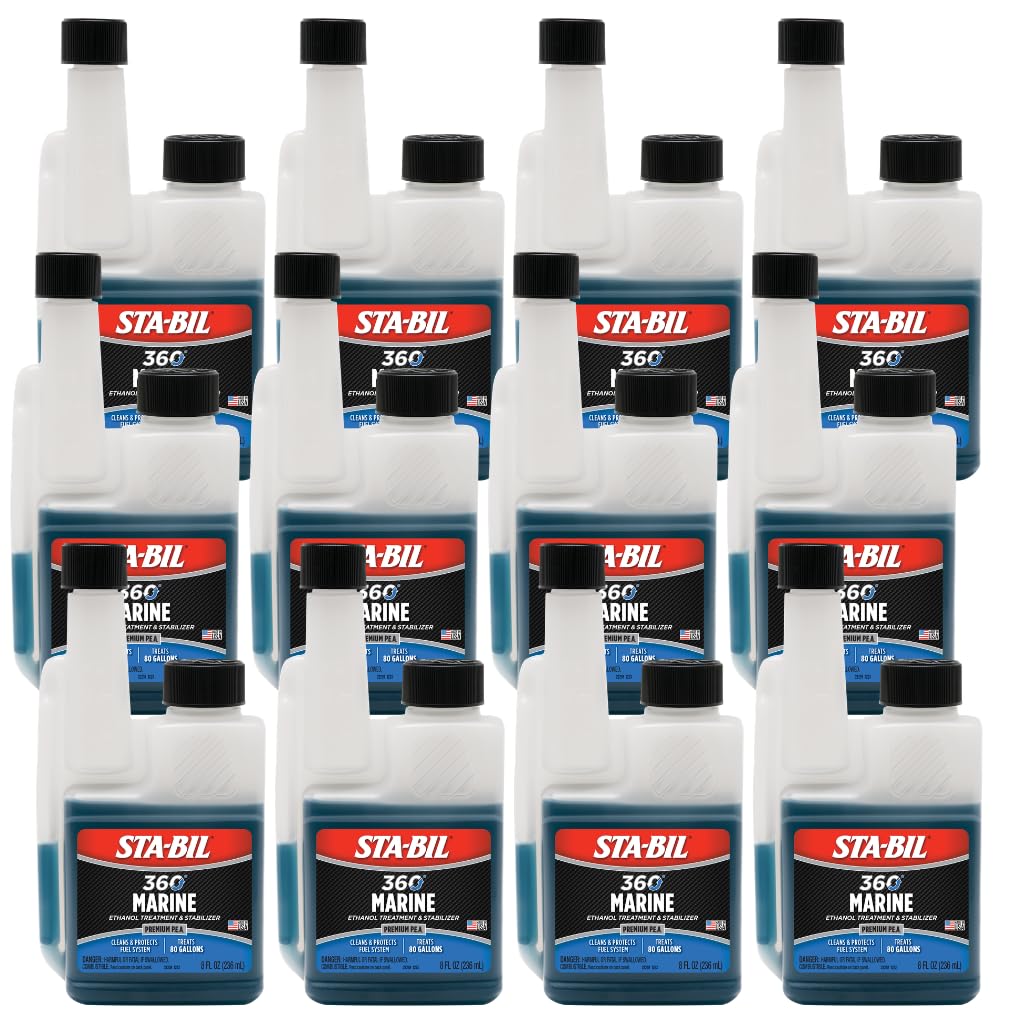
STA-BIL 360 Marine

96 /100
Angler Score Outstanding

Key details

Dosing
1 oz per 10 gallons
Formula
PEA cleaner, marine-specific
Bottle Count
12 bottles, 8 fl oz each
Corrosion Protection
Stated for internal fuel-system parts
Check Details on Amazon

Dosing is the first thing we check on a stabilizer, because it decides how many bottles you actually need. STA-BIL 360 Marine runs one ounce per ten gallons, so a single 8-ounce bottle covers 80 gallons. On a boat carrying 100 gallons, one bottle doesn't quite finish a fill, which changes how you read the twelve-bottle case: it isn't a bulk bargain so much as a season or two of treatment for a boat that gets filled regularly.

What earns it the top spot is that this is the one pick here formulated for a marine fuel system rather than simply labeled for boats. The PEA package works on injectors, lines, and pumps, and a separate corrosion claim covers the internal parts that sit damp through the off-season. On a boat, that matters as much as keeping the fuel itself from going stale. We prefer leaving cleaning chemistry in the tank over winter to a pure stabilizer that lets existing varnish sit there until spring.

Pour it in before you fuel rather than after, so the incoming gas does the mixing for you. The limit worth knowing is duration: STA-BIL sells this as in-season protection and a separate Storage product for layup, so a boat that sits for a year or more between runs is better served by the two-year claim on Quicksilver's bottle.

For the ordinary pattern of a season of weekends, a winter under a tarp, and a splash in April, this is the bottle we keep on the shelf. The dose is easy to remember, and a case means you're not hunting for one in July.

Pros

  • Marine-specific PEA cleaning for injectors and lines
  • Corrosion protection aimed at off-season internals
  • Straightforward 1 oz per 10 gallon dose

Cons

  • One 8 oz bottle falls short of a 100-gallon fill
Our verdict

Our default for a gasoline outboard: marine-specific cleaning and corrosion protection in a case that covers several seasons, once you check your tank against the dose.

Check Latest Price
2

Best Value

Star Tron Enzyme Treatment

96 /100
Angler Score Outstanding

Key details

Formula
Enzyme concentrate
Coverage
Up to 512 gallons per 32 oz
Water Handling
Disperses water as submicron droplets
Check Details on Amazon

One 32-ounce bottle treating up to 512 gallons is the number that makes Star Tron the value pick here. That's a small pour per fill, and the same bottle covers the outboard, the tender's tank, the mower, and the gas cans in the shed. We like a treatment that doesn't need a second version for the garage: one bottle, one shelf, no deciding which product goes in which tank.

The chemistry is the other reason it belongs near the top. Instead of dropping water out of suspension, Star Tron's enzymes break it into submicron droplets that stay dispersed in the fuel and pass through the engine as it runs, which is how it heads off phase separation rather than cleaning up after it. It also goes after gum, carbon, and varnish, so an outboard that has been sitting comes back to a cleaner fuel system, not merely a stabilized one.

That dispersing approach is the trade-off to understand. The water stays in the fuel rather than collecting where you can pull it out, which is exactly right for a healthy system and less comforting if you already suspect a layer in the bottom of the tank. Because it's a concentrate, you're measuring a very small amount into a large fill, so keep a graduated cup with the boating gear rather than eyeballing a splash.

Set against the top pick, it trades the marine corrosion claim for coverage: the most treated gallons and the fewest bottles to store of anything here. For a boat that burns its fuel in a season and gets fresh gas regularly, that trade costs nothing.

Pros

  • Up to 512 gallons from one 32 oz bottle
  • Disperses water before it can separate
  • Also removes gum, carbon, and varnish
  • Works in every gasoline engine you own

Cons

  • Small treat rate needs careful measuring each fill
Our verdict

Buy this one if you want a single treatment for the boat, the tender, and everything else in the shed, and you'd rather have coverage than a marine-specific corrosion claim.

Check Latest Price
3

Best for Long Storage

Quicksilver Quickstor

93 /100
Angler Score Outstanding

Key details

Dosing
1 oz per 5 gallons
Standard
Mercury Marine OEM specifications
Bottle Size
12 fl oz
Stabilization
Up to two years
Check Details on Amazon

Two years is the longest stabilization claim on this page, and it comes from a company that builds the engines the fuel goes into. Quickstor is blended to Mercury Marine original equipment specifications and is recommended by Mercury, which counts for more on a marine additive than most badges do.

The dose is one ounce per five gallons, heavier than the other rates here, so a 12-ounce bottle treats 60 gallons. A 100-gallon tank wants two bottles per fill, and that's the trade for a formula built to sit through a long layup rather than be topped up every weekend. Quicksilver's own guidance is to start with fresh gasoline in the tank, which is good practice for any of these.

Where it loses ground is breadth. Quicksilver's pitch here is stabilization rather than cleaning, so if your carbureted outboard is already running rough, sort that out first and begin the layup with a clean system. What we do trust it for is the length of the sit: for a boat that goes under cover in October and comes out in May, two years of headroom means you're not doing arithmetic about whether last spring's treatment still has life in it.

The small bottle is also the easiest one to justify if you winterize more than one engine, since at that dose you'll use it up rather than leaving three-quarters of a jug in the shed.

Pros

  • Stabilizes fuel for up to two years
  • Built to Mercury Marine OEM specifications
  • Simple 1 oz per 5 gallon dose

Cons

  • A 12 oz bottle treats only 60 gallons
Our verdict

The layup bottle for a boat that sits through a long off-season: two-year stabilization and Mercury's own specification in the smallest, plainest package here.

Check Latest Price
4

Best for Two-Strokes

Sea Foam Marine PRO

94 /100
Angler Score Outstanding

Key details

Lubricity
High-temp upper-engine protection
Pack Size
3 bottles, 20 fl oz each
Engine Use
2- and 4-stroke marine
Check Details on Amazon

Two-stroke outboards are why this one made the list. Sea Foam Marine PRO is labeled for both two- and four-stroke gasoline marine engines, inboard and outboard, and it's the only pick here that also claims high-temperature lubricity for upper-engine parts, which is what a two-stroke is short on when premix sits in a tank for months.

It also does the most jobs in one bottle. Marine PRO cleans, stabilizes, and adds that lubricity, so on a small boat with a single tank you're not stacking three products in the locker. The 20-ounce bottles are a sensible size for that job too: enough to keep a couple aboard without surrendering the space under the console.

The catch is scope. Marine PRO is a marine formula, so it doesn't follow you to the truck or the mower the way Star Tron does, and what you're buying is three bottles of a product with exactly one job. If you already keep a separate treatment for the garage, that costs you nothing; if you want one bottle for everything, this isn't it.

For a two-stroke that smokes and stumbles after a winter, though, run a treated tank through it before you conclude the carburetor needs a rebuild.

Pros

  • Labeled for two- and four-stroke marine engines
  • Cleans, stabilizes, and adds upper-engine lubricity
  • Three 20 oz bottles suit a small boat locker

Cons

  • Marine-only formula stays with the boat
Our verdict

Our pick for a two-stroke outboard that needs cleaning as much as stabilization, with upper-engine lubricity the other bottles here don't claim.

Check Latest Price
5

Water Removal

K100 Marine Grade

92 /100
Angler Score Outstanding

Key details

Fuel Types
Gasoline and diesel
Bottle Size
32 fl oz
Water Handling
Removes water from fuel
Check Details on Amazon

Water is what actually strands a boat, and K100 puts water removal at the front of the label rather than burying it. The claim is that it removes water to prevent phase separation, the opposite approach from Star Tron's dispersing enzymes, and it's the only pick here that also lists diesel alongside gasoline, which helps if you keep one jug for the dock and the generator.

It lands in also-consider because the water job is the part we can speak to most confidently. Cleaning, corrosion protection, and smoother running are all claimed, but the bottle is the same size as our value pick with less clarity about how far it goes, so the back label does the explaining before your first pour.

Where it earns its place is an older boat: a metal tank, a fuel system that has been through several seasons of ethanol, or any setup where you already suspect water sitting in the bottom. A treatment that removes water gives you something direct to address it with, while a dispersing product sends it through the engine instead.

Treat it as the water answer for a boat you're bringing back into service rather than the single bottle you keep for one that's already running clean.

Pros

  • Targets water removal rather than dispersal
  • Also labeled for diesel
  • Cleans gum, varnish, and deposits

Cons

  • No dose stated up front; read the bottle
Our verdict

A sensible bottle for an older boat with a suspect tank, where pulling water out of the fuel matters more than a long list of features.

Check Latest Price

How We Tested Marine Fuel Stabilizers

We started by pulling every marine-specific fuel treatment we could find that named ethanol protection, corrosion control, and a dosage ratio on the label, then cut the field to formulas actually intended for boats rather than cars. We also filtered by packaging size and cost per gallon treated, so the final group ranged from concentrated additives to larger bottles meant for seasonal storage. That left 14 products, which we ran through one full boating season—six months—alongside the fuel I actually use in a small outboard and two portable tanks.

Each formula got the same routine: I measured according to its label into a known volume of ethanol-blend fuel, shook or poured as directed, and noted whether it mixed cleanly or left globs or a strong solvent smell. The treated fuel went into portable tanks and a built-in tank that sat for two weeks, then a month, then the long winter stretch. I checked the tank walls and pickup for varnish, smelled the fuel at each interval, and looked for a visible fuel/water line in a clear sample jar.

On startup mornings, I primed each engine, timed how long it took to catch, and listened for a steady idle before heading to the ramp. On the water, I noted hesitation, bogging, and top-end pull; back home, I pulled plugs and checked for fouling. The formulas that held up stayed easy to dose, kept fuel clear after sitting, and started without drama—not necessarily the ones with the loudest label. We also compared cost per gallon treated, because a cheap bottle that requires twice the dose is not a value.

How to Choose a Marine Fuel Stabilizer

Match the treatment to the length of the sit

A boat that runs every weekend from May to October needs something different from a boat that goes under a tarp in November and comes out in April, and both differ from a hull that sits for two seasons. Stabilizers slow the breakdown of gasoline; the label tells you how long they claim to slow it. Quicksilver Quickstor claims up to two years, which is the longest in this group and the sensible target for a boat you're not launching next spring.

The trap is buying duration you'll never use. A boat that gets fresh fuel every few weeks never approaches the end of a one-season treatment, and paying for a long-storage formula just means the bottle ages on the shelf instead of in the tank. Decide how many months your fuel actually sits before you compare labels.

Dispersed water or removed water

Ethanol-blended gasoline absorbs water until it can't, then the excess drops out as a distinct layer at the bottom of the tank that no carburetor or injector will burn. Products handle this two ways: Star Tron's enzymes break water into submicron droplets that stay suspended and pass through the engine, while STA-BIL 360 Marine and K100 claim to remove water from the fuel outright. Neither approach is wrong; they suit different tanks.

The trap worth knowing before you buy: a stabilizer prevents phase separation, it doesn't undo it. Once a tank has separated, no bottle re-blends it — you drain or polish the fuel, then treat what goes back in. If you already suspect a water layer, deal with that first and treat afterward.

Run the dose against your tank size

Treat rates here range from one ounce per five gallons to roughly one ounce per sixteen, and the gap matters more than the bottle size on the shelf. A 60-gallon tank at the heavy end of that range wants a full 12-ounce bottle per fill; the same tank on a concentrate uses a few ounces. Multiply your tank capacity by the stated dose before you decide a pack is good value.

Pack format follows from that arithmetic. A case of small bottles suits a boat that gets topped up often; a single concentrate suits an owner with several engines and a small tank. Buying the wrong shape is how a treatment ends up half-used at the back of the garage.

Cleaning and corrosion are half the job

Stabilizing fuel keeps it burnable; it doesn't remove what previous seasons left behind. Ethanol leaves gum and varnish in carburetor jets and injectors over a layup, which is why the picks here pair stabilization with a cleaner — PEA in STA-BIL, enzymes in Star Tron, detergent in Sea Foam. If your outboard has never had a cleaning treatment, choose one that does both rather than adding a separate bottle later.

Corrosion deserves equal weight on a boat, where fuel-system internals sit in damp air for months. A product that names internal corrosion protection is doing work a pure stabilizer doesn't. In a humid climate or a boat stored outdoors, we'd weigh that claim as heavily as the stabilization number.

Frequently Asked Questions

Final Verdict

STA-BIL 360 Marine is the one we recommend for a gasoline boat first: marine-specific cleaning, corrosion protection for the internals that sit damp all winter, and a dose simple enough to remember. The case makes sense for anyone filling a tank regularly through the season.

Two requirements change the answer. Storing for a year or more pushes you to Quicksilver Quickstor and its two-year claim. Wanting one bottle for the boat, the tender, and everything else in the shed points to Star Tron, which covers the most gallons and asks the least of your shelf space.