
Best Marine Grease of 2026

A trailer wheel bearing never fails in your driveway. It lets go six miles from the ramp on the hottest Saturday of the summer, and the weekend becomes a tow truck and a hub you have to cut off. Marine grease is the cheap insurance against that, but the label on the tub tells you almost nothing about how it behaves once it's wet, hot, and spinning at highway speed. What you're actually buying is grease that stays where you packed it, keeps water out of the places it doesn't belong, and doesn't thin into nothing by August.

We spent six months working through 12 marine greases, packing trailer hubs, working winch gears, and coating battery terminals and tilt-and-trim fittings to see which ones held. Here's what first-timers don't know: "waterproof" on a marine label is really a claim about how long it takes to wash off, not whether it will. Thickness matters just as much, because grease that's too stiff won't pump through a gun on a cold morning and grease that's too soft slings off a spinning bearing and leaves it dry. The picks below are the ones that stayed put.

1

Best Overall

Maxima 80916 Waterproof Grease

95 /100
Angler Score Outstanding

Key details

Size
16 fl oz bottle
Thickener
Lithium complex
NLGI Grade
NLGI No. 2
Temperature Range
-20°F to 560°F
Check Details on Amazon

A 16-ounce bottle is the largest single container in this group, and that volume is the first thing that recommended it to us. Four trailer hubs swallow a surprising amount of grease, and a bottle this size gets through a spring repack without a second trip to the store. The published range of minus 20 to 560 degrees Fahrenheit is also the widest here, which matters at both ends — a hub that gets hot on a long tow, and a trailer that sits outside through a cold winter.

The spec that decides compatibility is NLGI No. 2 with a lithium-complex thickener. That is the consistency and the chemistry most trailer hubs are packed with from the factory, so topping up a hub you have not stripped is straightforward rather than a change of base. The extreme-pressure additives and corrosion inhibitors are the quiet work you never see, and they are the reason this beats a plain chassis grease for anything that touches salt.

Water is where it earns the top spot. Maxima builds this around a polymer meant to resist washout, and the grease behaves the way that claim suggests: thick, dark blue, and content to stay where it is put. On a vertical surface such as a tilt tube or the shank of a hitch ball it sits rather than creeping down in the heat, and a scoop pulled out of the bottle holds together instead of trailing a string across the fender.

The case for it is breadth. Trailer bearings, an outboard's tilt and trim, a winch, a steering cable — one bottle covers all of it at a consistency that suits sealed bearings and slow-moving pins alike. If your greasing is a couple of fittings a season and nothing that spins, a squeeze tube is easier to own. If anything on your rig turns at speed or lives in salt water, start here.

Pros

  • Widest temperature range in this group
  • NLGI 2 lithium complex matches typical hub fill
  • 16-ounce bottle covers a full repack
  • Resists washout and stays on vertical surfaces

Cons

  • Bottle needs a loader or scoop to fill a grease gun
Our verdict

We recommend it for anyone greasing bearings: waterproof, lithium-complex NLGI 2, the widest temperature range here, and enough in the bottle for a full trailer repack.

Check Latest Price
2

Best for Outboard Service

Quicksilver 8M0071838 Marine Grease

95 /100
Angler Score Outstanding

Key details

Size
8 oz tube
Container
Squeeze tube
Thickener
Calcium sulfonate
NLGI Grade
NLGI 2
Check Details on Amazon

Calcium sulfonate, NLGI 2, rated for high load and high temperature — the label on Quicksilver's tube reads like a page from an outboard service manual, which is more or less what it is. This is Mercury's own grease, and the list of places it is meant to go covers gimbal bearings, U-joints, steering and shift cables, suspension, and wheel bearings.

The calcium sulfonate thickener is the interesting part. It is a grease built to hold film strength under load and to resist thinning when a bearing gets hot, and the gimbal bearing is the component that makes the case for it: it sits behind the bellows where water collects if anything goes wrong, and it is a miserable job to redo. The same tube covers the trailer hubs and the coupler.

Where the tube format helps is the small stuff — shift and throttle cable ends, a tilt tube, a hinge. We found the squeeze tube quicker than a gun for those: one hand on the tube, one on the fitting, and the grease lands where you aimed it instead of running down the cable.

The deciding detail is the thickener family. Calcium sulfonate is not the same base as the lithium-complex grease in most trailer hubs, so if you do not know what is already in there, plan on a clean repack rather than a top-up. For a Mercury or MerCruiser owner working from the manual, that is a non-issue, and it is why we name this one first for outboard and sterndrive service.

Pros

  • Calcium sulfonate holds up under high load
  • Covers gimbal bearings, U-joints, and cables
  • Squeeze tube is quick on small fittings

Cons

  • Small 8-ounce tube: a four-wheel repack takes more than one
Our verdict

If you own a Mercury or MerCruiser, this is the grease we point you to: calcium sulfonate, high-load, and aimed at gimbal bearings, U-joints, and cables.

Check Latest Price
3

Best Budget Cartridge

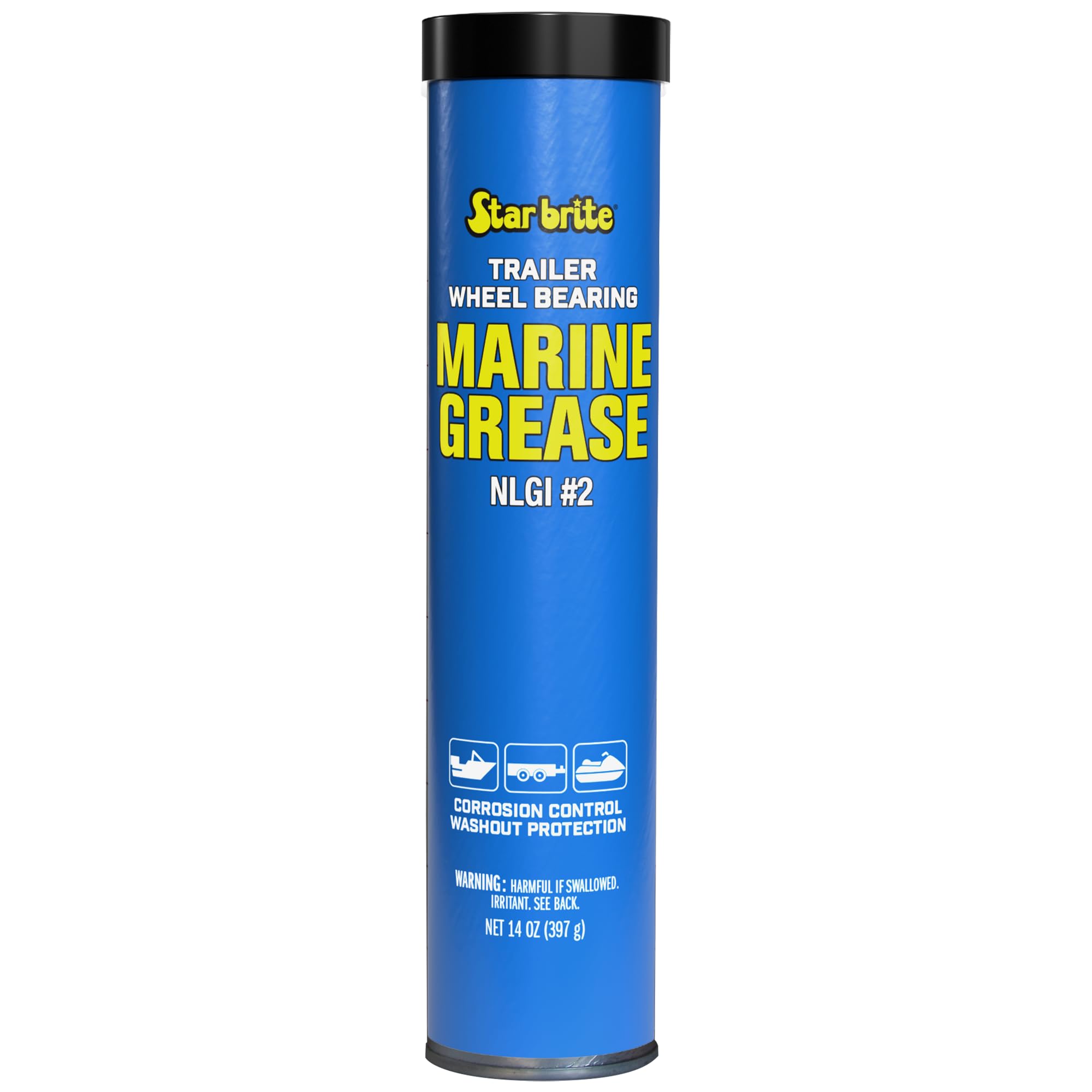
Star brite Wheel Bearing Grease

93 /100
Angler Score Outstanding

Key details

Size
14 oz cartridge
NLGI Grade
NLGI #2
Classification
ASTM D4950 GC-LB
Temperature Range
0°F to 325°F
Check Details on Amazon

The line worth reading on Star brite's cartridge is the ASTM D4950 GC-LB classification. It is an established service classification for wheel bearing and chassis grease, and this is the only pick here that prints one — a small piece of evidence that the grease was evaluated against a standard rather than a marketing brief. The 14-ounce cartridge fits a standard grease gun, and the formulation is aimed squarely at trailer wheel bearings that get dunked in salt water.

It is the least expensive cartridge in this group, and it does the job the category exists for: packing a trailer's hubs before the season and holding rust off the races. Be ready for a tacky grease. That is exactly what you want clinging inside a hub and exactly what you do not want on your hands, and it will string off a fitting when you pull the gun away. For a trailer dipped a dozen times a summer and repacked each spring, that is a fair trade.

Pros

  • Carries an ASTM D4950 GC-LB classification
  • Least expensive cartridge in this group
  • Fits a standard grease gun

Cons

  • Rated only from 0°F to 325°F, so margins are thin
Our verdict

We send budget-minded trailer work here: it is the only cartridge in the group with an ASTM D4950 GC-LB classification, and it handles hubs and chassis points.

Check Latest Price
4

Best Tub for Hand-Packing

Sta-Lube SL3121 Marine Grease

92 /100
Angler Score Outstanding

Key details

Size
14 oz tub
Thickener
Aluminum complex
Upper Temperature
469°F
Check Details on Amazon

A tub answers one specific job better than anything else: packing a wheel bearing by hand, palm full of grease, working it into the cage until it comes out the other side. Sta-Lube's 14-ounce tub sits open on the bench for scooping, and the blue aluminum-complex grease inside is tacky enough to stay in the rollers while you seat the seal. If you only ever feed a grease gun, skip it.

Aluminum complex with a polymer additive is the formulation, and the pairing targets water washout — this is a grease built to cling rather than rinse away when a hub goes under at the ramp. The published upper limit of 469 degrees Fahrenheit is generous for trailer work, and a tub this size lasts several seasons of spring repacks.

This is the tub we reach for when a bearing is going back together, because scooping beats trying to inject grease into a cage with a gun. It is a legitimate trailer grease rather than a bike-shop generalist, and the washout resistance and the 469-degree ceiling are why. Buy it if your maintenance involves a bearing packer or your own hands; buy a cartridge if it does not.

Pros

  • Tub format suits hand-packing bearings
  • Aluminum complex resists water washout
  • Rated to 469°F

Cons

  • Tacky enough that a dry rag will not clear it from your hands
Our verdict

A tub of tacky aluminum-complex grease is what we want for hand-packing trailer and 4WD bearings that see water, and this one is rated to 469°F.

Check Latest Price
5

Best for Fishing Reels

Yamaha Yamalube Marine Grease

93 /100
Angler Score Outstanding

Key details

Size
10 oz tube
Type
Marine grease
OEM Specification
Yamaha grease A
Check Details on Amazon

Use where grease A is specified in the service manual is the entire pitch, and for a Yamaha owner it is a good one. Buying the factory grease takes a decision off the table: if the manual calls for grease A, this is grease A, and there is no compatibility question to work through, no cross-reference chart, and no guessing about whether a generic marine grease meets the spec.

What we did not expect was how well it suits reels. A 10-ounce tube is a sensible size for a reel service, the grease is tacky enough to stay on a gear train without gumming the drag, and it works on baitcasters, fly reels, and saltwater spinners. If you service your own reels, that alone justifies keeping a tube in the box.

So it is a specialist's tube rather than a trailer-repack purchase. For the jobs the grease was actually specified for — outboard fittings, cables, and reels — it is the right thing to have on the shelf, and it is the answer for anyone who would rather follow the manual than second-guess it.

Pros

  • OEM grease for Yamaha grease A applications
  • Works well on baitcasters, fly reels, and saltwater spinners
  • One tube covers a full reel service

Cons

  • Small tube: a full trailer repack takes more than one
Our verdict

We keep this one for Yamaha service and reel work: it is the factory grease the manual calls for, and it is a sensible size for a baitcaster or a fly reel.

Check Latest Price
6

Rubber Seals and O-Rings

BRP Triple-Guard Marine Grease

93 /100
Angler Score Outstanding

Key details

Size
8 oz tube
OEM Part Number
0508298
Seal Compatibility
Won't swell seals, packing or o-rings
Check Details on Amazon

Won't swell seals, packing, or O-rings sounds like a marketing line until you have had the other kind of grease soften a rubber part you then had to replace. Triple-Guard is BRP's factory grease for Johnson and Evinrude outboards, and that seal compatibility is the reason it is in this guide instead of a generic tube of lithium.

The rest of the sheet is what a marine grease should be: waterproof enough not to wash off, unaffected by salt water, vibration, or cold, and compatible with other greases so a partial changeover is not a drama. It is an 8-ounce tube, sized for lower-unit and jet-pump work rather than a four-wheel repack, and it is thick enough that it beds into a spline and stays there.

We like having it on the bench for anything with a rubber seal in the stack — a water pump housing, a jet pump, a lower unit going back together — where the seal claim is worth more than a marginal difference in dropping point. It is also the pick when an Evinrude or Johnson manual names the factory grease, since that is precisely what this is.

Pros

  • Stated not to swell seals, packing, or O-rings
  • Waterproof and unaffected by salt water or cold
  • Compatible with other greases

Cons

  • Crimped tube seam can split and leak
Our verdict

We recommend it whenever a rubber seal is in the stack — BRP's factory grease states it will not swell seals or O-rings, and it stays put in salt water.

Check Latest Price
7

Bikes and Boats

Bel-Ray Waterproof Grease

93 /100
Angler Score Outstanding

Key details

Size
16 fl oz
Type
Waterproof grease
Container
Can
Check Details on Amazon

It is shelved with bicycle tools, which says where Bel-Ray expects to sell most of it, but a 16-ounce can of waterproof grease is a marine product in everything but name. This is a thick, sticky grease that resists water rather than rinsing out of a bearing — the property that matters in a trailer hub, an outboard pivot, or a dirt bike's linkage, and the reason one can ends up doing all three around here.

It is the crossover pick for a garage that already maintains bikes and a boat, because a can this size covers both and the formula is simple enough to trust for general bearing work. There is no wheel bearing classification or temperature rating printed on it, so you are buying on the formula rather than a spec table. If you are already a Bel-Ray user for motorcycles or bicycles, this is the same can doing double duty; if you want numbers to compare, one of the others will suit you better.

Pros

  • Waterproof formula that resists washout
  • 16-ounce can covers bikes and boats
  • Thick and sticky, so it stays in the bearing

Cons

  • Sticky formula makes clean application fiddly
Our verdict

It is the crossover pick we keep on the shelf for bikes and boats alike — a thick, waterproof grease that stays in a bearing and goes a long way.

Check Latest Price
8

Fleet and Shop Use

Lucas Oil 10320 Marine Grease

95 /100
Angler Score Outstanding

Key details

Pack
30 cartridges
Size
14 oz cartridges
Dropping Point
570°F
Timken OK Load
65 lb
Check Details on Amazon

Thirty cartridges is a commercial quantity, and that is the honest way to read this listing: a case of grease for someone with several trailers, a yard of equipment, or a service bay. Each cartridge is sized for a normal grease gun, so the format is familiar — the difference is buying a season or three at once.

The numbers on the label are the most specific in this group. A Timken OK load of 65 pounds describes how much pressure the film takes before it gives up, and a dropping point of 570 degrees Fahrenheit is high for a grease aimed at trailer axles. Translated, this is a grease for high-load, hot-running bearings — trailer hubs, steering cables under load — with adhesive properties that keep it from being flung off.

Lucas also lists rust and corrosion protection in both fresh and salt water, which is the claim a marine grease lives or dies by, and the adhesive character shows in the consistency: it is a sticky grease that hangs onto a surface rather than slumping off it. That is the behavior you want on a trailer that goes under twice a weekend all summer.

Where it makes sense is scale. A marina, a dealer, or somebody with four trailers and a tractor will work through a case and get the best per-cartridge economics here. One boat on one trailer is several years of grease in a single purchase, and a bottle or a couple of tubes will do the same job with less shelf space.

Pros

  • Timken OK load of 65 lb for high-load bearings
  • 570°F dropping point
  • Rust protection in fresh and salt water
  • Cartridges fit a standard grease gun

Cons

  • Cartridges can arrive noticeably underfilled
Our verdict

Buy the case if you maintain several trailers or a yard of equipment — it has the most specific spec sheet here, and the cartridges fit a standard gun.

Check Latest Price

How We Tested the Marine Greases

To build the shortlist, I read labels on roughly 30 greases and cut the field down by specs I could actually use: NLGI grade, base oil, the water-resistance claim, and the format it came in, whether a tub, a cartridge, or a squeeze tube. Cost per ounce was part of that cut, since a big tub only saves you money if you can get all of it into a bearing, and a tube that pockets grease at the bottom is a hidden loss.

Then we got them dirty. Each grease went into trailer wheel bearings, onto winch gears and bushings, onto battery terminals and trailer wiring connectors, and into tilt-and-trim and steering cable fittings on two boats that live outside. Everything got hosed down after each trip, and the trailer hubs were backed into salt water and pulled apart again eight weeks later to see what survived inside.

Along the way we watched for a few specific things. Thickness: how each one pumped through a grease gun on a 40-degree morning, and whether it stayed put when smeared on a vertical steel plate in July sun. Greasiness: whether it stayed tacky between your fingers or slid off wet, and how easily it came off your hands with ordinary shop soap. Durability: what the bearings and cable ends looked like after eight weeks of dunkings. Capacity: we weighed what actually came out of each container against what the label promised.

How to Choose Marine Grease

Start With the Container

Before formulation, count what you grease. A cartridge is the answer for trailer hubs and any fitting you reach with a gun; a squeeze tube suits small jobs and outboard fittings where a gun will not fit; a tub or bottle is for hand-packing, where you want to scoop. Get this wrong and you will be transferring grease from a tub into a gun with a spoon, which is exactly as enjoyable as it sounds.

The picks here cover all three: the Maxima bottle and the Sta-Lube tub for bearing work, Star brite and Lucas cartridges for a standard gun, and the Quicksilver and Yamaha tubes for fittings and reels.

Know What Is Already in the Hub

Thickeners do not all get along. Lithium complex, calcium sulfonate, and aluminum complex are the three bases in this guide, and mixing them can soften or harden the grease already in a bearing depending on the pair. NLGI 2 is the consistency most trailer hubs run, so that usually matches; the base is the part worth checking.

If you do not know what is in a hub, clean it out and repack rather than topping up. A bearing and a seal cost far less than a hub that lets go on the shoulder of a highway.

Water Resistance Is Not Binary

Waterproof on a label does not mean a hub can live underwater. What you are buying is washout resistance — the grease's ability to stay in the bearing instead of rinsing out — plus corrosion inhibitors that hold rust off the races. For a trailer that gets dunked at the ramp, that combination is the entire job.

Repack once a year if the hubs go under regularly, and pull a cap mid-season to look for milky or rust-streaked grease. Either means water is getting past a seal, and no grease formulation fixes a bad seal.

Read Temperature and Load Numbers Carefully

Two numbers get quoted and they mean different things. A dropping point, like the 570°F on the Lucas cartridges, is where the grease structurally fails — not a temperature you can run at continuously. A stated service range, like the Maxima's -20°F to 560°F, is closer to real use, and the cold end matters for a trailer parked outside.

Load figures such as a 65-pound Timken OK load describe film strength under pressure. That matters for wheel bearings and loaded steering cables, and barely at all for a hatch hinge or a coupler.

Buy Enough, and Check What Arrives

A four-wheel trailer repack uses more than one small tube, so two 8-ounce tubes for a four-wheel job is not overbuying. Cartridges occasionally arrive short of full, which is worth checking before you seat one in a gun.

Buy a case only if you will work through it in a season or two. For a single boat on a single trailer, a bottle or a couple of tubes covers the same work with less shelf space.

Frequently Asked Questions

Final Verdict

Buy the Maxima if you want one grease that covers trailer bearings, outboard fittings, and the winch — it has the widest temperature range in this group and enough in the bottle for a full spring repack.

If you run a Mercury or MerCruiser and want the grease the manual calls for, the Quicksilver's calcium sulfonate is the better match, though you should plan a clean repack if the hubs already hold lithium grease. And if a cartridge for a standard gun is all you need, the Star brite does trailer-bearing duty for the least money among the cartridges here.