Best Meat Grinders of 2026

Grinding your own meat ruins the store-bought version for you — better texture, a fat ratio you actually control, no mystery about what went into the tube. What stops most people is the machine. An undersized motor doesn't chop so much as mash, smearing fat across the die and turning a ten-minute job into twenty minutes of scraping. The right one pulls meat through steadily, keeps it cold, and comes apart fast enough that cleanup doesn't cancel out the win.

I grind pork shoulder for sausage and chuck for burgers most weekends, and over the past nine months my team has put 12 grinders through the same messy routine. The split had less to do with the wattage on the box than with gearing, auger fit, and how the parts lock together. One thing I'd tell any first-timer: chill everything — partly frozen cubes and a cold auger grind cleaner than room-temperature meat ever will. The picks below held up when there were 20 pounds to get through, not just on the spec sheet.

1

Best Overall

LEM BigBite #8

94 /100
Angler Score Outstanding

Key details

Build
Stainless steel head and plates
Motor
0.5 HP
Warranty
5 years
Grinding Rate
About 7 lbs per minute
Check Details on Amazon

Seven pounds of meat a minute is what a half-horsepower motor buys you here, and it's the figure that settled this pick for us. The BigBite #8 is fast enough that a deer's worth of trim stops being an afternoon project, and it does the work with a stainless head and stainless plates rather than the coated aluminum you find further down this list. Put a five-year warranty and a company that still sells replacement plates and knives beside that, and you have the machine we name first to anyone grinding more than a couple of pounds at a time.

What we didn't expect to care about was the noise. It runs quietly enough that you can hold a conversation next to it, which matters more than it sounds when the kitchen is also where everyone else is and you're pushing a big batch of pork through in an evening.

It's built like equipment rather than an appliance. The head locks down solidly, the base stays put instead of creeping toward the edge of the counter, and the permanently lubricated motor means there's no oiling routine to forget. Long strips of shoulder feed through without bogging — the auger grabs and keeps pulling, which is the difference between a grinder you use and one you stop bothering with.

The one thing it won't do is bones. LEM states that plainly, so keep them out and save the pet-food experiments for a machine rated for it. Otherwise the only real ask is counter space — this is not a grinder that lives in a cupboard, and it isn't built to.

Pros

  • Grinds about 7 pounds per minute
  • Stainless head, plates, and knife
  • Quiet enough for a busy kitchen
  • Five-year warranty with parts support

Cons

  • Sausage stuffing is its weakest job
  • Not built to grind bones
Our verdict

If you grind a deer a year or buy meat in bulk, this is the machine we point you to: fast, quiet, stainless, and covered for five years.
Check Latest Price
2

Best Heavy-Duty

MEAT! 1 HP #22

86 /100
Angler Score Excellent

Key details

Motor
1 HP
Weight
62.6 lb
Head Size
#22
Grinding Rate
11 to 14 lbs per minute
Check Details on Amazon

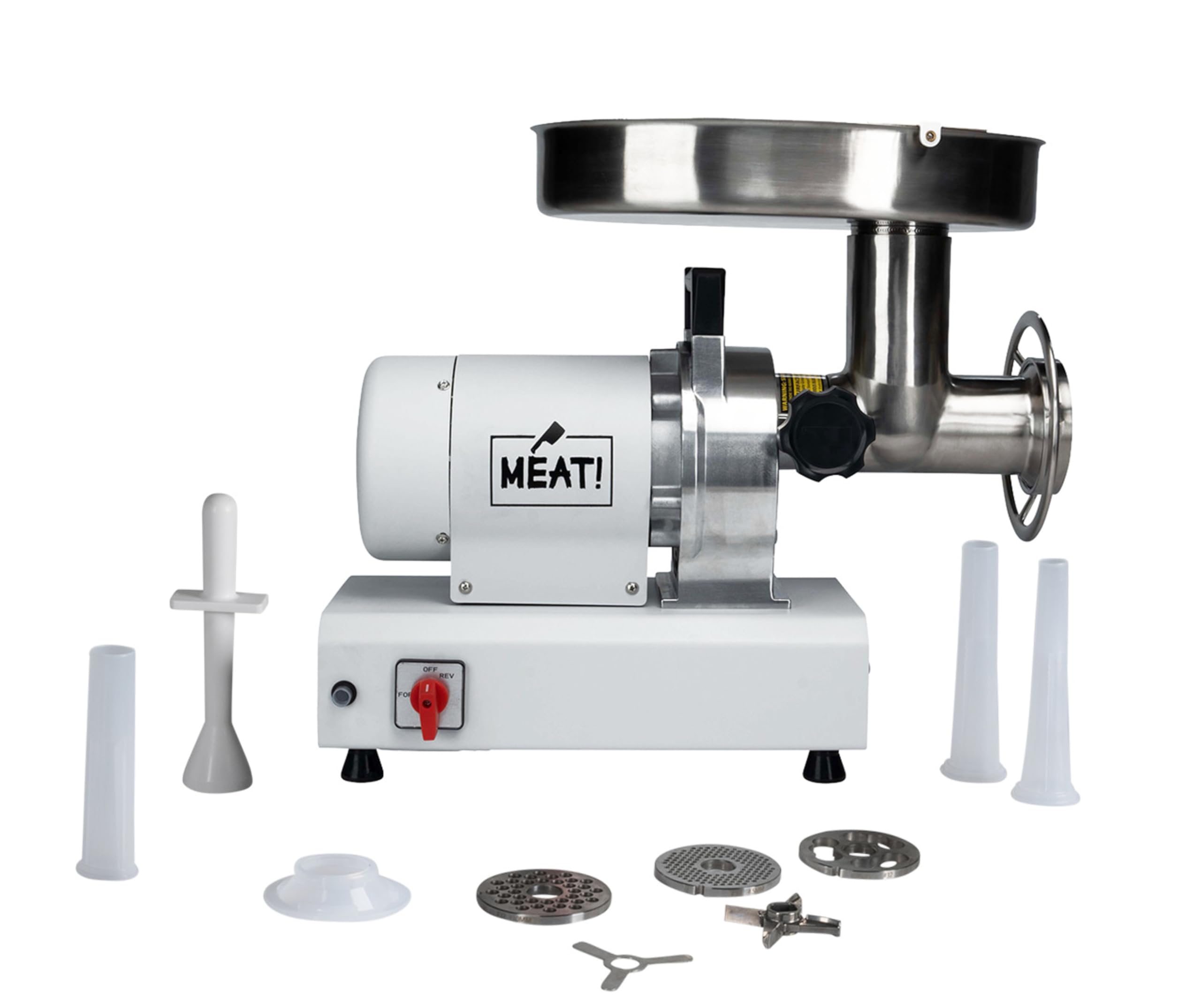
Sixty-two point six pounds is the number to get your head around, and it tells you most of what you need to know: this is processing equipment that happens to plug into a kitchen outlet. The 1 HP motor moves 11 to 14 pounds a minute, roughly double our top pick, and the #22 head swallows cuts that would need trimming down for a smaller throat.

For anyone butchering a deer or two a year and splitting a hog with family, that's the right trade. Everything down to the bolts is stainless, coarse and fine plates cover both grinds, and the machine is wired for the optional foot pedal — in our view the single best upgrade for one-person grinding, because both hands stay on the meat and the motor answers to your foot.

The cost is floor space. A 62-pound machine wants a dedicated spot at working height, and hauling it out of a closet twice a year is the fastest route to not bothering. Reassembly after cleaning also takes attention the first few times, since the parts only go together one way. Neither is a dealbreaker at this level of output, but together they're why we don't hand this to a first-time grinder.

Pros

  • 1 HP and 11 to 14 lbs a minute
  • All-stainless construction
  • Wide #22 throat for second grinds
  • Set up for an optional foot pedal

Cons

  • 62.6 pounds needs its own spot
  • Reassembly takes patience after cleaning
Our verdict

Buy this one when volume is the whole point: 1 HP, 11 to 14 pounds a minute, and stainless from the hopper to the last bolt.

Check Latest Price
3

Best Value for Big Batches

VEVOR #12 Electric Mincer

81 /100
Angler Score Excellent

Key details

Motor
750W / 1 HP
Head Size
#12
Certification
ETL listed
Grinding Rate
552 lbs per hour
Check Details on Amazon

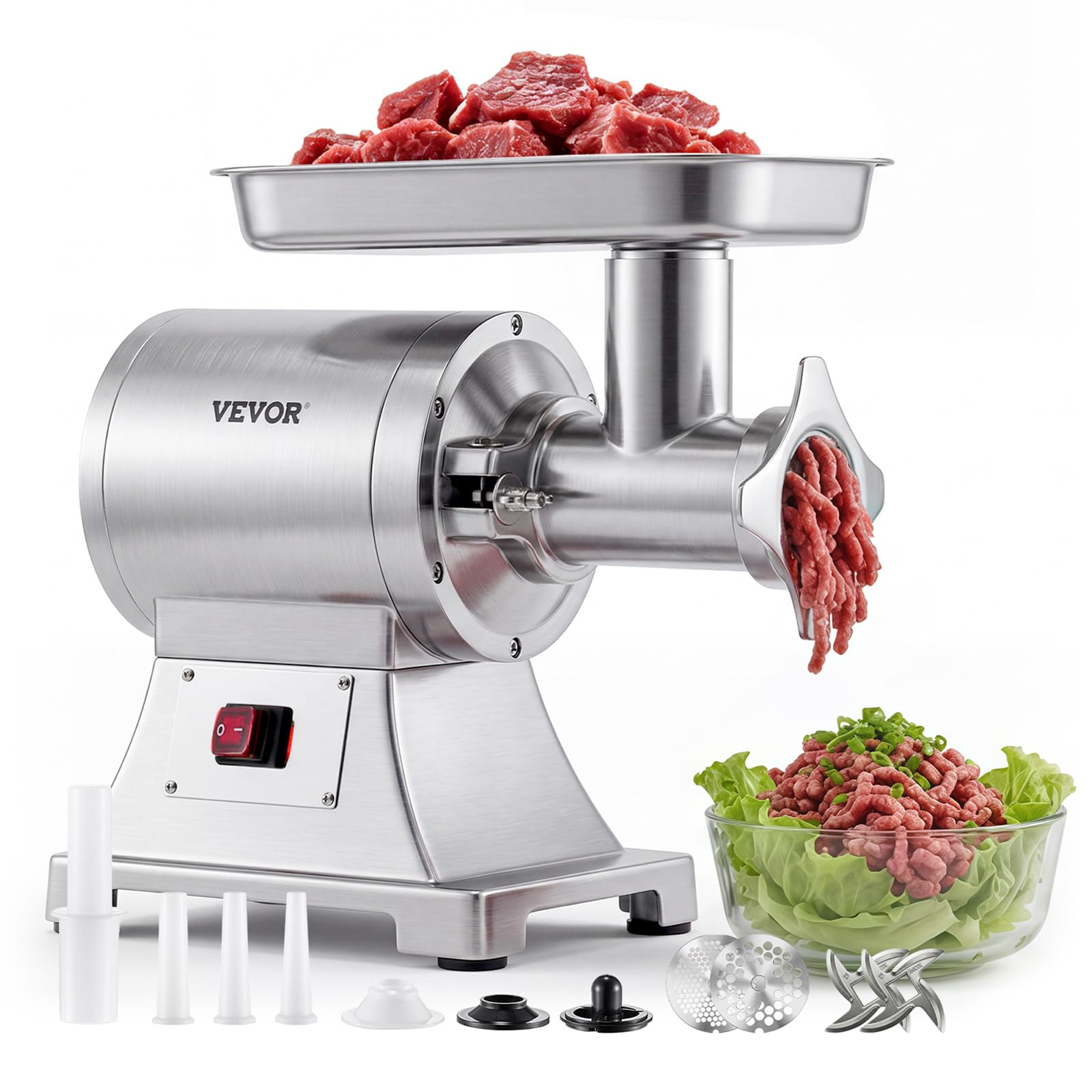
A #12 head and a 1 HP motor for less than either of our premium picks is the pitch, and it holds up. VEVOR rates this machine at 552 pounds an hour, more capacity than a family will use in a season, and the three-stage auger pulls meat into the head instead of letting it sit and warm in the throat.

The kit is unusually complete for the money: two cross blades, 6mm and 8mm plates, three stuffing tubes, and a kibbe set. The rapid cold-air cooling is the detail we appreciate most, since a long grind is exactly when a motor overheats, and the machine carries an ETL listing — something we like to see on a grinder with this much motor. Anti-vibration pads keep it planted on a stainless counter.

Where it gives ground is refinement. Cleanup takes more disassembly than the LEM, with more pieces and more threads to work around, and longevity is the real trade for the price. If a machine like this fails, it tends to fail early, so run it hard in the first month while the warranty is fresh and don't ask it to be a daily production grinder. For a few heavy weekends a year, it's the best value in this group.

Pros

  • 552 pounds an hour from a #12 head
  • Two plates, three tubes, kibbe kit included
  • ETL listed with cold-air motor cooling
  • Anti-vibration feet keep it steady

Cons

  • Cleanup takes more disassembly
  • Flimsy meat tray
Our verdict

For a few heavy weekends a year, this is the most grinding you can get for the least money, provided you accept a shorter service life.

Check Latest Price
4

Best for Small Batches

LEM Countertop #8

89 /100
Angler Score Excellent

Key details

Motor
575 watts
Weight
11.3 lb
Warranty
1 year
Grinding Rate
2 to 3 lbs per minute
Check Details on Amazon

Half the throughput of our top pick and a third of the weight is the trade this one offers, and for a lot of kitchens it's the right trade. At 11.3 pounds it lifts out of a cabinet, grinds two to three pounds a minute, and goes back where it came from. If your version of this hobby is ten pounds of sausage on a Sunday and burgers on a Tuesday, that's the whole job covered.

The aluminum head locks with a quarter turn and comes apart into pieces that fit in a sink, which sounds like a small thing until you're the one cleaning it at ten at night. Two boundaries worth stating: the head is aluminum rather than stainless, and it isn't built for bones. Neither matters for meat, and the pulse-reverse button clears a jam without a full teardown, so what you're really giving up is speed and a long warranty. For the money it's the easiest LEM to justify.

Pros

  • 2 to 3 lbs a minute in 11.3 pounds
  • Quarter-turn head comes apart easily
  • Pulse reverse clears jams

Cons

  • Aluminum head instead of stainless
  • One-year warranty only
Our verdict

The right grinder for a normal kitchen: a few pounds a minute, 11 pounds of machine, and a head that comes off with a quarter turn.

Check Latest Price
5

Best Controls

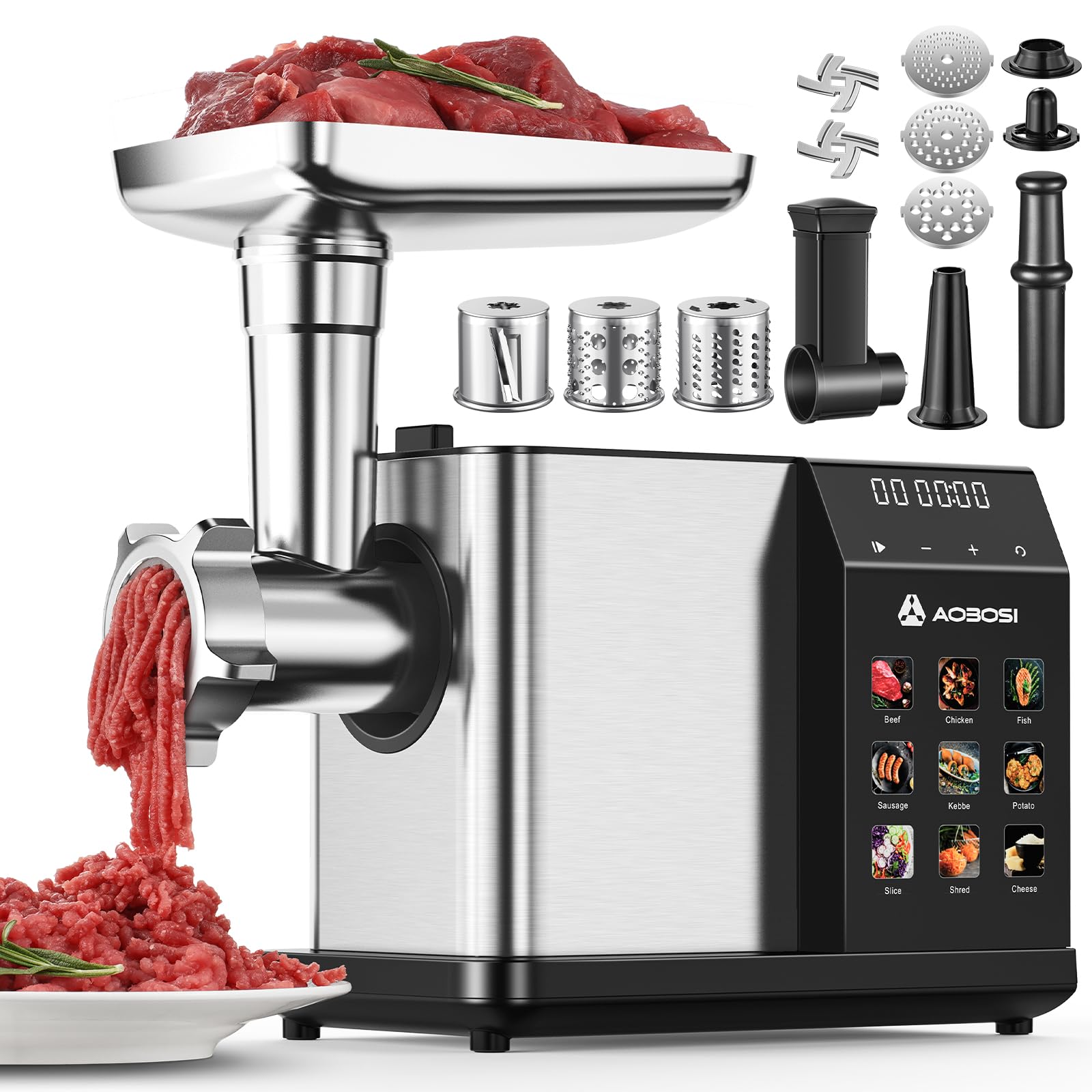
AAOBOSI Digital Grinder

86 /100
Angler Score Excellent

Key details

Storage
Built-in accessory storage
Controls
9-preset touch screen
Max Power
3000W
Grinding Rate
Up to 4 lbs per minute
Check Details on Amazon

Nine presets and a color touchscreen on a meat grinder sounds like a solution in search of a problem until you're the one standing over it with greasy hands. Tap Meat, tap Sausage, and the machine sets its own speed. That's the whole interaction, and it's why this is the grinder we hand to someone who has never ground meat before.

The presets aren't the real story, though. Built-in storage for every plate, blade, and tube means no twenty-minute hunt through a drawer before you start, and auto-reverse clears a jam without taking the head apart. It grinds up to 4 pounds a minute with nine speeds to fine-tune the feed, which is more control than most people will use and exactly what you want when you're dialing in a coarse chili grind.

The motor is the part to be careful with. Give it a breather between batches rather than running it continuously for an hour, and buy it knowing a machine with this much electronics inside is doing more work than a plain on-off grinder. It grinds well while it's running, and the storage alone justifies the step up from the cheapest models here.

Pros

  • Touchscreen with nine presets
  • Built-in storage for every accessory
  • Auto-reverse clears jams
  • Up to 4 pounds a minute

Cons

  • Loud enough to end a kitchen conversation
Our verdict

Buy it if you want the machine to walk you through the job — the presets and built-in storage make it the easiest here to live with, noise aside.

Check Latest Price
6

Best Budget

CHEFFANO Life Grinder

88 /100
Angler Score Excellent

Key details

Plates
2mm, 5mm, 7mm
Weight
6.6 lb
Cleaning
Hand wash only
Rated Power
500W (2000W max)
Check Details on Amazon

The least expensive grinder here we're comfortable recommending, and it gets the basics right: a 500W rated motor, plates at 2mm, 5mm and 7mm, a sausage tube, a kibbe kit, and overload protection that cuts the motor before it cooks itself.

At 6.6 pounds it's light enough to move with one hand, and the suction feet hold it down once you set it on the counter. Setup is order-of-operations simple — stack the blade and plate, thread the ring, press the button — and the reverse button handles the jam that comes from overloading the feed tube. Everything comes apart for washing, and the pieces are small enough to stack in a dish rack.

Where it stops is volume and lifespan. The plastic spacers are the wear point, so treat this as a machine for a few pounds at a time rather than a deer-season workhorse: grind in short runs, keep the meat cold, and it will earn its place. For occasional burgers and a batch of breakfast sausage, that's all a grinder needs to do.

Pros

  • Three plates plus sausage and kibbe kits
  • 6.6 pounds with suction feet
  • Overload protection and reverse

Cons

  • Hand wash only, no dishwasher
Our verdict

The least expensive way into real grinding: occasional batches, a light body, and accessories that cover sausage and kibbe.

Check Latest Price
7

Light Occasional Use

Aiheal Electric Grinder

88 /100
Angler Score Excellent

Key details

Plates
2mm, 5mm, 7mm
Max Power
3200W
Rated Power
300W
Sausage Tubes
3
Check Details on Amazon

The box says 3200W. The motor is rated at 300W. Both numbers are in the listing, and the gap between them is the most useful thing to understand before buying any grinder at this end of the market — the big figure is a peak the motor touches for an instant, and the small one is what it can sustain for the ten minutes you're actually grinding.

What the money buys is a genuinely complete kit: two blades, plates at 2mm, 5mm and 7mm, three sausage tubes, a kibbe attachment, and a reverse button. Assembly is tool-free and takes about a minute, the head comes apart for washing, and the body is light enough to move with one hand.

It grinds chicken, pork, and vegetables without complaint at a pace that suits small batches. Sinew is where it struggles — connective tissue wraps the blade, the machine slows, and you end up stopping to clear it. Trim your meat properly and the problem mostly goes away.

That makes this a grinder for learning whether home grinding fits your cooking, not for a cooler full of deer trim. Buy it for a few pounds a week, keep your cuts clean, and it does the job; if you already know you'll be processing whole animals, spend the money once and skip this tier.

Pros

  • Full accessory kit for the money
  • Light and tool-free to assemble
  • Reverse button clears jams

Cons

  • Rated motor is a fraction of the headline watts
  • Slows down on sinewy cuts
Our verdict

A light-duty machine for a few pounds a week; the rated 300W motor is the honest number, not the 3200W on the box.

Check Latest Price
8

Small-Batch Beginners

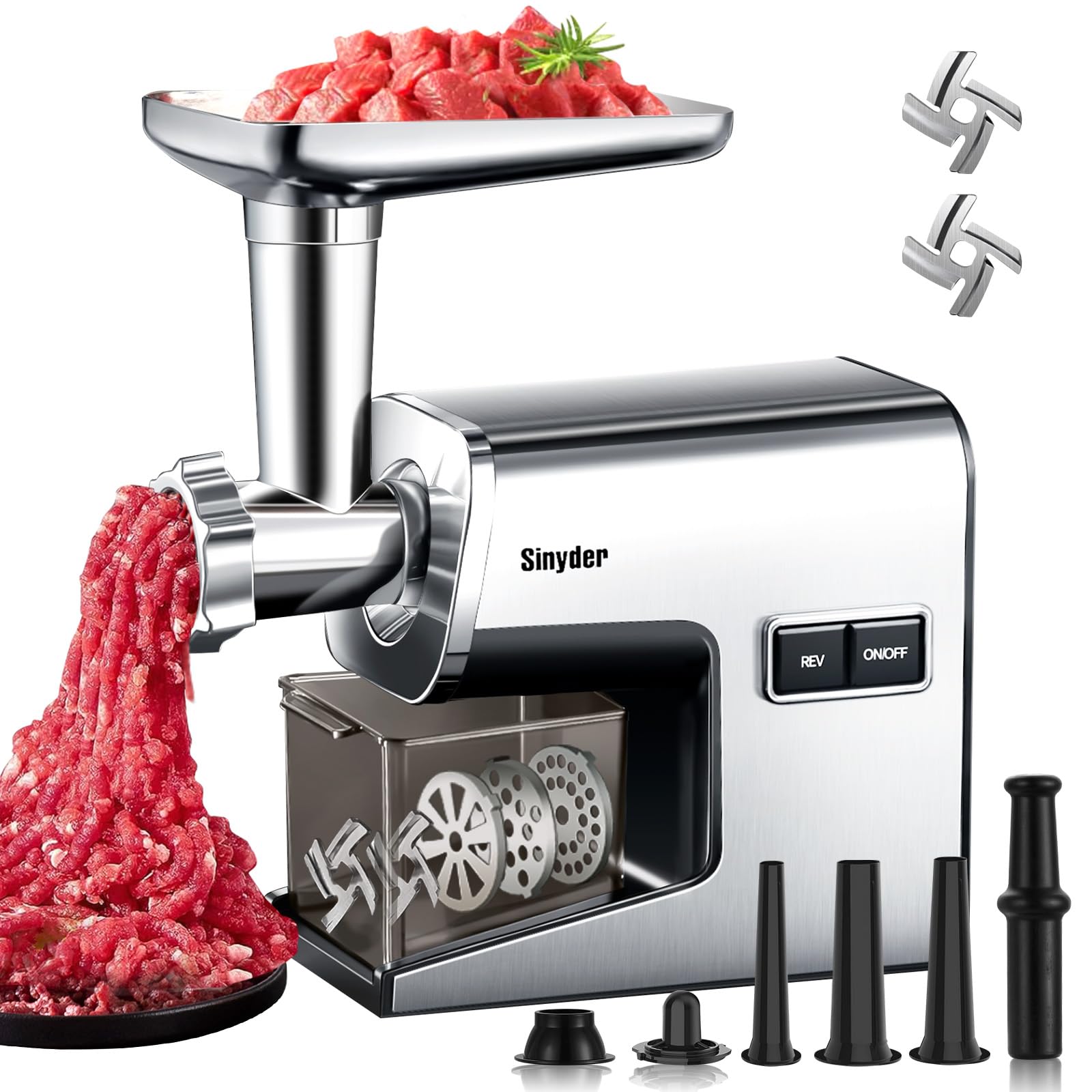
Sinyder Electric Grinder

84 /100
Angler Score Excellent

Key details

Plates
5mm and 7mm
Warranty
1 year
Max Power
3000W
Rated Power
700W
Check Details on Amazon

The word stainless in the title is doing a lot of work. The body is stainless steel; the parts that meet your meat include plated metal and plastic, and that's where wear shows first — the auger seat and the plastic spacers are the bits to watch if you plan to use this weekly.

What it has going for it is a 700W rated motor peaking at 3000W, one-button operation with a reverse, plates at 5mm and 7mm, a sausage tube, a kibbe kit, and a one-year warranty. It's compact enough to store on a shelf, and there's nothing to learn: load the tray, press the button, push with the stomper.

In use it's quick for its size. Small batches of chicken and pork go through without clogging, and the tray, while small, is easy to keep loaded. The limitation is the size itself — you're refilling often, which is fine for a weeknight's burgers and tedious if you're doing twenty pounds.

As a first grinder or a second machine for small jobs, it does the work, and the one-year warranty covers the window when a cheap grinder is most likely to let you down. What it won't do is grow with you; if the budget stretches to the LEM Countertop, that's the more durable version of the same idea.

Pros

  • 700W rated motor with reverse
  • Compact enough to shelve
  • Two plates, sausage tube, kibbe kit

Cons

  • Stainless is the body, not every part
  • Small tray means constant refilling
Our verdict

A workable starter grinder for small batches, as long as you go in knowing the stainless is the body and not every part inside.

Check Latest Price

How We Chose and Tested Meat Grinders

We started with roughly 40 machines from brand catalogs and retail listings, then cut anything with plastic drive gears, a die too small to keep up with a full hopper, or a wattage figure with no continuous rating behind it. That left 12 grinders, which we ran for nine months.

Testing happened where a grinder actually lives: on a kitchen counter during a Sunday sausage session, on a folding table in the garage when a friend brought over a deer, and on a weeknight when dinner was already late. We timed how long each took to push five pounds of chuck cubes through the coarse plate, weighed the output to see how much stayed packed in the auger housing, and noted whether the meat came out in clean separate curds or smeared into paste. Back-to-back 20-minute runs with pork shoulder exposed the motors that bogged down and ran hot.

Noise got a decibel app held at arm's length during those runs; two machines were loud enough that we finished their batches in the garage. Every unit went on a kitchen scale too, because a grinder you dread lifting out of the cabinet is one that stays in the cabinet. We broke each down and rebuilt it by hand, counting the steps, then washed the plates, auger, and housing the way anyone would at the sink and noted where ground meat hid in the seams. Over the months we watched for slow failures — metal shavings in the output, wear on the auger, cracks near the feed tube, gearboxes running hot — and compared what each machine asks for against the headroom it gives you.

How to Choose a Meat Grinder

Start With the Head, Not the Wattage

Grinder sizes run from #5 through #8, #12, and up to #22, and the number describes the diameter of the grinding head. An #8 handles most home batches, a #12 is the sensible step up for deer and large families, and a #22 is production equipment. Wattage is where the marketing lives: a listing advertising 3200W is usually quoting a peak the motor touches for an instant. Our Aiheal pick is rated at 300W and peaks at 3200W.

Ask what the motor sustains and judge the machine on that. A small head with an honest motor grinds better than a big number with a weak gearbox.

Match Throughput to Your Real Batch Size

Pounds per minute is the honest measure of how a grinder will feel in your kitchen. Two to three pounds a minute covers burgers and a few pounds of sausage. Seven, which our top pick claims, turns a deer into an evening's work instead of a weekend's. Eleven to fourteen is for people processing several animals who don't want to stand there feeding a slow throat.

The trap is buying for the one big weekend and resenting the machine the other 51 weeks. If you grind twice a month, buy for those months, not for November.

Cleaning Is What Decides How Often You Use It

A grinder you dread washing becomes a cabinet ornament. Count the pieces before you buy, and check whether the plates, blade, and head are dishwasher safe. A quarter-turn head like the LEM Countertop's comes off in one motion; threaded housings with bolts take longer and collect fat in the threads.

Some machines, including our budget pick, are hand-wash only and will dull or corrode in a dishwasher. An extra two minutes of cleaning per session is the difference between using the thing monthly and using it once.

Plan for the Weight, the Noise, and the Space

Grinders here run from about 11 pounds to 62, and that range decides where the machine lives. Anything past 30 pounds wants a permanent counter or a sturdy shelf at working height; lighter models go back in a cabinet. Grinders are also loud, and a quiet one is the exception rather than the rule.

Our advice: run it once in an empty kitchen before you commit to a Sunday morning grind with a sleeping household upstairs, and leave room for a foot pedal if you work alone.

Sausage Stuffing Is a Bonus, Not a Stuffing Machine

Almost every grinder ships with stuffing tubes, and the tubes work — slowly, and with more texture change than a dedicated stuffer gives you. If sausage is a hobby, the tubes will do. If you make fifty pounds at a time, plan to buy a standalone stuffer later and pick the grinder on its grinding.

The same logic applies to kibbe and vegetable attachments: nice to have, never the reason to choose one machine over another.

Frequently Asked Questions

Final Verdict

The LEM BigBite #8 is the grinder we recommend to almost everyone who asks, because it's fast enough for a deer, quiet enough to run while the kitchen is full of people, and covered by a warranty that outlasts most people's enthusiasm for the hobby.

If you process whole animals regularly and have a permanent spot for a 62-pound machine, the MEAT! 1 HP is the one that never makes you wait. And if you're not yet sure home grinding will stick, start with the CHEFFANO and find out for the least money.