
Best Paracord of 2026

A "550" on a paracord label is a promise, and plenty of spools sold online break it. Type III mil-spec cord is rated for 550 pounds, but makers get there with four-strand cores instead of seven, thin sheaths, or cord that measures 3.5 millimeters and calls itself 4. What a good spool buys you is boring reliability: a tarp that stays put through a windy night, a hammock that doesn't creep toward the ground, and ends that don't fuzz apart the third time you retie them.

I've kept a hank of cord in my truck for years — for loose loads, a sagging gate, a tent line that quit in the night. Over four months, my team and I worked through 14 spools, from 50-foot hanks to bulk rolls, judging strand count, stretch, knot behavior, and how each color held up. Worth knowing before you buy: the sheath takes the abrasion and the core takes the load, so a cord can be plenty strong and still miserable to untie. The picks below run from short hanks for lanyards and bracelets to spools I'd trust with a loaded tarp.

1

Best Overall

TOUGH-GRID 550 Type III

96 /100
Angler Score Outstanding

Key details

Core
7-strand nylon
Length
100 ft
Made In
USA
Tensile Strength
550 lb
Check Details on Amazon

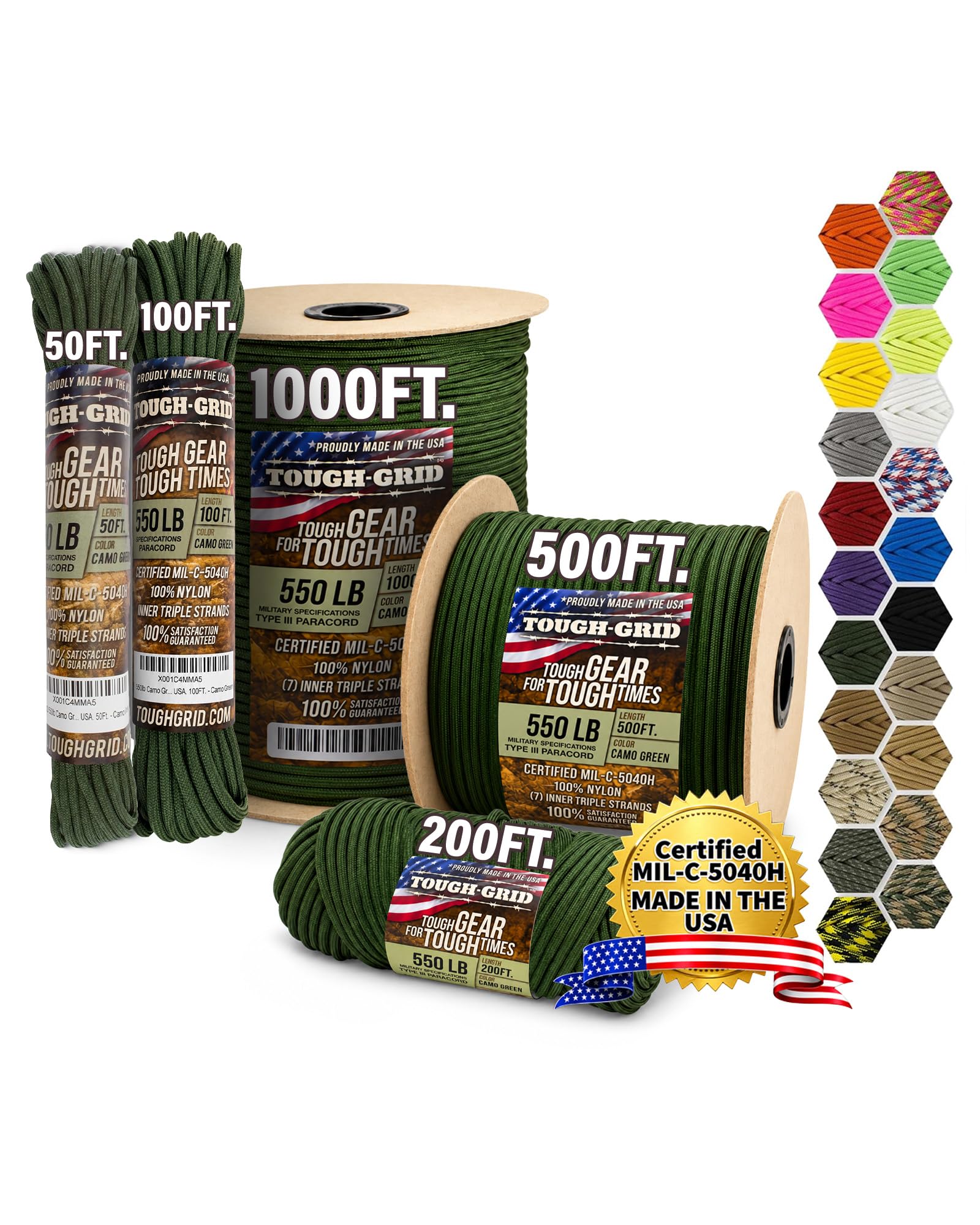
Some cords let you down in ways you only discover later, like a sheath that goes slack after a week in the sun or a core that turns out to be skinnier than the label promised. This TOUGH-GRID hank is the one we hand people who want a single cord and no homework: seven triple strands inside a nylon sheath, 100 percent nylon, made in the U.S., 550 pounds on the label, and a full 100 feet of it.

Length is the quiet advantage. A hundred feet gets a ridge line, four guy lines, a set of bootlaces, and a couple of handle wraps out of one hank, with enough left over to live in the pack. We cut and singed a lot of ends working through these cords, and this one beads into a clean tip rather than splaying out into a brush.

Material matters more than the headline number. Nylon has a little give, which is what you want from a guy line that gets nudged by wind, and it takes a flame cleanly when you finish an end. The camo green we've had out in the yard is still the same green, and the sheath hasn't gone shiny or slack at the tie points.

It's more cord than a bracelet maker needs and less brute strength than a serious hauling job wants. Everyone in between, whether that's camp, truck, boat, or emergency kit, gets the most useful single hank here, and the 750 below is there for the days when a load starts to worry you.

Pros

  • Genuine seven-strand Type III build
  • Made in the USA from 100% nylon
  • 100 feet covers more than one project
  • Doubles as craft cord for wraps and lanyards

Cons

  • Pricier than imported 550 of the same length
  • Camo green is easy to lose in grass and duff
Our verdict

The hank we point people to first: genuine U.S.-made Type III nylon in a 100-foot length that covers camp, truck, and craft duty without a second thought.

Check Latest Price
2

Best Heavy-Duty

TOUGH-GRID 750 Type IV

96 /100
Angler Score Outstanding

Key details

Core
11-strand nylon
Length
200 ft
Made In
USA
Tensile Strength
750 lb
Check Details on Amazon

Same maker, different job. The 100-foot 550 above is the hank that goes everywhere; this one is for the truck bed, the winter tarp, and anything you'd rather overbuild than think about again.

Eleven triple strands instead of seven and a 750-pound rating are the difference, and after working with both, we think the extra bulk earns its place once you're hauling. Two hundred feet also means a long run, a ridge line between two trees or a tarp over a woodpile, without a splice in the middle, and a splice is usually where cordage gives up.

Type IV is where cheap cord gets caught out, since a 750 label costs nothing to print and a genuine eleven-strand core costs real money. Ours counts out at eleven, the sheath sits tight on the core, and the camo green hasn't gone chalky on the length we've left hanging outdoors.

The trade-off is heft. It's a fat cord that doesn't enjoy small craft knots, and 200 feet of it is a lump in a daypack. Nobody carries Type IV on a day hike, and nobody who has lashed a load down with it wants to go back to 550 for that job.

Pros

  • 750 lb rating over an 11-strand core
  • 200 feet means fewer splices on long runs
  • U.S.-made 100% nylon construction
  • Holds up to sun, rain, and hard use

Cons

  • Premium outlay for a 200-foot spool
Our verdict

Buy the 750 when the load is the point: 200 feet of U.S.-made Type IV with eleven strands behind the rating, built for hauling rather than bracelets.

Check Latest Price
3

Best on a Spool

WEREWOLVES 650 Paracord

96 /100
Angler Score Outstanding

Key details

Core
9-strand nylon
Length
200 ft
Winding
Reusable spool
Tensile Strength
650 lb
Check Details on Amazon

Paracord rarely fails at the knot. It fails in the bag, where a hank that looked neat in the package has turned into a nest of loops. WEREWOLVES winds its 200 feet onto a reusable spool, and that single decision is why this one earns a spot: it pays out as fast as you can pull and winds back the same way.

The cord itself splits the difference between the two standards everyone knows. Nine strands and a 650-pound rating sit between Type III and Type IV, at the same 4 mm diameter, so it feeds through tent eyelets, tarp grommets, and pack hardware without you drilling anything out. We kept a length in the truck for a month and used it on a tarp, a cooler tie-down, and a fence repair.

Black is the color we've had, and it does the one thing black cord should do, which is disappear against a load and stay out of the way. The brighter colorways are easier to find in grass, and the orange in particular shows up in low light, which matters if you're stringing lines after dark.

Two hundred feet on a spool that survives a toolbox is the whole pitch, and it's why this one comes out ahead of the loose hanks for anything you plan to do repeatedly. Cut it without flinching, because there's a lot of it.

Pros

  • Reusable spool keeps 200 feet under control
  • 650 lb and nine strands split the difference
  • 4 mm body feeds through standard hardware
  • Bright colorways are easy to spot

Cons

  • Sheath can bunch under a hard-pulled knot
Our verdict

The spool is the reason to buy this one: 200 feet of 650 lb cord that pays out cleanly and winds back the same way instead of collapsing into a nest.

Check Latest Price
4

Best Budget

TECEUM 550 Paracord

95 /100
Angler Score Outstanding

Key details

Length
100 ft
Diameter
4 mm
Color Options
40
Tensile Strength
550 lb
Check Details on Amazon

At the bottom of the price range you're deciding what to give up, and with this TECEUM hank you give up very little. It spends the least of any 100-foot 550 here and still arrives with the standard Type III recipe rather than a lookalike.

The build is what you'd expect from a real 550: a 32-strand braided sheath over seven core yarns, 4 mm across, 550 pounds on the label, and a UV package that means it can stay outdoors without going brittle by August. Forty colors is the widest range in this set, which matters more than it sounds when you're marking guy lines or matching a kayak.

We've kept ours for the jobs where cord gets left outside, like a boat cover, shade cloth on a fence, or a clothesline between two posts, and it has come through a wet spring with its color and its knots intact. For craft work, the supple hand and the color range make it the easiest of these to buy in the exact shade a project needs.

Pros

  • Least expensive 100-foot 550 in this set
  • 40 color options to match a project
  • 32-strand sheath over seven core yarns
  • Holds up to rain and sun outdoors

Cons

  • Arrives on a cardboard winder, not a spool
  • Sheath tightness varies between hanks
Our verdict

The cheapest sensible 100-foot 550 here, and the one we buy when the cord is going to be left outside rather than kept in a drawer.

Check Latest Price
5

Best for Night Visibility

X XBEN Reflective 1000

93 /100
Angler Score Outstanding

Key details

Length
100 ft
Reflective
Yes
Inner Yarns
13
Tensile Strength
1000 lb
Check Details on Amazon

You notice reflective cord in the dark, not in daylight. String a guy line with this and a headlamp beam turns it into a bright line across camp, which is the whole point and the reason it's the one we reach for when lines go up at dusk.

The specs are aggressive: a 1000-pound rating, thirteen inner yarns, a 4 mm body, 100 feet, and a storage bag instead of a loose hank. That's a lot of claimed strength in a thin cord, and we haven't pulled one to failure, so treat the figure as the maker's rating rather than something we proved. What we can say is that it holds a taut line without visibly stretching, and the strip shows up from a good way up the trail.

Knots need more care than they do with nylon 550. Simple square knots can creep under a steady pull, so finish with a double fisherman's or a taut-line hitch and check them after the first hour of wind. For guy lines, trip lines, and a clothesline you have to find at two in the morning, that's a fair trade.

Pros

  • Reflective strip shows up in a headlamp beam
  • 1000 lb rating in a slim 4 mm cord
  • Storage bag keeps 100 feet tidy

Cons

  • Simple knots can creep under a steady pull
Our verdict

Buy it for the stripe: reflective cord you can find with a headlamp at midnight, at a heavy-duty rating and the lowest price here.

Check Latest Price
6

Best Small Hank

HERCULES 550 Paracord

92 /100
Angler Score Outstanding

Key details

Core
7-strand nylon
Length
50 ft
Diameter
4 mm
Tensile Strength
550 lb
Check Details on Amazon

Fifty feet is either exactly right or nowhere near enough, and that is the entire decision with this hank. As a glovebox, daypack, or boat-hatch cord it is the right buy. As a shelter kit it runs out halfway through the second guy line, and no amount of clever knot work fixes that.

What's on the hank is standard Type III: seven inner triple strands, 4 mm, 550 pounds, and a braided sheath that resists fraying when it rubs. It dries quickly and doesn't hold a locker smell after a wet week, which is more than we can say for some cheap cord.

We've had the best luck treating these as consumables: buy three, put one in each bag, and don't mourn the one that gets left tied to a trailer. At the bottom of the price range that's the sensible way to use it, and it's how a short hank earns its keep where a 100-foot spool would just be dead weight.

Pros

  • Cheap enough to keep several on hand
  • 4 mm, 550 lb cord that fits a glovebox
  • Dries fast and holds its color

Cons

  • Hanks may measure short of the stated length
Our verdict

Fifty feet of honest 550 for the price of a couple of coffees, and the hank we stash in a glovebox, a daypack, and a boat hatch.

Check Latest Price
7

Wraps and Color

Atwood Rope MFG 550

96 /100
Angler Score Outstanding

Key details

Core
7-strand nylon
Length
100 ft
Made In
USA
Tensile Strength
550 lb
Check Details on Amazon

Atwood's cord has a firmer hand than most of the nylon here, and that single quality decides whether you'll love it. A stiff lay holds a wrap or a coil exactly where you put it and takes a shape without arguing back.

The rest of the package is traditional: seven-strand core, 550 pounds, 100 feet, made in the U.S. by a company that has been winding cord for this market a long time. Nothing about the construction is a surprise, which is the point.

Color is where this one quietly wins. The neon green is genuinely neon rather than a washed lime, and the orange is properly bright, so a batch of bracelets or a set of lanyards comes out matching instead of nearly matching.

Set against the TOUGH-GRID 550 it's a slightly firmer cord, and against the budget hanks it costs more for the same 100 feet. What you're paying for is the hand and the color accuracy, and for wrap work we'll take that trade every time.

Pros

  • Made in the USA with true-to-listing color
  • Firm lay holds wraps and coils in place
  • Genuine 550 lb, seven-strand construction

Cons

  • Stiff lay is hard on fine decorative knots
Our verdict

Buy it if you want a firm U.S.-made 550 with colors that arrive as ordered, and you'd rather hold a shape than tie a dainty knot.

Check Latest Price
8

Outdoor Tie-Downs

Triberion 750 Paracord

94 /100
Angler Score Outstanding

Key details

Core
12-strand polyester
Length
100 ft
Diameter
4 mm
Tensile Strength
750 lb
Check Details on Amazon

Polyester instead of nylon is the first thing to know about this cord, and it changes which jobs it suits. It's the material you want for line that lives outdoors, like shade cloth, a boat cover, or a clothesline that stays strung, and it's why a 750-pound cord at this price is worth a look.

The build is heavier than the money suggests: twelve inner strands inside a 4 mm body, a tight compact weave that slides through hardware without fraying at the friction points, and a smooth surface that takes a knot cleanly. We've used ours for tensioning shade cloth and tying down a trailer load, and it hasn't gone fuzzy where it rubs.

The honest caveat is the rating. 750 pounds is the maker's figure and we haven't pulled a length to failure, which is fine for tarps, screens, and gear that stays put. Where a line is holding something overhead, go up a size and double it rather than betting on the label.

Against the TOUGH-GRID 750 it gives up U.S.-made nylon and gains polyester's tolerance for sun and water, at a fraction of the outlay. That's the trade: less pedigree, more weather resistance, and money left for the rest of the kit.

Pros

  • Least expensive 750 lb cord in this set
  • Twelve-strand core in a 4 mm body
  • Tight, smooth weave feeds through hardware

Cons

  • First unwind can throw a loop
Our verdict

The inexpensive way into a 750 lb cord: polyester, twelve strands, and best for line that gets strung outdoors and left there.

Check Latest Price

How We Tested 14 Spools of Paracord

We started with more than 60 listings and cut hard: no stated strand count, no type rating, or no honest material list meant you were out. That left 14 spools tested over four months — Type III and Type IV nylon, a reflective cord, short 50-foot hanks, and a couple of bulk rolls.

On the bench, I cut a six-inch section from each spool, separated the core, and counted strands. Calipers came out to check whether a 4 millimeter cord was actually 4 millimeters, and I unrolled every hank against a tape measure, since a few 100-foot spools ran short. Ten-foot lengths went on a kitchen scale, and a cut end went against a flame to see whether the core melted into a clean bead or burned to ash.

Then the cord went to work. One truck-bed tarp rode out two rainstorms, a hammock hung on a single line for a weekend, and a backyard clothesline ran six weeks in full sun, where fading and sheath fuzz showed up first. I tied bowlines, taut-line hitches, and figure-eights, loaded them with a bucket of water, then untied them to see which ones jammed. Each cord also wrapped a carabiner and went through a bracelet weave, which sorted stiff cord from cord that lays flat.

Every spool had to handle at least three jobs — campsite, yard, garage — before it earned a place, and each one got dragged over concrete to check abrasion and whether the sheath slipped back over the core. Colors were held against the product photos, because two cords can share a name and not a shade.

How to Choose Paracord

Start With the Load, Then Round Up

We treat 550 as the working minimum for camp and utility work: guy lines, lashings, bootlaces, a ridge line over a tarp. That rating is where a new length snaps, not what it holds every day, and a knot, a sharp edge, a season of sun, and any kind of jerk all take a bite out of it.

If a failure would drop something heavy or hurt somebody, move up to a 650 or a 750 like the TOUGH-GRID Type IV, and give the line a look before each trip. The heavier cord costs more and weighs more, and it buys you the margin you don't think about until the wind picks up.

Nylon or Polyester

Nylon is the traditional mil-spec material: a little stretch, good abrasion resistance, and ends that fuse into a neat bead when you singe them. Polyester, as in the Triberion hank, gives up some of that stretch and holds up better to long sun and repeated soaking.

Buy nylon for craft work, bootlaces, and general camp duty. Buy polyester for a clothesline, shade cloth, or a cover that stays strung outdoors for months at a time. Neither is better, and the listing rarely makes the choice for you, so check the material line before you order.

Length, and How It Arrives Wound

Fifty feet is a glovebox or daypack hank. A hundred is the general-purpose length. Two hundred is for shelters, truck loads, and runs where you don't want a splice in the middle. The packaging matters as much as the yardage: a loose hank you have to rewind is where most tangles are born.

Buy on a spool where you can, keep the velcro strap that comes with it, and wind anything loose onto a winder before it goes into a bag. A cheap spool with flimsy flanges is not a bargain, because the first time it collapses you're the one unspooling it.

Strand Count Changes How It Handles

Standard Type III is seven core strands inside a braided sheath; the heavier cords here run nine, eleven, twelve, or thirteen. More strands means a thicker, stronger, stiffer cord, which is an advantage when you're tensioning a load and a nuisance when you're tying small decorative knots.

If you're making bracelets, lanyards, and keychains, stay with a supple seven-strand 550. If you're lashing a load or stringing a line that has to stay tight, the extra strands are the whole reason to pay for them.

Color, Visibility, and Reflective Cord

Color is a working decision rather than a cosmetic one. Guy lines that you'll walk into after dark want something bright or reflective, and reflective cord only lights up when a lamp hits it, so pair it with a headlamp. Hunting and tactical use want drab or camo.

For craft work, a wide color range matters more than strength does, and forty shades gives you room to match a project. Whichever way you go, keep the cord's color consistent across a project, because dye lots differ even within one brand.

Frequently Asked Questions

Final Verdict

Buy the TOUGH-GRID 550 first. It's genuine U.S.-made Type III nylon in the length most people actually use, and it's the hank we hand to anyone who wants one cord for camp, truck, and craft duty without thinking about it again.

If you routinely haul loads, the 750 Type IV is the upgrade that matters. If the cord is going to live outdoors in the sun, the polyester Triberion is the smarter buy, and for packs and gloveboxes the 50-foot HERCULES is plenty.