Best Replaceable Blade Knives of 2026

A sharp knife is the whole job when you're field dressing an animal, and a dull one turns five minutes of work into a sweaty, sawing mess. Replaceable-blade knives sidestep the problem entirely: pop out the spent edge, click in a factory-sharp one, and you're cutting again without ever touching a stone or a steel. I've carried a folding knife most of my adult life, and after seven months with 14 replaceable-blade models, from pocket-sized everyday carriers to full skinning setups, I'd hand one to anyone who hunts, fishes, or simply resents sharpening.

1

Best Overall

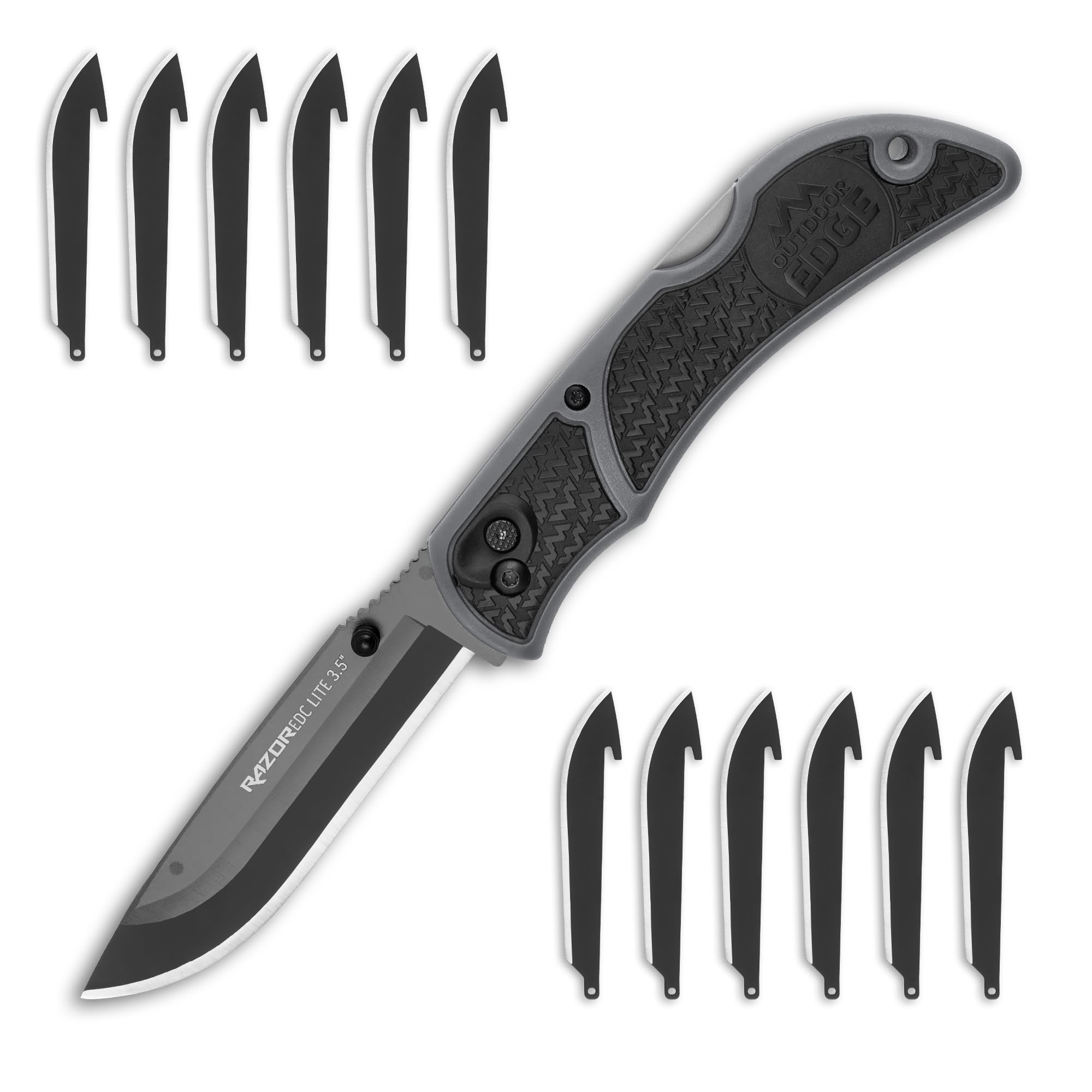
Outdoor Edge RazorLite EDC

96 /100
Angler Score Outstanding

Key details

Carry
Pocket clip
Handle
TPR
Blade Length
3.5 in
Blades Included
12
Check Details on Amazon

The moment that decides whether a replaceable-blade knife earns its place comes halfway through a job, when the edge goes and your hands are cold and wet. On the RazorLite that is a thumb press on the release, a tilt to drop the spent blade, and a push to seat a fresh one. No tools, no hunting for a sharpener in the dark.

That swap, repeated through a season, is why this is our top pick. Twelve 3.5-inch drop-point blades come in the box, enough that we stopped thinking about sharpening and started thinking about which pocket the knife was in. The lockback held the blade solidly under pressure, and the TPR handle kept its grip when things got slick.

Three and a half inches of drop point covers the most ground of any blade here: packages and boxes, breasting a bird, trimming around a joint on a deer without the tip wandering where you do not want it. The clip means it rides in a pocket where the other knives end up in a pack, and at 8 inches overall it still disappears into a jacket.

Set against the rest of this group, it is the knife that covers the most situations. The RazorBone brings more blade shapes but wants a pack; the Gerber is lighter but trades away blade length. Twelve blades and a 3.5-inch drop point is the combination we reach for when we do not know what the day holds.

Pros

  • Twelve blades included, so a season of sharp edges
  • Blades swap in seconds without tools
  • 3.5-inch drop point handles game and everyday tasks
  • Lockback holds the blade securely in use

Cons

  • Blade release takes a firm thumb press
  • Edge chips if you twist or pry
Our verdict

Buy it if you want one knife for deer, camping, and everyday cutting: twelve sharp 3.5-inch blades, a secure lockback, and a clip that keeps it close.
Check Latest Price
2

Best for Big-Game Processing

Outdoor Edge RazorBone

93 /100
Angler Score Outstanding

Key details

Carry
Nylon sheath and blade box
Blade Shapes
5 in boning, 3.5 in drop point, 3.5 in gutting
Blades Included
6
Weight With Sheath
6.4 oz
Check Details on Amazon

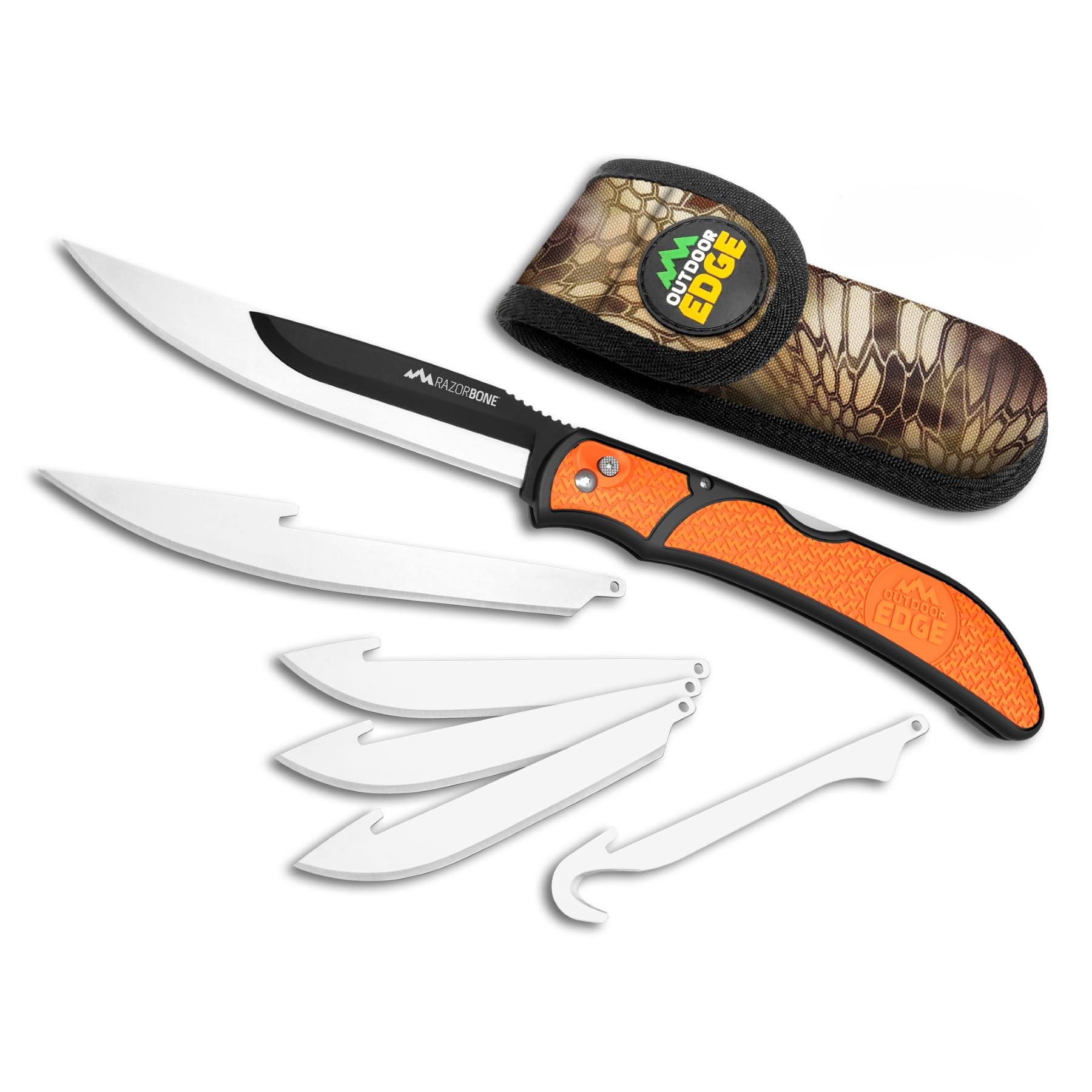
Two 5-inch boning blades, three 3.5-inch drop points, and one gutting blade: the RazorBone is a field-dressing kit that folds shut. The long boning blade is what makes it worth carrying. It flexes enough to follow a joint and reaches deep into a hindquarter, which is exactly where a short drop point runs out of reach.

The 3.5-inch drop point does the skinning, and the compound bevel takes hide and membrane without sawing at them. One oddity in the mix: four of the six blades are short and only two are long, so the gutting blade is the one that runs out first if you open up more than one animal on a trip.

Blaze orange with rubberized insets is the right call for something you set down in grass and blood, and the grip stays planted when it is wet. The nylon sheath carries a detachable blade carrier, so the spares travel with the knife instead of loose in a pocket, and the whole package weighs 6.4 ounces on the belt.

Blades are sold separately by model number, so order a pack of the 5-inch boning blades — that is the shape a deer will consume. Hand wash only, and let it dry before it goes back in the sheath.

Pros

  • Three blade shapes cover skinning, boning, and gutting
  • 5-inch boning blade reaches deep joints
  • Grippy blaze-orange handle stays visible
  • Sheath with detachable blade carrier

Cons

  • Long at 9.4 inches with the boning blade loaded
Our verdict

For hunters breaking down big game at camp, the RazorBone's long boning blade and three shapes replace a roll of fixed knives with one folding handle.

Check Latest Price
3

Best Ultralight

Gerber Vital

91 /100
Angler Score Outstanding

Key details

Weight
1.3 oz
Blade Length
2.8 in
Overall Length
6.9 in
Blades Included
6
Check Details on Amazon

At 1.3 ounces, the Gerber Vital is the knife that disappears into a shirt pocket or a hip-belt pouch and stays there until something needs cutting. It is a fraction of the weight of the RazorBone or the Lancergear kit, and that is the whole reason it is here.

We kept reaching for it for quick work — breasting a duck, opening a package, cleaning a fish on the tailgate — because the lockback snaps open one-handed and the blade swaps without tools, the least fiddly change in this group. Six 2.8-inch drop-point blades come in the box, and the deep finger choil behind the edge keeps your hand from sliding forward when a cut gets stubborn.

Two point eight inches is the catch. On deer and birds it is plenty; for reaching into the chest cavity of an elk, you want more blade, and this one comes up short. The handle is the smallest here, too — fine bare-handed, awkward in heavy gloves.

Gerber's replacement blades are the priciest of the systems here to restock, so plan on a spare pack. What that buys you is a knife you forget you are carrying and a swap you can do in seconds with nothing to lose in the leaves.

Pros

  • Featherweight at 1.3 ounces
  • Tool-free, one-handed blade change
  • Deep finger choil for control
  • Six blades included in the box

Cons

  • Breakage at the blade connection under hard use
Our verdict

The knife for anyone counting ounces: 1.3 ounces in a pocket, a tool-free blade change, and a 2.8-inch blade that suits birds, deer, and daily cutting.

Check Latest Price
4

Most Blades Included

Lancergear Replaceable Blade Knife

90 /100
Angler Score Outstanding

Key details

Handle
Rubber
Weight
4.59 oz
Extra Blades
15
Overall Length
7.2 in
Check Details on Amazon

Fifteen spare blades plus the one already in the handle makes sixteen, which is enough that you can treat the edge as disposable and leave the stone at home. The Lancergear folder is built around that idea: a push-button release lifts the blade clear so your fingers stay away from the edge while you swap it.

In hand it is a compact knife — 7.2 inches open, 4.59 ounces on the scale — with a rubber handle that has enough texture to hold onto when it is wet. The clip point is a slightly different animal from the drop points on the other picks: a deeper belly for slicing, with a finer tip that rewards a light hand around joints.

As value, we think it is the strongest of the four for someone who hunts a few weekends a year or wants a knife for the truck and the pack. It cuts alongside the more expensive knives here, the button release is easier to work in the cold than a thumb stud, and sixteen blades means a dull edge never ends a job.

Care is simple as long as you stay ahead of it: hand wash only, dry the blade channel, and a year's guarantee covers the knife if the button ever stops doing its job. For a first hunting knife or a spare that lives in the glovebox, that is plenty of reassurance.

Pros

  • Fifteen spare blades in the box
  • Push-button release keeps fingers off the edge
  • Light enough to carry in a pack all day
  • Rubber handle grips when wet

Cons

  • Grip runs small for large hands
  • Fit and finish trails the other picks
Our verdict

The blade-supply pick: sixteen blades and a push-button swap that keeps your fingers clear of the edge make it an easy first hunting knife.

Check Latest Price

How We Tested Replaceable Blade Knives

We started by pulling every replaceable-blade knife we could find that had a real blade supply behind it, since a knife whose blades vanish from shelves in a year is a disposable tool with extra steps. From there we filtered by handle size, blade shape, how many blades came in the box, and how the lock engages. Fourteen made the cut.

Testing ran seven months and covered a full whitetail season, a handful of spring turkey and fishing trips, and a lot of unglamorous cardboard and rope in the garage. Each knife was used for the work it was built for: skinning and quartering, breaking down birds, cutting bait and line, opening feed bags. Size and ease of use got checked the mundane way, clipped into a front pocket, a pack strap, and a belt, then worn for a full day to see which ones disappeared and which dug into the hip.

Blade locking got the hardest look. We grabbed each blade near the tip and tried to rock it side to side, then tapped the spine against a block of wood to see whether the lock crept under pressure. For durability, knives went back into damp sheaths after wet work and got checked the next morning for rust, staining, and rolled edges, and we cycled each lock a few dozen times. Blade replacement was timed bare-handed and again in cold, wet gloves with one hand only; the good ones swapped in seconds, the worst needed two hands and a flat surface. Sharpness we judged on the first pass through hide and sinew and on how many animals a blade lasted before it started dragging, and we tracked how many blades each knife burned through in a season, because one that eats blades isn't a value no matter what it costs up front.

How to Choose a Replaceable-Blade Knife

Folding or fixed comes first

A folder with a clip lives in your pocket and goes everywhere. A fixed handle gives you more leverage and a grip you can find with gloves on, but it needs a sheath and usually a pack to live in. That single decision removes half the field before you look at a blade.

Ask where the knife will spend most of its life: pocket, pack, or glovebox. If the answer is more than one of those, a clipped folder with a sheath option covers the most ground.

A fast swap only helps if the blade locks

Every knife here changes blades in seconds, and every one of them is only as good as what happens after the click. Seat a blade, then try to rock it side to side and pull it straight out. Movement means the knife is not ready for a hunt, whatever the listing promised.

Test the release with gloves on, too. The swap that matters happens in the cold, at dusk, with something heavy on the ground in front of you, not at the kitchen table.

Blade shapes matter more than blade count

A 3.5-inch drop point is the all-rounder: it skins, it trims, and it opens the mail. A 5-inch boning blade earns its place when you are following joints or taking fillets, and a gutting blade saves you from punching through the wrong thing.

Count shapes rather than blades. A set with four short blades and one long one is a different tool from a set with three of each, and the shape you use hardest is the one to buy refills of first.

Replacement blades are the running cost

These blades are thin, hardened stainless, and they are meant to be used up — that is the whole trade for never sharpening. What separates the systems is how many you get, how long an edge holds up, and what a refill pack asks for, which over a few seasons can outweigh what the knife itself cost.

Before you commit, price a refill of the shape you wear out fastest and note the model number on the pack. Refills are proprietary, so the number on the blade box is the one that has to match your handle.

Grip, hand size, and keeping it clean

Rubber and TPR handles hold up to blood and water better than smooth composites, but fit matters more than material: a handle that is too small for your hand costs you control at exactly the wrong moment. Get your hand around the knife before you trust it with a carcass.

Wash by hand and dry the blade channel. If a blade binds on the way in, dried fat is usually the culprit, and a rinse will fix what a firmer push will not.

Frequently Asked Questions

Final Verdict

If you want one knife that handles a deer, a weekend of camping, and the boxes that pile up at home, the Outdoor Edge RazorLite is the one we point you to. Twelve 3.5-inch blades, a lockback that holds under pressure, and a clip that keeps it where you can find it add up to the most useful knife in this group.

Two changes move you off it. If you break down big game and want a long boning blade in the same handle, the RazorBone is the better tool. If every ounce counts on a backcountry hunt, take the Gerber Vital and accept the shorter blade.