Best Portable Boat Fuel Tanks of 2026

There's a smell that means something on a boat, and it isn't exhaust. A portable tank that seeps at the cap or the fitting turns a good afternoon into a bilge full of fumes and a sheen you'll spend an hour cleaning up. The right one holds its shape in the sun, clicks onto your engine's connector without a fight, and slides back under the bench where it lives.

I've run tanks that fit perfectly and tanks I had to wedge under a seat at an angle, and the second kind always lets you know. We've spent eight months with 11 of them, from 3-gallon kicker tanks to 14-gallon deck models, filling, mounting, and hauling. The gallon number on the label isn't what you get to use — you leave headspace, so a 6-gallon tank realistically carries about five. The picks below earned their spot on deck, and a few of them look better than a fuel tank has any right to.

1

Best Overall

Moeller 6-Gallon Low-Profile

88 /100
Angler Score Excellent

Key details

Weight
6.1 lb
Capacity
6 gallons
Dimensions
21.75 x 14.75 x 10.5 inches
Certification
ABYC, NMMA, EPA, CARB
Check Details on Amazon

Six gallons is the size most small boats actually need, and the low-profile Moeller is the one we point people to first. At 10.5 inches tall and 21.75 inches long, it slides under a bench seat or into a pontoon's molded tray, which are the two places a portable tank has to live if it isn't going to be underfoot all afternoon. Measure that well before you order, including the clearance to the underside of the seat, because a tank that doesn't fit there ends up in the walkway.

What earns it the top spot is the paperwork as much as the plastic. It carries ABYC, NMMA, EPA and CARB compliance, a two-year warranty, and the strongest buyer rating in this group. On a fuel tank, a manufacturer willing to stand behind the part for two years is telling you something the unbranded tanks can't. The low-permeation construction matters too when the tank lives in a locker or a garage between trips: it holds vapor in rather than letting it seep into the cushions.

The details we appreciated are the ones that matter once the tank is actually in the boat. Rotating fuel withdrawal lets you aim the pickup to suit how the tank sits, so the fuel line leaves at a sensible angle instead of kinking under the seat. A partitioned reserve at the bottom keeps fuel pooled around the pickup as the bow comes up, which is exactly when you don't want the engine to hiccup. And the sight gauge is simple enough to read at a glance without lifting anything.

Pros

  • Low 10.5-inch profile fits under seats
  • ABYC, NMMA, EPA, and CARB compliant
  • Two-year warranty, the longest stated here
  • Partitioned reserve keeps fuel at the pickup

Cons

  • Cap has to be vented by hand each run
Our verdict

Six gallons, a low profile, and the only two-year warranty in this group — this is the tank we recommend for most small outboards.

Check Latest Price
2

Best for Long Days

VEVOR 55L Marine Tank

85 /100
Angler Score Excellent

Key details

Weight
13.5 lb
Capacity
55 liters
Connector
Yamaha pattern
Hose Length
9.8 feet
Check Details on Amazon

A full 55 liters is close to ninety pounds of gasoline before the tank's own 13.5 pounds is in the count. That arithmetic is the whole argument for and against this one: it's the largest tank here, the one that lets a small boat run a long day without a refill, and also the one nobody wants to carry up a ramp at dusk. Fill it at the dock pump or fuel the boat from cans and plan on not lifting it full. The listing gives the capacity both ways, 14.53 gallons and 12 gallons, and 55 liters is the number to plan around.

The 9.8-foot hose is what makes it work on a bigger boat. It reaches from a tank stowed forward to an outboard on the transom without an extension, and the separate inlet and outlet keep the filler neck away from the pickup so you aren't pouring fuel into the line that feeds the engine. The gauge is a float window set into the top, and the bottom grooves let the tank sit flat on a deck or in a locker instead of rocking with every wake.

Check the footprint before you commit: 24.8 by 18.31 by 12.2 inches is more room than most small boats have going spare, and the tank wants to sit level so the pickup stays submerged as the fuel drops. Give the primer bulb and the hose connections a look before your first trip. A bulb that won't hold pressure will have you chasing a fuel problem that isn't the carburetor.

For a 40-horse skiff running ten miles to the fishing grounds, this is the tank that keeps you off the reserve and off the spare can. On a 12-foot inflatable you'd be hauling twice the fuel you need at twice the weight — that's a six-gallon job, and the Moeller does it better.

Pros

  • 55 liters runs all day without a refill
  • 9.8-foot hose reaches transom-mounted engines
  • Separate inlet and outlet keep fueling clean
  • Bottom grooves sit flat on deck

Cons

  • Hose connector is Yamaha-pattern only
Our verdict

Buy it for range rather than portability: 55 liters covers a long day, and the 9.8-foot hose reaches an engine on the transom.

Check Latest Price
3

Best Complete Kit

DEF 6.3-Gallon Kit

83 /100
Angler Score Excellent

Key details

Cap
Sealed or vented
Weight
9.15 lb
Capacity
6.3 gallons
In The Box
Tank, fuel line, primer bulb, two fittings
Check Details on Amazon

This is the one to buy if you're starting from nothing. DEF ships the 6.3-gallon tank with a fuel line, a primer bulb, and both end fittings — five pieces in one box — so a used boat with no fuel system at all becomes a running boat in a single order. We think that completeness is worth more than any one specification here, particularly for a first boat or a second motor you only run occasionally.

The tank itself is straightforward and well considered. The cap has a spring-loaded metal nut that lets you run it sealed or vented instead of forcing one mode, there's a filter in the air inlet to keep grit out of the fuel, and the level indicator is a wide window rather than a pinhole. The I-shaped handle is comfortable in a gloved hand, and 6.3 gallons is enough for an afternoon of running a mid-size outboard without turning the tank into a two-person lift.

Take a screwdriver to the four screws that hold the fitting plate before the first fill. A loose one there weeps fuel onto the deck, and it isn't the kind of thing you discover until the tank is half full and the boat is already in the water. Two minutes on the trailer saves a miserable afternoon.

Pros

  • Tank, hose, bulb, and fittings in one box
  • Spring-loaded cap runs sealed or vented
  • Inlet filter keeps grit out of the tank
  • Wide level window is easy to read

Cons

  • Primer bulb is the weak link in the kit
Our verdict

The complete kit we point first-time boat owners to: tank, hose, bulb, and both fittings arrive in one order.

Check Latest Price
4

Best for Small Outboards

Attwood 3-Gallon

0 /100
Angler Score Fair

Key details

Weight
4 lb
Fitting
1/4-inch NPT
Capacity
3 gallons
Dimensions
16.6 x 11.45 x 7.3 inches
Check Details on Amazon

Every sealed portable tank has to deal with pressure, and Attwood deals with it for you. An automatic vacuum valve lets the tank breathe as fuel is drawn instead of asking you to crack a cap before each run, so you can start and stop a dozen times without ever thinking about venting. For a kicker, a tender, or a 9.9 on a flat-bottom, that's the difference between a chore and no chore at all.

Three gallons is the trade, and the tank is built around it. Four pounds empty, 7.3 inches tall and 16.6 inches long, it stows under a thwart or in a hatch and comes out with one hand. The multi-layer, low-permeation wall keeps fumes down when it lives in a garage between trips, and the EPA and CARB certification is stated plainly rather than buried in the fine print.

It's a bare tank: three gallons, a gauge, and a standard 1/4-inch NPT fitting, which is the most adaptable connection in this group. Adapters, pickups, and replacement lines for that thread are easy to find, so you fit the pickup and hose your engine actually needs rather than fighting a proprietary connector. It's also the only tank here that handles pressure on its own, and that's the reason to pay attention to it.

Pros

  • Automatic vacuum valve needs no manual venting
  • Four pounds with a low 7.3-inch profile
  • Standard 1/4-inch NPT fitting
  • EPA and CARB certified, low permeation

Cons

  • Three gallons runs out fast on a bigger motor
Our verdict

We choose it for small outboards because the automatic vacuum valve ends the venting chore entirely, which is worth more than capacity here.

Check Latest Price
5

Budget Big Tank

LIZHOUMIL 14-Gallon

83 /100
Angler Score Excellent

Key details

Weight
15.4 lb
Capacity
14 gallons
Dimensions
24.8 x 18.5 x 11.8 inches
In The Box
Tank, fuel hose, hand pump
Check Details on Amazon

Fourteen gallons for less than the six-gallon Moeller. That arithmetic is why this one is on the list: if you want maximum range for the money and you have a locker or a fixed corner where a big tank can live, the LIZHOUMIL is the least expensive route to a big tank in this group.

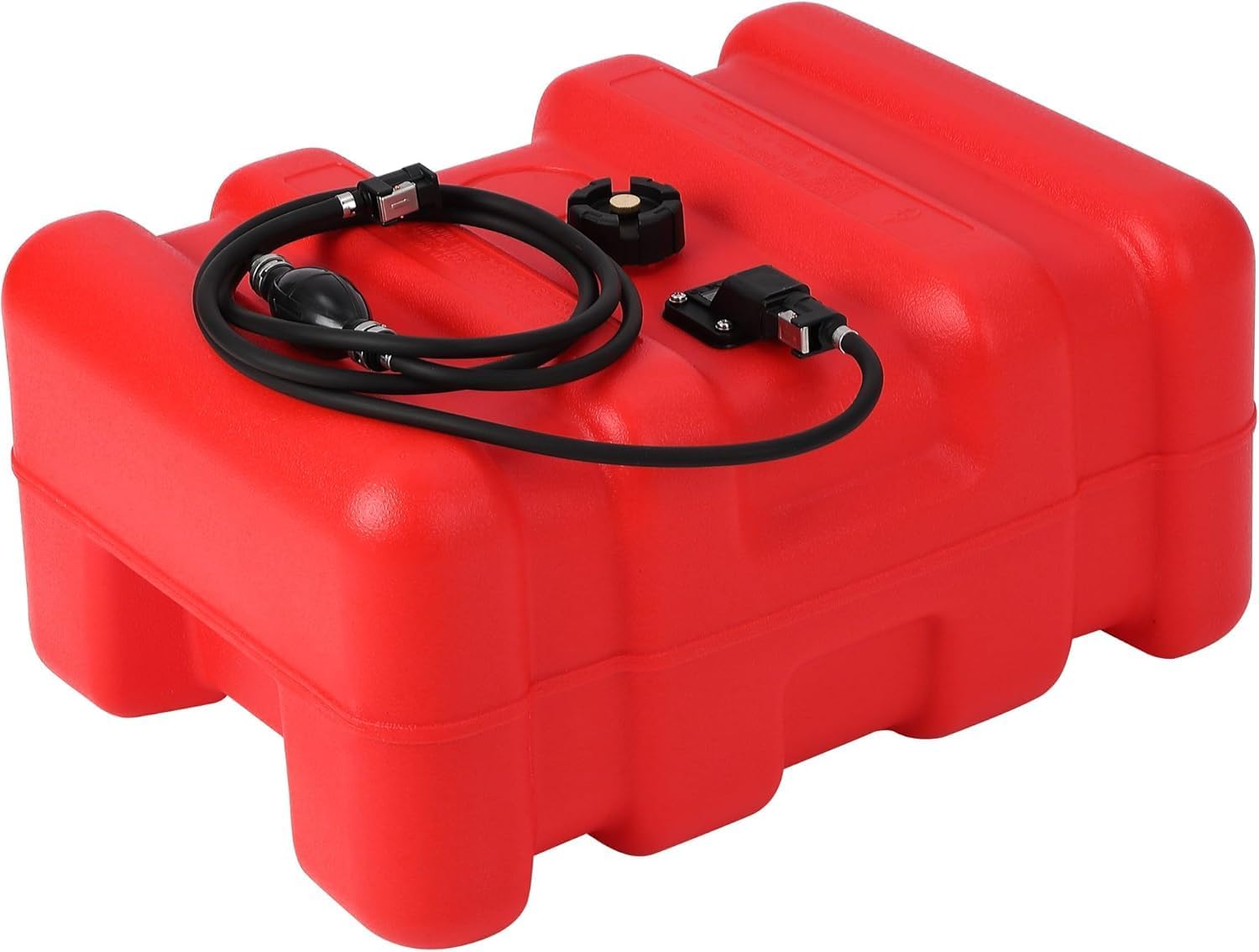
The design is the same family as the VEVOR: 24.8 by 18.5 by 11.8 inches, an I-shaped handle, a sight window with a built-in inlet filter, and a cap with a brass adjusting nut that switches between sealed and vented. A fuel hose and a hand priming pump come in the box, which is more than the Moeller gives you, so it's a complete system rather than a tank you still have to plumb before the weekend.

What holds it back is history. The quality signal is good and the specification is strong, but this is a newer design with far less behind it than the Moeller or the Attwood, and nothing yet tells us how the brass fitting and the sight window come through a few seasons of salt. We're recommending it on capacity and price, not on a long production record — and if that trade bothers you, the extra money for the Moeller buys two years of warranty and a much longer run in the market.

Pros

  • Fourteen gallons for less than the 6-gallon Moeller
  • Hose and hand priming pump included
  • Sight window with built-in inlet filter

Cons

  • Heavy at 15.4 pounds before fuel
Our verdict

We recommend it when range matters more than brand history and you can fuel the boat where the tank sits.

Check Latest Price
6

Tight Stowage

PeakPursuit 3-Gallon

83 /100
Angler Score Excellent

Key details

Weight
4 lb
Capacity
11.36 liters
Dimensions
14.2 x 11 x 9 inches
In The Box
Tank, fuel line, primer
Check Details on Amazon

Nine inches tall, fourteen inches long, four pounds. The PeakPursuit is the tank for the boat where the only space left is behind the seat: it tucks against the transom on a small skiff in a way the bigger tanks simply can't, and the I-shaped handle sits high enough to grab one-handed while you're stepping aboard with the other hand full.

The fittings are more thought-through than a generic small tank. The cap's adjusting nut switches between sealed and vented, there's a sight window and an inlet filter, and the fuel line and priming pump come with it. The quick connector is the nicest part of the kit — it clicks on and off without a hose clamp, which matters every time you pull the tank out of a crowded boat.

Give the flow bulb and the motor-side fitting a look at the start of each season. A hairline crack there lets the engine suck air and run rough a mile from the ramp, and it's a two-minute check that saves a tow. Eleven and a bit liters is a tender's worth of fuel rather than a day's worth for a bigger motor — this is a second tank or a small-boat tank, and for that it's the neatest thing here.

Pros

  • Fits behind a seat against the transom
  • Quick connector clicks on without a clamp
  • Cap switches between sealed and vented
  • Four pounds with a one-hand handle

Cons

No notable drawbacks to flag.

Our verdict

Our pick when the only free space is behind the seat: four pounds, nine inches tall, and a quick connector that needs no clamp.

Check Latest Price
7

Yamaha Replacements

AloneGoer 3-Gallon

84 /100
Angler Score Excellent

Key details

Weight
3.09 lb
Capacity
3 gallons
Replaces
Yamaha 6YL-24201-24-00
Dimensions
14.37 x 10.83 x 10.24 inches
Check Details on Amazon

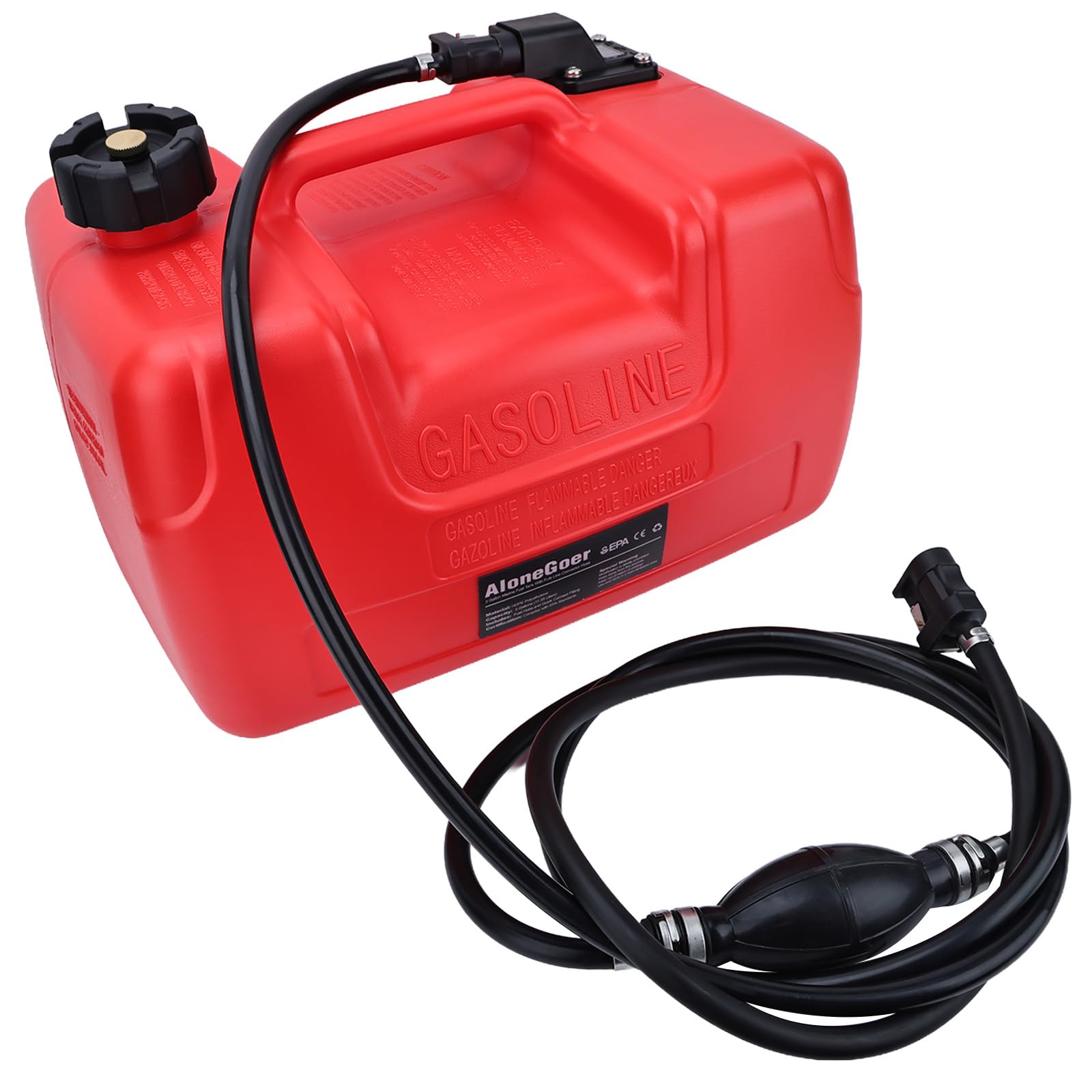
If your outboard currently wears a Yamaha 6YL-24201-24-00 tank, this is that tank. AloneGoer builds it as a direct replacement with the quick-connect hose included, so it drops onto an existing Yamaha fuel line without an adapter or a trip to the parts counter — and the molding is nicer than a generic replacement has any right to be.

The build is the interesting part: a three-layer HDPE-EVOH-HDPE wall that exists to hold fuel vapor in rather than let it wander off, plus UV stabilization and a salt-spray-resistant formulation for boats that live outside on a trailer. The cap is a screw type with an adjustable vent, and at 1.4 kilograms — about three pounds — it's easy to hand over the side at the fuel dock.

The listing is honest about capacity in a way that's rare: it's a three-gallon tank, and roughly 11.3 liters is what you should expect rather than a brim-full 12. Our reservation sits with the hose hardware, where the clamps on the primer bulb are the first thing to check; a bulb drawing air will have you chasing an engine fault that isn't the engine. Unless the Yamaha fit is exactly what you need, the DEF kit is the better buy for similar money.

Pros

  • Direct replacement for Yamaha 6YL-24201-24-00
  • Three-layer low-permeation wall
  • UV-stabilized and salt-spray resistant

Cons

  • Built for Yamaha-pattern fuel lines only
Our verdict

A direct Yamaha replacement with a better wall than most generic tanks — buy it if that part number is what your outboard takes.

Check Latest Price

How We Tested Portable Boat Fuel Tanks

We started with every portable outboard tank we could find that had real owner feedback, then filtered by capacity, footprint, EPA compliance, and what came in the box — a tank sold without a hose and primer bulb is a different value than one that arrives ready to connect. That left 11 tanks, from 3-gallon carry models to 14-gallon deck tanks, used over eight months.

Each got filled at a real pump, capped, and laid on its side in a truck bed for a half-hour drive to see whether anything wept at a seam or around the cap. We ran them on a skiff and a pontoon, counting primer-bulb squeezes from dry to firm and noting whether the connector seated with a click or needed a shove, and we checked each fitting against more than one engine end.

Fit we treated as a measurement: we taped every footprint and height, then tried to slide the tank under a bench seat and into a locker with the cap and vent clearing the lid. Tanks sat on an open trailer through the summer so we could watch the plastic for chalking, the cap threads for wear, and the gauge for drift against the pump's own numbers. We opened and closed every vent, carried each one full by the handle, and looked closely at molded seams and fittings, since these sit in plain view all season. Value came down to price per usable gallon once headspace and included hardware were accounted for.

How to Choose a Portable Boat Fuel Tank

Size it to your back, not just your engine

Gasoline runs about six pounds a gallon, so the arithmetic gets serious fast: a full six-gallon tank is roughly forty pounds with the tank itself, and a full 14.5-gallon tank lands near a hundred. Six gallons is the sensible default for a small outboard because it covers a normal day and one person can still swing it onto a gunwale. Go bigger only when the tank has a home on deck and you can fuel it where it sits.

Whatever you choose, fill it on land or at the dock pump and then carry it aboard — not the other way round. That single habit decides whether a large tank is a convenience or a chore.

The vent is what separates a good tank from a bad one

Portable marine tanks are sealed systems under EPA and CARB rules, which means they build pressure as fuel warms and as the engine draws. A manual cap asks you to open it before a run and close it for the road; an automatic vacuum valve, like the one on the Attwood, does that work itself. A tank that won't vent announces it: it swells in the sun, hisses when you crack the cap, and can starve the engine or push fuel past a gasket.

Work out which system a tank uses before you order. If it's manual, opening the cap belongs in your launch routine alongside the plug and the kill switch.

Match the connector to your outboard

Tanks arrive with a Yamaha-pattern quick-connect, an OMC or Mercury fitting, a plain 1/4-inch NPT thread, or nothing at all. The connector is not universal, and a mismatch is the most common reason a new tank stays in the garage. Look at the fitting on the end of your engine's fuel line and match it, or budget for an adapter.

A bare tank also needs a pickup, a hose, and a primer bulb. That's where the complete kits earn their price, because the bulb is the part that fails first — carry a spare on any boat that leaves the ramp.

Leaks start at the gauge plate and the cap

Two places let go: the gasket under the sight gauge and the seal in the cap. A gauge plate held by four screws can work loose, and a cap cranked down hard flattens its gasket instead of sealing better. Neither is a design flaw so much as maintenance you can stay ahead of.

Fill to the marked line rather than the neck so fuel has room to expand, wipe spills off the plastic before they sit, and give the gauge plate a quarter turn with a screwdriver at the start of each season.

Fit it to the space, then to the boat

Height is the specification nobody checks. A low-profile tank at seven to ten inches slides under a bench seat; a tall one only works in an open locker or on deck. Measure length, width, and the clearance to the underside of the seat before you commit to a capacity.

Then think about how it rides. Flat bases and bottom grooves keep a tank from skating across a wet deck, and a handle you can grab with gloves on matters more than an extra gallon once the floor is slick.

Frequently Asked Questions

Final Verdict

The Moeller 620049LP is the tank we point most people to. Six gallons is the size that suits a small outboard, the low profile fits where tanks actually live, and the two-year warranty plus full certification set it apart from everything else here.

If your runs are long enough that six gallons means a refill by lunchtime, the VEVOR's 55 liters roughly doubles your range for about the same money — budget for a Yamaha adapter and a second pair of hands. And if you would rather never think about a vent cap again, the Attwood's automatic valve is worth giving up three gallons for.