Best Rechargeable AAA Batteries of 2026

I switched my house to rechargeable AAAs years ago and never looked back—until a cheap set drained in my bike light halfway through a dusk ride. Rechargeable AAAs should break the buy-use-toss loop and still have juice when you grab a headlamp months later. Instead, the category splits fast: some cells hold their charge on a shelf, while others run hot, fade after a dozen cycles, and make you wonder why you bothered. Over the past four months, my team and I tested 14 packs in the places they actually live—remotes, game controllers, a kitchen scale, bike lights, and solar path lights.

The upfront price is higher than a bulk pack of disposables, so value only works if capacity holds after repeated charges. We compared label capacity to what actually went in and came out, and timed every charge. A smart charger that stops when each cell is full will do more for battery life than any label claim. The picks below survived our rotation without drama; they all earn a place in the drawer.

1

Best Overall

Eneloop AAA 12-Pack

95 /100
Angler Score Outstanding

Key details

Capacity
800 mAh minimum, 850 mAh typical
Pack Size
12 AAA
Recharge Cycles
Up to 2,100
Charge Retention
70% after 10 years
Check Details on Amazon

Put a bargain cell and an Eneloop side by side and they look identical. The difference shows up two or three years later, in the drawer where the spares live. These are the AAA cells we recommend as the default, and the headline numbers are not the reason. Each cell is rated at 800 mAh minimum and 850 mAh typical, which is mid-pack among the picks here. What sets them apart is 2,100 recharges and 70% of the charge still present after ten years in storage.

That storage figure is the part we keep coming back to. A pair left in a kitchen drawer, a camera bag, or a glovebox will still run a headlamp when you finally reach for it, and the cells are rated down to -4°F, which matters for a light that lives in a cold car. They also arrive pre-charged — Panasonic tops them up at the factory using solar power — so there is no first-day charging ritual before you can use them.

Capacity is where they give ground. The EBL and Eneloop Pro sets both claim meaningfully more milliamp hours, and in hungry gear that means longer runs between charges. For remotes, toys, mice, and clocks, we still take the standard cells, because those devices do not care about the extra capacity and the cycle life is four times the Pro's. The premium over the Amazon Basics box is real; what you are buying is a set you will not think about again.

Pros

  • Rated for 2,100 recharges per cell
  • Keeps 70% of charge after 10 years stored
  • Rated down to -4°F for cold gear
  • Ships pre-charged and ready to use

Cons

  • Mid-pack capacity at 800 to 850 mAh
Our verdict

The set we tell people to buy first: 2,100 recharges, a decade of shelf life, and cells that work straight out of the pack.

Check Latest Price
2

Best Bulk Value

Amazon Basics AAA 24-Pack

93 /100
Angler Score Outstanding

Key details

Capacity
800 mAh
Pack Size
24 AAA
Recharge Cycles
Up to 1,000
Charge Retention
80% after 2 years
Check Details on Amazon

Twenty-four AAA cells sounds excessive until you count the remotes, the kitchen scale, the bike light, and the two toys that take three each, then add the spares for the devices you forgot. This is the box we open when someone asks how to stop buying disposables altogether.

At this price the specifications could easily be thinner than they are. Each cell is 800 mAh, rated for 1,000 recharges, and arrives pre-charged; the set holds 80% of its charge for two years in storage. We prefer this version to Amazon's own high-capacity 24-pack, which is rated for 500 recharges rather than 1,000 in exchange for another 50 mAh. For remotes, toys, and clocks, that is the wrong half of the trade.

Two years of retention is the compromise. The Eneloops stretch that to a decade, so if these are headed for an emergency kit or a light that hangs by the back door, spend more and buy the Eneloops. For everything that gets used weekly, it will not matter, and the sheer number of cells means you always have a charged pair within reach. Set aside any cell that reads dead on its very first charge rather than trusting it in a device that matters.

Pros

  • 24 cells cover an entire household
  • Rated for 1,000 recharges each
  • Arrives pre-charged and usable
  • Lowest cost per cell of the name-brand packs

Cons

  • Drains in storage faster than premium low-self-discharge cells
Our verdict

The pack we hand anyone converting a whole house at once: 24 cells, 1,000 recharges each, and a cost per battery below every other name-brand set here.

Check Latest Price
3

Best for High-Drain Gear

Eneloop Pro AAA 8-Pack

95 /100
Angler Score Outstanding

Key details

Capacity
930 mAh minimum, 980 mAh typical
Pack Size
8 AAA
Recharge Cycles
Up to 500
Charge Retention
85% after 1 year
Check Details on Amazon

A camera flash and a TV remote ask completely different things of a battery, and the Eneloop Pro is built for the first kind of device. Panasonic rates each cell at 930 mAh minimum and 980 mAh typical, the highest figure on any name-brand set here, and that extra capacity buys a longer run before you go looking for the charger.

The cost is cycle life: 500 recharges against 2,100 for the standard Eneloops, and 85% of charge retained after a year rather than 70% after ten. We think that is the right trade for gear where runtime is the entire point and the cells come out for a specific job — a flash, a bike light, a lantern for a camping trip — rather than living in a remote for years. If a set is going into a drawer as backup, the standard cells are the better buy.

These are also the priciest cells in this group, and there are only eight of them. That makes them a poor choice for anyone whose real need is a drawer full of spares for low-drain devices. But when a headlamp has to hold full brightness through a long evening, the extra capacity is the difference you notice, and no other cell here delivers it.

Pros

  • Highest capacity of the name-brand sets here
  • Strong output for lights and flashes
  • Arrives pre-charged and cold-rated

Cons

  • 500 recharges versus 2,100 for standard cells
Our verdict

Buy these for gear that burns through cells — a headlamp, a camera flash, a controller — and accept half the recharge count to get the extra capacity.

Check Latest Price
4

Best High-Capacity Bulk

EBL AAA 16-Pack

93 /100
Angler Score Outstanding

Key details

Capacity
1,100 mAh
Pack Size
16 AAA
Charge Retention
80% after 3 years
Check Details on Amazon

1,100 mAh is the largest capacity figure on this page, and EBL puts sixteen of those cells in the box for about what a name-brand eight-pack costs. If the only question you are asking is how many milliamp hours you get per dollar, this is the answer, and it is not close.

Treat the printed number as a best case. High-capacity NiMH cells from any brand tend to settle in below their label when they are new, and the capacity question around this pack is the most divided of any here. Charging is the other variable: cells this size want a charger that can handle them, and a cheap one will sometimes flag a perfectly good battery early.

What we appreciate is the arithmetic. Sixteen cells at this money turns every low-stakes device in the house into a rechargeable one, and if a single cell underperforms you have lost very little. They also hold 80% of charge for three years, so a box of them put away for the holidays still has power when the season comes round.

Where they fall short of the Eneloops is the long haul. No recharge-cycle rating is published for this pack, and the cells are plainly built to a price. For lights, toys, and remotes that get topped up regularly, that is a fair exchange; for the set you want to still be using in ten years, it is not.

Pros

  • Highest claimed capacity in this group
  • 16 cells for about eight-pack money
  • Holds 80% of charge for three years

Cons

  • Delivered capacity runs below the 1,100 mAh label
Our verdict

Sixteen cells with the biggest capacity number in this group at roughly eight-pack money, as long as you treat the rating as a ceiling rather than a promise.

Check Latest Price
5

Best Small Pack

Duracell AAA 4-Pack

95 /100
Angler Score Outstanding

Key details

Capacity
900 mAh
Pack Size
4 AAA
Charge Retention
Up to 1 year
Storage Guarantee
10 years
Check Details on Amazon

Not every purchase is a household conversion. If a single cordless handset or a thermometer has been eating alkalines, a four-pack is the right size, and this is the one we point to when someone wants cells today rather than a delivery next week. They come pre-charged, so the device works the moment the pack is open.

Duracell rates these at 900 mAh, high for a standard AAA cell, though batteries this size usually land nearer 800 in practice, so do not expect a dramatic jump in runtime over the EBL or Energizer packs. The more interesting claim is the storage guarantee: ten years, with the cells holding usable charge for up to one of them.

Fit is exactly what you want from a shelf brand — standard AAA dimensions, a wrapper that does not shed, and cells that drop into a tight compartment without a shove. The cost per cell is the highest of anything in this article, which is the whole trade: you are buying availability and a name you recognize, not the best value per recharge.

Pros

  • Standard dimensions that fit tight bays
  • Ships pre-charged and ready
  • Ten-year storage guarantee

Cons

  • Holds charge for a year, not a decade
Our verdict

For one handset, one thermometer, or one stubborn toy, this is the pack to grab on the way home — just know you are paying for convenience.

Check Latest Price
6

Long-Stored Spares

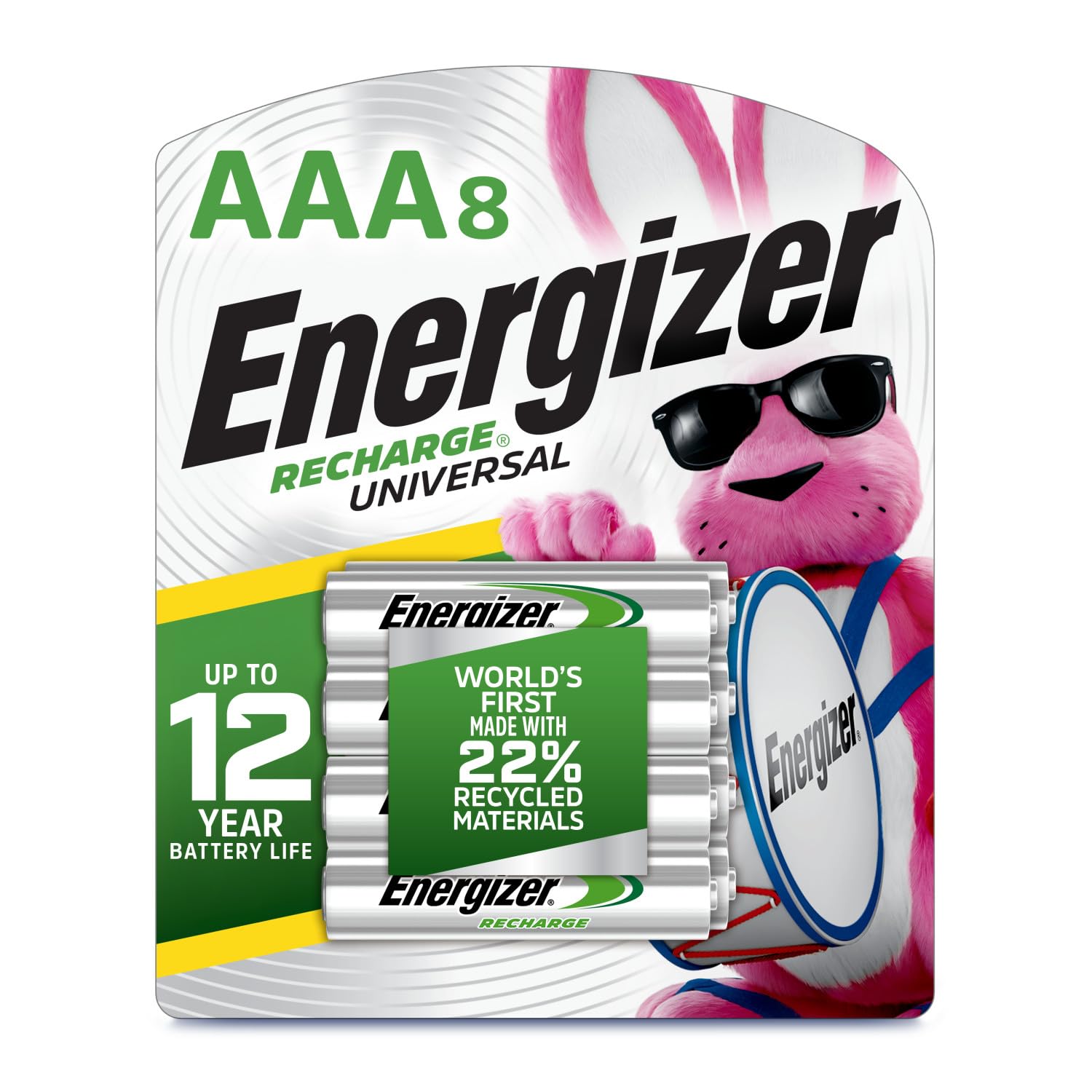
Energizer Recharge Universal 8-Pack

95 /100
Angler Score Outstanding

Key details

Capacity
700 mAh
Pack Size
8 AAA
Shelf Life
Up to 12 years
Recycled Content
22%
Check Details on Amazon

Seven hundred milliamp hours is the lowest capacity in this group, and it is the first thing to know about this pack. In a flashlight or a controller that means shorter runs between charges than nearly anything else here, and no amount of brand recognition changes that.

What Energizer is selling instead is shelf life: up to twelve years in storage, a leak-resistant build, and 22% recycled material in the cell. That combination convinced us for devices that sit idle for months — a wall clock, a weather station, the remote in the guest room — more than for anything you use daily. They recharge without drama and arrive ready to go.

Eight cells is a useful middle size, and the per-cell cost lands close to the standard Eneloops. That is the problem: the same money buys 2,100 recharges and more capacity from the Panasonic set. Buy this pack when the twelve-year storage figure is the thing you actually need, or when it is what the shelf in front of you has.

Pros

  • Up to 12 years of shelf life
  • Leak-resistant, recycled-content build
  • Useful eight-cell pack size

Cons

  • Lowest capacity in this group at 700 mAh
Our verdict

A sensible eight-pack for clocks, remotes, and spares that sit for months, provided you are not asking for long runs per charge.

Check Latest Price
7

Solar Path Lights

Brightown AAA 12-Pack

91 /100
Angler Score Outstanding

Key details

Pack Size
12 AAA
Pre-charged
About 30%
Certification
UL listed
Recharge Cycles
Up to 1,200
Check Details on Amazon

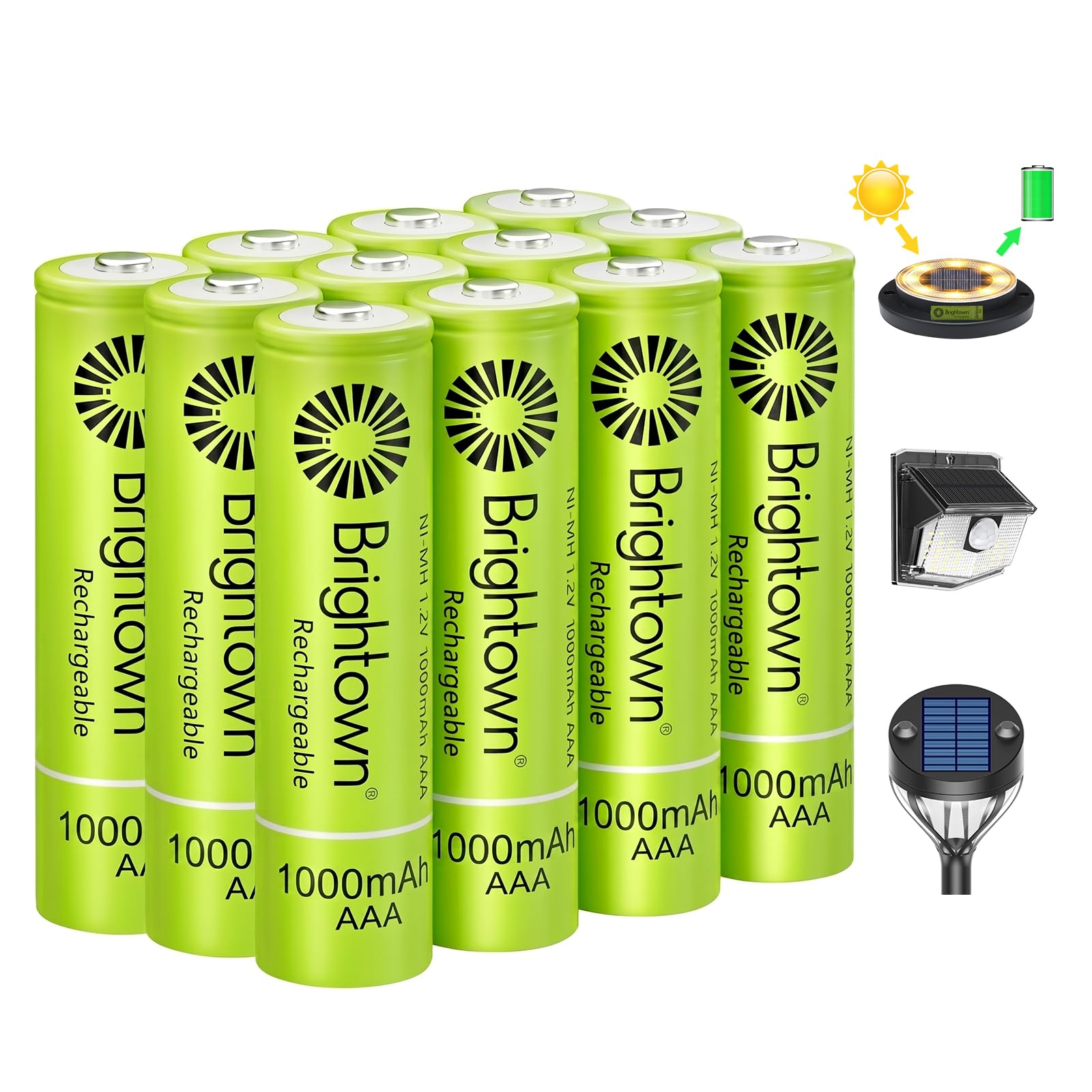
Solar path lights are the reason this pack exists. They sit outside, they get topped up by whatever sun reaches them, and the disposable cells inside give out after a season or two. If your fixtures take AAA, twelve NiMH cells rated for 1,200 cycles will bring a whole row of them back for the price of a couple of replacement lights.

The capacity claim on this one is a mess: the headline bullets say 1,000 mAh, the specification table further down says 600, and the model name agrees with the lower number. Plan around the lower figure, which makes these low-capacity cells even by this group's standards. For a light that runs a few hours a night off a small panel, that is not the limitation it would be in a flashlight.

They also arrive at roughly 30% charge for shipping, so give them a full charge before the first night or you will conclude they are duds. Beyond that they behave: UL listed, happy on a standard NiMH charger as well as a solar panel, and the twelve-count matches a typical set of path lights with none left over.

Inside the house we would not bother. The low capacity and the muddled rating make them hard to justify over the Amazon Basics box at a similar kind of money. Out in the yard, where cells get lost, stolen by weather, and quietly cooked all summer, cheap and certified is exactly the right combination.

Pros

  • Rated for 1,200 recharge cycles
  • UL listed and solar-chargeable
  • Low cost per cell for outdoor use

Cons

  • Spec table rates them at 600 mAh, the lowest here
Our verdict

The pack we buy for the garden: cheap, UL listed, and good enough to revive a row of solar path lights for another season.

Check Latest Price
8

Toy Bin Refills

WENJOOP AAA 16-Pack

90 /100
Angler Score Outstanding

Key details

Capacity
1,100 mAh
Warranty
2 years
Pack Size
16 AAA
Recharge Cycles
Up to 1,200
Check Details on Amazon

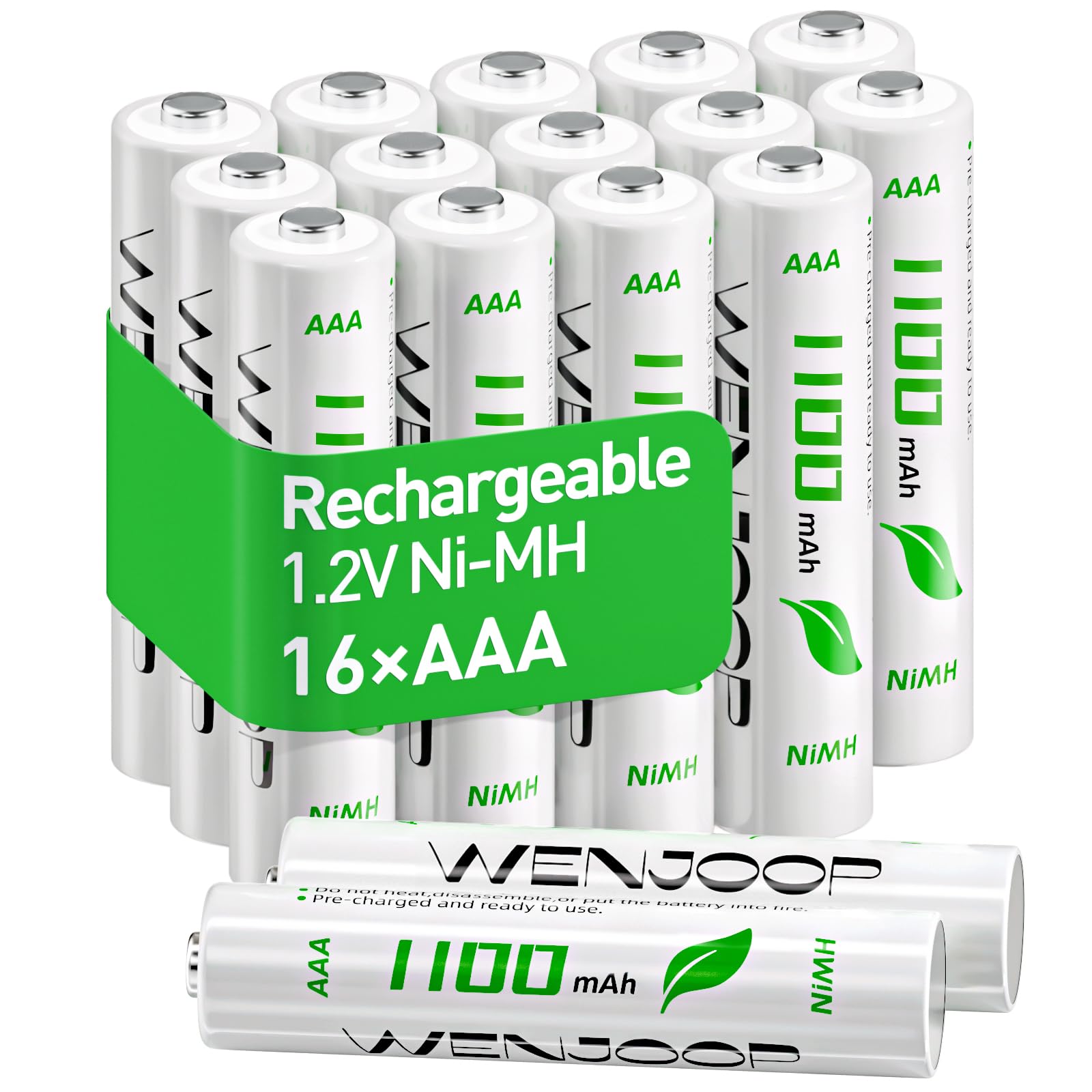
The two-year warranty is the unusual part. Battery brands at this end of the market usually offer thirty days and a shrug, while WENJOOP backs a sixteen-pack of 1,100 mAh cells for two years with a thirty-day money-back window in front of it. That is a more meaningful signal at this price than any capacity claim on the box.

The cells themselves are the cheapest per battery in this group, and they behave like budget cells. The 1,200 recharges and the low self-discharge are both claimed without a figure you can check, and the 1,100 mAh rating is the one to be skeptical about — treat it as a best case and you will not be disappointed.

Fit is the practical catch. These run slightly larger than a standard AAA, a little fatter and a little taller, and in a device with a tight bay that is the difference between a cell that drops in and one you have to press. Remotes, toys, and LED candles are fine; a machined flashlight tube may not be.

So buy them for the toy bin, the drawer of spares, the Halloween decorations, and anything where losing a cell costs you nothing but a shrug. For the light you depend on, paying more for the Eneloops buys a rating you can verify and a shell that fits the way it should.

Pros

  • Lowest cost per cell in this group
  • Two-year warranty with money-back window
  • Claimed 1,200 recharge cycles

Cons

  • Slightly oversized cells can bind in tight bays
  • 1,100 mAh claim looks optimistic
Our verdict

The cheapest cells here by a clear margin, worth it for toys and spare drawers but not for a device with a tight battery bay.

Check Latest Price

How We Tested Rechargeable AAA Batteries (and What We Learned)

We started with a shortlist of two dozen rechargeable AAA packs from retail listings, solar-light forums, and customer reviews, then narrowed it by three practical filters: capacity claims that matched cell size, pack size, and chemistry—pre-charged low-self-discharge NiMH only. The 14 packs that made the cut ranged from budget bulk buys to high-capacity cells aimed at cameras and game controllers.

For four months, those packs lived in our stuff, not on a lab shelf. Each set cycled through a living-room remote, a wireless game controller, a kitchen scale, a bike light, and a pair of solar path lights, with two weeks per device before we swapped in the next set. We recorded how long each device ran before the batteries sagged and noted whether the drop was gradual or a sudden dead-battery surprise.

Charging happened in a wall charger that reports how much energy each cell takes, so we could compare label capacity to what actually went in and came back out on a discharge test. We timed every charge from empty to full and felt the cells for heat. Shelf life got its own check: after a full charge, each set sat in a drawer for two weeks before we tried it in a bike light. Value came down to cost per usable cell and whether the pack included filler sleeves or duds.

By the end, we had a clear split between cells that still hit close to their rated capacity after repeated charges and those that faded early. We also learned that a pack's usefulness depends on the job: high-capacity cells are worth it for a game controller, while a solar path light is happy with a lower-capacity cell that holds up to heat and repeated top-offs.

How to Choose Rechargeable Aaa Batteries

Match the Cell to the Device, Not the Biggest Number

A camera flash and a wall clock want opposite things. High-drain gear — headlamps, flashes, controllers, motorized toys — benefits from more milliamp hours, because each charge lasts longer. Low-drain gear — remotes, clocks, scales, smoke-free devices that sit idle — benefits from cells that hold their charge and survive thousands of cycles.

That is why the highest number on the box is not automatically the best buy. The Eneloop Pro is rated around 980 mAh against roughly 850 for the standard Eneloop, but it is rated for 500 recharges rather than 2,100. Count your devices first; if most of them are remotes and clocks, buy standard-capacity cells and keep a couple of high-capacity ones for the light you take outside.

The 1.2-Volt Question

Every NiMH AAA here is a 1.2-volt cell, not the 1.5 volts of a fresh alkaline. Most devices never notice. A few do: some outdoor sensors, a handful of doorbells, and cheap motorized toys that spin visibly slower. A device that runs fine on alkalines and dies quickly on rechargeables is usually a voltage problem rather than a bad battery.

Try one cell in the fussiest device before you convert the whole house, and never mix chemistries in the same compartment. You also need a charger built for NiMH; a dumb charger that keeps pushing current is the fastest way to ruin a good set, and a smart one that reports capacity will tell you which cells are fading.

Pack Size Is Where the Real Price Lives

Cost per cell falls steeply as the pack grows. A four-pack can run several times the per-battery cost of a 24-pack, so the small pack is for trying a brand or topping up one device, not for converting a house. The WENJOOP and Brightown boxes are the cheapest cells in this group; the Duracell four-pack is the priciest.

Buy the large pack when you have a drawer of devices and a decade of use ahead, and the small pack when one handset or one thermometer is the whole job. A 24-pack of standard cells is the sensible middle for most homes, with eight high-capacity cells set aside for the hungry gear.

Storage, Fit, and the Solar-Light Exception

Charge retention separates the good packs from the cheap ones. The standard Eneloops keep 70% of their charge for ten years; the Amazon Basics pack holds 80% for two. For an emergency kit or a light that hangs by the back door, pay for the longer figure. And treat pre-charged as a head start, not a full tank — the Brightown cells ship at about 30%.

Cells also vary by a fraction of a millimeter, which matters in a machined flashlight tube or a tight remote. If a cell needs a shove, it is the wrong cell for that device. Solar path lights are their own case: they want cheap cells with a high cycle count and modest capacity, since a small panel cannot refill a big cell anyway.

Frequently Asked Questions

Final Verdict

Buy the Eneloops. At 2,100 recharges with 70% of their charge intact after a decade, they are the set that stays in service long enough to make the up-front cost irrelevant, and they are what we put in anything we rely on.

If a dozen cells is more than you want to spend today, the Amazon Basics 24-pack covers a whole house for far less per battery — just top them up if they sit unused for a season. And if your gear is a headlamp, a flash, or a controller rather than a remote, the Eneloop Pro's extra capacity is worth its shorter cycle life.