
Best Satellite Messengers of 2026

Two miles up a canyon trail with zero bars, a friend rolled her ankle, and the four of us stood there doing the math on how long it would take someone to hobble out for help. That afternoon is why a satellite messenger now lives clipped to my pack — it turns "I hope someone finds us" into an actual two-way conversation with a rescue center, plus a short text home so nobody spends the night worried. It's a small, unglamorous piece of gear, and the good ones earn their place by working the one time you need them.

Over the past nine months my team and I have carried seven of these into canyons, along a windy stretch of coast, and through long weekends at a cabin with no service, and the spread between them is wider than their price tags suggest. Here's what first-time buyers tend to miss: the device is only half the purchase. The subscription plan and the app you'll actually type on decide how much you use it, and a compact unit with clumsy menus will stay in your bag while a slightly bigger one that's easy to operate goes everywhere. What follows is what held up.

1

Best Overall

Garmin inReach Mini 2

92 /100
Angler Score Outstanding

Key details

Display
1.27-inch monochrome
Messaging
Two-way text
Navigation
TracBack routing
Battery Life
Up to 336 hours
Check Details on Amazon

The inReach Mini 2 is about 2 by 1 by 4 inches, so it disappears in a chest pocket or clips to a pack strap without tugging. That small body is the point: the screen is 1.27 inches, and it is not trying to be a handheld GPS. Garmin still gives it two-way satellite text, interactive SOS, location sharing, a digital compass, and TracBack routing.

We kept coming back to it because the core job is simple. Pair it with your phone and the Garmin app becomes the keyboard; the device handles the satellite link and the SOS button. The screen is fine for a status check, but typing a long message on it is slow. If you want a device that feels like a phone, this is not it; if you want a communicator that stays out of the way, that trade-off is the reason to buy.

Battery life is the other headline. Garmin rates it at up to 336 hours, and that is the number to treat as a best case; frequent tracking and cold weather shorten it. We like the digital compass when we are stopped and the TracBack line when we need to retrace a route. Neither replaces a map and compass, but both are useful when visibility drops or a trail gets vague.

The compromises are a small monochrome screen and basic on-device navigation. Bluetooth pairing can also take a couple of tries, which is annoying when you are cold and ready to move. None of that changes the recommendation for most hikers, hunters, and anglers. The best compliment we can pay it is that it disappears into the kit until you need it.

Pros

  • Pocketable 2-by-1-by-4-inch body
  • Two-way satellite text and SOS
  • Up to 336 hours of battery life
  • TracBack routing and digital compass

Cons

  • Tiny monochrome screen slows typing
  • Basic on-device navigation only
Our verdict

We recommend the Mini 2 as the default two-way messenger for most hikers, hunters, and anglers because it pairs interactive SOS with a pocketable body and long battery life.
Check Latest Price
2

Best Premium Compact

Garmin inReach Mini 3 Plus

90 /100
Angler Score Outstanding

Key details

Display
1.9-inch color touchscreen
Messaging
Text, photo, and voice
Durability
IP67 water rating
Battery Life
Up to 350 hours with 10-minute tracking
Check Details on Amazon

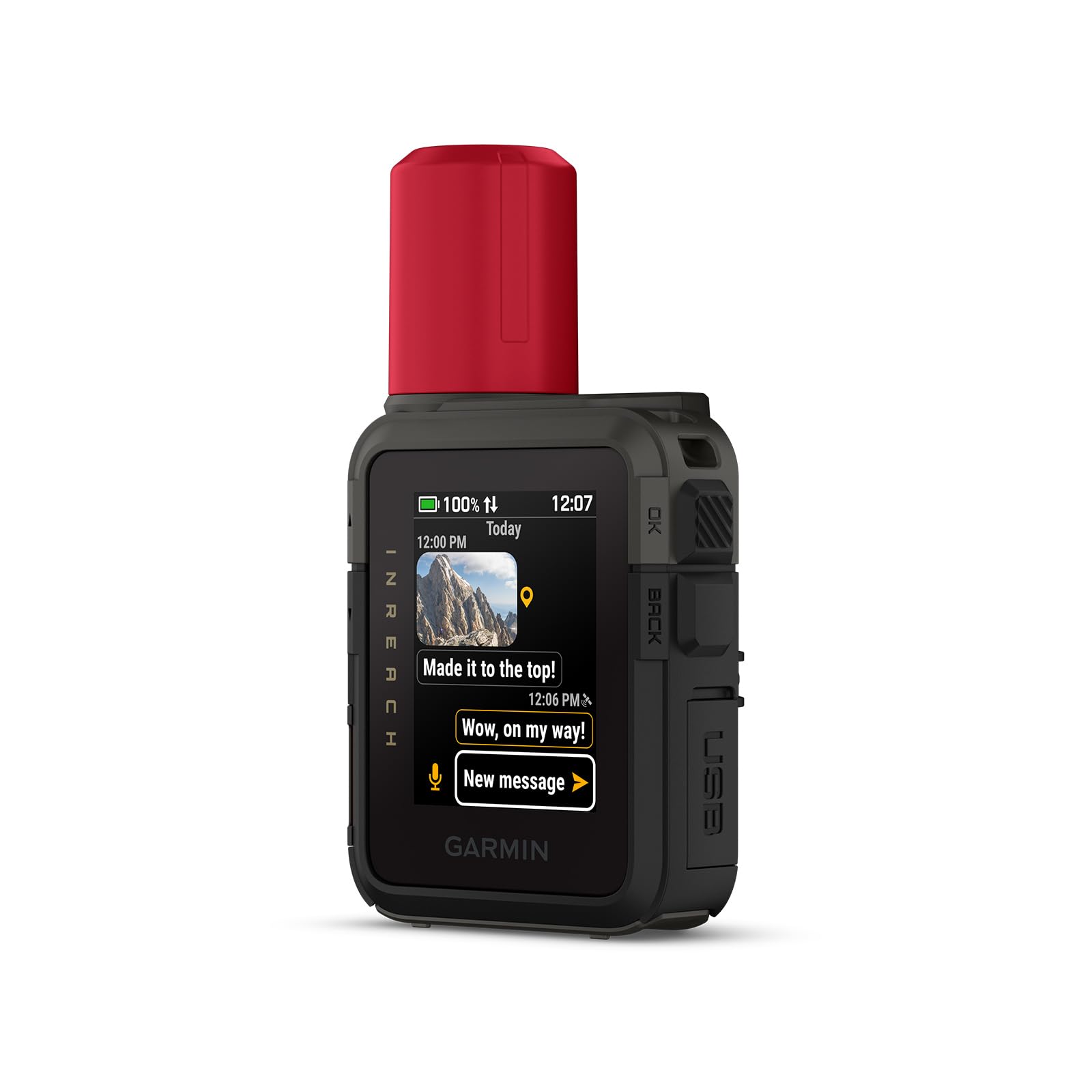
The inReach Mini 3 Plus is a compact Garmin messenger that feels pleasant to look at. Its 1.9-inch color touchscreen is a clear step up from the monochrome displays on the smaller models, and the 4.31-ounce body is still light enough to clip to a pack. You pay for that polish, both at checkout and in the device's larger footprint.

The screen earns its keep when you are checking a message or a location pin without pulling out your phone. Photos and voice messages are the bigger draw, but they still run through the Garmin Messenger app on your paired smartphone; the Mini 3 Plus is not a standalone phone. We like that division of labor. The device stays rugged and simple, while the phone handles the richer stuff.

Garmin rates it for up to 350 hours with 10-minute inReach tracking and up to 95 hours in performance messaging mode. Those are different use cases, not one blanket number, and the messaging figure is the one to watch on a trip where you are sending updates every day. The IP67 rating covers rain and splashes, and the scratch-resistant touchscreen is the part you will appreciate when the device is strapped to a pack.

This is a premium pick, and the premium is real. If you mostly send short check-ins and want the smallest thing that works, the Mini 2 is the better value. The Mini 3 Plus makes more sense when you want a readable screen and richer messages and do not mind carrying a little more device to get them. It is the one we reach for when the trip involves sharing the view, not just reporting that we are safe.

Pros

  • 1.9-inch color touchscreen
  • Text, photo, and voice messaging
  • Up to 350 hours with tracking
  • Rugged IP67 body

Cons

  • Premium price over the Mini 2
  • Photo and voice messages require a paired phone
Our verdict

We recommend the Mini 3 Plus for buyers who want a bright color screen and photo or voice messages and accept the higher price and phone dependence.

Check Latest Price
3

Simple Check-Ins

Spot Gen 4

82 /100
Angler Score Excellent

Key details

Weight
5.01 oz
Tracking
Yes
SOS Alerting
Yes
Check-in Messages
Yes
Check Details on Amazon

The Spot Gen 4 is built around a simple promise: send a check-in, share a tracking point, or call for rescue. It uses the Globalstar satellite network and a set of dedicated controls rather than a touchscreen. That makes it a beacon first and a communicator second, and it is the right purchase only if a simple okay check-in plus emergency backup is the whole job.

We like the idea of a device you can hand to a family member without a tutorial: press the check-in button, let the tracking run, and keep the SOS button covered until you need it. The 142-gram body is light enough to live in a pack, and the dedicated controls are simpler to operate than a tiny touchscreen menu. Tree cover can still slow a connection, which is the nature of satellite messaging.

The conversation is where the Gen 4 stops. It sends preset check-ins and tracking updates, but it does not receive replies, so your partner cannot ask a follow-up question or coordinate a pickup through the device. For a solo angler who just wants a tracking link and an SOS button, that may be enough. For a family that wants to check in both directions, it is not the tool.

The other caveat is confidence: you get limited confirmation that a message went out, and account setup can be fussy. The 142-gram body and simple controls still make it a useful, light beacon for a solo float trip or a hunt where the plan is already set. It is not the device we hand to a partner who wants to trade updates all afternoon.

Pros

  • Simple check-in and SOS controls
  • GPS tracking and location sharing
  • Light 142-gram body

Cons

  • No incoming messages or two-way replies
  • Limited confirmation that messages sent
Our verdict

We think the Spot Gen 4 makes sense only if you want a light, simple beacon for check-ins and SOS and do not need to receive replies.

Check Latest Price

How We Tested Satellite Messengers in the Field

We started by pulling every current satellite messenger with true two-way messaging and an SOS button that reaches a real rescue coordination center rather than a call tree, then narrowed by weight, price, and whether the device could send a message entirely on its own or leaned completely on a paired phone. That left seven units, which we've now lived with for nine months.

Testing happened where these devices actually get used: a week in a slot canyon where the walls swallow signal, two days paddling a stretch of coastline, several weekends at a cabin with no cell reception, and plenty of ordinary days with one clipped to a jacket pocket. We timed a cold start under open sky, then again under heavy pine cover, and walked into the canyon sending a check-in every ten minutes until messages stopped landing. Battery was tracked as a percentage across four-day trips with a fixed number of messages and tracking points, so the comparisons meant something.

For messaging, we sent the same 40-word note from all seven devices, timed how long it took to reach a phone back home, and counted how many characters got cut off. Each one was handed to a friend who had never used a satellite messenger and asked to send a preset and trigger a test SOS with no coaching from us; a few menus only made sense to whoever had read the manual. We logged every failed send and out-of-order message, weighed each unit, judged button feel, and carried them in the same chest pocket for full days to see whether buttons got bumped or antennas snagged on straps. Plan pricing went into the tally too, since a cheap device with a steep annual subscription isn't cheap.

How to Choose a Satellite Messenger

Two-way messaging versus a beacon

A satellite messenger can do two different jobs. A two-way device such as the inReach Mini 2 lets you send and receive texts, so a partner can ask a question and you can answer. A one-way beacon such as the Spot Gen 4 sends preset check-ins, tracking points, and SOS without a reply. If your safety plan depends on coordination, pay for two-way. If you only need to say you are okay and summon rescue, a beacon can be enough.

Screen size and phone dependence

Every compact messenger here leans on a phone for the best typing experience, but the screen still matters. The Mini 2's 1.27-inch monochrome display is fine for status and short replies; the Mini 3 Plus's 1.9-inch color touchscreen is easier to read and lets you do more without pulling out a phone. A bigger screen adds cost and bulk. If you mostly send preset messages, smaller is fine; if you want to read incoming texts at a glance, the color screen earns its keep.

Battery ratings need context

Battery figures are not interchangeable. The Mini 2 is rated for up to 336 hours; the Mini 3 Plus for up to 350 hours with 10-minute tracking and up to 95 hours in performance messaging mode. Those numbers describe different tracking and messaging loads. Frequent tracking, cold temperatures, and heavy message use all pull the runtime down. Choose based on how often you will track and message, and carry a power source on longer trips.

Subscriptions, coverage, and local rules

Every device here needs an active satellite subscription; the hardware alone will not send a message. Plans differ by message allowance, tracking interval, and contract terms, so price the service before you commit. The Garmin models use the Iridium network, while the Spot Gen 4 uses Globalstar. Satellite coverage is broad, but canyon walls, dense canopy, and buildings can block a connection. Check local regulations too, because some jurisdictions restrict satellite communicators.

Frequently Asked Questions

Final Verdict

For most hikers, hunters, and anglers, the Garmin inReach Mini 2 is the one to buy. It keeps the two-way text and SOS functions that matter, stays small enough to forget in a pocket, and has the battery life for multi-day trips. If you want a bigger color screen and photo or voice messages, the Mini 3 Plus is the premium upgrade. The Spot Gen 4 is a simpler beacon for check-ins only, not a replacement for a two-way messenger.