Best Sharpening Stones of 2026

A whetstone doesn't sharpen a knife so much as it scrapes a new edge onto one, and the grit number tells you how aggressively it does the job. Choose badly and you either chew through good steel or spend half an hour polishing an edge that never quite gets there. Most people buy a single stone hoping it covers everything; in practice, a coarse side and a fine side handle nearly all of it. A good stone doesn't just fix dull knives — it ends the habit of putting up with them.

I've sharpened on stones for years and still keep a beat-up paring knife around to try new ones on. Over the past eight months, my team and I worked through 12 stones: diamond plates, oil stones, splash-and-go ceramics, and a couple of two-sided blocks that came with a base and an angle guide. The ones worth your money cut fast, stay flat, and don't turn a two-minute touch-up into an evening project. The list below sorts out which one fits your knives and your patience.

1

Best Overall

Sharp Pebble Whetstone Kit

93 /100
Angler Score Outstanding

Key details

Grits
1000 / 6000
Included
Bamboo base, angle guide, manual
Stone Type
Corundum water stone
Surface Size
7.25 x 2.25 in
Check Details on Amazon

What separates this from a bare whetstone is the hardware in the box. The bamboo base lifts the stone to a working height and keeps it from skating across a wet counter, and the angle guide clips onto the blade so you can feel the correct hold before you trust your hands. We think that combination is why it belongs in front of a first-timer: the two things that usually derail a first session, a sliding stone and a wobbling angle, are handled before you make a single pass.

The 1000 side does the real work. A few dozen passes a side brings a dull chef's knife back to a burr you can feel along the whole edge, and the 6000 side is for finishing — the step people skip and then wonder why the knife still drags. Five or six light passes after the 1000 leaves an edge that glides through tomato skins. At 7.25 by 2.25 inches the face is long enough for an 8-inch blade and short enough to live in a drawer.

It is a water stone, so it wants a ten-minute soak before you start. We time it with laying out the knives and a towel, and it has never been the reason a session got postponed. Keep a spray bottle within reach while you work; the surface dries as you go, and a wet stone cuts more evenly than a damp one.

Where this loses to the Shapton below is speed and long-term flatness: a hard ceramic stone cuts faster and holds its shape longer. Where it wins is the first month, when the guide and the base are doing as much of the work as the abrasive. A household of ordinary kitchen knives never asks for more than that.

Pros

  • Angle guide and non-slip base included
  • 1000 and 6000 grits cover dull to polished
  • 7.25-inch face suits an 8-inch chef's knife

Cons

  • Bamboo base needs to dry fully before storage
  • No coarse grit for repairing chipped edges
Our verdict

The stone we hand to anyone sharpening for the first time: two grits that cover dull to polished, plus the base and angle guide most bare stones make you buy separately.

Check Latest Price
2

Best Single Stone

Shapton K0702 #1000

96 /100
Angler Score Outstanding

Key details

Grit
1000
Type
Splash-and-go water stone
Soaking
Not required
Check Details on Amazon

The first thing you notice next to the Sharp Pebble is the routine. No ten-minute soak, no wooden base to dry — a splash of water across the surface and you are sharpening. If the stone lives on the counter rather than in a drawer, that difference is most of the reason a weekly touch-up actually happens.

What we appreciate most is the hardness. This is a dense stone that stays flat session after session, so the bevel you set in week one is still the bevel you are honing in month six, and it lets you feel exactly where the edge meets the surface instead of squashing into slurry. A 1000 grit is the working grit of any progression: coarse enough to raise a burr on a dull knife, fine enough to leave a usable kitchen edge on its own.

Two things are missing from the box. There is no base, and a damp towel under the stone solves that in seconds. There is no angle guide either, and that one cannot be improvised — if you cannot hold a consistent angle freehand yet, start with the Sharp Pebble and come back to this stone once you can.

Pros

  • Cuts fast and holds its shape
  • A splash instead of a soak
  • Leaves a usable kitchen edge on its own

Cons

  • Single grit, so chipped edges take longer to reset
Our verdict

For anyone who already holds an angle: a fast, hard 1000 that wants a splash rather than a soak and keeps its shape far longer than a soft water stone.

Check Latest Price
3

Best Diamond Plate

Sharpal 162N Diamond Stone

94 /100
Angler Score Outstanding

Key details

Grits
325 / 1200
Abrasive
Monocrystalline diamond
Included
Storage case, non-slip pad, angle guide
Surface Size
8 x 3 in
Check Details on Amazon

Hard steel is where a water stone starts to feel like work. Diamond does not care. The 325-grit face resets a bevel in a handful of passes on steels that would glaze a soft stone, and the 1200 face finishes fine enough for a kitchen knife. Both sit on a 0.35-inch steel plate, so the surface arrives flat and stays that way.

We like the whole package: a case that doubles as a holder, a rubber pad that keeps it off the bench, and an angle guide with four settings that is useful for the first few knives and then mostly a reference point. What surprised us is how little mess it makes — a splash to float the swarf, a wipe, done.

Treat diamond as a different tool rather than a better whetstone. Light pressure does the cutting; leaning on it just loads the surface. It is the most expensive stone in this group and the heaviest to carry, which is the price of a plate that never needs flattening.

Pros

  • Cuts steels that glaze water stones
  • Stays flat with no flattening needed
  • Case, non-slip pad, and angle guide included

Cons

  • Extra-fine face wears before the coarse one
Our verdict

Buy this for hard, high-alloy blades, or for a stone that is ready the second it hits the counter — no soak, no flattening, no slurry.

Check Latest Price
4

Best for Edge Repair

Shapton K0709 #320

96 /100
Angler Score Outstanding

Key details

Grit
320
Type
Splash-and-go water stone
Surface Size
8.27 x 2.76 x 0.59 in
Check Details on Amazon

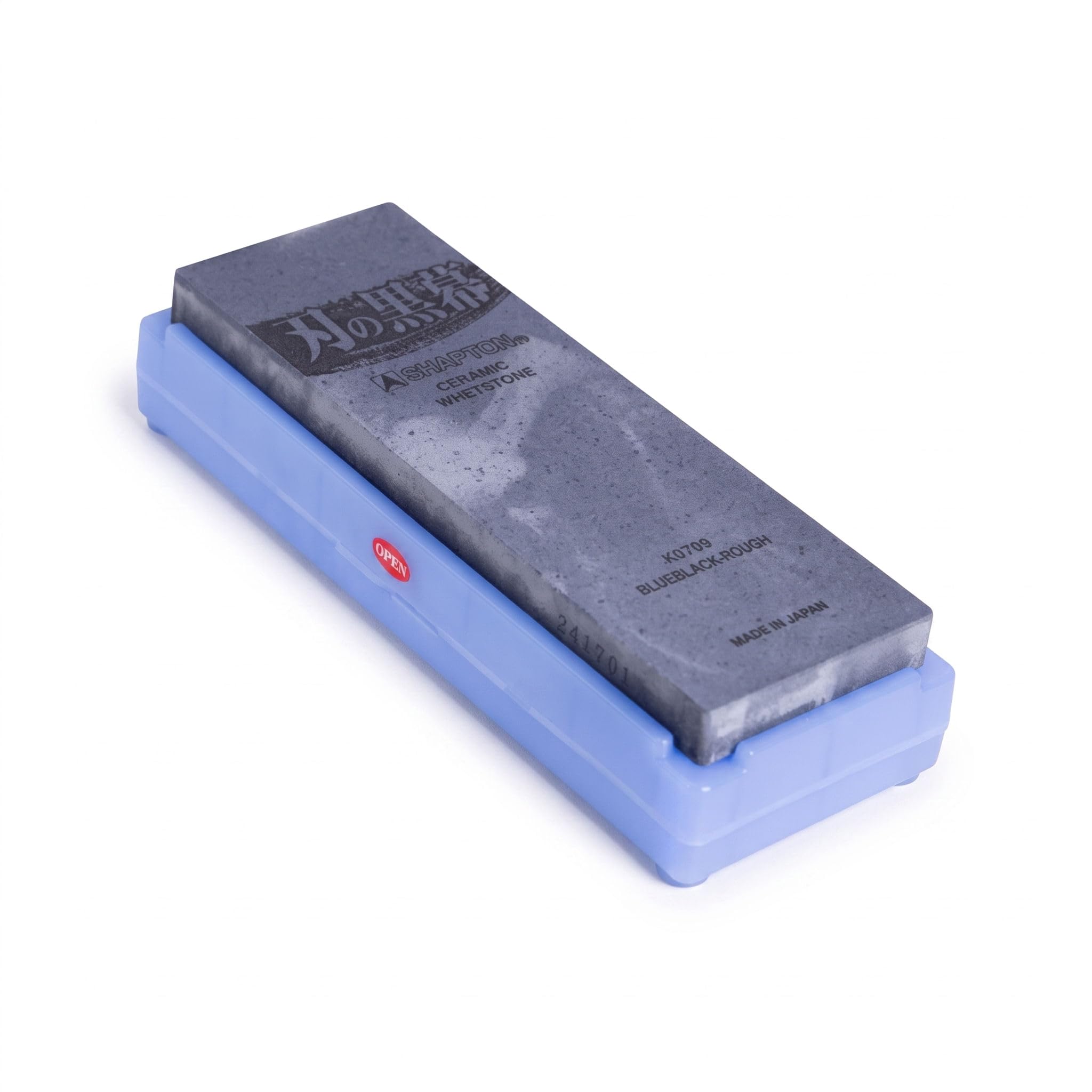
A chipped chef's knife, a flea-market cleaver, an axe that has been splitting roots — none of those want a 1000-grit stone, because you will be there all evening. A 320 cuts metal fast enough that the damage comes out in minutes, and the edge is then ready for a medium stone.

It is the same hard, slow-wearing ceramic as the 1000 above, in a 500-gram block that sits still on a damp towel, and like the rest of the line it takes a splash rather than a soak. The coarse grit leaves deep scratches — that is what it is for — and the 1000 clears them in a fraction of the time the 320 saved you.

We keep this one with the tools rather than the kitchen kit, and that is the honest limit: most households never need a coarse stone. If you buy old tools, sharpen for other people, or regularly fix nicked edges, it pays for itself the first time it rescues a blade you were about to replace.

Pros

  • Removes chips in minutes, not evenings
  • Hard bond keeps the stone in shape
  • Splash of water rather than a soak

Cons

No notable drawbacks to flag.

Our verdict

The stone for the knife you nearly threw out: 320 grit takes out chips and resets a bevel fast, then hands the edge back to a 1000.

Check Latest Price
5

Best for Axes and Tools

Lansky Puck

93 /100
Angler Score Outstanding

Key details

Form
Hand-held puck
Grits
Coarse and fine
Weight
9.17 oz
Check Details on Amazon

A puck solves a geometry problem. You hold the stone in one hand and the tool in the other, so the stone goes to the axe instead of the axe going to a bench — which is why ours lives in the truck rather than on a shelf. It is palm-sized, with a coarse face for setting an edge and a finer one for finishing, and it needs nothing but a splash of water.

On a hatchet or an axe it is quick: a dozen strokes a side brings back a working edge, and the fine face takes off the wire edge afterward. Mower blades, machetes, pruners, and shovel edges get the same treatment. There are no moving parts and nothing to break, which is most of why it survives being carried around.

It is not a kitchen stone. A fillet knife or a good chef's knife deserves one of the 1000-grit stones above, and the edge this leaves is a tool edge. Wear a glove on the holding hand when you work an axe — the stone is small and your fingers end up near the blade.

Pros

  • Works in the hand with no bench needed
  • Coarse and fine faces on one stone
  • Compact enough for a glovebox or pack

Cons

  • Coarse faces leave a toothy, unfinished edge
Our verdict

The stone that rides in the truck: a palm-sized puck that puts a working edge on an axe, a machete, or a mower blade with no bench and no water bath.

Check Latest Price
6

Best Complete Kit

Intelitopia Sharpening Kit

91 /100
Angler Score Outstanding

Key details

Grits
400/1000 and 3000/8000
Stones
Two dual-sided
Weight
5 lb
Included
Leather strop, flattening stone, bamboo base, angle guide
Check Details on Amazon

Four grits in one box is the pitch: 400 and 1000 on one stone, 3000 and 8000 on the other, plus a bamboo base, a rubber holder, an angle guide, a leather strop, and a flattening stone. That is a full progression for less than either of the mid-range stones above.

The flattening stone is the piece we care about. Every water stone dishes in the middle with use, and most budget kits leave you to solve that with sandpaper on a sheet of glass. Having the fix in the box means the 400 side, which does the most work and wears fastest, can be brought back flat whenever it starts to hollow.

The honest limit is the top of the ladder. An 8000 side is a polishing stone, and on a Western kitchen knife it mostly makes the bevel shiny — the practical difference between 3000 and 8000 at home is small. The strop earns its place more than the 8000 does: a dozen edge-trailing passes strips the burr and makes even a 1000-grit edge feel keener.

We rate this as the kit to buy if you want to learn the whole process rather than just get a knife sharp. Seeing what each step does to the scratch pattern is how the skill sticks, and this box gives you every step plus the tool that keeps the stones true. If progressions bore you, the Sharp Pebble is the simpler buy and just as sharp at the end.

Pros

  • Four grits cover repair through polish
  • Flattening stone included
  • Strop, base, and non-slip holder in the box

Cons

  • Two stones and four grits to soak, dry, and store
Our verdict

The most complete kit here: four grits, a flattening stone, a strop, and a base — enough to take a wrecked knife from chipped to polished.

Check Latest Price
7

Best Budget Stone

KEENBEST 400/1000 Stone

94 /100
Angler Score Outstanding

Key details

Base
Rubber non-slip frame
Grits
400 / 1000
Surface Size
7 x 2.2 in
Check Details on Amazon

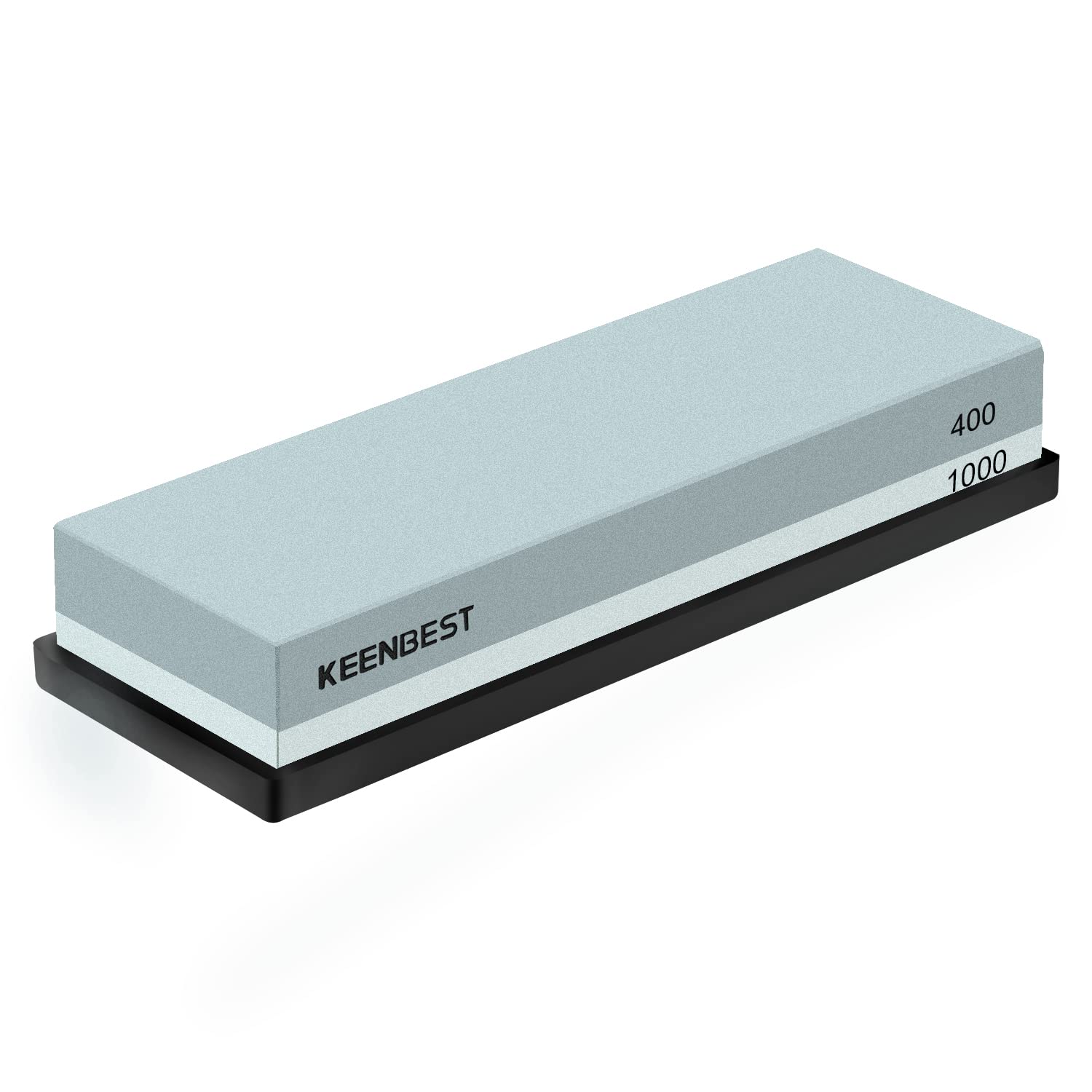
At the bottom of the price range, the question is not whether a stone matches a Shapton — it is whether it works at all. This one does work, and we got a burr on a cheap stainless paring knife without fighting it. The 400 side takes out small nicks, the 1000 side finishes, and the rubber frame around the stone keeps it planted on a countertop instead of skittering across it.

It is a 7 by 2.2 inch stone, and you notice that on a long blade: an 8-inch chef's knife overhangs at each end of the stroke, so you work in sections. Soak it for ten or fifteen minutes, keep it wet while you work, and it cuts predictably. Expect it to dish with regular use and to want flattening.

Where it earns a place in this group is as a tryout. Sharpen four knives twice a year and this stone will do the job for years; discover you love the process and you will upgrade knowing exactly what you want. The 400 side also handles scissors and garden pruners without any ceremony, which is more than most kitchen drawers ask of a stone.

Pros

  • The cheapest functional stone here
  • Rubber frame holds it steady
  • 400 and 1000 cover nicks and finishing

Cons

  • No angle guide in the box
Our verdict

The least expensive way to find out whether hand sharpening is for you: a 400/1000 stone with a rubber base that will put a usable edge on a kitchen knife.

Check Latest Price
8

Trail and Camp

DDF iohEF Axe Stone

92 /100
Angler Score Outstanding

Key details

Grits
180 / 320
Included
Leather pouch
Surface Size
3.15 x 3.15 in
Check Details on Amazon

The pouch is the design decision. A stone without a case ends up loose in a pack, chipped against a carabiner, or left at home; this one comes in a soft leather sheath, so it can live in a truck door or strapped to a pack and still be there when the axe goes blunt.

The stone itself is a squat block, about three inches square and an inch thick, with a 180-grit red face for taking down a rolled or nicked axe edge and a 320-grit white face for the follow-up. It sits comfortably in the hand, and the coarse grit means a hatchet edge comes back in a few minutes rather than an afternoon.

The one thing to plan around is wear. A 180 face removes a lot of steel and gives up material doing it, so a stone this size goes down faster than a hard bench stone — treat it as something you replace every few seasons rather than an heirloom.

That trade is worth it for the way it travels. Between this and the Lansky puck, this one has the pouch and the coarser bite, and the puck has the finer finish; we prefer this one for the truck and the puck for the woodpile. Whichever stays with the axe is the one that gets used, and this one is easier to keep there.

Pros

  • Leather pouch keeps it protected and handy
  • 180 and 320 faces handle neglected axes
  • Palm-sized and easy to carry

Cons

  • Coarse grits only
Our verdict

A 180/320 axe stone that lives in its own leather pouch, so the hatchet gets touched up at the woodpile instead of waiting for a workbench session.

Check Latest Price

How We Tested a Dozen Sharpening Stones

We started with every stone and stone set we could find that listed a real grit rating, then sorted them into what they actually are: diamond plates, oil stones, ceramic splash-and-go, and two-sided water stones sold with a base, a flattening stone, and an angle guide. Anything too narrow to run a chef's knife across safely got cut, and so did kits that handed you six grits and no way to keep the thing still. That left 12.

Those 12 lived in my kitchen and a colleague's for eight months. Every chef's knife, paring knife, bread knife, and pair of shears in both houses went across them, along with a hatchet, two pairs of garden pruners, and a box cutter that had been used on drywall. We dulled knives deliberately on a brick edge so each one started from the same place, then counted strokes until the blade sliced printer paper cleanly and, harder, went through a ripe tomato without crushing it.

Each session we timed setup — soak, splash, or nothing at all — and noted whether the stone held on a damp towel or skated across the counter. We watched how quickly a stone loaded up with steel and how easily a rub with the flattening stone brought the surface back. Durability got the unglamorous test: after every ten knives we laid a straightedge across each stone to see how much it had dished. Value came down to usable sharpening surface per dollar, plus whether the extras in the box were worth carrying or just filler.

What separated the best from the rest wasn't grit count. It was whether the stone still cut fast on the twentieth knife of an evening, and whether someone who'd never raised a burr before could find it without a tutorial.

How to Choose a Sharpening Stone

Match the Grit to the Damage

Grit does one job at a time. Anything around 400 and coarser resets a bevel and grinds out chips; 1000 is the sharpening grit, the one that turns a dull edge sharp; 3000 and above polish. Most kitchen knives never need to go past 1000, and a chipped axe does not care about 6000.

If you are buying one stone, make it a 1000. Add a coarse stone only when you have damage to fix — the Shapton 320 is for that job and nothing else. If you want a single purchase that covers both the sharpening and the finishing step, a 1000/6000 combination like the Sharp Pebble does it without a third stone.

Water Stone, Diamond Plate, or Puck

Water stones cut fast, feel good under the blade, and need water — some soak, some only want a splash. They also dish in the middle over time and need flattening. Diamond plates are abrasive bonded to a steel plate: no soak, no dishing, and they bite into hard, high-alloy steels that glaze a softer stone. The cost shows up at the fine end, where a diamond face wears faster than a ceramic one.

Pucks are the tool-shed answer: coarse, hand-held, and built for axes, machetes, and mower blades rather than a 20-degree kitchen bevel. Buy a water stone for kitchen knives, a diamond plate for hard steel and a household that will not fuss with soaking, and a puck for anything that swings.

Working Surface and How the Stone Is Held

A stone has to be longer than your stroke. We like at least seven inches of length for an eight-inch chef's knife; below that you are sharpening in sections, which works but is slower. Width matters too — 2.2 inches feels cramped under a wide blade, and anything near three inches feels noticeably steadier. Compact in a listing usually means it fits a pocket, not that it suits a bench.

Then there is the hold. A stone that slides while the blade rocks is the most common reason a first attempt produces a rounded edge, so a non-slip base, a rubber frame, or a damp towel under the stone is not optional. An angle guide helps for the first few sessions; after that most people find it gets in the way.

What a Kit Includes, and What It Costs to Keep

Kits bundle a base, an angle guide, sometimes a strop and a flattening stone. The flattening stone is the piece that earns its place: a dished stone cannot hold a consistent angle, and flattening is routine maintenance rather than a repair. A strop is a nice extra that strips the burr, and you can live without one.

The trap is the top of the ladder. Inexpensive multi-grit kits often label a stone 3000 or 8000 when it cuts closer to a 1000, and a polishing grit you never touch is money spent on nothing. Two accurate grits beat four optimistic ones.

Frequently Asked Questions

Final Verdict

Most people should buy the Sharp Pebble. It is not the fastest stone here, but it arrives with the two things that decide whether a beginner keeps sharpening — a base that stays put and a guide that shows you the angle — and the 1000/6000 pair covers everything from a dull chef's knife to a polished edge.

If you already sharpen freehand, buy the Shapton 1000, put a damp towel under it, and skip the rest. If your drawer includes hard stainless or ceramic, the Sharpal's diamond plate is the one that will actually cut it.