
Best Soft Plastic Lure Molds of 2026

A soft plastic mold is a machined aluminum book with two jobs: hold a bait's shape precisely, then let you get the finished lure out without tearing a fin off. You clamp the halves, shoot hot plastisol through the injector port, wait, open, and see what you got. Get it right and a pack of swimbaits becomes a few cents of plastic in whatever color and salt level you want. Get it wrong and you spend your evenings trimming flash and re-shooting voids that never filled.

I've been pouring my own baits for a few seasons — mostly on a tailgate before a morning on the water — and the lesson that took me longest to learn is that cavity count means nothing on its own. A three-cavity mold that fights you on clamping and demolding is slower than a two-cavity mold that drops clean baits every time. We've spent the last seven months running 12 molds through that exact routine, and the keepers all share the same handful of traits.

1

Best Overall

Smedioks Bandito Bug Mold

88 /100
Angler Score Excellent

Key details

Bait Style
Googan Bandito Bug
Bait Length
4 inches
Cavity Count
2
Mold Material
Acrylic stone
Check Details on Amazon

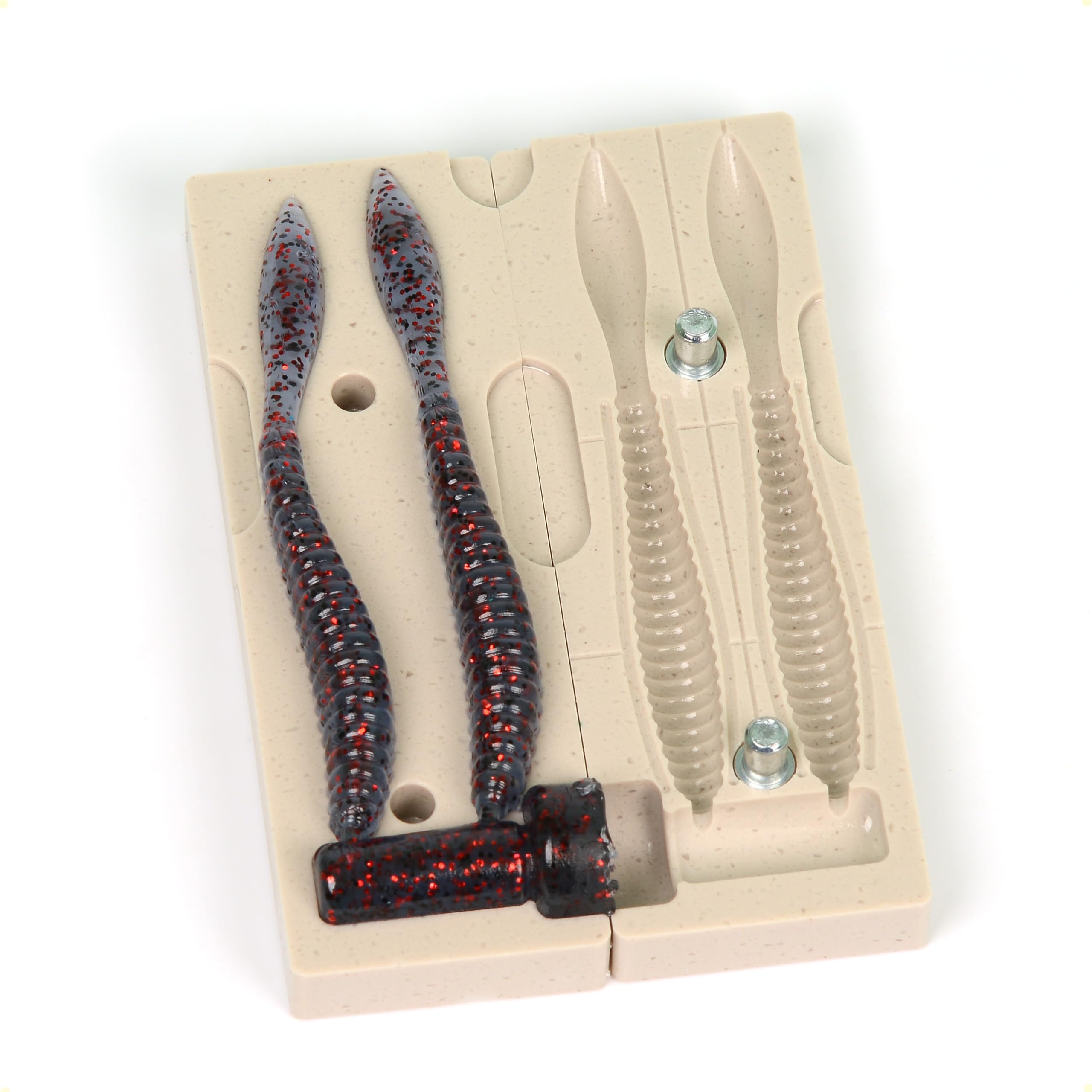
Of all the molds here, the 4-inch Bandito Bug is the one we recommend most often, because the profile is a bass bait that already earns its keep in a tackle box. The two cavities give you a pair per shot without making the mold awkward to handle, and the acrylic stone body carries the detail that makes a creature bait look alive in the water. We see it as the first mold for anyone who fishes bass and wants one bait that can be skipped, flipped, or used as a trailer.

The CNC-machined cavities and air vents are the practical part. The vents give trapped air a way out instead of letting it leave a void in the bait. When we fill a two-piece mold like this, the seam is where trouble shows up; clamping both ends keeps the halves tight and helps the bait come out clean. A single clamp in the middle lets the ends lift, so use two. The mold takes standard soft plastic injectors, and the box includes worm oil and an instruction sheet.

Two cavities are the main trade-off. This is not the mold for filling a box in one sitting; it is the one for making a useful batch of a bait you will actually fish. If volume matters more, the three-cavity FatFish V23-3C gives you another cavity, though its 2.8-inch bait is much smaller. The Bandito Bug stays our default because the bait size and profile are the versatile ones.

Pros

  • Versatile 4-inch Bandito Bug profile
  • Vented acrylic stone mold
  • Works with standard soft plastic injectors
  • Includes worm oil and instructions

Cons

  • Two cavities limit output per pour
Our verdict

We recommend this to bass anglers who want a proven 4-inch creature bait, clean two-cavity pours, and a mold that works with standard injectors.

Check Latest Price
2

Best Aluminum Mold

best_nj Aluminum Fluke Mold

90 /100
Angler Score Outstanding

Key details

Bait Style
Zoom Salty Super Fluke
Bait Length
5 inches
Cavity Count
2
Mold Material
Aluminum 7075T
Check Details on Amazon

Aluminum 7075T is the reason this Fluke mold sits at the premium end of this group, and the material is the first thing we look at when a mold is meant for repeat sessions. The two-cavity mold copies a 5-inch Zoom Salty Super Fluke, a bait that needs a straight body and a clean tail to swim properly.

We like the aluminum body for the long haul. It is the mold in this set that we treat as equipment rather than a consumable, and that matters if you plan to pour through several bags of plastisol. The premium is real, though: you pay for the material up front, and that is the main reason we do not recommend it as everyone's first mold.

Clamp both halves evenly, especially around the nose and tail, because a fluke with a thin edge is not worth trimming. The 5/8-inch port fits a common injector tip; check yours before ordering. For a first mold, the Bandito Bug is easier to justify; for frequent fluke pours, this is the aluminum upgrade we choose.

Pros

  • Aluminum 7075T mold body
  • 5-inch Zoom Salty Super Fluke profile
  • 5/8-inch injector compatibility

Cons

  • Two cavities limit batch size
Our verdict

We recommend the aluminum Fluke mold for anglers who pour often enough to justify the premium and want a durable 5-inch fluke profile.

Check Latest Price
3

Best Budget

best_nj Flat Worm Mold

83 /100
Angler Score Excellent

Key details

Bait Style
Powerbait Maxscent Flat Worm
Bait Length
3.5 inches
Cavity Count
2
Mold Material
Engineered stone
Check Details on Amazon

The flat worm mold is the lowest-cost way into this group, and it makes the case for starting small. It is a two-cavity 3.5-inch Powerbait Maxscent Flat Worm in engineered stone, with the same 5/8-inch injection port as the other Best_nj molds. We see it as a finesse mold first, which is exactly what a flat worm should be.

The 3.5-inch size is the point: it matches drop-shot and shaky-head presentations better than a bulky creature bait. The engineered stone is mixed with polymers for a low-porous surface, and the smart air vents are meant to push plastic into the fine tail section. Clamp both ends, fill steadily, and let the mold do the detail work. It stores easily and does not demand a lot of bench space.

This is not the mold for someone who wants one bait to do everything. A 3.5-inch flat worm is a specialty profile, and the two cavities keep output modest. But if finesse fishing is already in your routine, the low entry cost makes it an easy way to test whether pouring your own is worth the setup. The small bait also means a first batch is easy to manage.

Pros

  • Lowest-cost mold in this set
  • Two-cavity 3.5-inch flat-worm profile
  • 5/8-inch injector compatibility

Cons

No notable drawbacks to flag.

Our verdict

We recommend this as the budget entry point for finesse anglers who want a two-cavity flat-worm mold without spending much.

Check Latest Price
4

Best Compact Multi-Cavity

FatFish V23-3C Mold

82 /100
Angler Score Excellent

Key details

Bait Size
2.8 inches
Cavity Count
3
Injector Fit
5/8 inch
Mold Material
Artificial stone
Check Details on Amazon

The V23-3C is a small mold with three cavities, and that combination is the whole reason to look at it. The 2.8-inch bait sits in a 4 by 2.8 by 0.87-inch body, so it takes up less bench space than a full-size fluke mold. It also uses a 5/8-inch injector port, which keeps it compatible with common soft-plastic injectors.

We like it for compact profiles. Three cavities give you a useful batch without a mold that feels like a cutting board, and the artificial stone is designed to hold fine detail while releasing air through the vents. Clamp both ends and keep the pressure steady; small cavities are less forgiving of a half-clamped mold than large ones. The reward is a batch of small baits that suit perch, panfish, and finesse-minded bass anglers.

The limit is the bait size. A 2.8-inch profile is not a big-bait mold, and it will not replace a 5-inch fluke for anglers who fish large presentations. But for the water where small baitfish and compact trailers win, the three-cavity layout is the advantage. The compact body is easy to keep in a drawer, but the real reason to buy it is the output in a small package.

Pros

  • Three cavities per pour
  • Compact 4 x 2.8 x 0.87-inch mold
  • 5/8-inch injector compatibility

Cons

  • 2.8-inch bait profile only
Our verdict

We recommend the V23-3C to anglers who fish small profiles and want three cavities without a bulky mold.

Check Latest Price
5

Grub-Profile Fishing

Smedioks Stretch 40 Grub Mold

90 /100
Angler Score Outstanding

Key details

Bait Style
Yamamoto Stretch 40 Grub
Cavity Count
3
Mold Material
Acrylic stone
Mold Footprint
7.09 x 2.76 x 1.57 inches
Check Details on Amazon

The Stretch 40 Grub is a specialist mold, and it makes no apology for that. The three cavities turn out a grub profile in acrylic stone, with the same standard-injector compatibility as the other Smedioks molds. If grubs are already a confidence bait for you, the appeal is obvious: three at a time in a mold that does not dominate the workbench.

The footprint is 7.09 by 2.76 by 1.57 inches, so it is slim enough to store on a shelf. The CNC-machined acrylic stone is meant to hold detail and resist wear through repeated sessions, and the air vents help plastic fill the thin sections. Clamp both ends and use a steady injector; a grub tail is one of the places where a short shot shows up immediately.

We like it for grub-first anglers because three cavities of a proven profile are more useful than one cavity of a bait you rarely throw. The issue is breadth. This is not the first mold for a new lure maker who wants one do-everything bait, and it will not replace a creature bait or fluke in the box. Start with a small batch and one color; the three cavities let you see whether the profile suits your water before you commit to a shelf of them.

Pros

  • Three-cavity grub mold
  • Compact 7.09 x 2.76 x 1.57-inch body
  • Acrylic stone construction

Cons

  • Specialist grub profile only
Our verdict

We recommend the Stretch 40 Grub mold to grub-first anglers who want three cavities and a compact mold, not a do-everything bass mold.

Check Latest Price

How We Tested 12 Soft Plastic Lure Molds

We started by narrowing to two-piece aluminum injection molds — no silicone open-pour trays, no resin — then filtered by cavity dimensions, injector-port size and placement, availability, and cost per cavity. Anything that demanded a proprietary injector got cut, since a mold you can only feed with one brand's gun isn't much of a mold.

All 12 molds got the same medium-hardness salted plastisol and the same injector, so nothing but the mold changed between sessions. Pouring happened where pouring actually happens: a garage workbench on Saturday mornings, a folding table at the lake on a couple of weekend trips, and a stretch of weekday evenings after work. We shot each mold hot, around 340 to 350 degrees, then shot it again deliberately cool to see how it behaved once the plastic started gelling in the port.

Mold quality came down to feel and light. We ran a thumbnail along every cavity edge looking for burrs, held each one under a shop light to read the parting line, and measured cavity depth with calipers against the bait it copies. Functionality showed up in the small stuff: how many shots went by before the injector port needed clearing, whether the sprue snapped off flush at the base of the bait, whether the alignment pins seated without wobble, and how cleanly baits released cold versus still warm. For value, we counted usable baits per pour, weighed the plastic each one took, and compared price per cavity.

Every mold also lived in a garage between sessions and got knocked off the bench at least once, which turned out to be as telling as the pour tests — the ones that came through without a dinged cavity edge or a pin that no longer seated are the ones still on my shelf.

How to Choose a Soft Plastic Lure Mold

Match the Bait to Your Water

A mold is a commitment to one profile, so choose the bait you tie on most often rather than the one with the most cavities. A 4-inch creature bait such as the Bandito Bug covers a lot of bass fishing; a 3.5-inch flat worm is better for finesse and drop-shot work, and a 2.8-inch profile suits small baitfish imitations. We favor a versatile bass profile for a first mold because it earns back its shelf space. If you fish grubs or flukes specifically, buy for that instead.

Cavity Count and Handling

More cavities sound better until you are filling a large mold with hot plastisol. A three-cavity mold of small baits can be easier to manage than a two-cavity mold of 5-inch flukes, because each cavity holds less plastic. For a first mold, two cavities are a sensible balance: enough output for a useful batch, less clamping and filling to coordinate. If you already pour regularly and fish small profiles, the FatFish V23-3C's three cavities make sense. Do not count cavities without looking at bait size.

Mold Material and Durability

Engineered stone, acrylic stone, and aluminum all hold detail, but they ask different things of your budget and your routine. Stone molds are the lower-cost route and are fine for occasional pours. Aluminum, such as the 7075T Fluke mold, is the premium upgrade we choose when a mold will see frequent sessions. If you are testing whether you enjoy lure making, start with stone. If you already know you will pour often, pay for the material that is meant to last.

Injection Fit and Clamping

Check the injector port before you buy. Best_nj and FatFish molds use a 5/8-inch port; Smedioks molds are listed for standard soft plastic injectors. A matching tip keeps plastisol from leaking around the nozzle. Clamping is the other half of a clean pour: use two clamps, one near each end, rather than a single clamp in the middle. The ends can lift and let plastic flash into the seam. Clamps and injectors are sold separately, so put them on the same order.

Frequently Asked Questions

Final Verdict

For most bass anglers, the Smedioks Bandito Bug mold is the one to buy first. The 4-inch profile is versatile, the two cavities are manageable, and the vented acrylic stone mold works with standard injectors. It gives you a useful batch without turning a first pour into a production run.

If you pour often and want the premium material, the aluminum Fluke mold is the long-haul upgrade; if you fish finesse profiles, the flat worm mold is the budget route. The deciding question is not which mold has the most cavities, but which bait you will actually fish and how much clamping and filling you want to manage.