Best Soft Plastic Lure Injectors of 2026

Soft plastic injectors do one job: move hot plastisol from a cup into a mold in a single, steady push. Plenty goes wrong in that half-second — a nozzle that won't lock spins loose at the sprue, a plunger that grabs leaves a short pour, a body too small forces a second shot that sets unevenly against the first. I've had all three happen with a batch of swimbaits on the line. Over the past five months, my team and I poured with 14 injectors, from 45-milliliter plastic models to 120-milliliter aluminum ones, and the good ones all let you think about the bait instead of the tool.

Capacity is the spec most first-timers get wrong: you want enough plastisol on board to fill the whole mold in one push. Past that it's heat and handling — aluminum holds temperature, plastic stays lighter in the hand. The picks below cover both, plus a few value options that pour as cleanly as tools costing far more.

1

Best Overall

Fat Fish 45 ml Aluminum Injector

85 /100
Angler Score Excellent

Key details

Weight
4.64 oz
Capacity
45 ml (1.52 US fl oz)
Body Material
Aluminum
Injection Port
5/8 in, locking nozzle
Check Details on Amazon

The nozzle is the first thing we check on any injector, and this one gets it right: a 5/8-inch port with a locking collar, which is the diameter most soft-plastic molds are cut for. The collar keeps the tip seated against the sprue while you push, so the pressure goes into the cavity instead of into a tip that skates sideways halfway through a fill. Aluminum body, plastic handle, 8.66 inches end to end, 4.64 ounces.

Forty-five milliliters is the size that suits ordinary bench work. It covers a two- or four-cavity mold of bass-sized baits, and it's small enough that you empty the barrel before the plastisol inside starts to go thick and stubborn. We prefer refilling a small injector to wrestling a half-cooled column of plastic through a wide one, and that preference is most of why this one is our default.

The plastic handle matters more than a line in the specs suggests. An aluminum barrel sitting in hot plastisol gets genuinely uncomfortable against a bare palm, and the handle puts a barrier there — a small thing on the first fill, a real one by the fourth. At 4.64 ounces the tool stays balanced in one hand, which is what lets you hold steady pressure through a slow fill instead of gripping hard and jabbing at the sprue.

Pros

  • Locking 5/8-inch nozzle stays seated under pressure
  • Plastic handle insulates a hot aluminum barrel
  • 45 ml suits small, medium, and multi-mix molds
  • Balanced 4.64-ounce body for one-handed pours

Cons

  • 45 ml runs short on large single-bait molds
Our verdict

The one we tell most people to buy: 45 ml of aluminum with a locking 5/8-inch nozzle, sized for everyday molds and light enough to hold steady through a slow fill.

Check Latest Price
2

Best Budget

best_nj 45 ml Plastic Injector

83 /100
Angler Score Excellent

Key details

Weight
1.5 oz
Capacity
45 ml (1.5 US fl oz)
Bait Size
Under 5 in
Body Material
Hard plastic
Check Details on Amazon

Cheapest of the four here and the only one with a plastic barrel, and that plastic changes how it pours: it doesn't pull heat out of the plastisol the way aluminum does, so what's in the tube stays workable longer between fills. At 1.5 ounces it's also the lightest tool in this guide, light enough to hold over a mold for a whole session. For someone pouring a couple of dozen baits at a table, that's a better combination than the price suggests.

The design is deliberately plain. The spout is fixed, so there's no tip to lose or cross-thread mid-session, and the cap at the top of the syringe unscrews so you push residue out of the barrel rather than fishing for it at the nozzle. The maker pitches it at baits under five inches, and that's the honest scope — it's a small-mold tool, not a small version of a big one.

Where it earns a second look is as a pair. Two of these let you run two colours without purging in between, which is how most colour work actually goes, and the low outlay means a beginner can put the savings into plastisol and molds instead of the injector itself.

Pros

  • The cheapest injector in this set
  • Plastic barrel holds plastisol heat longer
  • Fixed spout
  • 1.5 ounces, easy to hold for long sessions

Cons

  • Scoped to baits under about 5 inches
Our verdict

Our budget recommendation: a light plastic 45 ml barrel that holds plastisol heat longer than metal and leaves your money for molds and plastisol.

Check Latest Price
3

Best for Large Batches

best_nj 120 ml Aluminum Injector

84 /100
Angler Score Excellent

Key details

Weight
4 oz
Capacity
120 ml (4 US fl oz)
Body Material
Aluminum
Injection Port
5/8 in, locking nozzle
Check Details on Amazon

One fill covers a mold instead of half of one. At 120 ml this barrel holds more than double what the 45 ml injectors here do, and that's the entire proposition — a pour you don't have to interrupt.

We reach for it on wide multi-cavity blocks and egg molds, where stopping to refill leaves a cold seam across the finished bait. The nozzle is the same locking 5/8-inch fitting as the Fat Fish, the handle is plastic, and the whole thing is 4 ounces.

That weight is the surprise. A barrel with more than double the capacity weighs less than the 45 ml aluminum pick, so the extra volume doesn't cost you wrist fatigue, and the wide bore wipes out easily between colours.

It also sits at the same money as the 45 ml metal injectors, so there's no budget penalty for the extra capacity — the only question is whether your molds can use a barrel that big. Small two-cavity blocks don't need it.

Pros

  • More than double the capacity of the 45 ml picks
  • Only 4 ounces despite the larger barrel
  • Standard locking 5/8-inch nozzle

Cons

  • Heat-swollen seals can shed plastisol into the batch
Our verdict

The volume pick: more than double the capacity of the 45 ml injectors here, in a 4-ounce body, for wide multi-cavity molds and egg molds.

Check Latest Price
4

Large Baits

FishForm 200 ml Aluminum Injector

77 /100
Angler Score Very Good

Key details

Weight
7 oz
Capacity
200 ml (7 US fl oz)
Body Material
Anodized 6061 aluminum
Injection Port
5/8 in, 9 mm hole
Check Details on Amazon

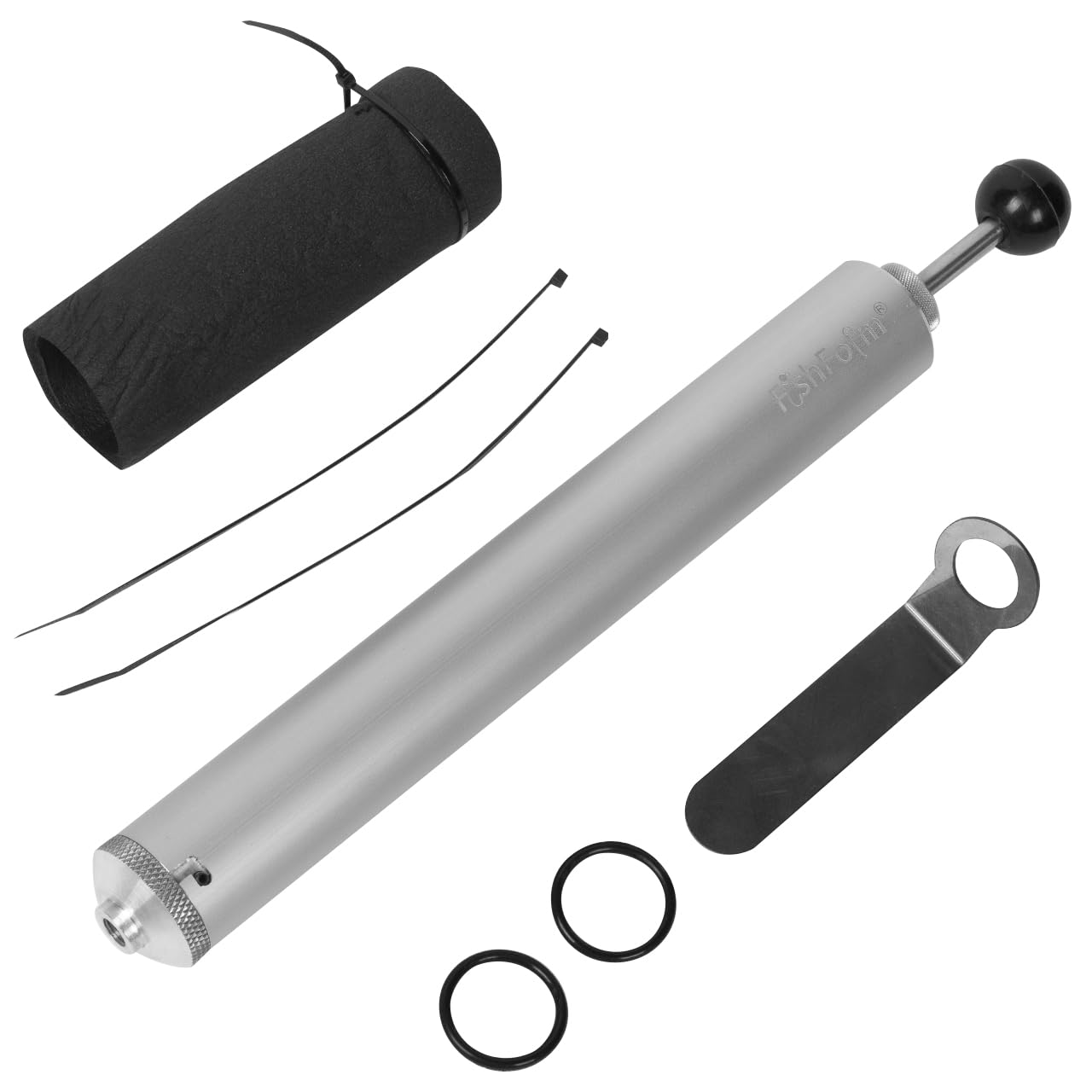
Two hundred milliliters makes this the biggest injector here by a wide margin — seven ounces of tool with an anodized 6061 aluminum body and stem, and a piston and nose cut from 2017 alloy. The nozzle is a 5/8-inch fitting with a 9 mm hole, and it gets a second fixation point on top of the lock.

Big baits are the reason it exists. A long swimbait or a wide laminate insert swallows a load this size without a refill, and an interrupted pour in a mold that big is exactly where a cold line shows up across the bait.

What we noticed is the effort. Two hundred milliliters of plastisol is a lot of thick material to move, and this is the injector in the set where hand strength tells — keep the plastisol properly hot and the push stays manageable, because a cool batch in a barrel this size is real work. Check the end cap before your first pour and make sure it's seated tight.

Pros

  • Largest capacity in this set at 200 ml
  • Anodized 6061 body with hardened alloy nose and piston
  • Second nozzle fixation point for hot work

Cons

  • Stiff plunger with a full barrel of plastisol
  • Premium price for a specialist tool
Our verdict

For long pours in big molds: 200 ml of anodized aluminum that saves refills, as long as you're ready for a stiff plunger and the highest price here.

Check Latest Price

How We Tested Soft Plastic Lure Injectors

We started by pulling every injector we could find in both plastic and aluminum, from 45-milliliter models up to 120-milliliter ones, then cut anything with a nozzle that didn't lock positively, a body with visible seams, or a plunger shorter than the barrel it sat in. That left 14, which we bought at retail so price stayed part of the conversation.

Testing ran five months, mostly Saturday mornings in a garage with a hot plate, a Pyrex cup, and a stack of two- to six-inch molds — swimbaits, worms, craws, paddle tails — plus a few larger molds for the 120-milliliter units. Each injector got the same routine: loaded, purged once back into the cup, then shot into a full mold while we watched whether the pressure held.

Ease of use came down to observable things: whether plastisol poured into the barrel without running down the outside, whether the nozzle stayed seated when twisted into the sprue, and whether the plunger traveled smoothly or grabbed and left us pushing with two hands. We wore nitrile gloves for every pour to see how the grip behaved with plastisol on it, and hefted each injector full to judge how the arm felt by the tenth shot. Quality meant checking thread wear after repeated heat cycles, whether seams wept, and whether the plunger seal swelled or shrank by month three.

Plastic and aluminum bodies failed in different ways, which is where value got interesting: an inexpensive injector that pours clean for a season beats a heavier one that clogs or drips between molds. Baits that came out dented or short traced back to the injector more often than to the plastisol. We're still pouring with the standouts and will update as we log more cycles.

How to Choose a Soft Plastic Lure Injector

Match capacity to the molds you actually own

A 45 ml injector suits two- and four-cavity molds of bass-sized baits, which in practice means anything under about five inches, and it carries one advantage that never shows up on a spec line: you finish the barrel before the plastisol inside starts to set. Step up to 120 or 200 ml when the mold is wide, the cavities are many, or the bait runs long, because those pours last long enough that a refill halfway through leaves a cold seam across the finished bait.

The trap is buying capacity for the mold you plan to own someday. A wide barrel full of thick plastisol takes noticeably more push, and if your bench work is mostly small molds, that effort buys you nothing. Count cavities and measure your longest bait first; our 45 ml picks cover everyday pouring, and the 120 ml is there for the wide blocks.

Aluminum and plastic handle heat differently

Aluminum is the default for good reasons: it holds its shape, takes knocks, and shrugs off repeated fills. It also conducts heat straight to your palm and pulls heat out of the plastisol, which is why the metal injectors here pair an aluminum barrel with an insulating plastic handle. A plastic barrel flips the trade — it holds the plastisol's heat longer, weighs almost nothing, and costs less, but it is a small-batch tool rather than a volume one.

Our split is simple: aluminum for the injector you plan to keep and use for years, plastic for a first setup or for the second colour you don't want to purge between pours.

The nozzle has to match the mold

Most soft-plastic molds are cut for a 5/8-inch injection port, and every injector in this guide uses that diameter, so the measurement is usually the easy part. The harder question is how the nozzle stays put. A locking collar fixes the tip to the barrel so pressure goes into the cavity rather than into a tip that backs out, and a second fixation point, like the one on the FishForm, is cheap insurance against a spray of hot plastisol.

Check the port on every mold you plan to run, not just the first one. If a mold has a smaller sprue, the injector still works, but the tip won't seat and you'll be holding it in the air by hand, which makes a clean fill much harder than it needs to be.

Cleaning is what the tool is like to own

Plastisol sets as it cools, so every injector eventually ends up with a plug of cured plastic in the barrel. The routine is the same everywhere — warm the barrel until the plug softens, push it out, never dig at it cold — but the design decides how much of a chore it is. A barrel you can open at the top turns it into a two-minute job; a sealed body means working from the nozzle end with a plunger and some patience.

Our preference runs to anything that unscrews. The plastic best_nj is the clearest example here: the cap comes off the top so residue pushes straight out, and nothing at the tip can go missing.

Frequently Asked Questions

Final Verdict

Buy the Fat Fish if you want one injector that handles everyday molds: 45 ml of aluminum, a locking 5/8-inch nozzle that keeps the tip where you put it, and a weight that stays steady through a slow fill.

If your molds are wide multi-cavity blocks, the 120 ml best_nj is the better buy — more than double the capacity in a lighter body. And if you're just starting out, the plastic 45 ml gets you pouring for the least money and holds heat longer while you learn the rhythm.