
Best Spearguns of 2026

A speargun is a simple machine: rubber bands or a sealed cylinder of compressed air store the energy, and a trigger releases it into a steel shaft. Everything that separates a good one from a frustrating one hides in between — how the barrel feels when you load it, whether the trigger breaks cleanly, whether the line release snags at the worst possible moment. Get it wrong and you don't just miss the shot; you lose the fish, the shaft, or your patience in four feet of swell.

The good news is that the guns worth buying share a few things: solid construction, hardware that shrugs off salt, and a size that matches the water you actually dive. Compact guns for holes and tight reef, longer ones for open blue water — buying for the fish you dream about rather than the ones you see is the most common first-timer mistake. My team and I have spent eight months with 12 spearguns, band-powered and pneumatic, loading them in cold water and off the side of a boat, and the differences are not subtle.

1

Best Overall

AB Biller 32 in Special Mahogany

84 /100
Angler Score Excellent

Key details

Shaft
5/16 in stainless steel
Powerbands
Two 9/16 in rubber
Barrel Length
32 in
Barrel Material
Mahogany
Check Details on Amazon

Mahogany is the reason to start here. The 32-inch barrel has enough mass to settle the gun in the water, and its natural buoyancy keeps the muzzle from pulling your aim down between shots. That neutral feel is the first thing we noticed when comparing it with the aluminum guns in this group: it hangs steadier rather than wanting to nose over. A quieter shot is the other benefit, and it matters when fish are already wary. We think that neutrality is worth choosing over the lighter aluminum guns if you shoot in open, clear water.

The 5/16-inch stainless shaft and twin 9/16-inch bands give it more authority than the short 65 cm guns here. The extra mass carries the shaft through a shot instead of letting it stall at the scales. The 32-inch length is the compromise: long enough to reach a spooky fish, short enough that it still turns in reef structure. The extended butt is a practical detail for scuba divers, because it gives you more leverage when you pull the bands back.

The stainless trigger mechanism is the part that sells the gun to us. It has a smooth, predictable break, and the double-barb Rockpoint tip is a workhorse rather than a delicate target point. We also appreciate that the gun is built around standard 9/16-inch bands and a 5/16-inch shaft, so replacing worn parts is straightforward rather than a hunt for proprietary pieces. That matters more than another ounce of theoretical power.

Pros

  • Neutral mahogany barrel steadies the aim
  • Twin 9/16-inch bands and 5/16-inch shaft add authority
  • Smooth stainless trigger mechanism
  • Extended butt helps scuba divers load

Cons

  • Wood stock needs drying and occasional oiling
  • 32-inch length is short for the largest bluewater game
Our verdict

For divers who want one quiet, neutral gun for reef and open-water hunting, we recommend the 32-inch AB Biller Special; its mahogany barrel and smooth trigger are the reasons it earns the spot.

Check Latest Price
2

Best for Accuracy

Hammerhead Evolution^2

86 /100
Angler Score Excellent

Key details

Shaft
17-4 stainless steel shark-fin
Powerbands
Dual Power Helix bands
Barrel Length
75 cm
Barrel Material
Anodized aluminum
Check Details on Amazon

The open muzzle is the feature that defines the Evolution^2. With no bridge over the shaft, your eye stays on the fish and the shaft all the way through the shot; that clean sightline is a real advantage when you are aiming at a moving target rather than a stationary one. The 75 cm aluminum barrel gives the gun enough reach without turning it into a broom, and the integrated shaft guide keeps the shaft tracking straight on the way out. We liked how simple the layout feels: fewer parts around the muzzle, less to snag, and nothing blocking the view.

Accuracy is where this one separates itself in our set. The 17-4 stainless shark-fin shaft and dual Power Helix bands are a matched package, and the reverse trigger places your index finger closer to the shaft line for a more instinctive point. We found the gun wants a smooth, deliberate pull rather than a quick jab, and that suits a diver hunting wary fish at the edge of visibility. It is the priciest gun here, but the open-muzzle setup and the fit and finish are what you are paying for.

The gun is also built to be modified. The design accepts different shaft and band combinations, a reel, and an action camera, so it can grow with your hunting rather than being a one-season purchase. That flexibility is a big part of why we are comfortable recommending a premium gun: you are not buying a fixed setup you will outgrow. The Hawaiian-style open muzzle is simple to re-rig, too, which matters when you are replacing a band on a boat rather than at a workbench.

Pros

  • Open muzzle keeps the shaft and target in view
  • Reverse trigger and 17-4 shaft support accurate shots
  • Accepts reels, cameras, and different band setups
  • 75 cm aluminum barrel balances reach and maneuverability

Cons

  • Muzzle hook can break after limited use
  • Dual bands take more loading effort
Our verdict

We recommend the Evolution^2 for divers who take deliberate, longer shots; its open muzzle keeps the target visible and the reverse trigger makes the gun feel direct.

Check Latest Price
3

Best Pneumatic

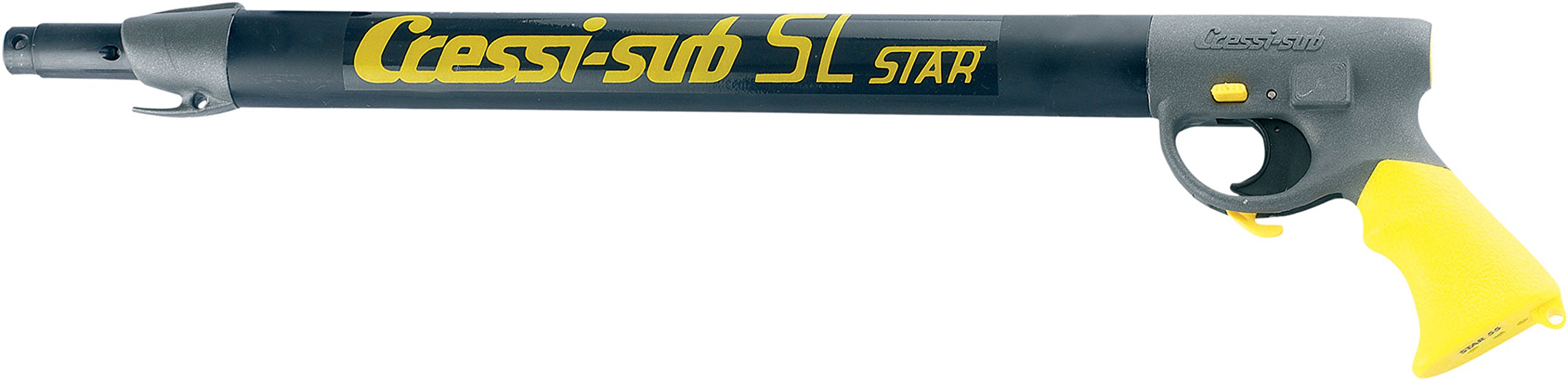
Cressi SL Star

82 /100
Angler Score Excellent

Key details

Type
Pneumatic
Handle
Contoured, yellow
Length
55 cm | 24"
Safety
Safety catch
Check Details on Amazon

A pneumatic changes the packing problem. The SL Star measures 55 cm, so it fits into a travel bag and slips through the water in tight cover where a 75 cm band gun feels like a fence post. The bright yellow handle is more than decoration: if the gun ends up on the bottom after a shot, that flash of color is easy to spot. We also like the contoured grip, which lines the gun up with your forearm instead of forcing your wrist into an awkward angle.

Pneumatic power comes without a long band stretch. The SL Star is easy to load, and the automatic line release keeps the shooting line clear when you pull the trigger. That combination makes it a friendly gun for a diver who is new to pneumatics or wants a backup that does not demand a big loading effort. The safety catch is a useful detail on a gun this short, where the muzzle can swing quickly.

For a travel gun or a short-range reef gun, the SL Star's compromises are easy to live with. It is the pneumatic we reach for first because it combines a small packed size with enough power for reef fish, and because the loading effort is low enough that you can manage a second shot without fumbling. The automatic line release is the detail that makes the whole package feel tidy on a crowded boat. It is not a bluewater gun, but it is a very practical one.

Pros

  • Fits in a travel bag at 55 cm
  • Easy loading and automatic line release
  • Bright yellow handle is easy to spot
  • Strong power for its compact size

Cons

  • Plastic line guide and slide are wear points
  • Needs periodic pressure checks
Our verdict

We recommend the SL Star for traveling divers and tight-visibility hunters; it packs pneumatic punch into a 55 cm package and loads easily in the water.

Check Latest Price
4

Best Lightweight Reef Gun

Mares Sniper Alpha

82 /100
Angler Score Excellent

Key details

Shaft
7 mm Tahitian
Powerband
14 mm circular latex
Barrel Diameter
25 mm
Barrel Material
Anodized aluminum
Check Details on Amazon

The ambidextrous handle is the first thing we noticed, and it is more than a marketing line. The concave thumb rest gives both left- and right-handed shooters a place to settle their grip, and the 25 mm aluminum barrel keeps the gun light enough to swing one-handed in a cave or around a piling. We think that light, quick feel is the Sniper Alpha's best argument: it does not fight your wrist when you change angle quickly.

The 14 mm S-power band and 7 mm Tahitian shaft are a sensible reef combination. The band is smooth to draw, the shaft has enough mass for small to medium fish, and the single-wing flopper opens reliably on the shot. The reversed firing mechanism and race wishbone keep the trigger pull direct, and the compact head gives you a clean view along the shaft. We found it easy to point at close targets, which is exactly where this gun is meant to work.

Where it fits best is reef hunting with reasonable visibility. The compact head and light barrel make it easy to track a fish through structure, and the ambidextrous handle means you can hand it to a buddy without adjusting anything. It is a gun we are happy to keep as a loaner or a second setup for that reason. That kind of easy handling is worth more on a reef than another band's worth of power.

Pros

  • Ambidextrous handle suits left- and right-handed shooters
  • Light 25 mm aluminum barrel swings easily
  • Smooth 14 mm band and 7 mm Tahitian shaft
  • Compact head gives a clean sightline

Cons

  • Single 14 mm band limits punch on larger fish
  • Grip is sized for medium to large hands
Our verdict

We recommend the Sniper Alpha for a light, pointable reef gun, especially if right- and left-handed divers will share it.

Check Latest Price
5

Best Simple Reef Gun

SEAC Sting

82 /100
Angler Score Excellent

Key details

Barrel
Extruded anticorodal aluminum
Length
65 cm
Powerband
16 mm latex
Handle Feature
Sternum rest
Check Details on Amazon

The Sting is the value play in this group, and the 16 mm band is a big reason it does not feel like a compromise. That band gives the gun more punch than the 13 mm starter setups, while the 65 cm aluminum barrel keeps it handy in tight visibility and around structure. The sternum rest is the sort of detail you notice on a long surface swim: it gives the butt of the gun something to brace against instead of digging into your chest.

We think the Sting hits a useful middle ground for a new diver. The 65 cm length is manageable in tight visibility, and the 16 mm band gives it more reach than the soft starter guns without demanding a second band. The extruded anticorodal aluminum barrel is light and stiff, and the simple layout means there is less to go wrong while you are learning to load, aim, and reload. The 16 mm band does take a firmer pull than the soft starter bands, but that is a fair trade for the extra range.

What we appreciate most is the simplicity. There is no second band to tune, no complex muzzle to fuss with, and nothing between you and the business of loading and shooting. The aluminum barrel does not need the oiling a wood gun does, and the muzzle and band setup are simple enough to inspect without a manual. That is exactly what a new spearo needs, and it is why the Sting stays useful as a backup after you move up.

Pros

  • 16 mm band adds useful punch
  • 65 cm aluminum barrel is handy in tight cover
  • Sternum rest helps on long surface swims
  • Simple layout is easy to learn and maintain

Cons

  • 65 cm barrel gives up reach on wary fish
Our verdict

We recommend the Sting to a first-time spearo who wants a proven 65 cm gun without paying for features they will not use yet.

Check Latest Price
6

Best Starter Kit

Beuchat Espadon

82 /100
Angler Score Excellent

Key details

Shaft
6 mm threaded galvanized
Length
75 cm
Powerband
13 mm circular
Barrel Diameter
25 mm
Check Details on Amazon

The Espadon arrives as a complete setup: gun, band, shaft, tip, and 2 mm shooting line. That matters more than it sounds. A first speargun should not turn into a rigging project, and the Espadon is ready to fish once you check the line and load it in the water. The 75 cm, 25 mm aluminum tube gives it a bit more reach than the short 65 cm guns, while the compact muzzle keeps the front end from feeling bulky.

The 13 mm circular band is the beginner-friendly part. It is softer to load than the 16 mm bands on the SEAC Sting and the twin-band setups here, so a new diver can practice the motion without fighting the gun. The 6 mm threaded galvanized shaft and single-barb tip are simple and replaceable, and the 2 mm nylon line is light enough to manage in the water. We like that the gun does not pretend to be a bluewater cannon; it is a straightforward reef tool.

What we appreciate is how little the Espadon asks of a new diver. The safety is simple, the loading sequence is short, and the gun comes with the line included. That means you can spend your first trips learning breath-up, duck dives, and shot placement instead of shopping for missing pieces. The standard 6 mm shaft thread is a small but useful detail, because replacement tips are easy to find.

For shallow, clear reef water, we think the Espadon's soft band and 75 cm length are assets rather than compromises. It is the gun we suggest for a new diver who wants to concentrate on technique, and the included line means one less thing to buy before the first trip. The real test is whether you can load it comfortably and repeat the shot; on that count, the Espadon makes the learning curve shorter.

Pros

  • Complete kit includes line, shaft, and tip
  • Soft 13 mm band is easy for new divers to load
  • 75 cm aluminum barrel gives reef reach
  • Standard 6 mm threaded shaft is easy to replace

Cons

  • 13 mm band limits power for larger fish
  • Galvanized shaft needs rinsing and drying
Our verdict

We recommend the Espadon to a new diver who wants a complete, easy-loading 75 cm gun to take from the box to the water.

Check Latest Price
7

Twin-Band Reef Setup

Salvimar Wild Pro

80 /100
Angler Score Excellent

Key details

Shaft
6.5 mm Tahitian
Length
75 cm
Powerbands
Two 14 mm screw-in
Barrel Diameter
28 mm
Check Details on Amazon

Twin 14 mm bands and a 28 mm barrel give the Wild Pro a more substantial feel than the single-band reef guns here. The wider barrel stiffens the gun and adds a little mass up front, which helps steady the shot, while the 6.5 mm Tahitian shaft keeps the projectile fast and slender. It is a combination aimed at reef fish with some size to them, not the tiny stuff you chase with a 55 cm pneumatic.

The details around the muzzle are what make it flexible. The removable bridge lets you change the band configuration, the metal wishbone is durable, and the reinforced muzzle is set up for a reel. The stainless steel release and fiberglass-reinforced handle give you a secure grip when you are drawing two bands. We like that the gun is ready to grow with you rather than locking you into one setup.

We think the Wild Pro is the strongest twin-band option here for a diver who wants a step up in power without losing reef manners. The 75 cm length is still manageable around structure, and the twin bands give you more range than the single-band guns when you need to reach a fish that is not coming closer. The reel-ready muzzle is the detail that makes it a long-term buy: you can add a reel when your hunting takes you into bigger water.

Pros

  • Twin 14 mm bands add range and power
  • 28 mm aluminum barrel steadies the shot
  • Reel-ready reinforced muzzle
  • Removable bridge lets you change band setup

Cons

  • Twin 14 mm bands take more effort to load
  • 6.5 mm shaft favors speed over heavy-game mass
Our verdict

We recommend the Wild Pro to a diver who wants twin-band power and a reel-ready muzzle without stepping up to a full bluewater cannon.

Check Latest Price

How We Tested Spearguns, From the Pool to the Reef

We started with shelf research, comparing barrel material and wall thickness, band versus pneumatic power, shaft diameter, overall length, and price, then cut anything that couldn't be serviced with parts you can actually buy for years to come. That left 12 guns, from short reef models to longer open-water builds, and we lived with them for eight months.

The pool came first. We loaded each gun 20 times, bare-handed and again in 3mm gloves, noting whether the band seated without pinching and how far the muzzle sat from a comfortable reach. Then we shot at a measured target from 10 and 15 feet, five shots each, and wrote down where the shafts actually landed; the guns that grouped low or drifted right got a second session before we blamed the shooter.

In the water, we took them along a rock jetty and over shallow reef, hunting dinner-size fish and poking into holes, paying attention to how each gun swung, stopped, and stowed on a float line. Durability got the long view: bands sat loaded in the sun between dives, guns rode in the back of a truck, and after every session we rinsed everything, rolled the shafts on a counter to check for bends, and inspected the line-release pin for the first sign of rust. Guns that needed constant fiddling to stay reliable stopped coming with us.

How to Choose a Speargun

Match barrel length to visibility and target size

Barrel length is the first decision because it determines where the gun feels at home. A 65 cm gun like the SEAC Sting swings quickly in holes and murk, while a 75 cm gun like the Beuchat Espadon gives you more reach on reef fish that keep their distance. The 32-inch AB Biller sits at the longer end of that reef range. Longer is not automatically better: in low visibility, a long gun is harder to turn and can encourage shots you cannot see. Match the gun to the water you dive most, then add a second gun only if you regularly hunt a different environment.

Choose bands around loading effort and real power

Band diameter and count set the loading effort and the power. A single 13 mm band, as on the Beuchat Espadon, is forgiving for a new diver; a single 16 mm band like the SEAC Sting's adds punch without a second pull. Twin 14 mm bands on the Salvimar Wild Pro give more range and speed, but they also demand a stronger, smoother load. More bands are not automatically better: extra power can make a light gun nose-heavy or harder to control, and a band you cannot load comfortably is a band you will not use well. Choose the most power you can load repeatedly.

Understand wood, aluminum, and pneumatic guns

Wood, aluminum, and pneumatic guns solve buoyancy and travel differently. A mahogany gun like the AB Biller is neutral in the water and quieter on the shot, but it needs drying and occasional oiling. Aluminum guns such as the Hammerhead Evolution^2 are lighter, stiffer, and less fussy, which makes them a good choice for travel and rough use. A pneumatic like the Cressi SL Star packs the most power into the shortest package, but it depends on pressure checks and has more small parts to maintain. Pick the material that matches your maintenance habits, not the one that sounds most traditional.

Check the trigger, safety, and line release

The trigger, safety, and line release are where a bargain gun can become a bad buy. Look for a metal trigger mechanism with a clean, predictable break, a safety that is easy to operate with your thumb, and a line release that clears the shooting line without snagging. The Mares Sniper Alpha's reversed trigger and the Cressi SL Star's automatic line release are examples of details that make the gun feel sorted. A safety catch is not a substitute for muzzle discipline: keep the gun pointed away from people and load it only in the water. If a trigger feels gritty or the safety is vague, return the gun before you dive it.

Plan the rigging, spares, and travel

Rigging is the part new buyers underestimate. Check whether the gun comes with a shooting line, whether the shaft tip is replaceable, and whether the bands are a standard size you can source locally. The Beuchat Espadon is complete out of the box, while the Salvimar Wild Pro uses screw-in bands that are easier to replace when they wear. Also budget for a float, a stringer, and spare bands; those are part of the real cost of spearfishing. If you travel, confirm the gun fits your bag before you book, and check carrier and destination rules before you pack it.

Frequently Asked Questions

Final Verdict

For most divers, the 32-inch AB Biller Special is the speargun we recommend first. Its mahogany barrel gives it a quiet, neutral feel that suits reef and open-water hunting, and the smooth trigger is the kind of detail you notice every time you shoot. If you travel or hunt in tight visibility, the Cressi SL Star's compact pneumatic package is the more practical choice. If you want an open-muzzle gun for deliberate shots, the Hammerhead Evolution^2 is worth the step up.