Best Spinning Reels of 2026

Spin a reel's handle in the aisle and almost all of them feel smooth — cheap and expensive alike. The differences show up on the water: in the fourth hour of casting into wind, when braid peels off in loose loops, or when a good fish makes a run and the drag either gives line steadily or stutters. What you're paying for is a drag that stays consistent, a body that doesn't flex under a hookset, and a spool that lays line evenly instead of stacking it into a cone.

Smoothness in the store is the least useful thing to know about a reel; what matters is whether it still cranks that way after a season of sand and salt. My team and I fished 14 spinning reels over five months, from ultralight trout setups to bigger reels off a jetty, and the ones that felt best on day one were rarely the ones still clean in month five. Match the reel to your rod and line rather than to the fish you're hoping for — an over-spooled big reel casts worse than a well-matched mid-size one. The picks below are the ones that held up.

1

Best Overall

KastKing Sharky III 3000

91 /100
Angler Score Outstanding

Key details

Bearings
10+1 stainless steel
Max Drag
39.5 lb
Gear Ratio
5.2:1
Braid Capacity
135 yd / 20 lb
Check Details on Amazon

Thirty-nine and a half pounds of drag is where the Sharky III starts, and it's the number that settles most of the argument. Nothing else in this guide comes close on stated stopping power, and the spool, body and rotor all carry KastKing's water-resistant sealing — the part that decides whether a reel shrugs off salt spray or starts grinding by August.

The rest of the parts list holds up. Ten stainless bearings plus a roller give the retrieve a tight, quiet feel under load, the 5.2:1 gear has the cranking power for big plugs and live bait, and the spool is braid-ready, which means you tie straight on with no mono backing and no tape. That last detail saved us a step every time we restrung.

Where the reel earns the top spot is the overlap of drag headroom and saltwater sealing. A 3000 that will stop a fish well past its size class means one outfit covers schoolie stripers in the surf and largemouth in a pond, and the sealed rotor is what makes that a realistic plan rather than wishful thinking.

The triple-disc carbon drag deserves its own mention: carbon washers start a fish running smoothly instead of with a lurch, which is what you want when the drag has to do the work on light leader. Rinse it after salt and don't overfill the spool, and those two habits are the whole maintenance story.

Pros

  • More drag than any other reel here
  • Sealed body, rotor and spool for saltwater
  • Braid-ready spool needs no backing
  • Quiet 10+1 stainless bearing retrieve

Cons

  • Braid capacity is shallow for a 3000
  • Bail can fail to close fully
Our verdict

Our pick if you want one reel for fresh and salt water: nothing else here combines this much drag with a sealed body and a braid-ready spool.

Check Latest Price
2

Best for Big Water

Shimano Sedona 23 C5000XG

89 /100
Angler Score Excellent

Key details

Weight
11.2 oz
Bearings
3+1
Max Drag
24.3 lb
Gear Ratio
6.2:1
Check Details on Amazon

If your fishing happens from a beach, a jetty, or the back of a boat chasing fish that run, the Sedona in this 5000 size is the one to look at. The spool is deep — 400 yards of 1.5 PE braid or 190 yards of 4-pound mono — and the 6.2:1 gear picks up line fast when a fish turns and comes back at you.

We came away more impressed by the internals than by the spec sheet. Silent Drive is a real difference after a couple of hours: the handle stays quiet, the rotor feels tight, and nothing about the retrieve loosens up. Three bearings plus a roller is a modest count for what this reel costs, and that's the trade — you're paying for Shimano's build and line lay rather than a bearing number.

The drag is the other half of it. At 24.3 pounds it trails only the Sharky III here, and it starts smooth rather than with a snatch, which is exactly what you need on the first run of a fish that has already seen the beach. It's more reel than a pond bass needs; where it makes sense is anywhere the fish can take line.

Pros

  • Deep spool for long runs
  • Quiet, tight Silent Drive retrieve
  • 24.3 lb drag with a smooth start
  • Fast 6.2:1 line pickup

Cons

  • Only 3+1 bearings at a premium price
Our verdict

The reel for big water: a deep 5000 spool, a smooth 24.3-pound drag, and Shimano's Silent Drive making it the tightest retrieve here.

Check Latest Price
3

Best for Freshwater

Pflueger President 30

91 /100
Angler Score Outstanding

Key details

Weight
10.2 oz
Bearings
10
Max Drag
10 lb
Gear Ratio
5.2:1
Check Details on Amazon

Ten pounds of maximum drag is the lowest figure in this guide, and it's the one thing that keeps the President 30 out of the top spot. Everything else argues the other way: ten ball bearings and instant anti-reverse, a sealed oil-felt front drag, and slow oscillation gearing paired with Pflueger's Total Line Control, which lays line flat and heads off the wind knots a coarser oscillation system produces.

On the water it's the sweetest light-tackle retrieve here. The handle turns with very little resistance, and you feel the difference on a small crankbait or a sixteenth-ounce jig, where a coarser reel transmits every gear tooth through the rod. The 5.2:1 gear trades a little speed for cranking power — 25.3 inches a turn — which suits light line and small trebles.

Where the 10-pound ceiling bites is big fish and heavy cover. Trout, panfish, walleye and most bass never test it; a pier, a jetty or a flipping bite will. The 30-size spool holds 160 yards of 10-pound braid, which is right for the class, and the aluminum spool takes braid without a backing.

Pros

  • Ten bearings and instant anti-reverse
  • Slow oscillation lays line flat
  • Light at just over 10 ounces
  • Sealed felt drag stays consistent

Cons

  • 10 lb drag ceiling rules out bigger fish
Our verdict

The most refined light-tackle reel in this guide — ten bearings, flat line lay, and a 10-pound drag ceiling that keeps it in freshwater.

Check Latest Price
4

Best for Surf and Pier

Penn Wrath II 4000

90 /100
Angler Score Outstanding

Key details

Bearings
2+1 stainless steel
Max Drag
15 lb
Gear Ratio
6.2:1
Braid Capacity
360 yd / 15 lb
Check Details on Amazon

The line-capacity rings on the Wrath II's spool tell you who Penn built this for. Bands machined into the spool mark how much line is left, so a glance tells you whether you still have a full cast in the reel — a small thing that matters more than it sounds when the beach is long and the fish are showing far out.

Around those rings sits a saltwater reel: a corrosion-resistant graphite body, a machined anodized aluminum spool, and 360 yards of 15-pound braid on the 4000 size. The 6.2:1 gear takes back 37 inches a turn, quick enough to keep a plug moving in a crosswind.

What holds it at runner-up is refinement rather than capability. Two shielded stainless bearings plus the anti-reverse roller is a thin count next to the ten in the Pflueger, and the felt front drag starts fast instead of easing into a run the way a carbon stack does. Neither is a fault at this price — they're the difference between a reel that does the job and one that flatters you while it does it.

Pros

  • Line-capacity rings take the guesswork out
  • 360 yd of 15 lb braid on the 4000
  • Corrosion-resistant graphite body
  • 37 inches of line per crank

Cons

  • Only 2+1 bearings at this price
  • Felt drag is less progressive than carbon
Our verdict

A surf-and-pier reel at a mid-range price: capacity rings, 360 yards of braid, and a graphite body that doesn't mind salt.

Check Latest Price
5

Best Value

KastKing Royale Legend Glory 1000

90 /100
Angler Score Outstanding

Key details

Frame
Zero-rust graphite
Bearings
7+1 stainless steel
Gear Ratio
6.2:1
Line Retrieve
38.3 in per turn
Check Details on Amazon

The first thing we noticed on the Royale Legend was how far it throws a light lure. The asymmetric rotor spins up easily, the 6.2:1 gear keeps the retrieve quick without feeling frantic, and line leaves the spool cleanly enough that a small bait still lands where you aimed it.

The parts list is what sold us. A zero-rust graphite frame and rotor, a zinc alloy drive gear, an oversized stainless main shaft, a brass pinion, seven double-shielded stainless bearings and a triple-disc carbon drag — that is a more serious set of internals than the price suggests, and it's why we're comfortable putting this reel on a rod that gets used hard.

What it gives up is spool size. This is a 1000, so it's built for light braid, small jigs, and trout, panfish and school bass — not for flipping heavy cover or pushing a big plug into a headwind. On small water with light tackle, that isn't a compromise so much as the point.

Pros

  • Seven double-shielded stainless bearings
  • Zero-rust graphite frame and rotor
  • Triple-disc carbon drag
  • Casts light lures a long way

Cons

  • 1000 spool suits light line only
Our verdict

Seven shielded bearings, a zero-rust frame and a carbon drag in a light 1000 — the value pick if your fishing is light line and small water.

Check Latest Price
6

Travel and Backup

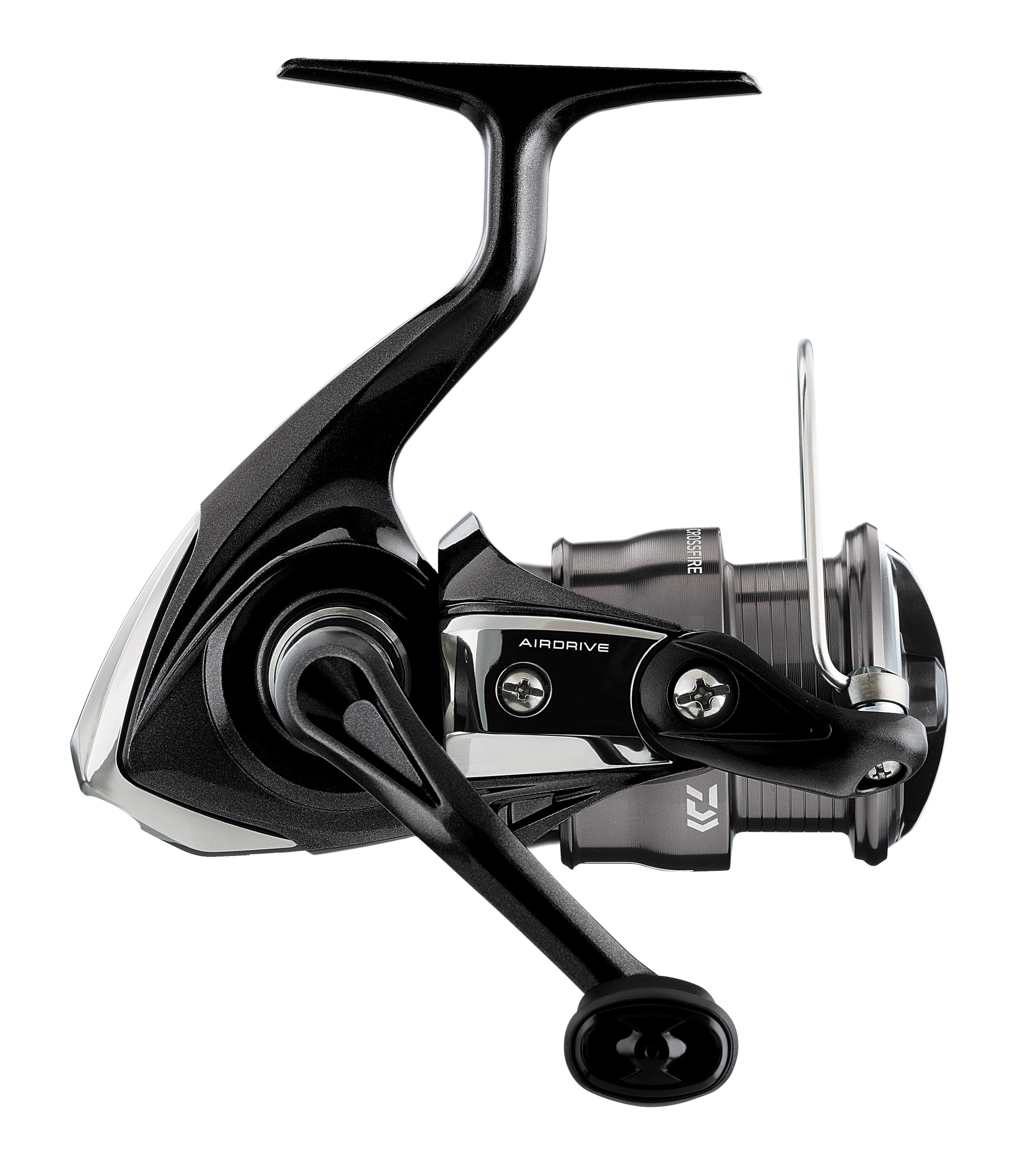
Daiwa Crossfire LT 3000

82 /100
Angler Score Excellent

Key details

Weight
9.2 oz
Bearings
3 ball + 1 roller
Max Drag
22 lb
Gear Ratio
5.3:1
Check Details on Amazon

At 9.2 ounces, the Crossfire LT is one of the lightest 3000-size reels here, and that's most of the reason it made the list. Daiwa's AIRDRIVE design is built around cutting rotation resistance, and you feel it at the handle — the retrieve starts easily and keeps going with very little effort behind it.

The drag is more than the size suggests: 22 pounds through Daiwa's ATD Type-L system, well past what the Pflueger offers and enough for inshore fish on 15-pound braid. The LC-ABS spool is shaped so line comes off it cleanly, and long casts come with surprisingly little input from the caster.

Three ball bearings plus a roller is a modest count, and the retrieve feels a touch drier than the ten-bearing Pflueger as a result. The 3000-C spool takes 200 yards of 10-pound mono, which is a sensible all-round capacity for bass, walleye and light salt.

Our take is that this is the reel to buy as a travel spare or a second rod that lives in the car. It's light enough to fish all day, capable enough that a good fish won't expose it, and if it gets lost or dunked you won't be mourning a flagship.

Pros

  • 9.2 oz in a 3000 size
  • 22 lb ATD Type-L drag
  • LC-ABS spool casts cleanly
  • Balanced AIRDRIVE retrieve

Cons

  • Only 3 ball bearings plus a roller
Our verdict

Light, smooth and modestly priced for what it does: a 9.2-ounce 3000 with a 22-pound ATD drag that makes a good travel spare or second rod.

Check Latest Price
7

Ultralight Finesse

Daiwa Revros LT 2500

88 /100
Angler Score Excellent

Key details

Weight
8.1 oz
Bearings
4 ball + 1 roller
Gear Ratio
5.3:1
Mono Capacity
4/250, 6/160, 8/110
Check Details on Amazon

Zaion V is Daiwa's name for the resin-and-carbon composite in the Revros LT's body, and the point of it is stiffness without weight. The 2500 size comes in at 8.1 ounces, which makes it the lightest reel in this guide by a comfortable margin.

The fittings are the interesting part. The Air Bail is a hollow stainless tube, so it stays rigid without the heft of a solid wire bail, and the Air Rotor keeps rotating mass low where you feel it most. The machined aluminum handle screws directly into the body rather than threading onto a shaft, and the 2500 spool takes 160 yards of 6-pound mono.

Four ball bearings plus a roller is a thin count for what this reel costs, and that's the honest case against it — you're paying for the frame, the rotor and the line lay rather than a stack of bearings. Our view is that it's the right trade on an ultralight setup, where every fraction of an ounce shows up in how the rod balances in your hand.

Pros

  • Lightest reel here at 8.1 oz
  • Rigid Zaion V composite body
  • Hollow stainless Air Bail
  • ATD drag and Digigear internals

Cons

  • Modest bearing count for the price
Our verdict

The lightest reel here at 8.1 ounces, with a rigid composite body and Daiwa's Air Bail — an ultralight that earns its price in feel.

Check Latest Price
8

Trout and Panfish

Handing LITE II 1000

88 /100
Angler Score Excellent

Key details

Size
1000
Weight
9.9 oz
Max Drag
14.3 lb
Gear Ratio
5.2:1
Check Details on Amazon

A 1000-size reel is a specialist tool, and the LITE II knows it. This is a reel for 4- to 8-pound line, small spinners and jigs, and the kind of creek or pond where the cast is short and the fish are small — trout, panfish, and the occasional bass that doesn't know its own size.

The graphite body keeps it around 9.9 ounces, and the aluminum spool is machined rather than stamped, which is where the money went. The handle swaps from left to right easily, so the same reel works for whoever picks the rod up next.

A 5.2:1 gear and 14.3 pounds of drag are more than a 1000-size reel ever needs, which is a good sign — you won't run out of drag on a trout. The bail snaps over cleanly, the anti-reverse is solid, and the whole thing feels tighter than the price would suggest.

The open question is longevity. Nothing in our time with it raised a flag, but a graphite-framed reel this light is the kind that either lasts or doesn't, and a season on the water tells you which. As a cheap second outfit for creeks and panfish, it's a pleasant surprise.

Pros

  • Machined aluminum spool
  • Handle swaps left to right
  • 14.3 lb drag on a 1000 body
  • Around 9.9 ounces

Cons

  • 1000 size limits it to light line and small fish
Our verdict

A tight little 1000 for creeks and panfish: a machined aluminum spool, 14.3 pounds of drag, and a feel well above its price.

Check Latest Price

How We Tested These Spinning Reels

We started by pulling every reel in the sizes a general-purpose angler actually fishes — mostly 1000 through 4000 — and cross-checked gear ratios, drag ratings, spool capacity, and bearing counts against the line weights we planned to use. Anything with a thin parts network or a drag figure that looked inflated for the frame size got cut. That left 14 reels, a mix of brands we've fished for years and a few we hadn't.

Each reel was spooled with both monofilament and braid, checking whether the line bit into the spool or spun on the arbor, then paired with a matching rod and fished from the bank, from a boat, and off a jetty for five months. To judge smoothness, we cranked under load with a weighted plug and felt for grind on slow retrieves and fast ones. For drag, we pulled line off by hand against a scale, then let fish run and listened for start-up stutter, rechecking the setting after the drag had been worked hard.

Line lay got its own attention: we watched how line stacked across the spool during a retrieve and counted wind knots after repeated casts into wind. We back-cranked every handle to feel for play in the anti-reverse and checked whether the switch was findable with wet hands. Reels were dropped on gravel, dunked, rinsed, and left in a hot car; at the end we looked at bail springs, handle wobble, and corrosion, and weighed each one on a kitchen scale to see how it balanced on the rod. Value came down to what survived all of that, not what had the most bearings stamped on the box.

How to Choose a Spinning Reel

Start With Spool Size, Then Read the Capacity

Size codes are a rough guide, and the capacity figures underneath them are the honest ones. A 1000 or 2000 suits 4- to 8-pound line and small fish; a 2500 or 3000 is the all-round size for bass, walleye and light inshore work; a 4000 and up carries enough line for surf, piers and fish that make long runs.

The trap is assuming a size code means a fixed amount of line. The Sharky III's 3000 spool holds 135 yards of 20-pound braid, while the Crossfire's 3000 takes 200 yards of 10-pound mono — same number on the box, very different amounts of line. Read the capacity for the line you actually fish, and when you're between sizes, take the smaller reel for light line and constant casting, the bigger one when capacity keeps you in the fight.

Understand What Drag Actually Does

Maximum drag is a ceiling, not a setting. The useful question is how smoothly the drag starts a fish running at the low end, because that's where most of the fight happens. A carbon-fiber stack like the Sharky III's eases into a run; a felt drag like the Penn's starts faster and can feel abrupt on light leader.

Set the drag to roughly a third of your line's breaking strength so the line gives before the rod does. Then buy headroom rather than a maximum: 39.5 pounds on a reel you fish with 15-pound braid is insurance, not a number you'll ever use.

Weigh Bearings Against Gears and Sealing

Bearing counts sell reels, and past a point they tell you less than the parts they sit in. Ten shielded stainless bearings feel slick in the shop; whether the reel still feels that way in two seasons comes down to the drive gear, main shaft and pinion — zinc alloy, brass and stainless wear better than plastic — and to how well water stays out of them.

Our preference is to spend on gears and sealing before bearing count. A modest 3+1 reel with good internals, like the Sedona, isn't the handicap the number suggests, while a high bearing count with a plastic frame is a spec sheet winning an argument the water will settle differently.

Match Corrosion Protection to Where You Fish

If you never see salt, corrosion protection is a nice-to-have. If you do, it's the whole purchase. Look for a sealed spool, body and rotor — KastKing's KISS system is the example here — or at minimum a corrosion-resistant graphite body like the Wrath II's, and stainless bearings through the whole reel.

Whatever the listing promises, rinse a saltwater reel in fresh water after every trip, dry it, and don't dunk it. Rated bearings still corrode when salt sits on them, and the rinse takes thirty seconds.

Balance Weight and Gear Ratio Against Your Rod

The reels here run from 8.1 ounces to about 12.6, and the figure matters less than the pairing. A light reel on a heavy rod disappears in the hand; a heavy reel on a light rod leaves you with a tip-heavy outfit you'll feel by mid-morning.

Gear ratio is the other trade. A 5.2:1 gear, as on the President and the Sharky III, gives cranking power for slow presentations and big blades; a 6.2:1, as on the Sedona and the Royale Legend, picks up slack fast for working lures and keeping contact in current.

Frequently Asked Questions

Final Verdict

For most anglers, the KastKing Sharky III is the reel to buy. It's the only pick here that pairs a genuinely sealed body with enough drag to handle fish well outside its size class, and that combination covers a jetty, a boat and a pond with one outfit.

Change one requirement and the answer changes. If your fishing is light, freshwater and feel-first, the Pflueger President 30 is the sweeter reel and its drag ceiling won't cost you a fish. If line capacity is what keeps you fishing — surf, piers, long runs — step up to the Sedona's 5000 spool.