Best Tent Repair Tape of 2026

A rip in a tent never happens at a good time. It's a snagged guy line at dusk, a zipper that catches and tears the door panel, a seam that gives up on the second night of rain — and suddenly the shelter you're sleeping in has a hole in it. Repair tape is the fix that skips the sewing machine and the trip to a repair shop, but it has to stick, stay stuck through sun and rain, and look like it belongs there.

Over the past five months my team and I have stuck 16 rolls and patch kits onto ripped tents, and the differences showed up fast — one peeled off a rainfly overnight, another is still holding five months on. The fabric matters as much as the adhesive: nylon tape on a coated nylon fly behaves nothing like canvas tape on a heavy wall, and clear tape is its own separate bargain. Below are the ones that stayed put, with notes on color matching and sizing a repair that doesn't announce itself.

1

Best Overall

OAZ Nylon Repair Patches

91 /100
Angler Score Outstanding

Key details

Material
Nylon
Sheet Size
7.87" x 5.9"
Sheets Per Pack
8
Water Resistance
Waterproof
Check Details on Amazon

A rip in a tent fly is almost never a neat circle. It's a three-cornered gash, a split that runs along a pole sleeve, or a ragged hole where something sharp went through — and that is the argument for sheets rather than a narrow roll. Each patch measures 7.87 by 5.9 inches with a self-adhesive backing, so you can cut a shape that follows the damage and still leaves a full inch of overlap on every side.

Eight sheets is the other half of the appeal. We got several repairs out of a single sheet by cutting around the tear rather than over it: a rectangle for the gash, a strip for a scuffed seam, and enough left over for a pinhole in a footprint. The nylon is thin and the waterproof coating sits on the face, so a patch on a fly stays flat when the tent is rolled instead of standing up like a scab.

Application is as simple as this category gets: cut, peel, press. The one technique worth adopting is rounding the corners with your scissors before you peel, because a square point is exactly where a patch starts to lift. Press from the middle outward and work the edges down with a thumb.

Black is the catch. On a dark green or charcoal tent the patch vanishes; on a pale sand or light gray fly it reads as a black rectangle, and black is the only color this one comes in. That is a cosmetic cost rather than a functional one, and it doesn't change our recommendation: eight waterproof nylon sheets big enough for a real tear, with enough of them to keep a couple back for the next trip.

Pros

  • Eight large sheets cut to any shape
  • Waterproof nylon stays flat on a fly
  • Peel and press, no heat or sewing

Cons

  • Black only, obvious on pale tents
Our verdict

Our default for a torn tent: eight waterproof nylon sheets big enough to cut a patch that matches the tear instead of tiling a narrow roll.

Check Latest Price
2

Best for Long Tears

Cahomo Nylon Repair Tape

90 /100
Angler Score Outstanding

Key details

Material
Nylon
Roll Size
3" x 79"
Water Resistance
Water resistant
Check Details on Amazon

Where the top pick gives you width, this gives you length: one 3-inch by 79-inch strip of black nylon that you cut as you go. We prefer it for the tear that runs — a split along a pole sleeve, a seam that let go, a long graze from a rock — because a continuous strip covers the whole line in a single piece instead of four patches with four sets of edges to lift.

Holding power is where this tape has one of the strongest records in this group. The nylon is thin, which we like on a fly: it follows the curvature of a taut panel instead of standing away from it, and it doesn't leave a stiff lump where the tent folds back into its bag.

The backing peels cleanly and the tape cuts with ordinary scissors, so a repair takes minutes rather than an evening. One honest note: it's rated water resistant rather than waterproof, which is fair for a coated nylon strip — it keeps rain off a repair, but over a large hole in serious weather a waterproof film tape seals better.

Pros

  • 79-inch roll covers a long tear in one strip
  • Thin nylon follows a taut fly panel
  • One of the strongest holding records here

Cons

  • 3-inch width means piecing on wide tears
Our verdict

Buy the Cahomo roll when the damage runs in a line — 79 inches of nylon covers a split seam or a pole sleeve in one continuous strip.

Check Latest Price
3

Best Trail Kit

GEAR AID Tenacious Tape Patches

92 /100
Angler Score Outstanding

Key details

Color
Black
Material
Nylon
Patch Count
19 pre-cut
Patch Shapes
Assorted
Check Details on Amazon

The case for pre-cut patches is the place you'll use them. Cutting a neat rectangle in a windy campsite, with cold hands and a knife balanced on your knee, is a worse job than it sounds — and this pack takes scissors out of the equation. Nineteen assorted shapes, peel the backing, press.

They're small. The pack is built around a spark hole, a thorn snag, a pinhole in a down jacket, not a split seam, and a six-inch rip will eat most of it. That is not a flaw so much as a job description: when the damage is long, reach for the Cahomo roll and leave these for the small stuff.

Where these earn their place is on clothing and sleeping bags rather than tent panels. The shapes read as logos more than repairs — several are animal silhouettes — and on a black shell they're close to invisible, which is more than we can say for a black rectangle on a pale fly. This pack is what goes in the repair pouch for a week in the backcountry.

Pros

  • Pre-cut shapes, no scissors needed
  • Nearly invisible on black shells and bags
  • Assorted sizes cover holes and snags

Cons

  • Backing is fiddly on the smallest shapes
Our verdict

For clothing, sleeping bags, and any repair made in the wind, these pre-cut shapes peel and press with no scissors involved.

Check Latest Price
4

Best for Canvas Tents

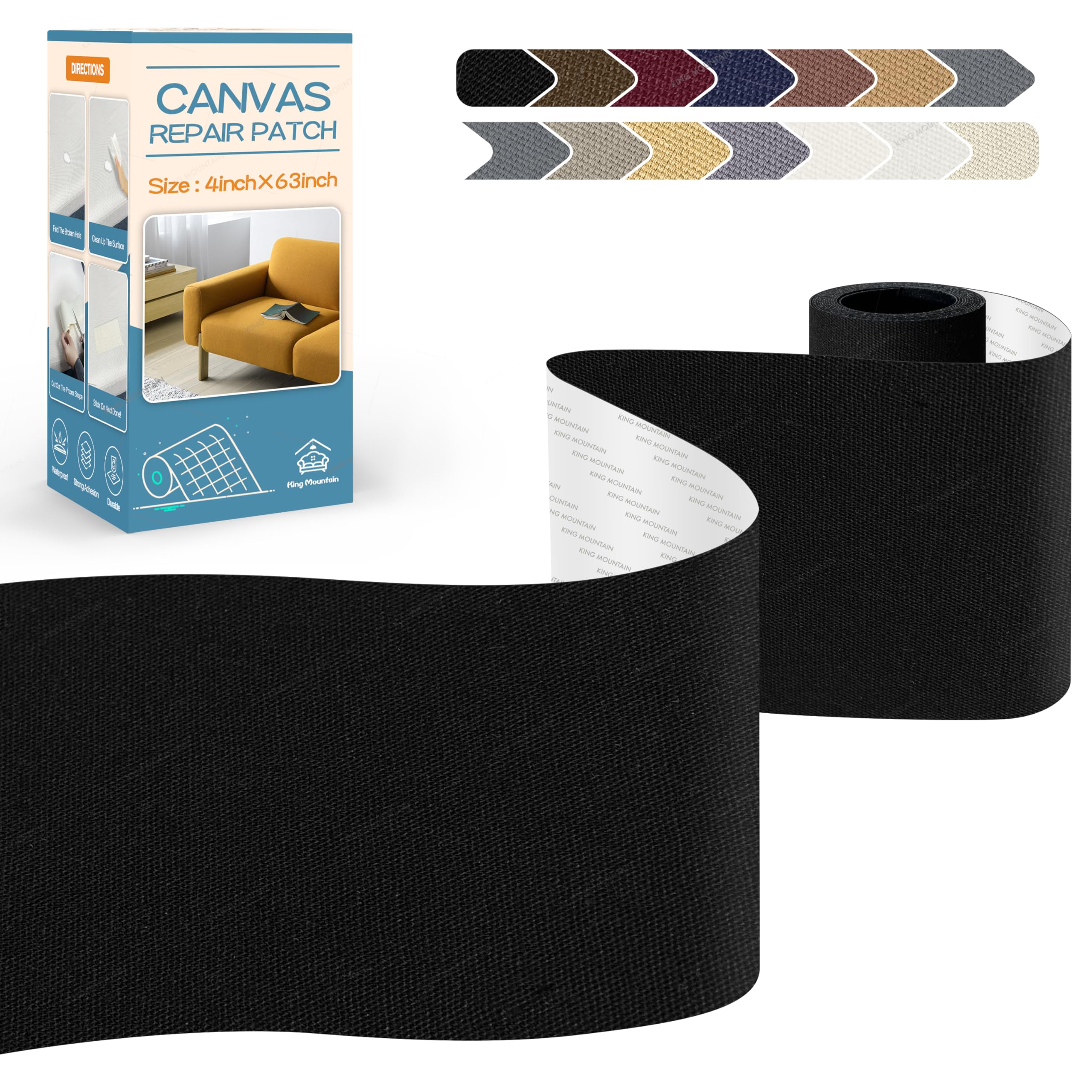
KING MOUNTAIN Canvas Repair Tape

89 /100
Angler Score Excellent

Key details

Material
Cotton canvas
Roll Size
4" x 63"
Thickness
0.6 mm
Water Resistance
Waterproof
Check Details on Amazon

This is the wrong tape for a nylon backpacking tent and the right one for a canvas bell tent, a polycotton wall tent, or a set of canvas chairs — and the difference is material, not quality. The 0.6 mm cotton canvas face bonds to cotton and to the heavy coated fabrics on awnings, covers, and boat tops; it does not behave like a nylon patch on a silicone-treated fly.

Thickness is the whole point. Four inches wide with a woven face that shrugs off abrasion, it's built for surfaces that get dragged across a deck or a patio. On a thin tent panel that same thickness can catch on a zipper or a stuff sack, which is another reason to keep it off lightweight gear.

The sun is its weakness. Black canvas facing the sky goes gray-brown, and the darker and more saturated the color, the more obvious the drift — navy bleaches noticeably faster than tan. The repair keeps holding while the color goes, so this is a tape for a panel nobody photographs: the underside of a cover, a chair seat, the shaded side of a wall tent.

Length is generous. Sixty-three inches on a 4-inch roll runs a single strip along a hem or a full seam, and we appreciate that the fabric backing cuts cleanly with household scissors rather than needing a blade kept for the purpose.

Pros

  • Thick woven canvas resists abrasion
  • Bonds to cotton, duck, and awning fabric
  • 63-inch roll covers a long rip
  • Waterproof coating on the canvas face

Cons

  • Color can arrive off from the photo
Our verdict

Canvas tents, awnings, and covers only: the woven cotton face bonds where a nylon patch won't, and it takes real abrasion.

Check Latest Price
5

Best Clear Tape

GEAR AID Tenacious Tape Roll

88 /100
Angler Score Excellent

Key details

Color
Clear
Roll Size
3" x 20"
Machine Washable
After 24 hours
Water Resistance
Waterproof
Check Details on Amazon

Clear is a specific need rather than a general upgrade: a pale fly, a vinyl window panel, a rainfly that shouldn't end up with a black rectangle across it. This is the roll for those — 3 inches by 20 inches, cut to size, with a waterproof coating on the face.

Adhesion is the split on this one, and it's worth knowing before you commit. On clean, dry, taut nylon the bond is strong enough that placing it wrong is a real problem; on a dusty footprint or a fabric with a fresh water-repellent finish, edges can lift. What we found is that prep decides it — wipe the panel, let it dry fully, and give it a full minute of thumb pressure, especially at the corners.

The waterproof coating earns its keep on a fly, where rain beads instead of wicking through the patch, and the roll is rated machine washable after 24 hours, which matters if the tear turns out to be on a shell rather than a tent. It is clear rather than invisible: on a soft, wrinkled panel the film shows as a shine, and against a matte fabric it reads as a shiny patch.

Pros

  • Clear film suits pale flies and window panels
  • Waterproof coating keeps rain beading
  • Rated machine washable after 24 hours

Cons

  • Only 3 inches wide for big tears
Our verdict

This is the clear tape we hand someone with a pale fly: it keeps rain out and doesn't announce the repair in black.

Check Latest Price
6

Beige Canvas Gear

Gheeidau Canvas Repair Tape

86 /100
Angler Score Excellent

Key details

Color
Light beige
Material
Waterproof cotton canvas
Roll Size
4" x 70"
Thickness
0.6 mm
Check Details on Amazon

Light beige is the reason to choose this over the black canvas roll. On a sand-colored awning, a tan boat cover, or an older canvas tent that has already faded toward gray, a beige strip reads as a repair rather than a black bar across the panel.

The canvas is 0.6 mm with a double waterproof coating, and it cuts cleanly with kitchen scissors — which is the whole technique with a canvas tape: cut a shape, peel, press, work the edges down. The woven face also takes abrasion on a seat or a cover that gets sat on, so it holds up where a thin film would scuff through.

What we like is that it behaves like fabric rather than film: it bends around a cushion corner and takes a fold without cracking. What it needs is a genuinely clean, dry panel. Canvas covers and awnings are usually dusty, and this adhesive will not forgive that — wipe the surface down, let it dry, and the corners stay.

Pros

  • Beige blends on sand-colored canvas
  • Waterproof coating on both layers
  • Cuts and folds like fabric

Cons

  • Beige darkens toward brown in strong sun
Our verdict

A beige canvas tape for sand-colored covers and older faded tents, where a black strip would be the first thing anyone sees.

Check Latest Price
7

Tarps and Covers

Tikfoam Heavy Duty Repair Tape

87 /100
Angler Score Excellent

Key details

Color
Clear
Material
PET film
Roll Size
4" x 10 ft
Water Resistance
Waterproof
Check Details on Amazon

Four inches wide and thick enough to feel like a strip of plastic rather than tape — that's the pitch, and it's the right one for a tarp, a groundsheet, a trailer cover, or a flat panel that has to shed water. It is not the tape for a fly you'll fold small.

Water is where this earns its place. Of the picks here it has the most consistent record of keeping rain out, and the film is stiff enough to bridge a hole rather than sag into it — a real advantage on a puncture in a tarp or a cracked vent cover, where a thin tape would dish under standing water.

Ten feet on a 4-inch roll is a lot of repair, and because it's a roll you can cut a strip as long as the damage instead of tiling patches. That makes it the one we keep for tarps and covers, and, on a tent, the tape that goes to the groundsheet rather than the fly.

Pros

  • Thick film bridges holes and stays flat
  • Most consistent rain-keeping record here
  • 4-inch by 10-foot roll covers a long split

Cons

  • Lifts along an edge on curved panels
Our verdict

Keep this stiff clear film for tarps and groundsheets, where a wide waterproof strip that bridges a hole beats a supple patch.

Check Latest Price

How We Tested Tent Repair Tape in the Field (and in the Rain)

We started with more than 40 tapes and patch kits sold for gear repair, then filtered hard: if a listing didn't say what fabric the tape was made for, or arrived as a single patch with no backing, it was out. We compared nylon, canvas, and clear options across roll widths, patch sizes, color offerings, and price, and bought 16 to test.

Testing ran five months, in the places tents actually fail. That meant a backyard setup that stayed up through a week of rain, two weekend trips, and a retired tent we tore on purpose — a pinhole, a four-inch L-shaped rip across the door, a frayed hem, and a seam that had started to separate. We timed every application one-handed and again in wind with a headlamp, since that's usually how it goes.

Adhesion got checked at 24 hours, after a soak, and again a week later; we noted which edges lifted and which corners curled. Samples were left on a south-facing deck for six weeks to see how quickly colors chalked or faded, and we held each patch against the tent fabric in daylight and shade to judge color match. At the end of each repair we hosed the panel for five minutes and looked inside for damp. Size mattered more than we expected: a narrow roll needed two overlapping passes on bigger tears, while multi-size patch kits covered a rip in one go, and we logged how easily backing paper peeled and whether the tape wrinkled when smoothed.

The tapes that scored best are still on those tents now. We check them each season and update this list when something finally gives.

How to Choose Tent Repair Tape

Match the Tape to the Fabric First

The most useful thing you can do before ordering is read the tent's material. Coated nylon and polyester — nearly every backpacking tent — want a thin nylon patch, like the OAZ sheets or the Cahomo roll; the adhesive is built for those fabrics and the film stays supple. Cotton duck, polycotton, and the coated canvas on awnings and covers want a woven canvas tape, which is where the KING MOUNTAIN and Gheeidau rolls earn their place.

The trap: a canvas tape will not bond to a silicone-treated nylon fly, and a thin nylon strip on heavy duck flexes until it peels. They are not interchangeable, and no amount of pressing changes that.

Adhesion Is Decided Before You Press

Almost every repair that fails comes down to the surface rather than the tape. Dust, sand, old waterproofing, and yesterday's rain all sit between the adhesive and the fabric. Wipe the panel with a damp cloth and let it dry completely, cut the patch with rounded corners rather than square points, and press from the middle outward for a full minute. On a cold morning, warm the panel with your hand first.

A square corner on a dusty fly is the classic way to lose a patch on the first windy night.

Roll or Pre-Cut Patches

Tear shape decides this one. A long split along a seam or a pole sleeve is a job for a roll: a continuous strip has two edges instead of eight, and edges are what lift. A pinhole, a spark hole, or any repair you'll make standing up in the wind is a job for pre-cut patches you peel and press without scissors.

Width matters as much as length. Three inches is the practical minimum for a linear tear, and a gash wider than about four inches wants a sheet you can cut to shape rather than a strip you tile.

Waterproofing, Sun, and Visibility

A patch has two jobs: hold, and keep rain on the outside. Clear film tapes are the most reliably waterproof of the group because the coating is continuous, which is why they suit tarps and groundsheets. Coated fabric tapes shed water but fade — black and navy canvas go gray-brown on a sun-facing cover within a season, so put them where the sun doesn't land.

Then decide about looks. Black on a dark fly disappears, black on sand is a label, and clear film shines on matte fabric.

Frequently Asked Questions

Final Verdict

Start with the OAZ patches. Eight waterproof nylon sheets give you enough material to cut a shape that matches the tear with an inch of overlap all round and spares left in the bag, and that combination is what fixes a real rip rather than a pinhole.

If the damage runs in a line, take the Cahomo roll instead: 79 inches of the same nylon in a 3-inch strip covers a split along a sleeve in one pass. And if your tent is canvas, skip both and buy the KING MOUNTAIN — a nylon patch has no business on cotton duck.