Best Tent Stoves of 2026

A tent stove is a wood stove shrunk to carrying size: a metal box, a few feet of pipe, and a fire you feed by hand. The box is rarely the problem. What separates a good one from a miserable one is everything around it — pipe joints tight enough that smoke goes up the chimney instead of into your sleeping bag, a door that seals but still opens with gloves on, legs that hold steady in the dark. Get those right and a freezing night becomes the reason you went.

We've now run 10 of these stoves through eight months of cold-weather camping, and the pattern holds: the models that cost a little more earn it back in draft, in how long a load of wood burns, and in whether they still seal after a season of wet pack-outs. My advice to a first-time buyer: size the firebox to your tent, not your ambitions — too big and the stove chases you out at 2 a.m., too small and it never catches up. The picks below cover both ends.

1

Best Overall

OneTigris Tiger Roar

83 /100
Angler Score Excellent

Key details

Glass
Schott ROBAX
Weight
22 lb
Chimney
7 sections plus 4 elbows
Body Material
304 stainless steel
Check Details on Amazon

The four elbow sections are the first thing we look at on the Tiger Roar. They let you route the flue around an off-center stove jack or step the pipe out under a low canopy, which is more useful in a real hot tent than another inch of firebox.

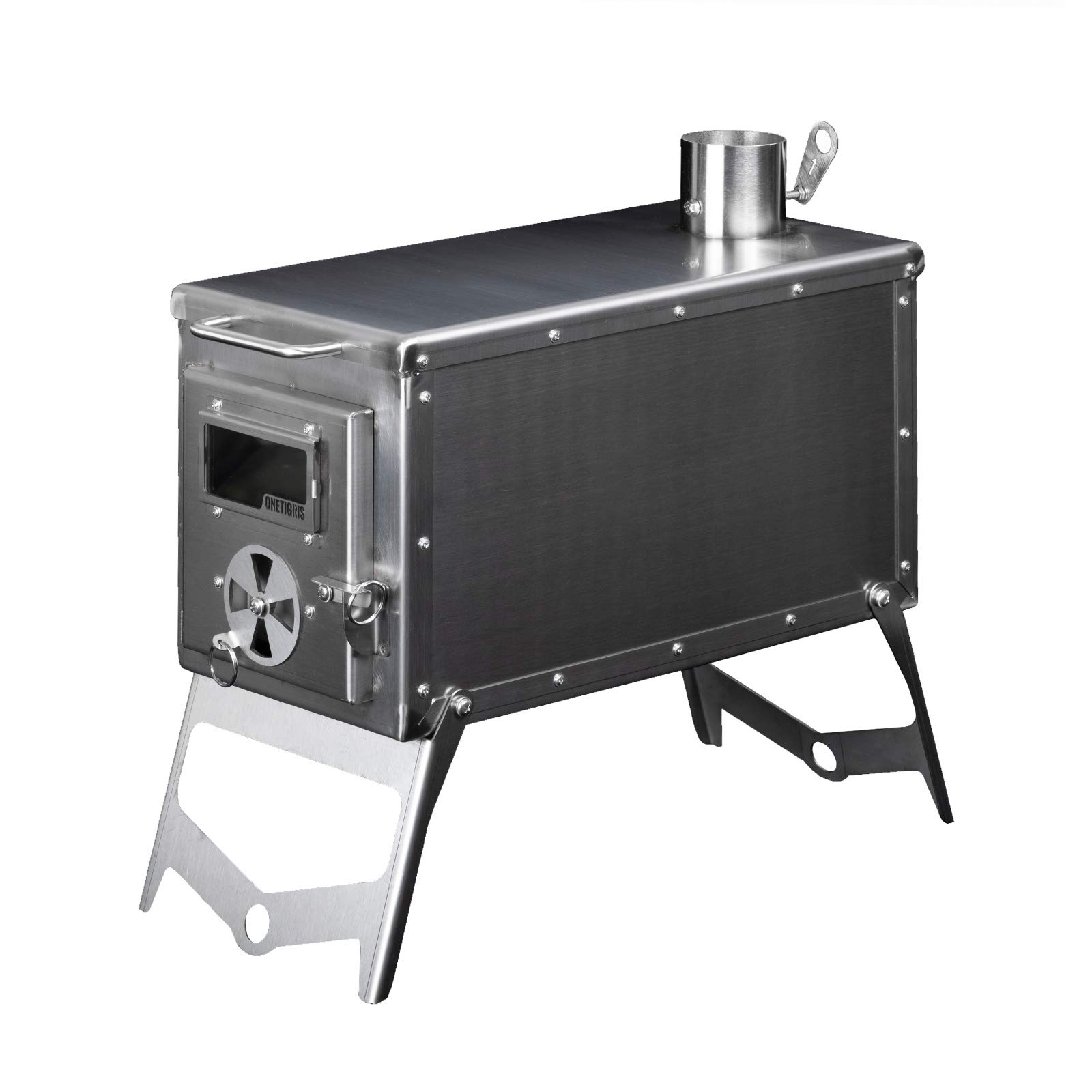
The rest of the stove is built to match. The body is 304 stainless steel, the top plate is 3 mm thick, and the door uses Schott ROBAX glass; the air-intake valve splits flow up and down so you can shift between a fast, bright fire and a slower one. We appreciate that the glass is a heat-rated panel rather than a decorative window, and the exhaust guide is aimed at keeping sparks and embers out of the flue.

At 10 kg / 22 lb, this is a car-camping stove, and that is the trade-off we accept for the way it is built. The weight buys thicker steel and a body that feels planted rather than tinny, and the 10.6 x 8.5 x 17.3-inch footprint still tucks into a corner of a small hot tent. For most hot-tent campers, this is the one we reach for first: it has the heat, the glass, and the flue parts to handle a real trip without a bag of adapters.

Cooking is straightforward on the flat top, and the glass door is the detail we keep coming back to. You can read the fire without opening the door and pulling smoke into the tent, which matters more on a cold night than another gadget.

Pros

  • 304 stainless body with 3 mm top
  • Four elbows allow flexible flue routing
  • Schott ROBAX heat-rated glass door
  • Air-intake valve and exhaust guide

Cons

  • Long multi-section flue takes time to assemble
Our verdict

For most hot-tent campers, this is the stove we recommend: a stout stainless body, useful flue elbows, and heat that holds up in cold weather.

Check Latest Price
2

Best Ultralight

FireHiking Titanium Stove

85 /100
Angler Score Excellent

Key details

Damper
Adjustable
Weight
4 lb
Viewing
Glass side windows
Material
Titanium (TA1)
Check Details on Amazon

At 4 pounds, the FireHiking is the one stove here we treat as backpacking gear rather than car camping gear. The body and legs fold, the titanium is TA1 grade, and the whole thing packs into a space that disappears alongside a sleeping bag. That is the reason it earns a place: it makes a hot tent possible on trips where every other stove in this group is too much to carry.

The design is not just light. The side glass lets you watch the fire, the damper gives you control over the burn, and the folding legs remove the loose hardware that can go missing in the dark. The titanium is heat-resistant and corrosion-resistant, and the compact body is built to throw heat quickly; the damper lets you slow it down when you want a longer fire. We also appreciate that the glass door lets you check the fire without opening the stove and losing the heat you just built.

The flue is the fussy part. The pipe sections have to be rolled and fitted, and that takes patience, especially in the cold. That is the trade-off for the packable design, and it is one we accept when the stove has to travel light. Do a dry run at home before you try to roll pipe in the dark.

Pros

  • 4-pound titanium body
  • Folds without loose hardware
  • Strong heat with adjustable damper
  • Glass window for fire viewing

Cons

  • Titanium panels can dent if handled roughly
Our verdict

If the stove has to go in a pack, this is the one: a 4-pound titanium body, real heat, and a folding design that disappears into a backpack.

Check Latest Price
3

Best Budget

VEVOR 640 cu in Stove

85 /100
Angler Score Excellent

Key details

Weight
11.7 lb
Chimney
8 pipes
Firebox
640 in³
Heating Area
Up to 100 sq ft
Check Details on Amazon

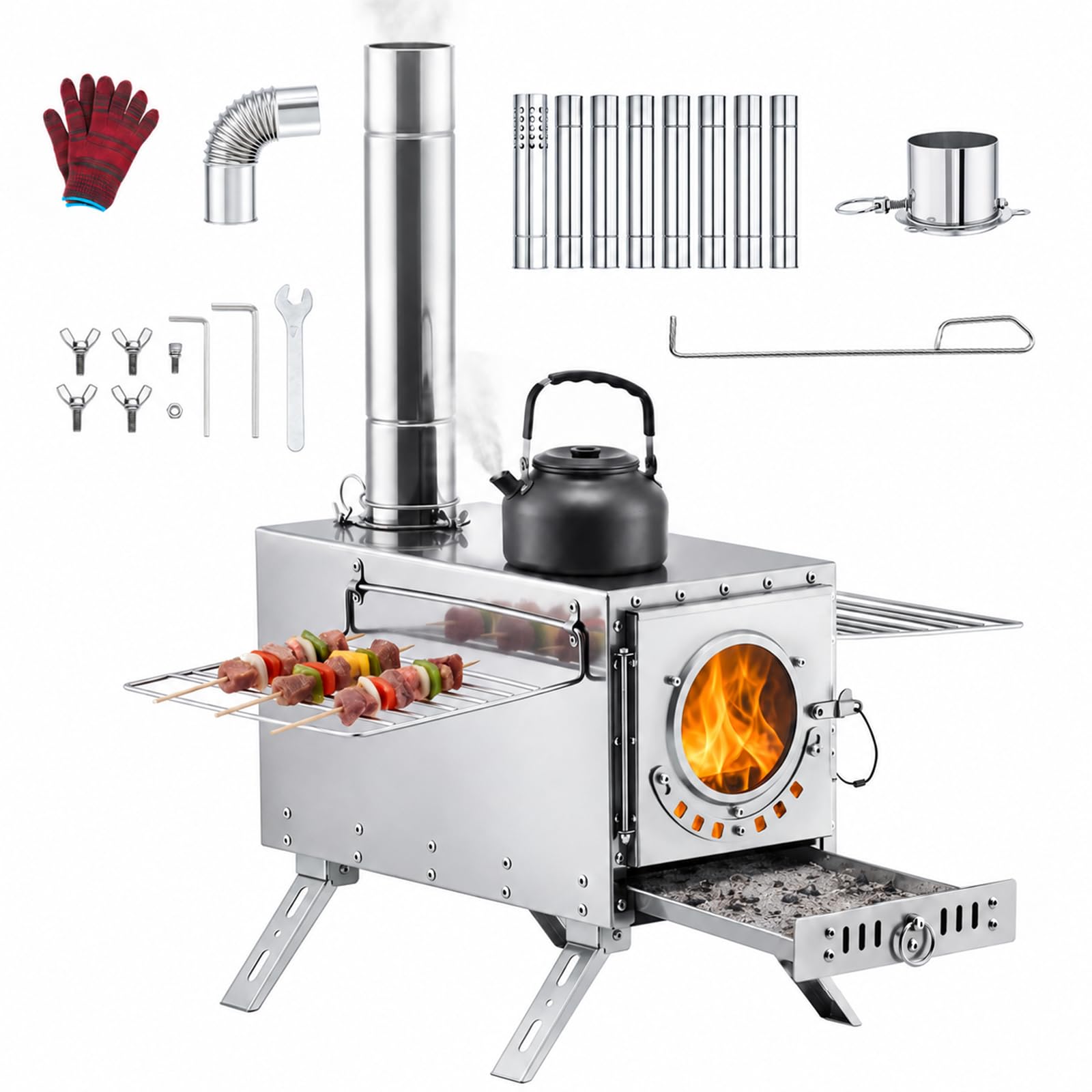
A first-time hot-tent camper does not need a titanium showpiece; they need a stove that lights, heats, and does not cost a fortune. The VEVOR arrives as a full kit: 640-cubic-inch firebox, eight chimney pipes, rain cap, gloves, stove bag, and two cooking shelves.

We recommend it as the budget starting point because the assembly is simple and the shelves turn the top into a usable cooking surface. At 11.7 pounds, it is light enough to move around camp, and the eight pipe sections give you more height to work with than many cheap kits. The 1 mm stainless panels are easy to wipe down and less fussy than painted steel.

The door is the weak point. It can fit loosely, and without a gasket it lets air and smoke past the opening; check the latch and run a test burn outdoors before you trust it in the tent. The stove also rewards small, dry splits, because a packed firebox can smother the draft.

The shelves are the part we use most: they turn a basic heater into a place to set a pot and keep dinner moving. For a first stove, the value is in the size of the kit, not in a polished fit and finish.

Pros

  • 640-cubic-inch firebox
  • Eight chimney pipes and accessories
  • Simple assembly with usable shelves
  • Lowest price tier here

Cons

  • Firebox needs frequent refueling
Our verdict

The VEVOR is the budget pick for a reason: a large firebox, eight pipe sections, and simple assembly make it an easy first hot-tent stove.

Check Latest Price
4

Best for Wall Tents

VEVOR 3000 cu in Stove

84 /100
Angler Score Excellent

Key details

Weight
58.6 lb
Firebox
3000 in³
Cooking Shelves
7 x 20 in
Panel Thickness
3 mm
Check Details on Amazon

A 3000-cubic-inch firebox tells you what this stove is for before you read another spec. It swallows larger splits, holds heat in a big canvas tent, and gives you a cooking surface that does not feel like an afterthought. That is the reason it earns a place in a roundup of portable stoves: it is the one that turns a wall tent into a base camp.

The 3 mm alloy steel panels and eight-pipe chimney are the details that make it feel substantial. The spark arrestor and powder-coated body are aimed at the sparks and odors that come with a big fire, and the firebox is sized for real firewood rather than kindling. The detachable 7 x 20 inch shelves add a useful cooking surface without making the stove harder to load.

The shelves are the part that turns this into a camp kitchen. You can set a pot, a kettle, and a pan on the same stove, and the surface is wide enough to move a pan without knocking the kettle. This is a stove for a camp that stays put and cooks in.

Pros

  • 3000-cubic-inch firebox
  • 3 mm alloy steel panels
  • Large 7 x 20 in cooking shelves
  • Eight chimney pipes included

Cons

  • 58.6-pound body is vehicle-bound
Our verdict

For a wall tent or a base camp that does not move, this VEVOR is the sensible buy: a huge firebox, thick steel, and room to cook that make it a proper camp kitchen.

Check Latest Price
5

Best for Cooking

Gonex Hot Tent Stove

83 /100
Angler Score Excellent

Key details

Weight
23.8 lb
Firebox
16.9 x 10 x 9.5 in
Material
1 mm stainless steel
Chimney Height
72.8 in
Check Details on Amazon

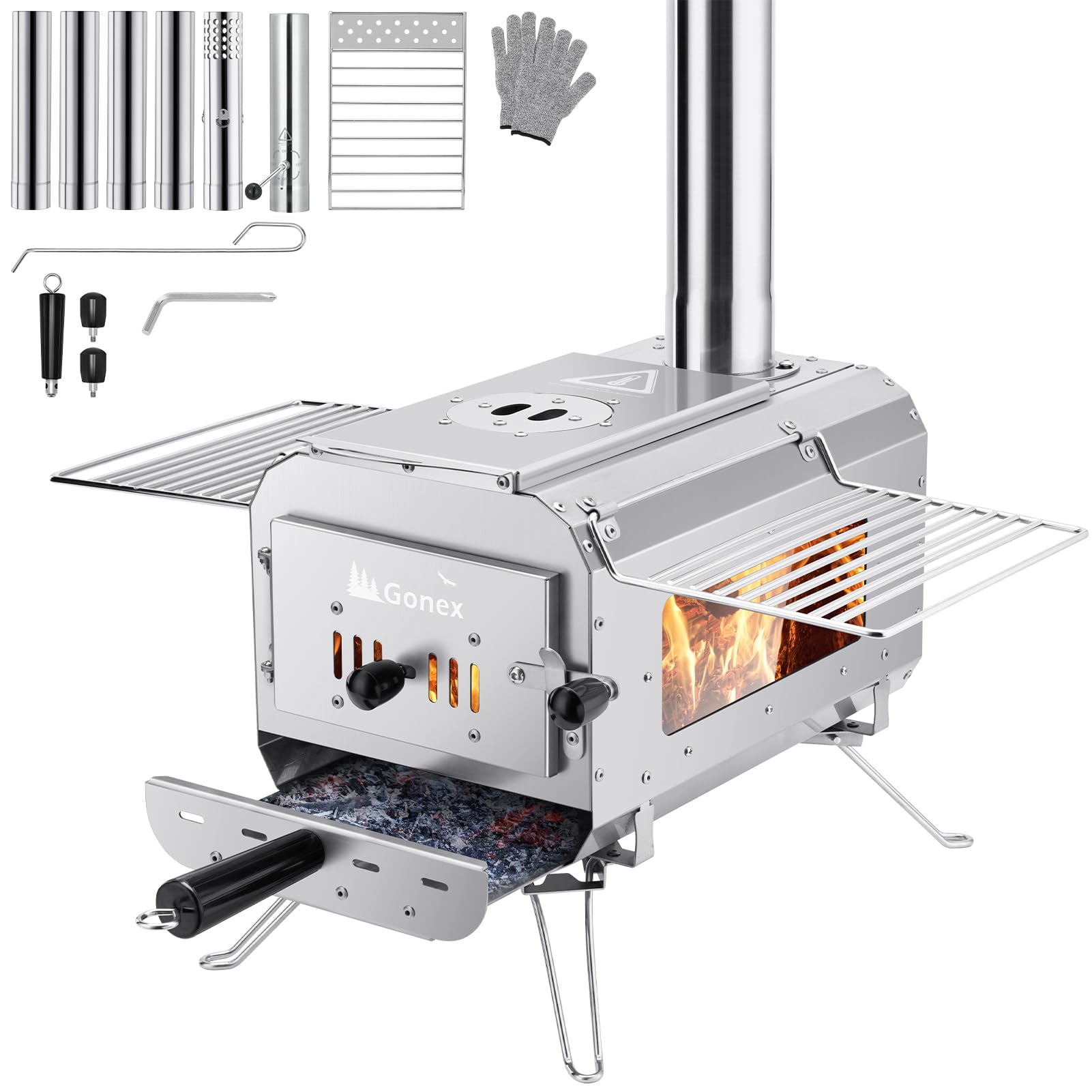
The ash drawer is the first thing we look for on a stove that will be used for a weekend, not just an emergency warm-up. Pull it out, dump the ash, and you avoid raking through a hot firebox before the next fire.

The Gonex is built for that kind of camp cooking. The foldable grill and wide lid give you more than a flat top, and the dual air inlets let you dial in the burn. The 16.9 x 10 x 9.5-inch firebox is a sensible size for a small group, and the rear anti-clog structure is there to keep ash from choking the burn.

The 72.8-inch chimney and crescent damper are meant to keep rain and backflow out, and the chimney is tall enough to clear a typical hot-tent roof. The side glass earns its keep on a cold morning: you can read the fire without opening the door and losing the heat you just built. The wide lid is what makes breakfast possible, but the glass is what makes the stove easy to live with.

Pros

  • Pull-out ash drawer simplifies cleanup
  • Foldable grill and wide cooking lid
  • Dual air inlets for burn control
  • 72.8-inch chimney with crescent damper

Cons

  • 23.8 pounds is more than a backpacking load
Our verdict

For car campers who cook as much as they heat, the Gonex is a smart middle choice, with an ash drawer, a useful top, and a chimney designed to keep rain and backflow out.

Check Latest Price
6

Best for Small Tents

tounto Tent Stove

81 /100
Angler Score Excellent

Key details

Weight
17.9 lb
Firebox
15.2 x 7.7 x 8.5 in
Material
Stainless steel
Heating Area
Up to 150 sq ft
Check Details on Amazon

The tounto is a compact stove, and we mean that literally: its firebox is 15.2 x 7.7 x 8.5 inches. In a one- or two-person hot tent, that is enough to take the edge off a cold morning and boil water for coffee.

Speed is the first advantage. Open the four feet, slide in the chimney, set the ceramic glass, and the stove is ready; the whole kit is 17.9 pounds, so it moves around camp without a struggle. The flat cooktop is a real benefit on a small stove, and the sliding damper gives you some control over the flame.

The glass door and rain cap are welcome details at this price tier, and the stainless body is easy to wipe down. The firebox is small enough that you want short splits, and the stainless frame cover keeps the look tidy after a few trips.

For a solo camper or a couple in a small tent, the fast setup and low-fuss kit make it an easy stove to live with. The 17.9-pound kit is light enough to move from truck to tent and stores small enough to leave in the vehicle between trips.

Pros

  • Fast two-minute setup
  • 17.9-pound kit is easy to move
  • Flat cooktop and glass door
  • Stainless body wipes down easily

Cons

  • Small firebox needs frequent refueling
  • 150-square-foot rating is optimistic for larger tents
Our verdict

A good fit for a solo camper or a small tent: the tounto sets up fast, heats quickly, and gives you a flat cooktop in a compact kit.

Check Latest Price
7

Off-Center Stove Jacks

Ytaoeo Tent Stove

85 /100
Angler Score Excellent

Key details

Elbow
90° included
Chimney
8 sections, 2.36 in diameter
Firebox
15.6 x 11.7 x 12.6 in
Ash Drawer
Pull-out
Check Details on Amazon

The 90-degree elbow is the reason this stove stands out in a group of straight-up chimney kits. It lets you turn the flue under a low roof or angle it toward a jack that is not directly above the stove, which is the sort of problem that decides whether a stove works in a particular tent.

The rest of the kit is practical: eight 2.36-inch chimney sections, a pull-out ash tray, folding legs and side shelves, and a fire grate. The ash tray makes cleanup easier, and the folding shelves pack flat with the stove.

Heat output is strong for a compact stove, and the top is set up for cooking. The fire grate helps air get under the wood, and the ash tray slides out without moving the stove. The eight chimney sections and elbow give you more routing options than most stoves at this level, and the folding side shelves are the detail that earns its keep: they give you a spot for a mug and a spoon without adding a table.

Pros

  • 90-degree elbow for off-center jacks
  • Eight 2.36-inch chimney sections
  • Pull-out ash tray simplifies cleanup
  • Folding legs and shelves save space

Cons

  • Best suited to small and midsize tents
Our verdict

If your stove jack is off-center or your tent roof is low, the Ytaoeo's elbow and eight pipe sections make it the easiest to route, and the ash tray keeps cleanup simple.

Check Latest Price

How We Tested: Eight Months, Two Tents, Ten Stoves

We started with spec sheets for roughly 40 stoves and cut down from there. Packed weight, firebox volume, pipe diameter, how many pipe sections came in the box, and whether a damper and spark arrestor were included did most of the work — a stove that ships with too little pipe to clear your tent's peak isn't a bargain at any price. That left 10 models, which we bought outright so nothing came with strings attached.

Testing ran eight months, from the first cold snap in October through a wet spring, and every stove went into the same two shelters: a canvas wall tent with a factory stove jack and a smaller synthetic tent we fitted with an aftermarket one. We assembled each in the dark at least once, timing from unrolling the carry bag to the first lit fire, and noted which pipe sections needed two hands, which joints needed a twist before they sealed, and whether the pipe cleared the jack without wobbling. We also checked that each stove fit through the tent door and that the legs sat level on uneven ground.

Once lit, the questions got practical. We fed each stove the same mix of split softwood and hardwood, recorded how long a full firebox lasted before the tent cooled noticeably, and watched the pipe at startup and again when the wind shifted to see whether smoke rolled back down or leaked at the seams. We boiled water on every top plate and looked for hot spots and warping. In the morning we packed them away damp, then checked hinge play, rust along the seams, and whether the latch still worked one-handed with gloves on. Value came down to what was actually in the box: extra pipe, a damper, a scoop, or a bag you had to buy yourself.

How to Choose a Tent Stove for a Hot Tent

Match the firebox to the tent and the tending

We start with firebox size because it tells you how the stove will live. A 640-cubic-inch box like the VEVOR budget pick suits a solo camper or a small hot tent, but it needs more frequent feeding than a big box. The 3000-cubic-inch VEVOR is a wall-tent tool: it takes longer splits, holds more heat, and stays at the truck. Decide how often you want to get up in the night before you decide how much stove you can carry.

A claimed heating area is useful only when it matches the tent's real volume and insulation. A 150-square-foot rating on a small stove does not make it a wall-tent heater; the firebox size and burn rate tell the truer story.

Decide whether portable means backpack or truck

Portable covers everything from a 4-pound titanium stove to a 58.6-pound base-camp heater. We treat the FireHiking as backpacking gear because it folds into a pack at 4 pounds, while the 11.7-pound VEVOR and 23.8-pound Gonex are vehicle-to-tent stoves. If you hike in, weight and packed size come before cooking surface. If you drive in, a heavier stove buys thicker steel, a bigger firebox, and a more stable base.

Plan the flue around your stove jack

Chimney routing is where a stove either fits your tent or does not. Measure the distance from the stove to the jack and the height you need, then count the sections and elbows. A 90-degree elbow, as on the Ytaoeo, solves an off-center jack; four elbows on the OneTigris give you more ways to step around a low roof. Keep bends to a minimum and support the pipe, because every joint is a place for smoke to escape.

Treat smoke as a sealing and draft problem

Smoke in the tent usually comes from a cold flue, a loose door, or an unsealed pipe joint, not from the idea of a wood stove. Cure the paint outdoors before the first in-tent burn, check the door latch and gasket, and warm the flue with a small hot fire before you close the damper. We also want a carbon monoxide alarm in any tent with a burning stove, regardless of how well the stove is built.

Decide how much cooking and cleanup you need

A flat top is enough for a kettle; a stove with side shelves, a grill, or an ash drawer is a different kind of camp kitchen. The Gonex and VEVOR 3000 make cooking a real part of the purchase, while the tounto keeps it simple with a flat cooktop and glass door. An ash drawer is worth paying for if you will use the stove for several mornings in a row, because cleanup is the job that gets old first.

Frequently Asked Questions

Final Verdict

Start with the OneTigris Tiger Roar if you want one stove for most hot-tent trips: its stainless body, glass door, and four elbows make it easier to live with than the straight-pipe budget kits, and it has the heat to carry a small canvas tent. If you are carrying the stove on your back, choose the FireHiking Titanium instead; the 4-pound body changes the trip more than any cooking feature.

For a wall tent that stays put, the VEVOR 3000's firebox and shelves are the practical choice. It is not a backpacking stove, and it is not meant to be.