Best Vacuum Sealer Bags of 2026

A vacuum sealer is only as good as the bag you clip into it. The machine pulls the air and fuses the seam, but the bag has to hold that vacuum through a slammed freezer door, a shifting stack of frozen chili, and the slow creep of air that turns a good steak gray. When a bag fails, you find out months later, with dinner already ruined. The right bag is what keeps a full freezer worth eating from.

I learned that the annoying way, after a batch of portioned ground beef went icy inside a bag that looked sealed at the time. Since then my team and I have run 16 bags and roll sets through my kitchen over five months, weighing thickness, seal strength, size variety, and cost per usable bag. Here's what surprised me: thickness gets all the attention, but the embossed air channel and the width of the seam do more of the work, especially with wet fillings like stew. The picks below are sorted by how you actually cook.

1

Best Overall

FoodSaver Custom Length Roll Multipack

96 /100
Angler Score Outstanding

Key details

Care
Freezer, microwave, dishwasher safe
Material
BPA-free multi-ply
Roll Sizes
8" x 20' (2 rolls), 11" x 20' (3 rolls)
Sealer Compatibility
FoodSaver systems
Check Details on Amazon

Two widths in one box is why this multipack is our top pick. You get three 11-inch rolls and two 8-inch rolls, each 20 feet, so a whole pork loin and a single steak both end up in plastic that actually fits them instead of a loose skirt of bag around the food. Cut-to-length also means you stop buying sizes you never use.

Sealing is the part you can't fix later, and among the picks here this one's seal is among the steadiest — which is what the brand premium buys you. The multi-ply film stays pliable enough to pull down over odd shapes rather than tenting at the corners, and it's BPA-free for raw and cooked food, the freezer, the microwave and the dishwasher. Made in the U.S. is a small extra we noticed and appreciated.

The 11-inch width earns its place more often than you might expect: a roast, a whole chicken, a bundle of asparagus. The 8-inch roll handles chops and single servings without wasting a foot of material, and both rolls feed easily from the machine's dispenser.

What you give up is money and speed. These run more per foot than the third-party bags here, and every bag needs a cut and two seals instead of one. If your freezer is mostly quart portions, a precut box is the smarter buy. For everything else, this is the box we keep on the shelf.

Pros

  • Two widths cover whole cuts and single portions
  • Sealing among the steadiest in this group
  • Pliable multi-ply film handles odd shapes
  • BPA-free, freezer, microwave and dishwasher safe

Cons

  • Costs more per foot than third-party rolls
  • Every bag needs a cut and two seals
Our verdict

We recommend the FoodSaver multipack to anyone with a FoodSaver-style sealer who bags whole cuts as often as portions: two widths, a pliable film, and no guessing which roll size to buy.

Check Latest Price
2

Best Quart Box

Wevac 8x12 Quart Bags, 100 Count

95 /100
Angler Score Outstanding

Key details

Count
100 precut bags
Bag Size
8" x 12" quart
Material
BPA-free polyethylene
Compatibility
FoodSaver, Seal-a-Meal, Nesco, Weston, Cabela's, Ziploc
Check Details on Amazon

One size, one hundred bags, one decision: if your freezer runs on quart portions, this is the simplest thing to buy. There's no roll to measure against or trim, no second seal to line up, and no half-used bag left over when the portion comes out smaller than you expected. That is worth more than it sounds on a Sunday when you're working through twenty pounds of ground beef.

The bags are 8 by 12 inches with embossed channels on one side to give the pump somewhere to draw, and Wevac rates them for FoodSaver, Seal-a-Meal, Nesco, Weston, Cabela's and Ziploc machines — the longest compatibility list of anything here. They're BPA-free and fine for sous vide, and the brand's no-questions return policy takes most of the risk out of a first box. The box itself weighs a little over two pounds, so it tucks onto a shelf.

Quart-only is the catch. Buy it if you portion ground beef, stew meat or batches of chili; skip it if you also freeze whole birds or single servings. It's also not the cheapest per bag in this group — the 200-count boxes from O2frepak and Bonsenkitchen undercut it — so what you pay extra for is a smaller box and a stronger record on the seal.

Pros

  • Precut bags need only one seal
  • Long compatibility list beyond FoodSaver
  • Strongest seal performance in this group
  • No-questions return policy from the brand

Cons

  • Quart size only
  • Costs more per bag than the 200-count boxes
Our verdict

We point quart-portion cooks to this 100-count box: one size, one seal, a machine list that covers the common sealers, and the strongest seal performance in this group.

Check Latest Price
3

Best Size Variety

Syntus 150-Piece Precut Bags

95 /100
Angler Score Outstanding

Key details

Count
150 bags, 50 of each
Material
BPA-free PA+PE
Thickness
4 mil
Sizes Included
6" x 10", 8" x 12", 11" x 16"
Check Details on Amazon

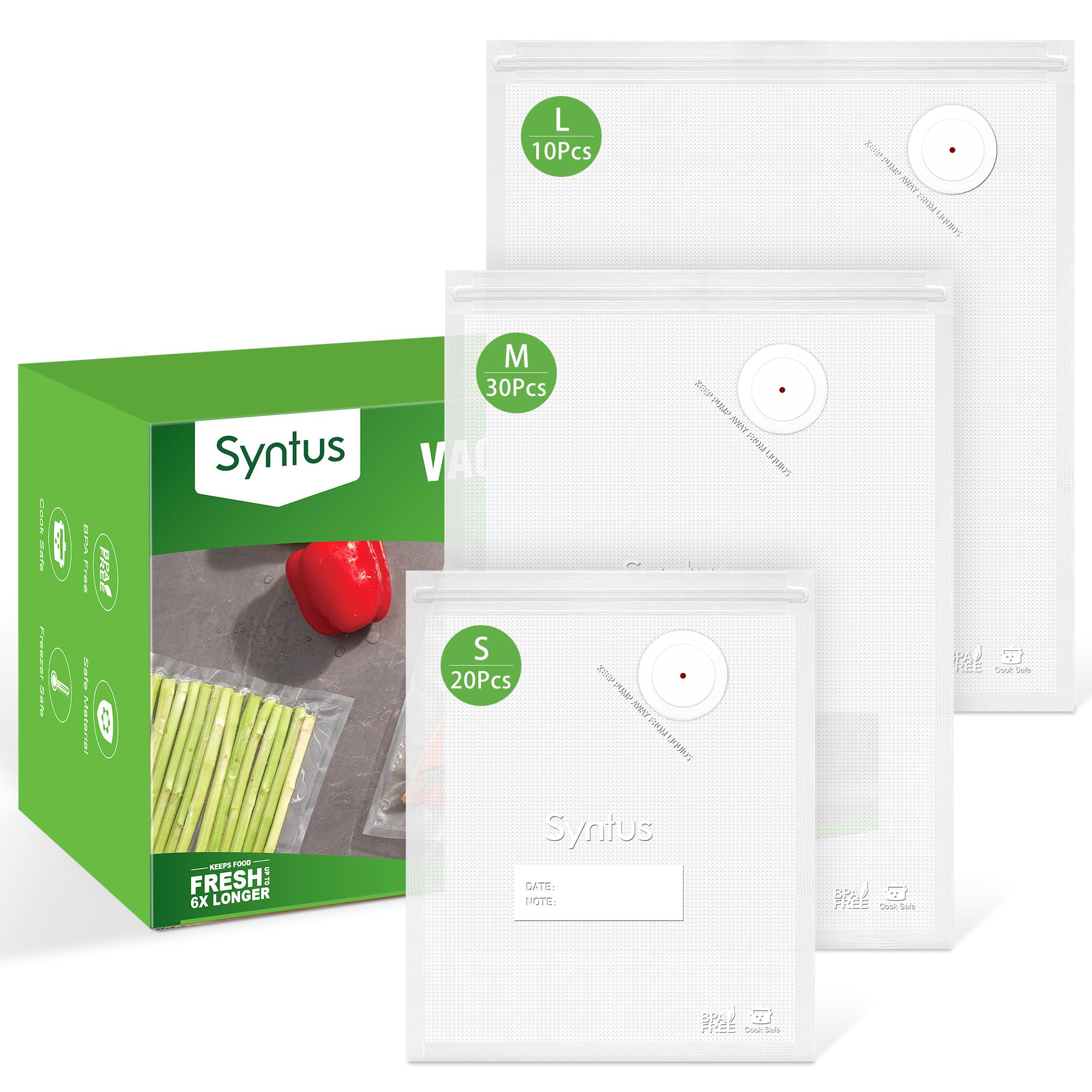
Fifty pint, fifty quart and fifty gallon bags in one box solves a problem you don't notice until you've bought three separate boxes: the bag has to match the food. The 6 by 10 pint takes a chicken breast or a single serving of stew, the 8 by 12 quart handles a pound of ground beef or a couple of steaks, and the 11 by 16 gallon swallows a whole bird or a batch of stock.

The film is 4 mil with a textured dot pattern on one side, which is what lets a clamp-style sealer pull air along the surface instead of choking on smooth plastic, and the bags arrive sealed on three sides so it's one heat seal and done. For a first box, or for a household that freezes everything from single servings to a holiday turkey, this is the mix we point people to — nothing else here covers all three sizes in one purchase.

Sealing is the softer half of the pitch: it is less consistent than on the FoodSaver rolls or Wevac's quart bags, and a firm 4 mil film rewards a sealer in good working order. Run one bag before you fill fifty. The 4.1-pound box also takes genuine shelf space, which is the price of not buying three boxes.

Pros

  • Three sizes in a single purchase
  • 4 mil film with textured channels
  • Precut bags, so one seal each

Cons

  • Seal consistency trails our top picks
  • Large box takes real shelf space
Our verdict

Buy this box when you can't predict what you'll freeze next: three usable sizes, a firm 4 mil film, and fifty bags of each, which is the mix most freezers actually need.

Check Latest Price
4

Best for Bone-In Cuts

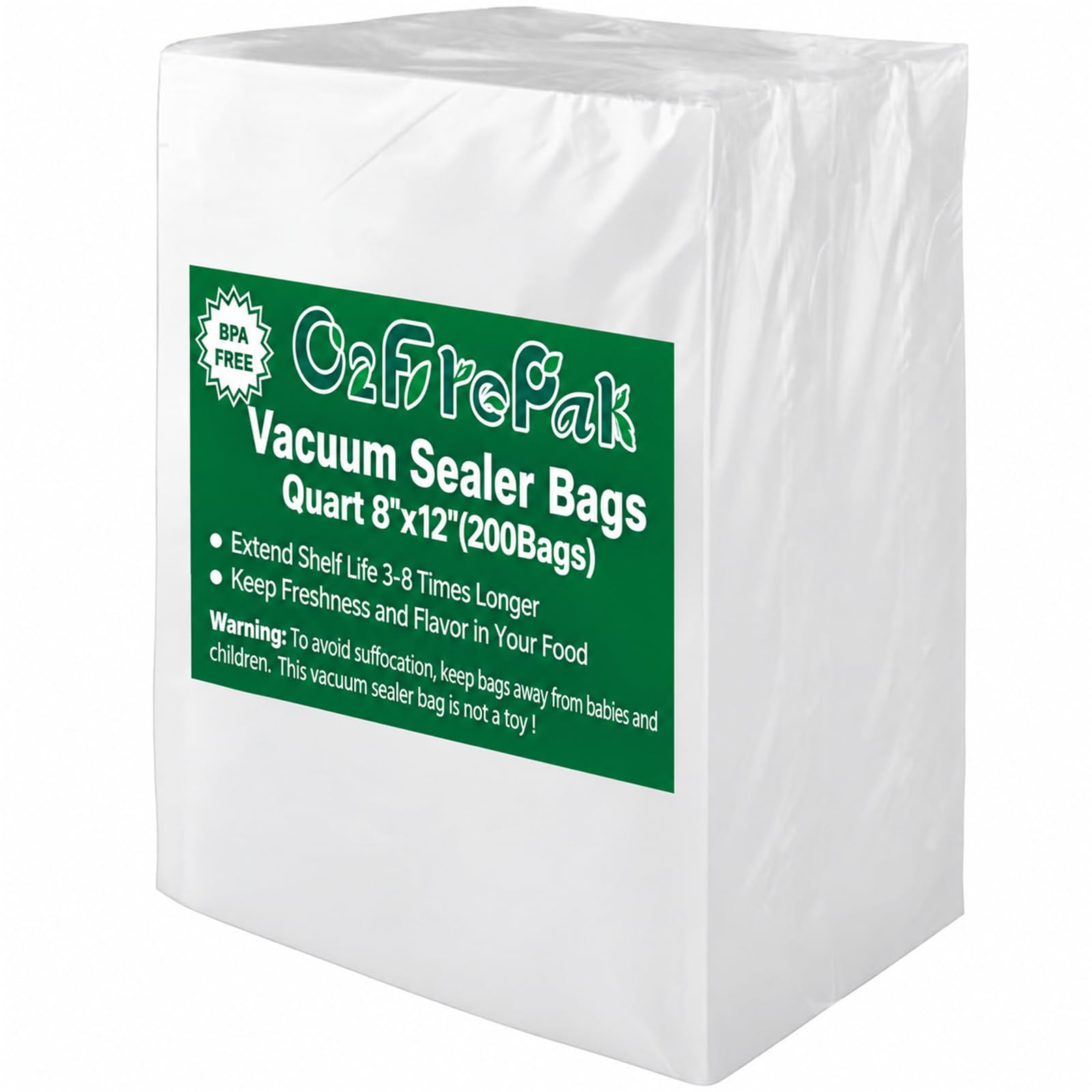
O2frepak 8x12 Quart Bags, 200 Count

95 /100
Angler Score Outstanding

Key details

Count
200 precut bags
Bag Size
8" x 12" quart
Material
Food-grade PA+PE
Thickness
3.5 mil front, 4 mil textured back
Check Details on Amazon

A 3.5 mil smooth front and a 4 mil textured back is the specification that earns this box its place. The embossed side gives a clamp sealer channels to draw along, the heavier smooth side resists a bone edge, and the bags are built with bone guards. For venison, ribs and anything with a joint still in it, that combination matters more than the count.

Two hundred quart bags is a serious supply — better than four and a half pounds of box — so it's a buy for a household that fills the freezer in one session, or for splitting with family after a successful season. They're rated for clamp-style machines, BPA-free, and safe for the freezer, microwave, boiling water and the dishwasher, which also makes them an easy sous vide bag.

The trade-off is that heavier film isn't automatically better. A stiff bag can defeat a sealer whose heater is on the way out, so run one bag before committing to two hundred. And quart-only means the whole cuts still go to a roll.

Pros

  • Two-panel film with a textured back
  • Bone guards for bony cuts
  • Boil, microwave and dishwasher safe

Cons

  • Quart size only
  • Thick film can defeat a weak sealer
Our verdict

This is the box we hand to hunters and bulk buyers: a two-panel film with a textured back, bone guards, and 200 quart bags to work through.

Check Latest Price
5

Best for Long Cuts

Wevac 8-Inch Rolls, 2-Pack

95 /100
Angler Score Outstanding

Key details

Material
BPA-free polyethylene
Roll Size
8" x 50' (2 rolls)
Total Length
100 feet
Compatibility
Suction heat sealers
Check Details on Amazon

Fifty feet of 8-inch roll, twice over, is enough that you stop rationing it — and enough that you have to think about where it lives. These are big rolls. If your machine has a built-in roll compartment, measure it before ordering, because a full roll of this diameter may not drop in; in that case the roll sits beside the sealer and you feed it by hand.

The film is BPA-free polyethylene with embossed channels, and Wevac rates it for suction heat sealers including FoodSaver, Seal-a-Meal, Nesco, Weston and Cabela's. It's fine for sous vide, and it's the same material as the brand's quart bags in a format that lets you cut a bag to fit a fish or a loin instead of trimming the food to fit the bag.

This is the pick for backstraps, whole mackerel, loins, and anyone who resents being told a bag is 12 inches when the food is 14. The single 8-inch width is the limitation; if you also want a wide roll for roasts and whole birds, the FoodSaver multipack covers both widths and adds that brand's seal consistency.

Pros

  • 100 feet of roll for custom lengths
  • Embossed channels for suction sealers
  • BPA-free and sous vide safe

Cons

  • Full rolls may not fit a machine compartment
  • 8-inch width only
Our verdict

We keep this one for whole fish and long cuts: 100 feet of 8-inch roll, cut to whatever length the catch needs, and enough footage to stop counting.

Check Latest Price
6

High-Volume Quart Sealing

Bonsenkitchen 8x12 Quart Bags, 200 Count

95 /100
Angler Score Outstanding

Key details

Care
Microwave, freezer, boil, dishwasher safe
Count
200 precut bags
Bag Size
8" x 12" quart
Thickness
4 mil
Check Details on Amazon

Deeper air passages than the competition is the claim on this box, and it's a claim about the embossing rather than the plastic: one side has recessed grooves, the other is glossy, and the grooves are where air travels before it reaches the pump. It's the kind of detail that decides whether a stubborn sealer pulls down on the first try.

At 4 mil and 200 bags, it sits in the middle of the precut group — a heavier smooth panel than O2frepak's front layer, without the bone guards. The bags are BPA-free and made for the microwave, freezer, boiling water and dishwasher, and the box weighs about four and a half pounds.

Where this earns its spot is as the plain quart box for a busy kitchen: ready to use, one seal, no decisions. It also works out cheapest per bag of the quart boxes here, which is what you want if you're sealing several times a week. What it doesn't give you is variety or extra protection for bony cuts.

Pros

  • Lowest per-bag cost among the quart boxes
  • 4 mil film with deep air channels
  • Washable and dishwasher safe

Cons

  • Quart size only
  • Seal consistency trails our top picks
Our verdict

We reach for this box when the freezer work is all quart portions: 200 precut bags, the lowest per-bag cost of the quart boxes here, and deep channels for a clamp sealer to pull.

Check Latest Price
7

Wide Cuts

EverFresh 11-Inch Rolls, 4-Pack

92 /100
Angler Score Outstanding

Key details

Care
Sous vide, boil-in-bag, microwave safe
Embossing
15% deeper than standard
Roll Size
11" x 25' (4 rolls)
Total Length
100 feet
Check Details on Amazon

Eleven inches wide and 25 feet long, in a four-pack: these rolls are built for the cuts that won't fit a quart bag. EverFresh specifies a 3.5 mil smooth layer and embossing it rates at 15% deeper than standard, which is the part that helps a clamp sealer pull a vacuum across a wide, awkward shape like a salmon side or a bone-in rib roast.

Four shorter rolls rather than two long ones is a small, likable choice — a 25-foot roll is easier to store and less likely to unspool across the counter, and you still get 100 feet in total. The bags are BPA-free and rated for sous vide, boiling and the microwave, with the sensible instruction to puncture the bag first if it goes in the microwave.

Fit is the caveat. These are thick rolls, and a full one may not sit in the dispenser compartment of a compact sealer, so check the compartment's width against the roll's diameter before ordering, or plan to feed the roll by hand.

For a freezer that fills up with whole fish, large roasts and big batches of stock, the extra width and the shorter rolls are worth it. If most of what you seal is single portions, an 8-inch bag uses less plastic and seals more easily, and the FoodSaver or Wevac rolls are the better fit.

Pros

  • 11-inch width fits large cuts
  • Four 25-foot rolls store more easily
  • Deeper embossing for a stronger pull
  • Boil and sous vide safe

Cons

  • Thick rolls may not fit a sealer dispenser
  • Sealing less consistent than our top picks
Our verdict

We like this one for wide, awkward cuts: an 11-inch roll, deeper embossing, and four shorter rolls that store more easily than a single long one.

Check Latest Price
8

Reusable Sous Vide

Syntus 60-Piece Reusable Bags

92 /100
Angler Score Outstanding

Key details

Count
60 zipper bags
Closure
Double zipper with clip
Compatibility
Valve sealers and handheld pumps
Sizes Included
8" x 10", 10" x 13.8", 11.8" x 13.8"
Check Details on Amazon

A zipper and a silicone valve instead of heat: these 60 bags close with a double zip and a supplied clip, then pull down through a valve that works with a handheld pump or a sealer's accessory hose. That's a different routine from a flat bag, and for some kitchens it's the one that actually gets used.

The assortment is 20 small at 8 by 10, 30 medium at 10 by 13.8 and 10 large at 11.8 by 13.8. The valve is adhesive-free, which is what lets the whole bag go under water in a sous vide bath instead of being clipped to the side of the pot, and the single-sided embossed channel helps the suction along. Everything is BPA-free.

Sealing is the strongest part of this design and the best-supported part of it here: a double zip does the holding and the valve only has to stay shut, so the seal holds up better than on any flat bag in this group. They wash and go again, and the three sizes run from a lunch portion to a whole roast.

The catches are cost and commitment. This is the most expensive set here, it only works with a machine that has an accessory port or a handheld pump, and you can't cut a bag down to fit a long fillet. For sous vide regulars and lunch prep, though, buying once and washing beats buying plastic by the hundred.

Pros

  • Reusable, washable zip-and-valve bags
  • Three sizes including an extra-large
  • Best seal performance in this group
  • Fully submersible valve for sous vide

Cons

  • Needs an accessory port or handheld pump
  • Priciest set here, with no custom lengths
Our verdict

We recommend this set for sous vide cooks who want to stop buying bags: a zip and valve closure, three sizes, and the best seal performance in this group.

Check Latest Price

How We Tested Vacuum Sealer Bags

We started by reading through hundreds of reviews on bags and rolls that people buy again and again, then filtered by size range, stated thickness, machine compatibility, and cost per bag. Anything that claimed to fit every machine without listing a channel width got cut. That left 16 bags and roll sets, including precut quart and gallon sizes, rolls, and a few reusable ones, which we tested over five months.

Most of the testing happened during ordinary cooking: portioning family packs of chicken thighs, freezing Sunday batches of chili and stock flat, sealing coffee beans, and running a few sous vide cooks at 145 degrees. We filled bags halfway with wet chili to see whether liquid crept into the channel before the seal took, then froze the results flat and checked at two, six, and ten weeks for ice crystals, air pockets, and seams that had started to peel. Any bag that lost its vacuum got refilled and resealed to see whether the failure repeated.

We measured thickness with a micrometer at three points on each bag and checked seam width with a ruler right after sealing. To test durability, we sealed bags over a sharp bone edge and dropped them onto the counter from waist height, then looked for pinholes. We also ran every bag through two machines, a full-size model and a compact one, to see how the fit held, measured whether rolls delivered their stated length, and counted usable bags per pack to land on an honest cost per bag. The reusable ones went through three wash-and-reseal cycles.

How to Choose Vacuum Sealer Bags

Precut Bags or a Roll

A roll buys length: you cut to the food, which matters for whole fish, loins and anything irregular, and you pay for it with a second seal and a moment of measuring. A precut bag is one seal and no thinking, but the food has to fit the bag you bought. We keep both on hand — a roll for the odd shapes, a precut box for the weekly portioning. If you're choosing one, count how often you bag something bigger than a quart. And skip the wide roll if everything you seal is a chicken breast; that extra width is just wasted plastic.

Match the Bag to Your Machine

Clamp-style and suction sealers need a bag with embossed or textured channels so air can travel to the pump; smooth plastic gives them nothing to grab, which is why almost every bag here has one textured side. Zipper bags with a valve are a different system altogether: they need a handheld pump or a hose plugged into an accessory port, and a plain clamp sealer won't pull one down by itself. Check your machine for that port before you buy a valve set, and check the compatibility list — Wevac names FoodSaver, Seal-a-Meal, Nesco, Weston, Cabela's and Ziploc, which is the sort of coverage to look for.

Thickness, Channels and Puncture Protection

Most of the bags here are 4 mil, and thicker is not automatically better: a stiff bag can stop a weaker heater from closing the seam, so a machine that seals one brand beautifully can fail on another. For bone-in cuts and game, look for a textured back panel and bone guards, as on the O2frepak quart bags. Read the width honestly, too — the sealed edges eat into the stated size, so a bag sold as 6 inches leaves you around five inches of usable space.

How Big a Box to Buy

Two hundred quart bags is a good buy for a household that fills a chest freezer after a hunt or a warehouse run, and a poor one for a kitchen that seals twice a month: the box takes shelf space and locks you into a single size. A mixed box covers more ground on a first purchase. Per-bag cost falls as the count climbs, but only for the size you'll actually use — the cheapest bag is the one that gets filled.

Where the Roll Lives

Long rolls are the quiet fit problem in this category. A 50-foot roll is bulky, and a machine with a built-in dispenser may not accept it; the roll then sits beside the sealer and gets fed by hand, which works fine but takes counter space. Measure both the compartment and the roll's diameter before ordering, or choose shorter 25-foot rolls that store more easily — EverFresh splits the same 100 feet into four rolls you can tuck in a drawer.

Frequently Asked Questions

Final Verdict

The FoodSaver Custom Length Roll Multipack is the box we recommend first. Two widths cover a whole roast and a single chop, the film stays pliable enough to pull tight over odd shapes, and the seal holds up as well as anything in this group — which is the only thing that matters once the food is in the freezer.

If your freezer runs on quart portions, take the Wevac 100-count box instead: same reliability, no measuring, less outlay. And if you cook sous vide several times a week, the reusable Syntus valve set is the one that ends the bag habit altogether.