Best Camping Lighters of 2026

The wood is stacked, the marshmallows are out, and dusk is turning the campsite blue — this is the moment your lighter earns its keep or dies in your hand. A camping lighter has a narrow job and a lot of ways to fail: a flame that shrinks in the cold, butane that quietly leaks out between trips, an arc that won't catch on damp kindling. What you want is one that fires on the first or second flick, every trip, and feels worth the money and the pocket space.

I've carried a disposable in my jacket for years, and a lighter is only as good as its third season. We spent four months with 16 lighters — butane, arc, refillable, disposable — clicking them in wind, rain, and cold mornings. Nobody tells a first-time buyer that butane creeps out of any lighter, even an unused one, so a refillable you top off each trip beats a disposable that's been baking in a hot car. The picks below cover both kinds, plus the ground in between.

1

Best Overall

LcFun Dual Arc Lighter

93 /100
Angler Score Outstanding

Key details

Weight
1.55 oz
Fuel Type
Electric, USB rechargeable
Charge Time
About 2 hours
Water Resistance
IP56
Check Details on Amazon

The first thing we noticed is the cap: a metal ring, a locking clasp, and a short paracord lanyard. That combination tells you what this lighter is for, a body sealed against weather rather than a flame that has to be sheltered. It carries an IP56 water-resistance rating, it weighs about an ounce and a half, and the lanyard means it can hang inside a pack or off a belt loop instead of vanishing into a stuff sack.

Inside, a dual arc replaces the flame. We used it on camp stove burners, lantern mantles, and the paper and fire-starter cubes that get a damp fire going, and there is nothing for wind to blow out or rain to drown. There is also no butane quietly evaporating between trips, which is the real advantage for gear that lives in a bin for six weeks at a stretch. A full charge takes roughly two hours over USB.

This is the one we pack. Of everything here it has the fewest ways to let us down: charge it before you leave and it works, wet or dry, windy or still. What it cannot do is make fire out of coarse wood, because an arc is a small hot point and it wants a wick, paper, or a fire starter rather than the side of a log. Bring tinder and it lights that in conditions that would kill a flame.

One habit worth forming: click the lid shut. The seal only does its job when the cap is closed, and that is the kind of detail that decides whether a lighter works on the second morning of a wet trip.

Pros

  • Lights in wind and rain, no flame to blow out
  • No fuel to evaporate between trips
  • Lanyard keeps it findable in a pack

Cons

  • Arc needs tinder or a wick, not bare wood
  • Must be charged before a trip
Our verdict

We keep this one in the pack because it has no fuel to forget and no flame for wind to blow out; buy it if your ignition has to work wet.

Check Latest Price
2

Best for Stashing

BIC Maxi Pocket 10-Pack

96 /100
Angler Score Outstanding

Key details

Safety
Child-resistant
Fuel Type
Butane
Pack Size
10 lighters
Claimed Lights
Up to 3,000 each
Check Details on Amazon

Ten lighters is a plan, not a quantity. We seed them: one in the glovebox, one in the tackle box, one in the pack lid, a couple in the kitchen drawer, and the rest in a dry bag as replacements. The question stops being where the lighter is and becomes which one is closest, and that is the failure that actually costs you a fire on a cold evening.

What you get is the maxi BIC in butane: up to 3,000 lights apiece, child-resistant, and as dependable as a cheap lighter gets. What you do not get is any protection from weather. A pocket flame in a breeze is a coin toss, there is no reach for a fire pit or a burner set back under a windshroud, and cold saps butane pressure until the flame turns lazy, which is why one of these lives in an inside pocket rather than the pack's outer pouch.

Two things we noted. The color mix can land heavy on pink and purple, so do not order this expecting the neon assortment in the photo if that matters to you. And flames vary a little from lighter to lighter, some generous and some modest, so strike each one before you trust it as your primary. Neither changes the arithmetic: per lighter, this is the cheapest insurance in this guide.

Pros

  • Ten lighters for the price of one decent tool
  • Up to 3,000 lights apiece
  • No charging, no fuel cans, no upkeep

Cons

  • No wind protection and no reach
  • Assorted colors may arrive mostly pink and purple
Our verdict

The most dependable cheap ignition here: buy the ten-pack, put one in every kit, and accept that a stiff wind will beat it.

Check Latest Price
3

Best Long Reach

BIC Multi-Purpose 4-Pack

93 /100
Angler Score Outstanding

Key details

Length
14.38 in
Fuel Type
Butane
Pack Size
4 lighters
Wand Material
Metal
Check Details on Amazon

End to end, the wand measures 14.38 inches, and that length is the entire argument. It puts the flame a long way from your fingers, which is what you want for a camp stove burner tucked under a windshroud, a fire pit you prefer not to kneel beside, or a lantern you are lighting on a picnic table.

This is the one we hand to whoever is lighting the grill. The reach matters more in practice than it sounds on paper, since you light from a comfortable standing position instead of crouching into the heat, and four in the box means one can live with the barbecue and one in the camp bin without either going missing. It is a plain butane flame at the end of a metal tube, though, and a real breeze pushes it around; hold it low and shield it with your body.

There is no charging and no fuss, and the child-resistant trigger is a genuine safeguard for a lighter that ends up in a kitchen drawer, costing you nothing after the first few tries. What it does not offer is a way to check the fuel. A lighter with a nearly empty tank looks exactly like a full one, so light it once before you zip the bag.

Pros

  • 14.38-inch metal wand keeps hands clear of heat
  • Four lighters cover grill, camp bin, and drawer
  • No charging or batteries to manage

Cons

  • No fuel window to check level
  • Long body is awkward to pack
Our verdict

A four-pack of long-wanded lighters we hand to anyone lighting a camp stove or a grill, because reach is what keeps fingers out of the heat.

Check Latest Price
4

Best Classic Windproof

Zippo Classic Brushed Chrome

89 /100
Angler Score Excellent

Key details

Fuel
Zippo premium lighter fluid
Weight
1.76 oz
Material
Brass
Warranty
Lifetime
Check Details on Amazon

A Zippo that has been sitting in a pack since the last trip is usually a dry Zippo. Fluid can be gone within a week of filling, and that single fact decides whether this lighter suits you: it rewards a small ritual of filling it, checking the flint, and dropping it in your pocket, and it punishes the set-it-and-forget-it approach that a sealed arc or a disposable thrives on.

What the upkeep buys you is the most satisfying ignition here. The brushed chrome case feels like an object worth carrying, the lid opens with the click people recognize across a campsite, and the chimney shelters the flame so a breeze that kills a pocket lighter does not touch it. It is refillable, the flint and wick are replaceable, and it carries a lifetime guarantee, the strongest backing of anything in this guide.

We keep one, and it is the lighter we hand someone who wants to light a fire rather than a stove. A sheltered flame takes hold of dry grass and birch bark that a bare pocket flame gives up on, and there is a reason the design has survived this long. Fill it the night before a trip, pack fluid for anything longer than a weekend, and the ritual becomes part of the evening instead of a chore.

Pros

  • Sheltered flame shrugs off a breeze
  • Refillable with replaceable flint and wick
  • Lifetime guarantee backs the case

Cons

  • Flint wheel is the part that fails first
Our verdict

The lighter we bring when the forecast is breezy and the tinder is stubborn, provided we remember to fill it the night before.

Check Latest Price
5

Best Budget Arc

Flame bird 2-Pack

91 /100
Angler Score Outstanding

Key details

Neck
Rotates 360°
Length
10.24 in
Fuel Type
Electric, USB rechargeable
Pack Size
2 lighters
Check Details on Amazon

Two arc lighters for less than any other arc here, and both of them worth having. One lives by the candles, the other stays in the camping bin, so a dead battery in one never sends you hunting for matches. The neck rotates a full 360 degrees to bend into deep jars and lantern globes, a four-light gauge shows what is left in the battery, and the safety lock on the side is stiff enough to trust in a pack full of gear.

The catch is the arc itself. It is small and focused, happiest with a wick, paper, or a gas burner; there is not enough spark to be useful on a grill, and coarse wood is out unless you have brought tinder. Length helps, since 10.24 inches gets into a lantern without putting your knuckles over the element. The two-pack is also the hedge: build quality varies from unit to unit, and the second lighter covers the first.

Pros

  • Two lighters for less than one elsewhere
  • 360-degree neck reaches deep jars and globes
  • Four-LED battery gauge and safety lock

Cons

  • Small arc will not handle a grill or bare wood
  • Build quality varies from unit to unit
Our verdict

The cheapest way to put an arc in two places, one for the kitchen candles and one for the camper, as long as you are lighting wicks rather than burners.

Check Latest Price
6

Pre-Trip Fuel Checks

Scripto AIM 'N Flame 4-Pack

91 /100
Angler Score Outstanding

Key details

Safety
Child resistant
Pack Size
4 lighters
Fuel Gauge
Visible fuel supply
Check Details on Amazon

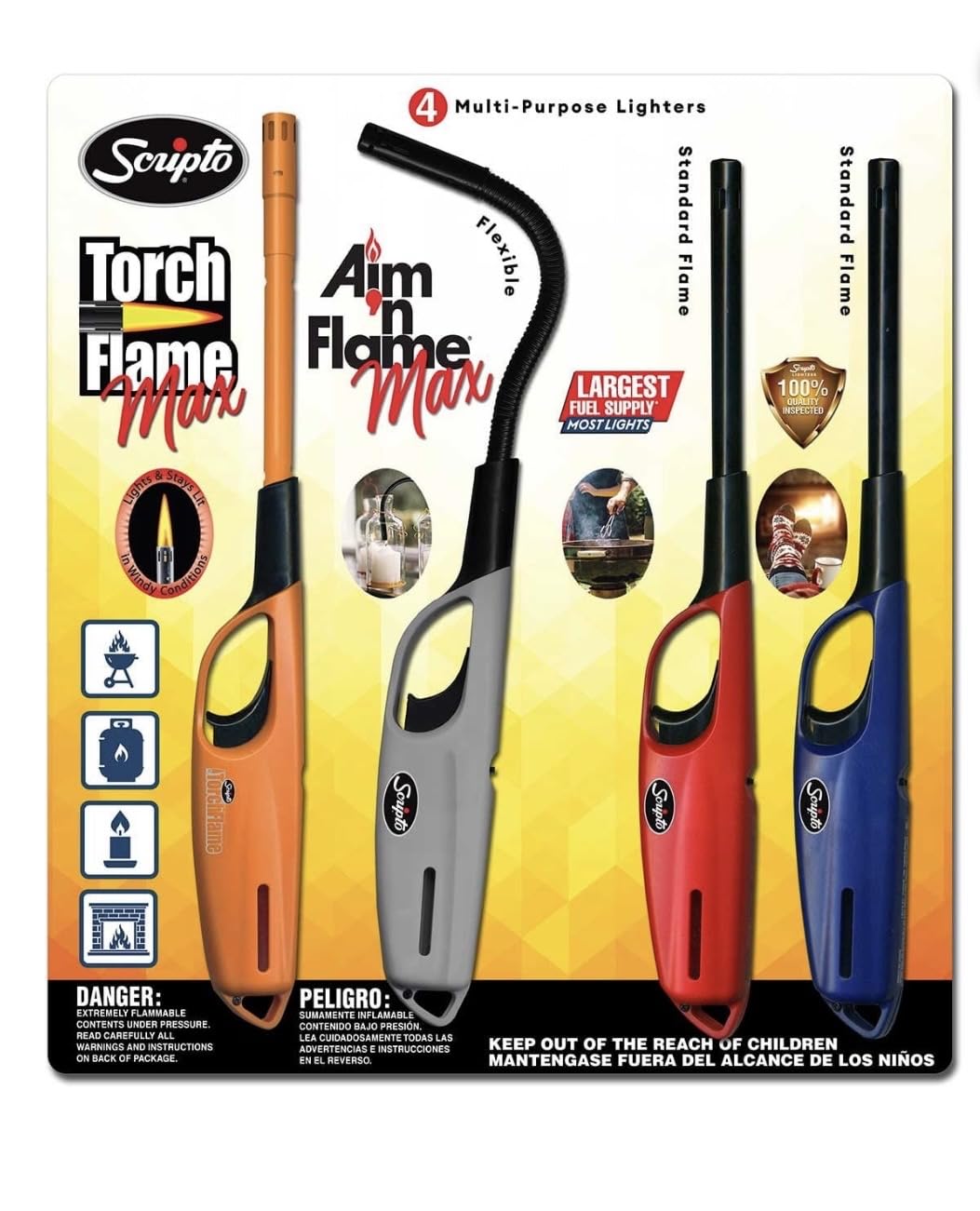
A clear fuel window on a utility lighter solves a problem you do not notice until it bites: you can see whether the thing will light before you zip the pack, rather than finding out at the fire pit. The AIM 'N Flame is a long-reach lighter sold for grills, pilot lights, hurricane lamps, fireplaces, and camping equipment, and four in a pack means one can live in the truck and one in the camp box.

The mechanism is where it gives ground. The child-resistant interlock takes a deliberate squeeze and is close to a two-handed job, which is the last thing you want while holding a lantern in the other hand. Units that quit after a couple of uses also turn up. So we treat this as the spare four-pack for the truck or the cabin rather than the lighter we count on, and the fuel window and the four-count make that a fair trade.

Pros

  • Visible fuel supply makes pre-trip checks easy
  • Long reach for grills, lamps, and fireplaces
  • Four lighters spread across truck and camp box

Cons

  • Stiff child-resistant interlock is awkward one-handed
  • Unit-to-unit reliability is uneven
Our verdict

A four-pack with a fuel window we appreciate before a trip, if you can live with a stiff trigger and units that do not always last.

Check Latest Price

How We Tested These Camping Lighters

To build the shortlist, we started with the formats people actually buy for camping — refillable butane, disposable multipacks, long-neck utility lighters, and USB arc models — then filtered by price, size, weight, and whether the specs matched how the lighter would be used. Reviews mentioning leaks, dead-on-arrival arcs, or broken hinges ruled a few out before we ever opened a box. We ended up with 16 lighters and used them for four months.

Each one went into rotation on real trips: a weekend of car camping, several backyard fire-pit nights, a damp spring outing where everything got rained on, two mornings in the low 30s, plus the boring jobs — a camp stove, a candle in the tent, charcoal for the grill. We counted how many clicks it took to get a steady flame from cold, then repeated it in front of a box fan to see which flames held and which blew out. Flame size got measured against a marked stick, and we noted whether the flame flared, shrank, or stayed put when the lighter was tilted toward a fire. Ease of use was tested the honest way: lighting each one in the dark, wearing thick gloves.

Over the long haul, we weighed refillable models on a kitchen scale before and after a month in a pack to see how much fuel had crept out, which settled a couple of picks. Arc lighters logged every ignition between charges so battery life comparisons weren't guesswork. We dropped each one from waist height onto gravel, left one in a hot car in July, and splashed a few in a puddle to check durability. Color mattered more than expected — we noted which ones were easy to spot on a picnic table at dusk or find at the bottom of a dark stuff sack, and which looked scuffed after a month. Value came down to whether a lighter still lit on the first click after all of that.

How to Choose a Camping Lighter

Flame or Arc: Start With What You're Lighting

The first decision is not brand or price, it is whether you need fire or a spark. An arc lighter runs current between two electrodes and lights whatever catches from a hot point: wicks, lantern mantles, paper, gas burners, the frayed edge of a fire starter. It has no flame, so wind and rain cannot touch it. What it cannot do is set the side of a damp log alight.

If your camping means a fire most nights, pair an arc with tinder or a fire starter, or carry a flame lighter and accept the sheltering it needs. We pack an arc and a small bag of dry shavings rather than choosing between the two.

Wind and Water Are Two Different Problems

A windproof lighter is one whose flame is sheltered or replaced by a spark. The Zippo's chimney and any arc qualify; a bare pocket flame does not. Water is separate: it kills the flint, soaks the wick, and shorts the works.

A sealed body with a locking cap, like the LcFun, is the version that survives a wet pack, and the seal only counts when the cap is clicked shut. If you are not paying for either feature, keep the lighter in an inside pocket or a dry bag and stop worrying about the specification sheet.

Pick the Upkeep You'll Actually Do

Every lighter here wants something from you. Butane evaporates, batteries drain, flints wear. Choose the one that matches your habits rather than the one with the better spec: a Zippo rewards a fill-the-night-before ritual and punishes a pack that sits in the garage, a rechargeable arc suits anyone already charging a headlamp before a trip, and a disposable box needs nothing and dies without warning.

The most common camping-lighter failure is a good lighter that ran out between trips. Whatever you buy, make checking it part of packing, not part of arriving.

Reach Decides More Than You Think

Where the flame sits matters as much as whether there is one. A pocket lighter is right for a fire you are kneeling beside. A long wand gets your hand out of the way of a grill, a fire pit, or a camp stove burner tucked under a windshroud. A flexible neck bends into a lantern globe or a candle jar too deep for anything straight.

If most of your lighting happens at a stove or a barbecue, buy the wand first and the pocket lighter second. That is the order we pack them in, and it is why the long utility lighters here earn their space even though they are not the most capable lighters on the list.

Frequently Asked Questions

Final Verdict

The LcFun dual arc is the one we pack: sealed against weather, no fuel to evaporate, a lanyard that keeps it findable, and tinder as the only thing you have to add. If a flame matters more than a spark, whether for damp twigs or a breezy evening, the Zippo is the better tool and it asks for a fill the night before.

For the cheapest answer that never leaves you without a light, take the BIC ten-pack and put one in every kit you own.