Best Fixed Blade Camping Knives of 2026

A blade that shaves paper in the kitchen can be useless by the second day of a trip, and steel is usually why. High-carbon holds a gorgeous edge and stains orange the first time you put it away wet; stainless shrugs off rain but can be a chore to bring back. Get the balance right and you stop thinking about your knife at all — the wood splits, the rope parts, the fish gets cleaned, and you move on.

My team and I have spent the past eight months carrying 14 fixed blades — through firewood duty behind my house, several wet camping weekends, and a great deal of fish cleaning. Weight surprised me most: a heavy knife on a belt feels fine in the store and like a brick after six miles. Sheath retention and grip with wet hands separated the good ones as sharply as edge quality did. A couple of the picks below are inexpensive and genuinely great; one or two will outlive me.

1

Best Overall

Morakniv Companion

96 /100
Angler Score Outstanding

Key details

Sheath
Polymer with belt clip
Weight
3.9 oz with sheath
Blade Steel
Sandvik 12C27 stainless
Blade Length
4.1 inches
Check Details on Amazon

The Companion weighs 3.9 ounces with its sheath on, and that number does most of the arguing. A knife that vanishes on a hip belt is one you still have with you at the third mile, and this one disappears in a way the pound-class blades here never do. At 8.5 inches overall with a 4.1-inch blade, it's small enough to forget and big enough for a chicken at the picnic table or an evening of whittling.

What earns it the top spot is how little upkeep it demands. The Sandvik 12C27 stainless blade doesn't care about a wet cutting board or a rainy afternoon, the polymer handle has a finger guard that keeps your hand behind the edge when your grip is slick, and the plastic sheath holds the blade securely on a belt clip. For a first camp knife or a tenth, that combination is hard to argue with.

A 2 mm blade is thin beside the thick-spined knives in this guide, and thin is what you want at the cutting board: it slices an onion instead of splitting it, and it makes clean work of trimming meat and cutting cord. We keep a second one in the truck box, which says more about how often it gets picked up than any specification on this page.

Pros

  • 3.9 ounces with the sheath, easy to carry all day
  • Stainless blade shrugs off rain and wet prep
  • Finger guard keeps your hand behind the edge
  • Thin stock slices food instead of wedging it

Cons

  • 2 mm stock isn't built for splitting firewood
Our verdict

For most campers this is the knife to buy: stainless, sharp out of the box, and 3.9 ounces with the sheath so it rides a pack belt without complaint.

Check Latest Price
2

Best for Woodcraft

Cold Steel SRK

96 /100
Angler Score Outstanding

Key details

Sheath
Secure-Ex
Weight
7.9 oz
Blade Steel
SK-5 carbon steel
Blade Length
6 inches
Check Details on Amazon

Five millimeters of SK-5 sounds like a spec-sheet number until the SRK meets a round of hardwood. This is the knife we reached for whenever the job was splitting, shaving tinder, or squaring off a tent peg, and the 6-inch clip point keeps cutting long after a thinner blade would be binding in the kerf.

The balance is what we noticed first. At 7.9 ounces with a 4.75-inch Kray-Ex handle, the weight sits under your index finger rather than out at the tip, so the blade does the work instead of your wrist. The black coating earns its keep too: SK-5 is carbon steel, and that finish is what keeps it from blooming rust between trips.

Six inches is more blade than an onion needs, and that's the honest limit — this is a woodcraft knife that handles camp cooking in a pinch. Where it gives nothing away is in the hand: the handle is the most secure-feeling of this group once everything is wet, and the Secure-Ex sheath holds a heavy blade with real retention.

Pros

  • 5 mm SK-5 stock takes splitting and batoning
  • Balanced under the index finger at 7.9 ounces
  • Kray-Ex handle grips when everything is wet
  • Coating protects a carbon blade from rust

Cons

  • Carbon edge needs drying and oiling after wet use
Our verdict

Buy it when your camp chores are splitting and shaving wood: 6 inches of tough SK-5, balanced in the hand, with a sheath that keeps up.

Check Latest Price
3

Best Carry Options

Gerber StrongArm

96 /100
Angler Score Outstanding

Key details

Sheath
Multi-mount MOLLE
Blade Steel
420HC with Cerakote
Blade Length
4.8 inches
Overall Length
9.8 inches
Check Details on Amazon

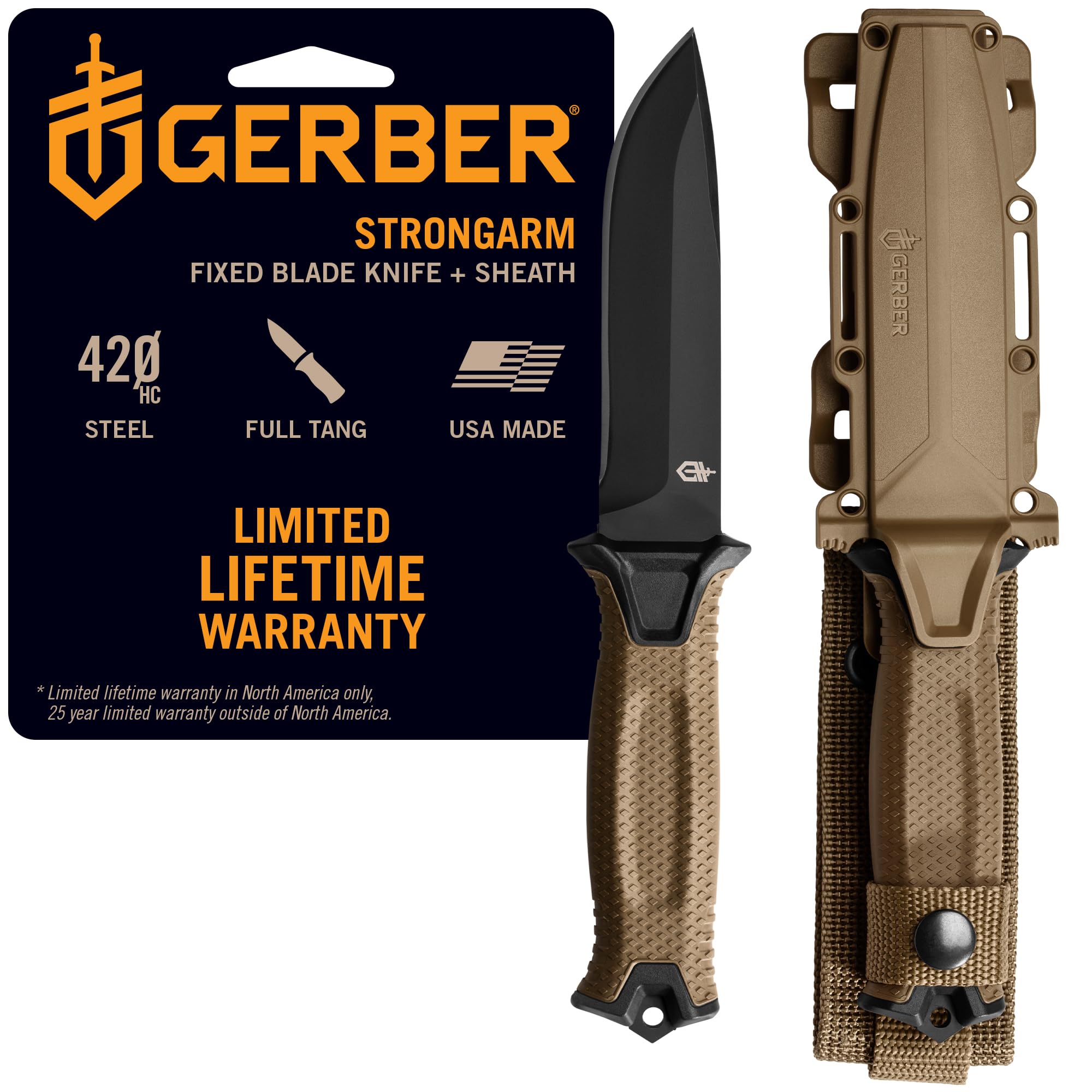
The sheath is the reason to choose the StrongArm over the other full-tang knives here. Gerber's multi-mount system bolts to MOLLE webbing or rides horizontally on a belt, which keeps the handle out of your ribs when you're crouched at a fire or wedged into a kayak seat.

The blade underneath is a 4.8-inch drop point in 420HC with a Cerakote finish, and the rubberized diamond grip is the surest thing in this group with wet hands. At 9.8 inches overall it's a belt or pack knife rather than a pocket one, and the full tang gives it the solidity you expect from a blade this size.

What the premium buys is the mounting system and the finish rather than a magic edge. We like it most for the paddler or hunter who wants one knife lashed to a pack and never thought about again. If your knife lives on a belt clip and comes out for peppers and cord, the Companion does that work for a fraction of the money.

Pros

  • Multi-mount sheath carries horizontal, vertical, or on MOLLE
  • Full tang and Cerakote finish for hard, wet use
  • Rubberized diamond grip holds in wet conditions

Cons

  • Highest price tier of the eight here
Our verdict

Worth the premium if you want one full-tang knife that mounts to a pack, a belt, or a thigh rig and takes wet weather in stride.

Check Latest Price
4

Best Classic

KA-BAR USMC

98 /100
Angler Score Outstanding

Key details

Sheath
Leather
Blade Steel
Carbon steel
Blade Length
7 inches
Overall Length
11.875 inches
Check Details on Amazon

The full-size KA-BAR was designed to be carried places a camp knife never goes, and that history explains its shape: 11.875 inches overall, a 7-inch straight edge, and stacked leather washers under your palm.

It's also a genuinely good camp knife, which is easy to forget when it's presented as a military icon. The 20-degree edge slices rope and tomatoes with the same ease, the handle is long enough to give you real control when you're chopping, and the leather sheath hangs properly from a belt instead of flopping around.

The stacked leather is the part to think about. It wants an occasional wipe of conditioner to keep from drying out, and a carbon blade left in a leather sheath is a rust trap — take the knife out when it goes into the truck box for the winter. What you get in return is the best-looking knife here and a handle that wears in rather than out.

Pros

  • 7-inch 20-degree edge slices rope and food cleanly
  • Full-size leather handle gives real chopping control
  • Leather sheath hangs properly from a belt

Cons

  • Nearly a foot long and 11 ounces on a belt
Our verdict

A 7-inch American classic that still earns its place at basecamp, provided you look after the leather and don't mind the heft.

Check Latest Price
5

Best Survival Kit

Gerber Ultimate

94 /100
Angler Score Outstanding

Key details

Weight
11 oz
Blade Edge
Half-serrated
Blade Length
4.8 inches
Sheath Extras
Ferro rod, sharpener, whistle
Check Details on Amazon

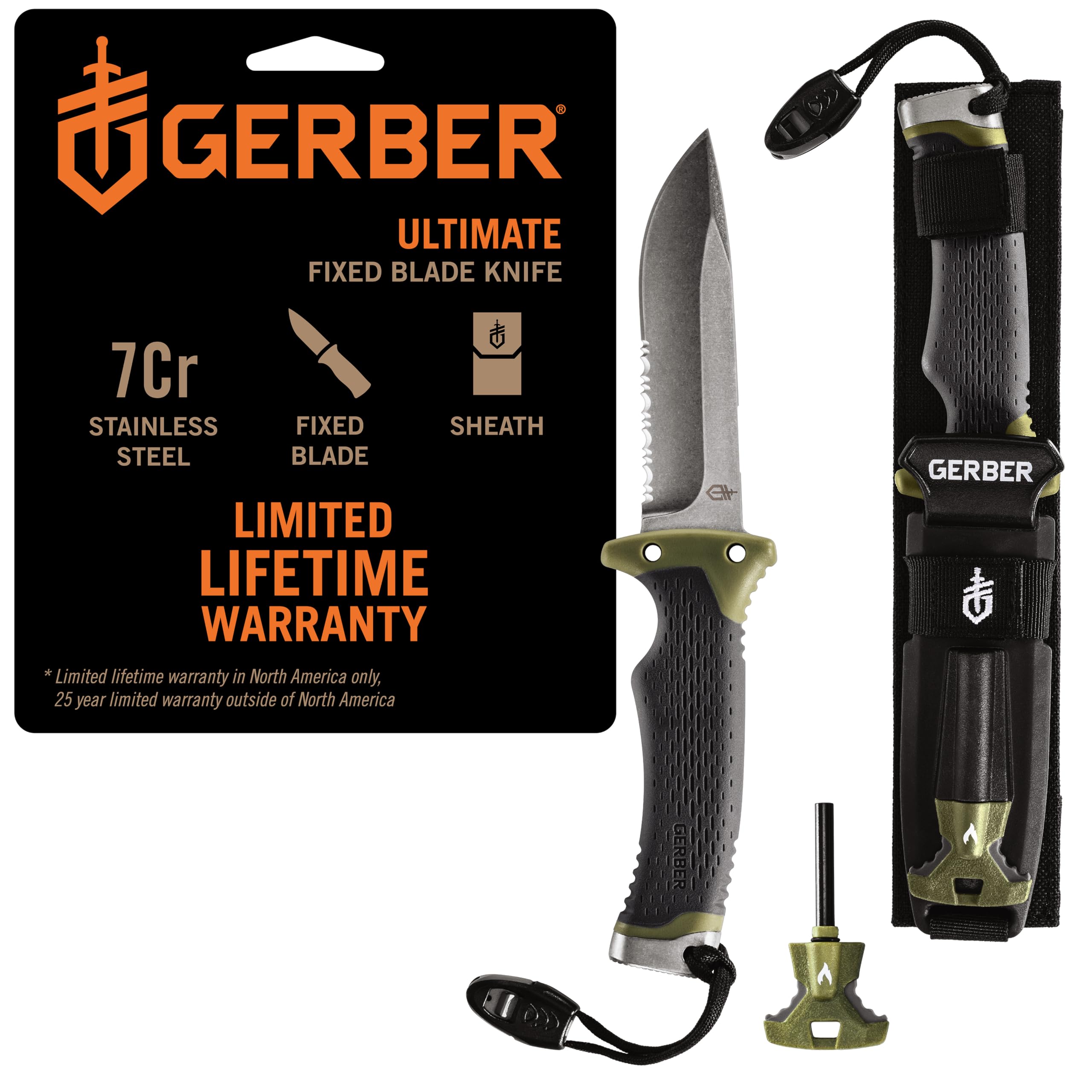
Everything about the Ultimate is organized around what hangs off the sheath: a sharpener, a ferrocerium rod, and a whistle, with a flat pommel for driving tent pegs. It's the only knife here that arrives as a kit rather than a blade, and for a knife that lives in a pack that's the right call.

The knife itself is a 4.8-inch stainless drop point with a half-serrated edge, a textured rubber handle, and 10 inches of overall length at 11.02 ounces. The grip is comfortable over long use, and the pommel gives you a flat surface to hammer with instead of the butt of the handle.

The half-serrated edge is where we part ways with it for general camp duty: serrations tear through rope and bread but skate across a tomato and fight you when you're carving a spoon. As a fire-and-emergency knife that lives in a pack, the package is smart — you can touch up the edge without unpacking anything, and everything you need for a fire is on one piece of gear.

Pros

  • Sharpener and ferro rod live in the sheath
  • Flat pommel gives you a hammering surface
  • Comfortable textured rubber handle over long use

Cons

  • Half-serrated edge is clumsy for carving and food prep
Our verdict

The pick for a truck or pack kit: fire starter, sharpener, and whistle on one sheath, with a blade that favors rope over tomatoes.

Check Latest Price
6

Best for Hunters

Mossy Oak 2-Piece Set

95 /100
Angler Score Outstanding

Key details

Blades
5-1/8 and 4-1/4 inches
Pieces
2
Sheath
Nylon, dual carry
Blade Steel
Stainless steel
Check Details on Amazon

Two knives, one sheath, and a job description: this set is for the hunter who has an animal on the ground and wants the work over with quickly.

The 5-1/8-inch straight blade does the breaking down, and the 4-1/4-inch gut-hook knife opens a cavity without letting the point wander where you don't want it. Both are full-tang stainless with a camo handle that stays findable when you set one down in grass, and the nylon sheath carries the pair on a single belt.

For the money this is a lot of knife, and we keep a set in the truck through deer season. The edges arrive inconsistent — ours took a few passes on a steel to get where we wanted them — but once honed, both blades do the job they were shaped for. The gut hook is the piece worth having on its own: it opens a cavity cleanly, and that's a job a drop point does badly.

Pros

  • Two full-tang stainless knives on one belt sheath
  • Gut hook opens a cavity without nicking the paunch
  • Camo handle stays visible when set down

Cons

  • Skinning profiles are poor at food prep and carving
Our verdict

A lot of knife for the money for anyone who dresses game: a straight blade, a gut hook, and one sheath for both.

Check Latest Price
7

Heavy Camp Chores

KA-BAR Becker BK2

96 /100
Angler Score Outstanding

Key details

Tang
Full tang
Weight
16 oz
Blade Steel
1095 Cro-Van carbon
Blade Length
5.25 inches
Check Details on Amazon

Set the BK2 beside the full-size KA-BAR above and it looks like the wrong knife: 5.25 inches of blade on a handle nearly as long, and 16 ounces of weight — heavier than the 7-inch knife.

That heft is the whole point. The BK2 is a wedge with an edge, a full-tang 1095 Cro-Van drop point that turns a round of hardwood into kindling and keeps going when the wood is wet and knotty. The Ultramid handle doesn't care about weather, and the powder coat keeps the carbon steel out of trouble.

It is a poor kitchen knife. The thick spine wedges through an onion rather than slicing it, and the same mass that makes it a good splitter makes it tiring for detail work. We carry it alongside a small folding knife rather than ask one blade to do both jobs.

For a basecamp where the firewood comes in big and the walk in is short, the BK2 is the most capable chopper of the ones we cover. Set it next to the 3.9-ounce Companion and you can see the whole trade: one knife you forget you're carrying, one you don't.

Pros

  • Full-tang carbon steel splits like a wedge
  • Ultramid handle unaffected by weather
  • Powder coat protects a carbon blade

Cons

  • Sixteen ounces is a lot to carry far
Our verdict

Pick it when the firewood is bigger than your arm and the walk in is short: a pound of full-tang carbon steel that splits like a wedge.

Check Latest Price
8

Budget Whittling

Morakniv 511

95 /100
Angler Score Outstanding

Key details

Sheath
Hard plastic combi-sheath
Weight
3.9 oz with sheath
Blade Steel
Carbon steel
Blade Length
3.6 inches
Check Details on Amazon

The 511's blade is carbon steel, and that one fact shapes everything about owning it. It takes a keener edge than the stainless Companion, and it will spot and rust if you sheath it wet and leave it there.

What you get for the care is a 3.6-inch blade that whittles like a much more expensive knife. The thin stock bites into green wood, the 3.9-ounce package disappears in a jacket pocket, and the hard plastic combi-sheath has a belt clip and Morakniv's Smart Button, which lets you clip several of their knives together.

The handle is where the low price shows. The grip is fine dry and turns slick once your hands are wet, which is the opposite of what you want when you're carving beside a river. The sheath itself holds the knife securely, and the belt clip is better than the price suggests.

We keep one in the toolbox and reach for it for whittling and opening feed bags, and at this price tier there's no reason not to. As a first camp knife, the stainless Companion is the safer buy: no oiling ritual, no rust, and a handle that holds when it's wet.

Pros

  • Carbon steel takes a keen edge for whittling
  • 3.9 ounces with the sheath
  • Smart Button links several Morakniv knives

Cons

  • Handle gets slick when wet
  • Short blade limits it to detail work
Our verdict

The cheapest way into a properly sharp camp knife, best for whittling and toolbox duty where a little rust care is no burden.

Check Latest Price

How We Tested These Camping Knives

We started with a list of roughly 60 fixed blades and narrowed it by steel type, blade length (3.5 to 6 inches), handle material, sheath design, and what owners reported after months of use, then bought 14 at retail so the samples were the same ones you'd get.

Testing ran eight months. Each knife came on at least three outings: fire prep at camp, meaning batoning kindling and shaving feather sticks; rope and cardboard breakdown in the yard; and food duty, from onions to steaks to trout. We also carried them on day hikes to see how weight sat on a belt over five or six miles, and passed them around to friends with wet hands and heavy gloves on.

Before first use, every blade had to slice printer paper cleanly, and we counted passes through manila rope until it stopped shaving arm hair. Then we resharpened and noted how long that took and whether the edge held the second time around. Durability meant striking a ferro rod on the spine, light drilling and prying at the tip, and a few deliberate drops onto gravel. Cost came into it last: we asked whether each knife's steel, sheath, and handle actually earned what it asked.

For rust, each knife went away damp in its sheath overnight, and a few sat out with salt spray on the blade to see what bloomed by morning. Grip was judged with soapy hands and wet gloves. Every sheath had to survive a shake test upside down and be re-sheathable one-handed, in the dark, without looking.

How to Choose a Fixed-Blade Camping Knife

Match the blade to the work

A 3.5- to 4.5-inch blade with thin stock is the most useful shape at a campsite: it slices food, carves a tent peg, and cleans a fish without fighting you. Step up to 5 or 6 inches only when splitting firewood is a real part of your trip, and accept that the same blade will be clumsy at the cutting board.

The trap is the big survival knife that looks capable in a photograph and turns out to be a poor kitchen knife and a worse carver. Our top pick sits at the small end for exactly that reason, and the heaviest knife here is the one we leave at basecamp.

Stainless steel or carbon steel

Stainless is the right default for camp use. Sandvik 12C27 and 420HC hold a working edge and shrug off a wet sheath, a rainy dinner, and a knife left in the sink. Carbon steels such as SK-5 and 1095 take a keener edge more easily, which matters if you whittle, but they spot and rust without a wipe and a drop of oil.

If you want one knife to do everything and don't enjoy maintenance, buy stainless. If you want the sharpest edge you can get for wood, buy carbon and treat it like a tool that needs drying.

The sheath decides whether the knife comes along

A belt-clip sheath is fine for a knife that lives on your hip. A multi-mount system that rides horizontally or bolts to MOLLE is better for a pack, a boat, or a vehicle, and it is the main thing the Gerber StrongArm offers that the cheaper picks don't.

Check retention before you trust it: turn the loaded sheath upside down over a bed and shake it. Leather looks better and molds to a blade, but it holds moisture against steel in a way plastic and nylon don't.

Handle, weight, and tang

Your hands are wet, cold, or both when it matters, so handle material earns its place. Rubberized polymer and textured Kray-Ex stay put, stacked leather looks better and wants occasional conditioning, and smooth plastic is the one to avoid on a knife you'll use in the rain.

Weight is the other quiet decision. A 4-ounce knife with a plastic sheath rides a pack all day; a pound of full-tang steel splits wood and reminds you it's there. Full tang buys toughness for batoning, so if you don't split wood, you're carrying that weight for nothing.

Frequently Asked Questions

Final Verdict

The Morakniv Companion is the knife we point most campers toward: 3.9 ounces with the sheath, a stainless blade that ignores rain, and a price tier that makes a spare a sensible purchase rather than a luxury. It slices food, carves pegs, and clips to a belt without being noticed.

If your trips are built around firewood rather than food, the Cold Steel SRK is the better tool — 6 inches of SK-5 that splits and shaves, in a sheath that keeps up. Start with the Companion and add the SRK when the woodpile gets serious.