Best Castable Fish Finders of 2026

A castable fish finder is a sonar unit about the size of a tennis ball that you tie to your line, cast past the weedline, and read on your phone: bottom depth, fish arches, sometimes a GPS trail. The appeal is obvious — no drilling, no wiring, no bracket bolted to a transom. But the sonar itself is only half the job; the other half is everything between the transducer and your hand, and that gap is where a bargain unit quietly eats a whole afternoon of fishing.

Since early spring I've kept 11 of these in rotation — from shore, from a kayak, off a pontoon, and through one cold morning on ice — and the spread between a good castable and a frustrating one is wider than the price tags suggest. The lesson that took a few trips to learn: a unit's depth rating and its usable casting range are two different numbers, and the box only promises the first. The picks below are the ones that stayed accurate, stayed connected, and still made sense for the money.

1

Best Overall

Garmin STRIKER Cast

88 /100
Angler Score Excellent

Key details

Weight
2.65 oz
Mapping
Quickdraw Community, 1 ft contours
Sonar Modes
2-D and ice flasher
Wireless Range
Up to 200 ft
Check Details on Amazon

Two hundred feet of wireless range from a sonar ball that weighs 75 grams is the balance that earned the STRIKER Cast the top spot here. It's light enough to cast on a rod you already own, small enough to drop in a jacket pocket, and it turns the phone you're already carrying into the display. For bank fishing, where the water in front of you might as well be opaque, that's the least extra gear that actually answers the question.

What we appreciated most is how little the app asks of you. Traditional 2-D sonar is the default view, an ice flasher sits one tap away, and the Quickdraw Community puts downloadable contours as tight as a foot onto unfamiliar water — all through an app that costs nothing to install. The flasher mode is the feature we didn't expect to use and now reach for first; it turns a scrolling picture into something you can read in a glance.

The caveat is the one every app-based unit here shares: the further out you cast, the harder the wireless link has to work. Nothing failed on us, but the picture took longer to settle at the far end of a long throw, and reeling the puck back to a comfortable range fixed it. The 20-foot tether in the box earns its keep on every cast — it turns a snag into a short, boring retrieve instead of a lost unit.

Pros

  • Streams sonar to a phone up to 200 ft
  • 75 g puck casts on an ordinary rod
  • Free app with ice flasher and contours
  • Tether and carry bag included

Cons

  • Sonar drains the phone battery on long sessions
  • Picture can stutter at the longest casts
Our verdict

We think most anglers should start here: it casts on a normal rod and puts clear sonar, plus an ice flasher, on the phone you already carry.
Check Latest Price
2

Best for Mapping

Deeper PRO+ 2

83 /100
Angler Score Excellent

Key details

GPS
Built-in, bathymetric maps
Weight
3.2 oz
Max Depth
100 m
Wireless Range
330 ft
Check Details on Amazon

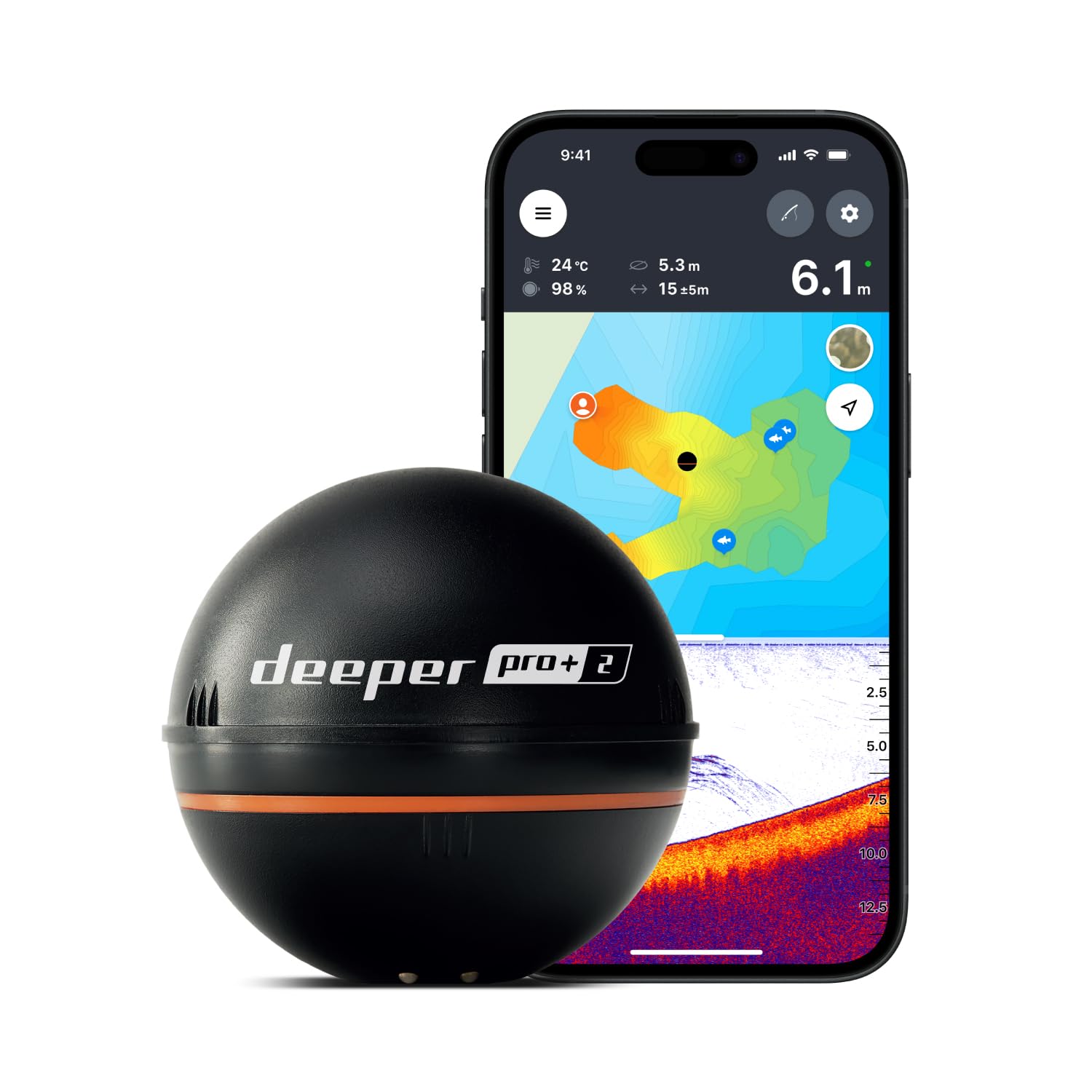
If the point of your trip is to learn a lake rather than check one spot, this is the pick. The PRO+ 2 casts 330 feet, reads down to 100 meters, and carries its own GPS, so it draws bathymetric maps as you work across a flat and files them in the Fish Deeper app. Of the units here, it's the one built for the angler who wants the whole picture, not a snapshot.

Three beams do the heavy lifting. The wide and mid beams cover water quickly when you're hunting, and the narrow beam separates targets down to 0.4 inches, which is the difference between a blob on the bottom and a fish sitting beside a rock. It's the most detailed sonar picture in this group, and the depth figure is the deepest on the page.

One thing to accept before you buy: the advanced mapping sits behind a subscription, so ownership costs run past the purchase. Set that against a season spent learning new water and it's easier to justify — this is the unit for the angler who wants the map more than the moment.

Pros

  • Reads to 100 m with a 330 ft cast
  • Built-in GPS builds bathymetric maps
  • Narrow beam resolves 0.4 in targets
  • Three beam widths in one unit

Cons

  • Advanced mapping needs a subscription
  • Highest price in this set
Our verdict

We recommend it for structure fishing on big water: it maps as it goes, and the narrow beam picks fish off cover that cheaper sonar smears together.

Check Latest Price
3

Best Handheld Display

LUCKY YMT-202

84 /100
Angler Score Excellent

Key details

Weight
1.54 lb
Display
3.5 in LCD
Max Depth
147 ft
Operating Distance
853 ft
Check Details on Amazon

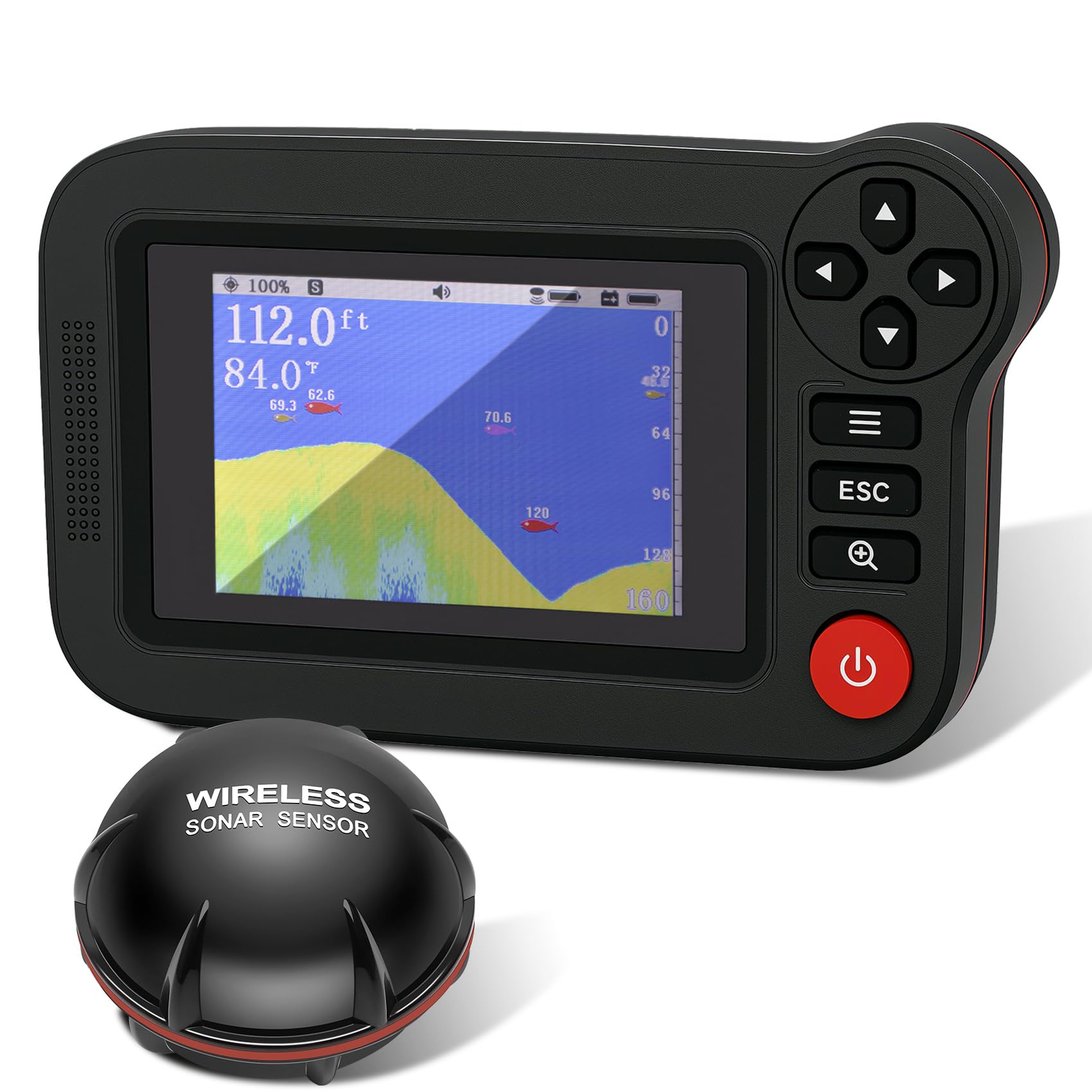
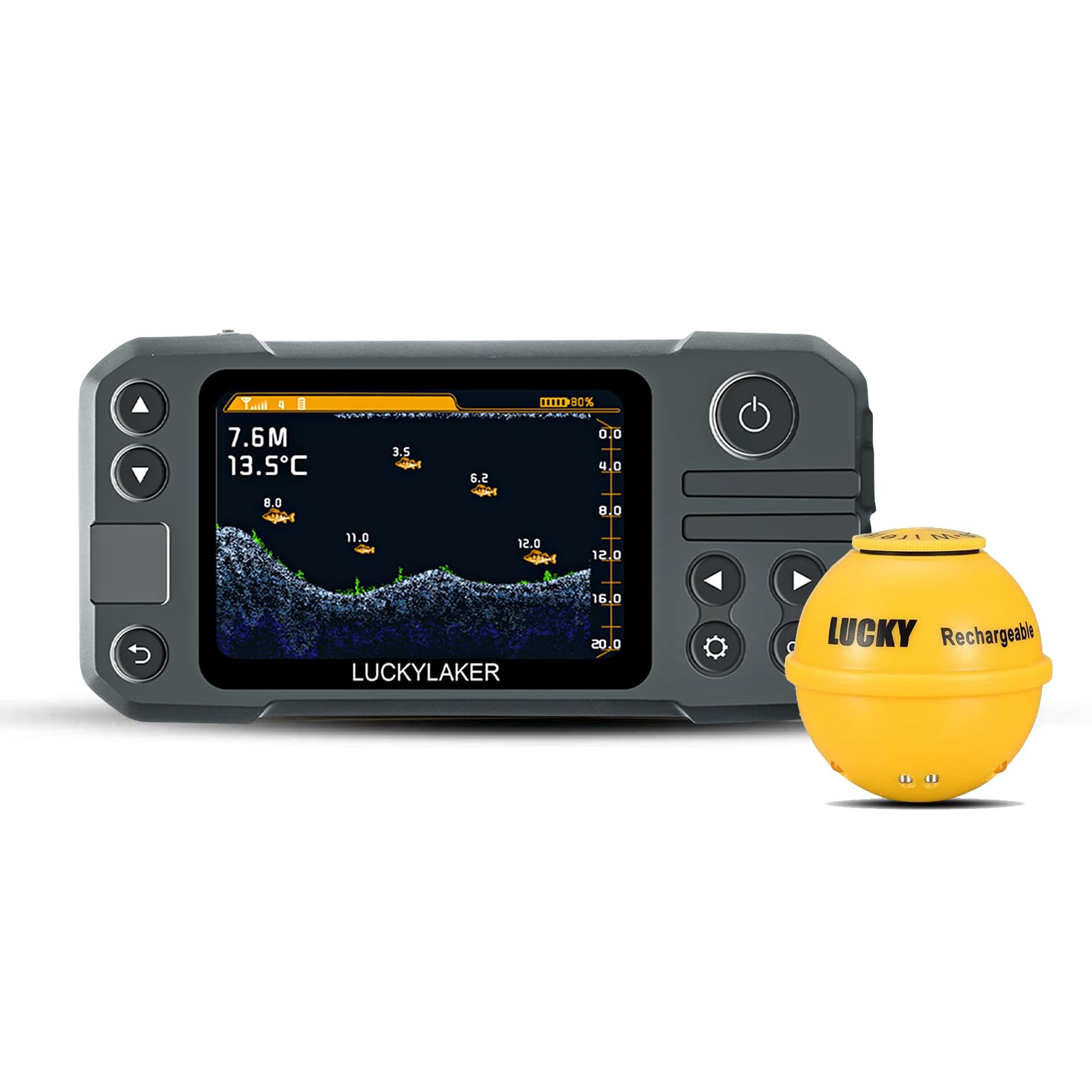
Every app-based finder here shares one point of failure: the phone. The YMT-202 sidesteps it with a 3.5-inch LCD built into the handset and a floating sonar ball that talks to it over a wireless link rated to 853 feet — no pairing screen, no download, and no battery shared with your phone.

The screen carries water depth, temperature, bottom contour and fish icons with their own depth numbers, laid out horizontally so it reads like a dashboard rather than an app. Fish icons that carry a depth figure are the difference between knowing something is down there and knowing where to drop a jig.

Cold mornings are where we came to prefer it. A screen you can glance at without waking a phone beats a touchscreen you have to take a glove off to use, and there's nothing to swipe when your hands are wet. The limits are real: 147 feet of depth rules out deep trolling, the kit runs 0.7 kilograms across two pieces, and both need charging. For ice, docks and cold-water bank fishing, it's the least fiddly thing in this group.

Pros

  • 3.5-inch screen needs no phone at all
  • 853 ft wireless operating distance
  • Fish icons carry their own depth numbers
  • Works across open water and ice

Cons

  • Depth tops out at 147 feet
  • Two pieces to charge before a trip
Our verdict

We like it for cold-water and ice fishing: the 3.5-inch screen needs no phone, and the long wireless range lets you cast well away from the hole.

Check Latest Price
4

Best Value Handheld

DANOPLUS DP-104

84 /100
Angler Score Excellent

Key details

Weight
5.28 oz
Display
2.4 in color LCD
Max Depth
147 ft
Beam Angle
90 degrees
Check Details on Amazon

This is the value pick of the group: a 2.4-inch color LCD showing depth, water temperature, bottom contour and fish sized small, medium or big, plus a fish alarm for the times you're watching a rod instead of a screen. For ponds, docks and small lakes where 147 feet covers everything you'll fish, it does the job the expensive app-based units do, minus the map and the ecosystem.

Two details stand out. The sensor switches itself on when it touches water, which sounds minor until you've fumbled for a power button on a windy bank, and a lamp inside the ball lights up underwater — we're not convinced it draws fish, but it does make the unit easy to spot when it bobs back up. The screen is small at a glance in bright sun, and the alarm will chirp at weed tops if you leave sensitivity high.

Pros

  • Color screen and fish alarm at budget money
  • Sensor activates on contact with water
  • 147 ft range suits ponds and docks

Cons

  • Small screen takes a squint in sun
  • Fish alarm trips on weeds and cover
Our verdict

We point budget buyers here: color screen, fish alarm and simple depth and temperature for ponds and docks, with no app to install.

Check Latest Price
5

Best Budget

LUCKY 1108C-ICE

81 /100
Angler Score Excellent

Key details

Display
2 in LCD
Runtime
4-5 hours, power-saving mode
Max Depth
328 ft
Beam Angle
45 degrees
Check Details on Amazon

The blue shell around the transducer is the whole idea. It holds the sonar ball at a useful angle in a hole, gives gloved fingers something to grab, and still casts from a bank or a dock. Inside, the range runs 3 to 328 feet on a 45-degree beam, with a 2-inch LCD, a blue backlight for low light, and a power-saving mode rated at four to five hours.

Nothing else here reads as deep for as little, which is why it earns a place. The trade is the display: at 2 inches you get depth, fish icons and a bottom line, not the detail a 3.5-inch screen shows. Think of it as a depth tool that also marks fish and buy it on that basis — for ice and shallow-to-mid water, it's enough.

Pros

  • 3 to 328 ft depth range for very little
  • Extra housing made for ice fishing
  • Blue backlight for low light

Cons

  • 2-inch screen limits what you can read
  • Four-to-five-hour figure assumes power saving
Our verdict

We recommend it as the cheap way onto the ice: 328 feet of depth range and a housing built for a hole, in exchange for a very small screen.

Check Latest Price
6

Simple Travel Kit

Venterior VT-FF005

85 /100
Angler Score Excellent

Key details

Display
2.6 in color TFT
Warranty
2 years
Max Depth
164 ft
Wireless Range
262 ft
Check Details on Amazon

Before you take the Venterior to water, you can learn its screen on dry land. A simulation mode runs the display through a fake bottom so the icons, the depth scale and the fish sizes stop being a mystery on your first cast. It's a small feature that saves a whole trip's worth of squinting.

The rest is straightforward: a 2.6-inch color TFT handset measuring 2.75 inches on a side, 164 feet of depth range, a 262-foot wireless link and a two-year warranty. Compared with the STRIKER Cast, you give up mapping and app polish and gain a unit that needs nothing but its own battery.

That's the case for it — travel, rental boats, a tackle bag that doesn't want another screen to charge. Two things to know going in. The sonar ball unscrews to reach the charging port and the threads are fine enough to treat gently, and the display is the part that fails when something goes, so test it inside the warranty window rather than the week after it closes.

Pros

  • Self-contained 2.6-inch color screen
  • Simulation mode teaches the display
  • Two-year warranty on a budget unit
  • 262 ft wireless range

Cons

  • Sonar ball must be unscrewed to charge
  • Blank displays are the failure to watch for
Our verdict

We suggest it for travelers and occasional anglers: it needs no phone, teaches you its own screen, and comes with two years of coverage.

Check Latest Price
7

All-Day Sessions

Fuceter XF-08

80 /100
Angler Score Excellent

Key details

Weight
1.5 lb
Display
3.5 in TFT LCD
Runtime
8 hours on a 2-hour charge
Max Depth
164 ft
Check Details on Amazon

Eight hours of working time from a two-hour charge is the claim on the XF-08, and it's the reason this one belongs in a long-day kit. The sonar probe runs on its own 5V battery, so the day doesn't hinge on a phone staying awake.

The display is the other half of the pitch: a 3.5-inch TFT LCD with three backlight settings, showing depth, fish size, fish depth, bottom contour and water temperature down to 164 feet. In the box are an antenna, a mounting bracket, a lanyard and both charging cables — enough to set it on a console and leave it there.

The bulk is what you notice. At 1.5 pounds the kit is one of the heavier setups here, and the two-piece arrangement means a display to mount and a probe to charge. That's the price of a screen this size.

Our take: if a big, readable display and a full day of runtime matter more than pocketability, this is the one to look at. Watch the depth reading in wind, where a choppy surface is hard on any sonar.

Pros

  • 3.5-inch TFT with three backlight modes
  • Claimed eight hours from a two-hour charge
  • Mounting bracket and cables included

Cons

  • Heavier two-piece kit to carry
  • One-year warranty only
Our verdict

For long days on the water we like it: a 3.5-inch screen, a claimed eight-hour runtime and a mount that stays on the console, if you can live with the bulk.

Check Latest Price
8

Kayak and Ice

HawkEye FishPod 5x

82 /100
Angler Score Excellent

Key details

Modes
4 presets plus FishEcho
Mount
TraxNut 1/4 x 20
Warranty
2 years, covers damage
Max Depth
199 ft
Check Details on Amazon

Two years of coverage that includes damage is unusual in this group, and it's the first thing worth knowing about the FishPod 5x. Break it, and the repair is the warranty's problem rather than yours.

The four presets are the second thing. Rather than making you tune sensitivity and gain, the FishPod adjusts the sonar for fish size, depth or schooling, with FishEcho trimming clutter and false echoes and BottomScan sorting vegetation from hard and soft bottom.

A vertical flasher view is there for ice, and the TraxNut mount takes any 1/4 x 20 bracket, so the unit can live on a kayak rail or in a rod holder instead of sliding around a seat. Depth reads to 199 feet.

Our read: this is for the angler who wants the tuning done for them and prefers fishing to fiddling. The catch is that there's no display in the box — everything runs through the app on your phone — so the experience is only as good as that link on the day.

Pros

  • Four presets adjust sonar automatically
  • FishEcho and BottomScan separate clutter from bottom
  • Vertical flasher for ice fishing
  • Two-year warranty covers damage

Cons

  • No display in the box; the app is the screen
Our verdict

We like it for ice and kayak anglers who want the tuning handled: four presets, a flasher view and a two-year warranty that covers breaks.

Check Latest Price

How We Tested Castable Fish Finders in Real Water

We started with every castable unit that published a real sonar spec sheet: depth rating, wireless range, battery claim, GPS or no GPS, and whether the app ran on both iOS and Android. That narrowed the field to 11 units across three price tiers, all bought at retail rather than sent by brands, fished over eight months — from the first warm weekends of spring through the morning the ice finally held.

Each unit got the same treatment on the same water: cast from a rocky bank into 6 to 40 feet, trolled behind a kayak, dropped over the gunwale of a pontoon, and jigged through an ice hole. We checked every depth reading against a handheld sounder and a rope marked in one-foot increments, noting when a unit drifted, stalled, or reported a bottom that wasn't there. Fish tracking got an eyeball test too — whether arches held as a fish moved through the cone or flickered and vanished.

Battery life we timed from full charge to the low-battery warning, then again with the unit sitting idle, because standby drain is where the cheaper models outed themselves. Every dropped connection went into a tally sheet in a waterproof notebook, along with how long the app took to recover, and each outing started cold — unit off, phone in a pocket — so we could count the seconds until a depth number appeared. GPS got checked by walking back to a marked waypoint; portability by whether the thing fit in a jacket pocket and whether the line tie survived repeated casts of a two-ounce payload.

Value came down to how much of that a unit got right for the money, not how many toggles the app advertised. We're still fishing most of these and will update as the batteries age.

How to Choose a Castable Fish Finder

Phone App or Handheld Display

This is the fork that decides everything else. An app-based unit like the Garmin STRIKER Cast gives you a bigger, brighter screen than any handheld here, plus mapping, because you supply the display. A handheld like the LUCKY YMT-202 works with gloves on, needs no pairing, and doesn't share a battery with your phone. Bank fishing in November pushes you toward the handheld; open water with the phone already mounted pushes you the other way. Pick the display style first — the rest of the specification list only matters after that.

Cast Range, Depth Range, and Beam Angle

The biggest number on the box is usually wireless range, not depth. One unit here is rated to 853 feet of operating distance and 147 feet of water, and a 200-foot cast is limited by your rod, your line and your nerve long before the sonar gives out. Match the depth figure to the water you actually fish, then look at the beam: a 90-degree cone covers more ground per cast, while a narrow beam separates individual fish from structure. Wide for searching, narrow for deciding.

Runtime, Charging, and Cold Weather

Two batteries are in play on every trip: the sonar's and your display's. App-based units push a phone hard, and cold weather drains lithium cells fast — exactly when you least want a blank screen. Handhelds split the load but give you two things to charge. Charge everything the night before, carry a small power bank, and keep the phone in an inside pocket instead of on a mount in the wind. A claimed runtime usually assumes a power-saving mode and a warm day.

What the Screen Is Really Telling You

Fish icons are the sonar's interpretation of an echo, sized small, medium or large, and they'll happily flag a weed top or a sunken branch. The figures worth trusting are depth, bottom contour and water temperature, which come from a hard return. Buy for those, learn to read the bottom line, and treat fish symbols as a hint that something is there. Where a unit lets you adjust sensitivity, turning it down in weedy water cleans up the display more than any other setting.

GPS and Mapping: Worth Paying For?

Mapping changes how you fish rather than how you see. The Deeper PRO+ 2 builds bathymetric maps from its own GPS and keeps them in the app; the Garmin pulls contours as tight as a foot from the Quickdraw Community. On water you'll come back to, that's a real advantage: you're buying the second trip, not the first. On a pond you can read in an afternoon, the same money buys nothing.

Frequently Asked Questions

Final Verdict

If you want one answer, it's the Garmin STRIKER Cast. It casts on a rod you already own, streams a clear 2-D picture to the phone in your pocket, and adds an ice flasher and downloadable contours without another display to buy or charge. Our one condition is that you go in with a charged phone and a power bank.

Change the requirement and the answer changes. Fish mostly through a hole in the ice, or in weather that kills a phone battery before lunch, and the LUCKY YMT-202's own 3.5-inch screen is the better buy. If you're learning unfamiliar water all season, the Deeper PRO+ 2 earns its premium.