Best Portable Fish Finders of 2026

A fish finder does one simple thing: it pings sound into the water and draws whatever comes back. What separates a good one from a frustrating one is how much of that picture you can actually read — depth, bottom composition, the arc of a fish — on a screen the size of a deck of cards, in glare, with cold hands. Get it right and you stop fishing blind: you see the ledge before you cast to it, and you know whether that mark near the bottom is a brush pile or a school of crappie.

I've fished from docks, kayaks, and a borrowed tin boat, and I spent years guessing depth with a knotted rope. Over eight months, my team and I ran 12 portable units through open water and hard-water season, weighing portability against accuracy and keeping track of what each one really cost once you added the extras. Battery life, GPS, app connectivity, and a screen that survives February all got the same scrutiny as fish tracking. The picks below are the ones that kept telling the truth.

1

Best Overall

Garmin Striker 4 with Portable Kit

93 /100
Angler Score Outstanding

Key details

Sonar
CHIRP with built-in flasher
Display Size
3.5 inches
Kit Includes
Battery, charger, bag, transducer, mounts
Maximum Depth
1,600 ft freshwater
Check Details on Amazon

What arrives is a soft-sided bag with the whole system already inside: the 3.5-inch display, a rechargeable battery, a wall charger, a CHIRP transducer, a foam float, a tether, and mounts for a transom, a trolling motor, or the inside of a kayak hull. Charge it at home, clip the head unit into the bag, and it travels to the launch like a lunchbox.

That completeness is why it tops this list. Most castable units here ask you to bring a charged phone and a rod; the bare boat units ask you to wire your own battery. The Garmin asks for neither. You get a screen that stays readable in direct sun, CHIRP sonar with enough separation to tell a fish from the top of a weedbed, and a flasher mode for vertical jigging through ice. Of everything we used, it behaves most like a small boat unit that happens to fit in a bag.

Depth is rated to 1,600 feet in freshwater, which is far more than any lake you will fish from a kayak asks of you. The practical limit is the screen: 3.5 inches is small enough that you will be squinting at marks rather than studying them. The battery also connects with two separate plug leads, so recharging means unplugging both by hand rather than dropping the pack onto a dock.

Mapping is the one job it does not do. The built-in GPS saves waypoints, but the unit ships without charts, so drawing your own contours is the Deeper's work rather than this one's. For depth, fish marks, and a waypoint to come back to, everything you need is already in the bag.

Pros

  • Battery, charger, bag, transducer and mounts included
  • CHIRP sonar with a built-in ice flasher
  • Rated to 1,600 feet in freshwater
  • GPS saves waypoints without a phone

Cons

  • GPS ships without charts or maps
  • Battery recharges through two separate plug leads
Our verdict

Our default pick for most anglers: a real sonar unit with a readable screen, an ice flasher, and every part needed to run it in one bag.
Check Latest Price
2

Best for Mapping

Deeper PRO+ 2

83 /100
Angler Score Excellent

Key details

Weight
3.2 oz
Mapping
Built-in GPS bathymetric maps
Maximum Depth
100 m
Target Separation
0.4 in (narrow beam)
Check Details on Amazon

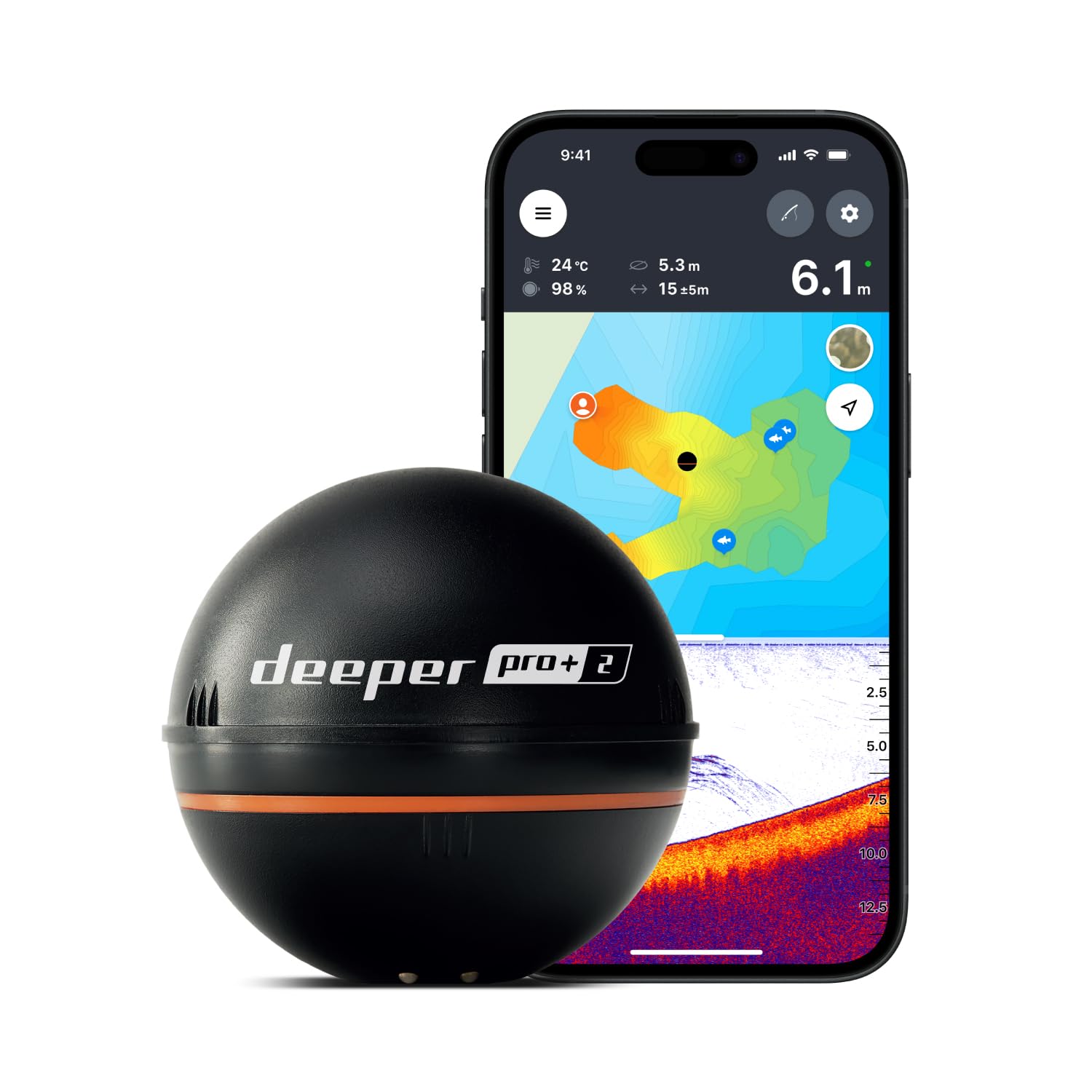
Fish the same lake all season and the PRO+ 2 gets more useful with every trip. It is a 3.2-ounce sonar you cast on an ordinary rod, and it draws bathymetric maps of whatever it passes over, saved in the Fish Deeper app, so your second lap around a point is informed by the first.

Three beams do different jobs: wide to cover water quickly, mid for a general read, narrow for detail. The narrow beam's 0.4-inch target separation is fine enough to pick a single fish off the bottom instead of a smear. Rated to 100 meters, it handles the deep reservoirs where the shallower castables start guessing, and the GPS is genuinely valuable from a bank or dock, where there is no boat electronics to fall back on.

It lives on your phone, and that cuts both ways. The app is where the maps and the paid pro features sit, so the unit's usefulness depends on a charged phone paired to the bobber, and the advanced mapping layers want a subscription. Reading a 2D image of a 3D scan also takes practice when you are working out which way a fish is facing.

For ice it is a hole-hopper: pocket it, drill, drop it in, and carry it to the next hole without a bag of cables. What it lacks next to the Garmin kit is a screen of its own — nothing here works without the phone.

Pros

  • Draws GPS bathymetric maps you keep
  • Three beams, 0.4-inch target separation
  • Rated to 100 meters of depth
  • Light enough to cast on a normal rod

Cons

  • Advanced mapping needs an app subscription
  • No standalone display; everything runs through a phone
Our verdict

Buy this one if you fish the same lake all season and want your own contour maps; it is the most capable castable here and the most dependent on your phone.

Check Latest Price
3

Best Castable for Bank Fishing

Garmin Striker Cast

88 /100
Angler Score Excellent

Key details

Included
Carrying bag, 20 ft tether, USB cable
Sonar Modes
2-D and ice flasher
Maximum Depth
200 ft
Wireless Range
Up to 200 ft
Check Details on Amazon

There is no screen on this one, and that is the design rather than the compromise. The STRIKER Cast is a 75-gram puck you tie on and cast; it streams 2-D sonar and an ice flasher to the STRIKER Cast app, which means the display you already own does the work.

From a bank, casting at a drop-off you cannot reach, we think it is the least fussy solution in this group. The puck and the phone are the only things to charge, there is no head unit to leave on the kitchen counter, and a 20-foot tether in the box gives you a second way to get it back if the knot lets go. Fish come back as arches with depth and water temperature attached, and flasher mode keeps it useful after the lake freezes.

Range is where the honest part of the conversation starts. Garmin rates the link at 200 feet; Bluetooth is the first thing to give out and it goes well short of that, so plan on keeping the cast inside a comfortable distance rather than at the edge of the claim. The phone pays for the missing screen twice, because the app drains it and a cold morning drains it faster.

What settles it for us is the size of the water you fish. Tight to structure from a kayak or a dock, this is the tidiest kit here; heaving it toward the middle of a reservoir from the beach is where the Deeper becomes the realistic tool.

Pros

  • No head unit to charge or pack
  • 20-foot tether included for retrieval
  • 2-D sonar plus an ice flasher mode
  • Pocketable 75-gram sonar

Cons

  • Bluetooth drops well before the rated 200 feet
  • Phone battery carries both units
Our verdict

The cleanest choice for a bank angler casting at structure: a 75-gram puck, a free app, and no head unit to charge or forget at home.

Check Latest Price
4

Best Color Screen Kit

Humminbird PiranhaMAX 4 Portable

86 /100
Angler Score Excellent

Key details

Sonar
Dual beam
Battery
7 Ah with wall charger
Display
4.3-inch color TFT
Kit Includes
Carrying case, portable transducer, battery, charger
Check Details on Amazon

The 4.3-inch screen is among the largest in this group, and color earns its keep when you are deciding whether a mark is a fish or the top of a weedbed. It reads at a glance in a way the small handheld displays do not.

Humminbird ships it as a complete kit: the PiranhaMAX head unit, a portable transducer, a 7-amp-hour battery with a wall charger, and a soft case that swallows all of it. That lead-acid pack is the quiet advantage over the USB-rechargeable units. It holds far more than an internal cell, it fills from any wall outlet at a cabin, and you are not nursing it between sessions.

Two things to know before you commit. At 2.5 pounds with the case it is the heaviest thing here, so it is a boat, kayak, or float-plane kit rather than something you hike in. And the portable transducer hangs on a suction cup; on a scuffed or weedy hull that cup is the weak link, so clean the spot or fit the transom bracket and the bottom reading holds.

Dual beam sonar gives a narrow and a wide option, which is more useful than it sounds: wide to find the school, narrow to stay on it. This is the closest thing in the guide to a permanent boat unit you can carry to the water and back.

Pros

  • 4.3-inch color display, clearest of the group
  • 7 Ah battery charges from a wall outlet
  • Complete kit with case and portable transducer
  • Dual beam sonar for coverage or detail

Cons

  • Heaviest unit here at 2.5 pounds with the case
  • Suction-cup transducer needs a clean, smooth hull
Our verdict

Worth the weight if most of your fishing happens away from an outlet: the biggest color screen here and a battery that charges from a wall socket.

Check Latest Price
5

Best Budget Wired

Venterior VT-FF001

82 /100
Angler Score Excellent

Key details

Display
4.3-inch LCD
Beam Angle
45 degrees
Sensor Cable
25 ft
Maximum Depth
328 ft
Check Details on Amazon

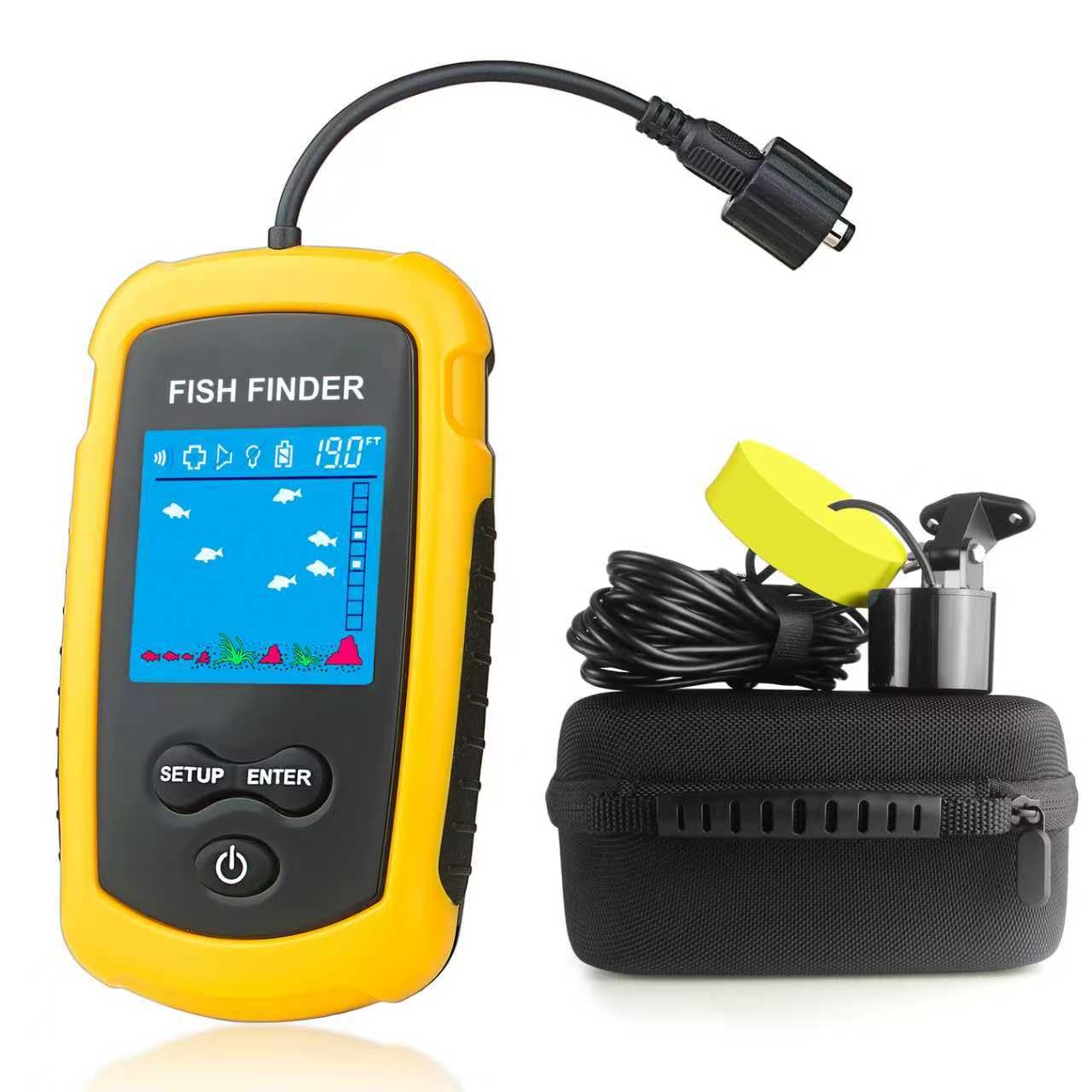
Twenty-five feet of cable is the whole proposition. The transducer goes over the side on a tether, the display hangs from a neck strap, and there is no pairing step, no app, and no phone anywhere in the chain.

From a kayak, a canoe, or over an ice hole, we think that is the right trade. Toss the sensor, turn the unit on, and depth reads to 328 feet on a 45-degree beam; the box also includes a transom bracket if you want it fixed to a small boat. Nothing about it needs a signal, which is more than several of the wireless units here can say.

From shore the cable becomes a leash. Twenty-five feet gets you to the edge of a drop-off and no further, so bank fishing is out unless the water deepens close in. Fish come back as small, medium, or big symbols at a depth rather than as arches, so you are reading a summary of the water rather than a picture of it. That summary is honest enough for the job, the water-resistant bag in the box is a small thing that matters on a wet deck, and two years of warranty is more coverage than we expect on a unit this simple.

Pros

  • No pairing, app, or phone required
  • Depth to 328 feet on a 45-degree beam
  • Neck strap and water-resistant bag included
  • Two-year warranty on a simple unit

Cons

  • 25-foot cable rules out bank fishing
  • Fish show as size symbols, not arches
Our verdict

For a kayak, canoe, or ice hole, this wired handheld is the simplest thing that works: no pairing, no app, no signal to lose.

Check Latest Price
6

Long Casts

LUCKY MT-202

84 /100
Angler Score Excellent

Key details

Weight
1.54 lb
Display
3.5-inch LCD
Maximum Depth
147 ft
Wireless Range
853 ft
Check Details on Amazon

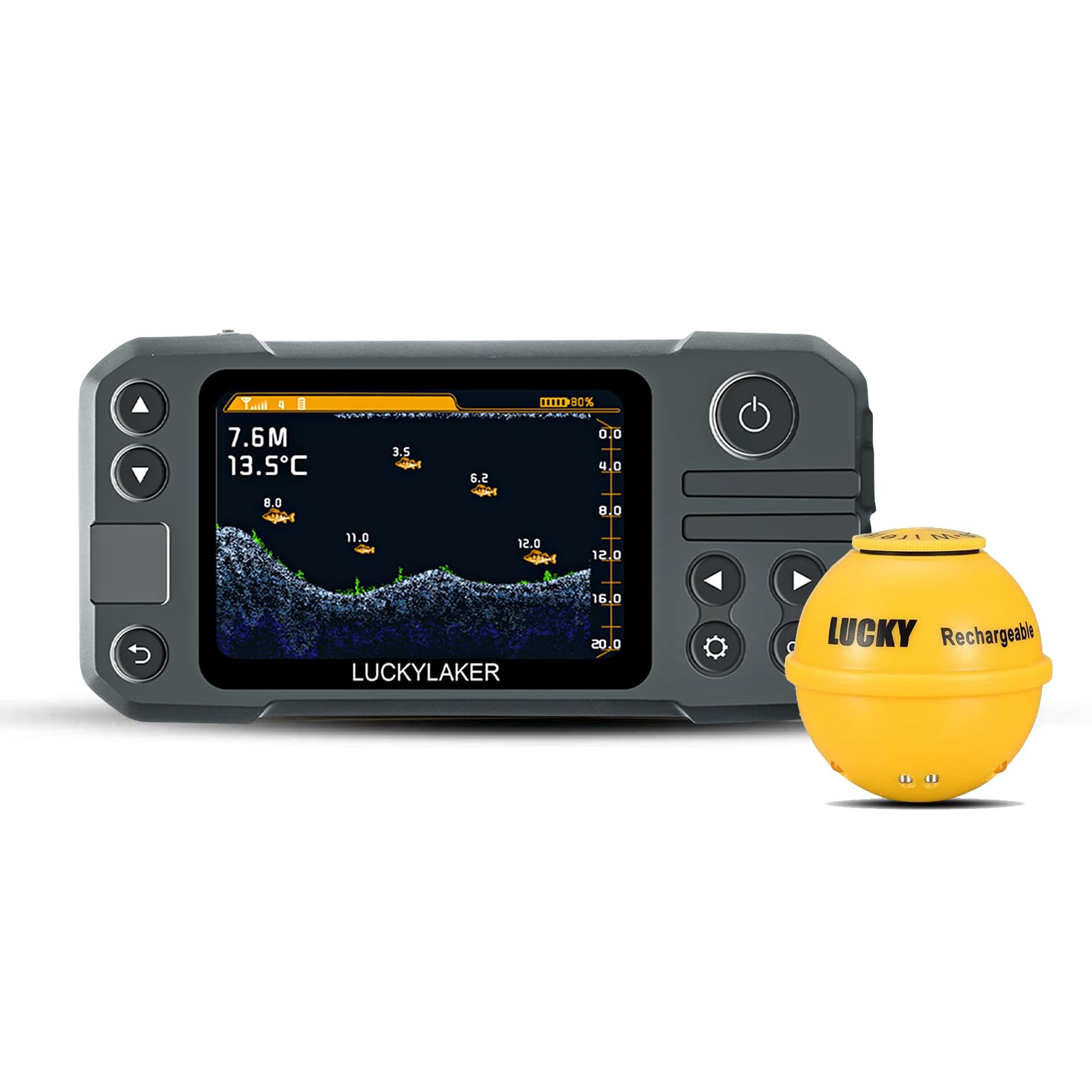
The range claim is 853 feet, which is far more than you can cast. What a long link actually buys you is margin: the connection does not fall over at 50 feet, which is where a couple of the castables here start to struggle.

The screen is the other argument. At 3.5 inches with a horizontal layout it reads more like a fish finder than a phone, with fish icons carrying their own depth numbers instead of a symbol and a guess from you.

For big, open water from a kayak, where you want the sensor well away from the hull, it earns a place. The handheld and the floating sensor together weigh less than a one-liter bottle, comfortable to hold through a session, and it is rated to 147 feet, plenty for most inland water you will fish from a paddle craft. Where we are cautious is the long game: the warranty is one year, the shortest here, and this is the pick whose reliability over several seasons we are least sure of. For ice, plan on drilling and lowering the sensor into clear water rather than expecting it to shoot through a thick lid.

Pros

  • 853-foot wireless range with margin to spare
  • 3.5-inch horizontal display with fish depth labels
  • Light enough to hold through a session

Cons

  • One-year warranty, the shortest in this group
  • 147-foot depth rating is the shallowest here
Our verdict

A sensible pick if you want a long wireless link and the biggest handheld screen for open-water kayak fishing, as long as you accept the shortest warranty here.

Check Latest Price
7

Ice Fishing

FishPod 5x

82 /100
Angler Score Excellent

Key details

Mount
TraxNut, fits 1/4-20 brackets
Display
5 inches
Sonar Modes
Four presets plus vertical flasher
Maximum Depth
199 ft
Check Details on Amazon

The vertical flasher is the feature that sells this one, and it is the right call for ice. A flasher shows your jig and whatever is investigating it in real time; scrolling sonar history is more information than you need when you are staring down a hole.

Four preset modes do the tuning for you. Choose fish size, depth, or schooling and the unit adjusts its own settings, which is a kindness to anyone who has spent an evening nudging sensitivity. BottomScan reads the lakebed as weed, soft mud, or hard, and the display is listed at 5 inches, the largest here.

The TraxNut mount screws to any 1/4-20 bracket, so a rod holder or rail clamp does the job instead of a proprietary cradle. Rated to 199 feet, it covers the water most of us fish, and the two-year 'you break it, we fix it' warranty is the only coverage in this guide that promises damage rather than defects.

The open question is how it holds up over several seasons; there is less of a track record behind it than behind the Garmin or the Deeper. Buy it for the flasher and the presets if ice is your season, and treat that warranty as the safety net it is.

Pros

  • Real-time vertical flasher for ice
  • Four presets tune sonar automatically
  • Warranty covers damage, not just defects
  • Mounts to any 1/4-20 bracket

Cons

No notable drawbacks to flag.

Our verdict

The most purpose-built ice unit in this guide, with a real-time flasher, preset tuning, and a warranty that covers damage rather than defects.

Check Latest Price
8

First-Timers

Yoocylii Handheld Fish Finder

82 /100
Angler Score Excellent

Key details

Display
4.6 cm LCD
Beam Angle
45 degrees
Maximum Depth
328 ft
Check Details on Amazon

Three hundred and twenty-eight feet of depth range, a 45-degree beam and 200 kHz sonar: on paper this handheld does the same core job as units costing several times as much, in a body that disappears into a tackle box.

For two buyers we think it is the right call. One is the angler who wants to know how deep the water in front of them is and whether anything is down there. The other is anyone buying a first finder for a kid who will not read a manual. Toss the transducer in, switch the unit on, and read the depth.

The screen is where the corners were cut, and we think that is an acceptable trade at this end of the range. At 4.6 cm the numbers are hard to catch at a glance, fish come back as size symbols rather than arches, and it goes through batteries faster than we liked. Set expectations to depth and presence rather than structure, and it earns its place in the box for the days the main unit stays home.

Pros

  • Depth range to 328 feet
  • Simple toss-and-read operation
  • 45-degree beam at 200 kHz

Cons

  • 4.6 cm display is hard to read at a glance
  • Goes through batteries quickly
Our verdict

A reasonable first finder or backup for depth and fish presence, as long as you want a small screen and accept the battery habit.

Check Latest Price

How We Tested Portable Fish Finders

We started by pulling together every portable unit we could find in the sub-few-hundred-dollar range, then cut the list by reading spec sheets and owner reviews: transducer type, whether GPS was built in or tied to a subscription, screen size against how much bulk you'd carry, and whether the unit had its own display or leaned on your phone. That left 12 units, all of which we bought ourselves so no brand had a say in what we wrote.

Testing ran across eight months and four kinds of water: casting from a public dock, paddling a kayak across a windy reservoir, a two-day ice trip where everything sat on the ice in single-digit wind chill, and a farm pond from a small aluminum boat. To check accuracy, I dropped a weighted, knotted line at a dozen spots for a true depth reading and compared it against what each screen displayed, then marked brush piles and weed edges to see whether fish showed up where I knew they were holding. On the units with GPS, I saved a waypoint at the dock, paddled off, and navigated back using nothing but the screen.

Battery life got tested the hard way: full charge to dead, with hours logged. Castable models were counted in retrieves and app time rather than screen time. Portability meant weighing each unit and case, then seeing whether it fit through a kayak hatch and into a five-gallon bucket. We carried them in and out of a cold truck, wiped them with wet hands, and dropped two onto the dock from waist height to watch how the housings held up. Connectivity was checked at 30, 60, and 100 feet to see whether the app held or stuttered, and value came down to what was in the box — case, mount, transducer rig — versus what you already owned.

How to Choose a Portable Fish Finder

Castable, tethered, or a kit

A castable unit is a bobber on a line: you throw it with a rod, it floats, and the reading goes to a handheld or a phone. It is the only type that works from an open bank, and the only type where the water between you and the fish is a problem, because the link weakens with distance. A tethered unit sends its reading up a cable to a display on a neck strap. It never loses a signal and never reaches past the cable.

A kit puts a head unit, a battery and a suction or transom transducer in a bag. It behaves most like a boat unit and weighs the most. Whichever you choose, check that the transducer does not need to be bonded into a hull, because 'portable' in a listing often just means it packs up small.

A screen in your hand or the phone in your pocket

App-based sonar saves you a head unit to charge and pack, and it puts the picture on the brightest screen you own. It also drafts your phone into the tackle: wet hands, gloves, glare, cold mornings, and one battery covering two devices. If you fish in gloves or in low light, a dedicated display is easier to live with; if you already carry a phone and a power bank, paying for a second screen is money spent twice.

Depth ratings, beams, and what a screen can show

A depth rating is a ceiling, not a score. If the deepest water you fish is 60 feet, a 300-foot rating buys you nothing you will use. Beam angle decides what you actually see: a 45-degree cone covers a wide circle that widens with depth, which is good for finding the edge of a school and bad for detail, because everything inside it gets averaged.

A narrow beam marks less water and shows structure more clearly, which is why multi-beam units like the Deeper PRO+ 2 are worth the step up if you fish structure rather than open basins. Buy the coverage that matches how you search.

Power, cold, and charging on the water

Two designs dominate: a sealed internal battery charged over USB, and a kit battery that charges from a wall outlet and plugs into the head unit. The internal cell is smaller and simpler; the pack runs longer and does not tie up a cable overnight. Cold cuts runtime on both, and a phone-based unit pays twice. Charge everything the night before and pack a power bank, because a finder with nothing left to give is an expensive float.

What comes in the box

Battery, charger, carry bag, transducer mounts, tether, neck strap. The extras are where a bargain quietly disappears, and a kit that includes them usually costs more up front and less overall than a bare unit you then have to equip. Read the included list like a parts diagram: if the mount or the charger is missing, you will be improvising at the launch.

Frequently Asked Questions

Final Verdict

The Garmin Striker 4 with Portable Kit is what we hand most anglers: real sonar, a screen you can read, an ice flasher, and a bag that already contains the battery, charger, transducer and mounts. It is the least fussy way to get a proper reading from a kayak, a rented boat, or a hole in the ice.

If you fish from a bank and want your own contour maps, the Deeper PRO+ 2 earns its higher price. If you want no pairing, no app and no dropouts, the Venterior VT-FF001 does the job on a cable and a neck strap.