Best Dual Fuel Generators of 2026

The first time a storm knocks out power for three days, a generator stops being a gadget and becomes the plan. A dual-fuel model gives you a second way to keep the fridge, furnace, and Wi-Fi alive: gasoline when it's easy to find, propane when stations are dark or the gas has sat too long. What separates a useful unit from a frustrating one isn't the wattage on the box—it's whether it starts on the first button press, holds a steady load, and stays tolerable in the yard.

Over the past nine months, my team and I ran eight dual-fuel generators through real outages and weekend projects, from backing up a fridge and sump pump to running a camper's essentials. We timed cold starts on propane, checked remote-start range from inside the house, listened under load, and noted whether the battery still had juice after weeks in the garage. Setup, fit and finish, and the little stuff that wears out after repeated use got as much attention as the wattage claims—these picks earned their place by being easy to live with, not just powerful on paper.

1

Best Overall

Westinghouse WGen9500DF

95 /100
Angler Score Outstanding

Key details

Fuel Tank
6.6 gallons
Gas Running Watts
9,500
Propane Running Watts
8,500
Transfer-switch Outlets
L14-30R 30A and 14-50R 50A
Check Details on Amazon

The outlet panel is the first thing we look at on a backup generator, and this one has the set that matters: a 30-amp L14-30R for a transfer switch or interlock kit, a 50-amp 14-50R for an RV or a heavier panel feed, and two GFCI household outlets under rubber covers. That combination is the difference between a generator that backs up a house and one that runs extension cords.

The numbers behind it hold up. It's rated 9,500 running and 12,500 peak watts on gasoline, or 8,500 running and 11,200 peak on propane, from a 457cc engine and a 6.6-gallon tank rated for up to 12 hours. Run the arithmetic against your own panel. A furnace blower, a well pump, a fridge and a few rooms of lights fit comfortably inside the 8,500 watts you get on propane, and that's the figure that decides the purchase if a tank is your fuel plan.

Starting is where it pulls away from the cheaper units here. There's a key fob, a push button and a recoil cord as the fallback, plus a digital hour meter for tracking oil changes. Firing it from the doorway before stepping out into a January sleet storm is a small convenience that stops feeling small the second time you use it. Oil, a funnel, a propane hose and a battery charger come in the box, so the first run is a short job.

Against the DuroMax below, you give up about a thousand running watts and spend less for it; against the WEN DF475T, you pay more and get a 50-amp outlet and the fob. We keep coming back to this one because it sits between those two and does the whole-house job on either fuel.

Pros

  • 9,500 running watts on gas, 8,500 on propane
  • Both 30-amp and 50-amp 240-volt outlets
  • Remote fob, electric start, and recoil backup
  • Three-year limited warranty

Cons

  • Open-frame noise carries across the yard
Our verdict

For most households this is the dual fuel generator we point to first: enough running watts to carry a real house on either fuel, and a start you can trigger from the doorway.

Check Latest Price
2

Best for 30-Amp Inlets

Westinghouse WGen5300DFcv

89 /100
Angler Score Excellent

Key details

Weight
135.6 lb
Fuel Tank
4.7 gallons
Gas Running Watts
5,300
Propane Running Watts
4,800
Check Details on Amazon

A 30-amp inlet changes the shopping list. This Westinghouse is built for exactly that: 5,300 running and 6,500 peak watts on gasoline, 4,800 running and 5,800 on propane, with a 30-amp L14-30R for a transfer switch and a TT-30R for a travel trailer on the same panel.

The 4.7-gallon tank is rated for up to 14.5 hours, and the 274cc engine carries a CO shutdown sensor alongside the usual low-oil cutoff — the sensor kills the unit if carbon monoxide builds, which is a feature you hope never to test. Oil, a funnel, the propane hose, a wheel kit and a tool kit are all in the box, so there's no separate shopping trip before the first outage.

We reach for this one when a 50-amp unit is more generator than the house needs and more money than the job justifies. A well pump, a fridge, a freezer and lights sit well inside its range, and the propane side only costs about 500 watts. For a cabin, a small house or a trailer with a 30-amp hookup, it's the sensible middle of this group.

Pros

  • 5,300 running watts on gas, 4,800 on propane
  • Transfer-switch and RV outlets on one panel
  • CO shutdown plus low-oil protection
  • Up to 14.5 hours on a 4.7-gallon tank

Cons

  • Pull start only
  • 135.6 pounds to lift and move
Our verdict

Buy this one when the inlet on the side of your house is 30 amps: 5,300 running watts on gas, an RV outlet, and a CO shutdown sensor for mid-size money.

Check Latest Price
3

Most Power

DuroMax XP13000EH

91 /100
Angler Score Outstanding

Key details

Engine
500cc
Weight
234 lb
Peak Watts
13,000
Gas Running Watts
10,500
Check Details on Amazon

Thirteen thousand peak and 10,500 running watts on gasoline is the biggest number on this page, and it's the reason to look here at all. A house with central air, a well pump and an electric water heater has a realistic chance of staying on through an outage, provided you sequence the big loads rather than asking for all of them at once.

The build is the second argument. The frame and power panel are all metal with no plastic parts, and the fuel selector faces forward at the panel, so switching between gas and propane doesn't mean reaching around a hot engine. The 500cc engine comes with a wheel-and-handle kit, a tool set and an oil funnel.

Start is a push button, and the unit is transfer-switch ready — pair it with a 50-amp inlet and an interlock and getting the house back takes about a minute. A three-year warranty covers it, which is the equal of anything here.

We rate it the choice for the heaviest loads in this set, with one caveat we take seriously: the electric-start battery is what lets these machines down after a long sit. Keep it on a maintainer and run the unit under load once a month. Do that, and the wattage per dollar here is the strongest in the group.

Pros

  • 10,500 running watts, the highest here
  • All-metal frame and power panel
  • Front-facing fuel selector at the panel
  • Push-button electric start with three-year warranty

Cons

  • 234 pounds, the heaviest stated weight here
  • Open-frame noise at full load
Our verdict

The most power in this group: 10,500 running watts on gas, a 50-amp feed, and an all-metal frame, for a house with central air and an interlock already installed.

Check Latest Price
4

Best Budget 240V Pick

WEN DF475T

89 /100
Angler Score Excellent

Key details

Weight
105.8 lb
Fuel Tank
4 gallons
Gas Running Watts
3,800
Propane Running Watts
3,500
Check Details on Amazon

Two things rarely turn up together at the budget end: a 240-volt L14-30R outlet for a transfer switch and an electric key start. The DF475T has both, plus a recoil cord for the day the battery is flat, and it does it for the least money in this group.

Output is 3,800 running and 4,750 surge watts on gasoline, or 3,500 and 4,350 on propane, from a 224cc engine and a 4-gallon tank rated for up to 11 hours at half load. A wheel kit and handle are included, and at 105.8 pounds one person can roll it out of a shed and lift it into a truck bed with some grunting.

We keep it on the list because the money goes where backup actually needs it: the 240-volt outlet, the key start and a tank that lasts a night. What it doesn't buy is a good battery. The factory one is the usual first failure on a unit that sits between storms, so plan on a maintainer or a replacement battery before the first outage rather than during it.

Pros

  • 240-volt outlet and key start at the lowest price here
  • 105.8 pounds with a wheel and handle kit
  • Fuel selection dial for gas or propane

Cons

  • 3,800 running watts leaves little headroom
  • 30-amp maximum, with no 50-amp outlet
Our verdict

The least expensive way here to get a 240-volt panel feed and a key start — 3,800 running watts on gas, and a machine one person can wheel out.

Check Latest Price
5

Best for Camping and RVs

WEN DF480iX

87 /100
Angler Score Excellent

Key details

Weight
78.5 lb
Fuel Tank
1.9 gallons
Gas Running Watts
4,000
Propane Running Watts
4,000
Check Details on Amazon

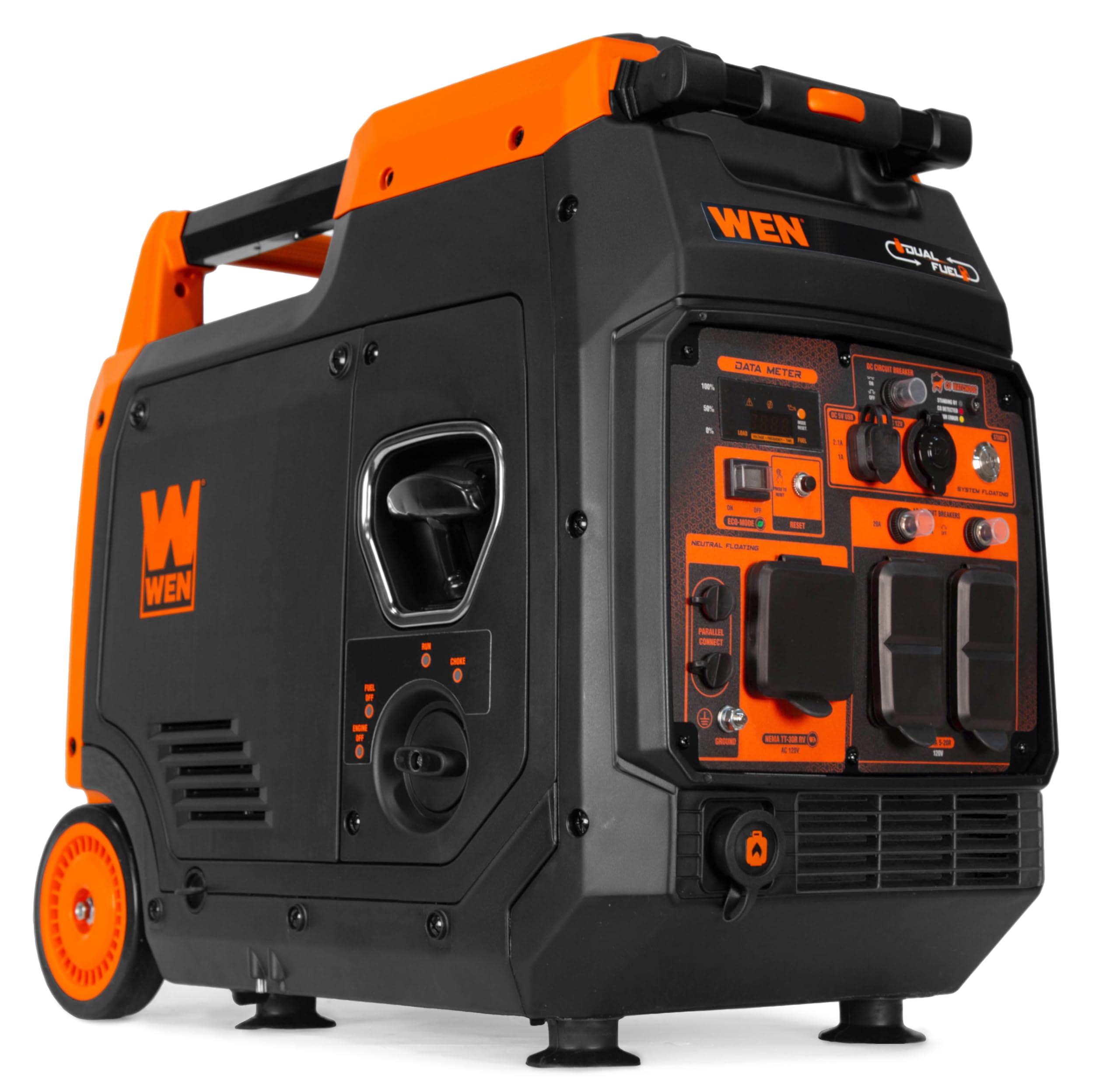
If the generator is going to sit six feet from where you sleep, this is the one we hand people. It's an inverter in a closed housing rather than an open frame, so the sound is a hum instead of a bark, and at 78.5 pounds with onboard wheels and a telescoping handle it moves like a suitcase rather than a generator.

Output is 4,000 running watts on either fuel — 4,800 surge on gasoline, 4,320 on propane — through a TT-30R RV outlet and four household receptacles. That's a 30-amp trailer with one air conditioner running, plus the fridge and the lights, which is the realistic camping load. The CO Watchdog shuts the unit down if carbon monoxide builds, and a fuel shutoff lets you run the carburetor dry before it goes into storage.

Propane is the better half of this one: a tank feeds it through a tool-free quick-connect, so you're not hauling gasoline in the truck bed or worrying about fuel going stale between trips. Keep the start battery on a charger between outings — it's the maintenance item that bites small inverters — and this is a unit that quietly does its job for years.

Pros

  • Inverter power in a quiet, closed housing
  • 78.5 pounds with wheels and a pull handle
  • TT-30R RV outlet plus four household outlets
  • CO Watchdog and fuel shutoff for storage

Cons

  • 1.9-gallon tank means daily refills on gas
  • 4,000 watts covers one RV air conditioner, not two
Our verdict

Our pick for campgrounds and travel trailers: 4,000 running watts on either fuel, inverter power, and 78.5 pounds on wheels with a handle.

Check Latest Price
6

Essentials and Camping

PowerSmart MB5040DC

87 /100
Angler Score Excellent

Key details

Weight
68 lb
Gas Running Watts
3,600
Propane Running Watts
3,300
Total Harmonic Distortion
Under 3%
Check Details on Amazon

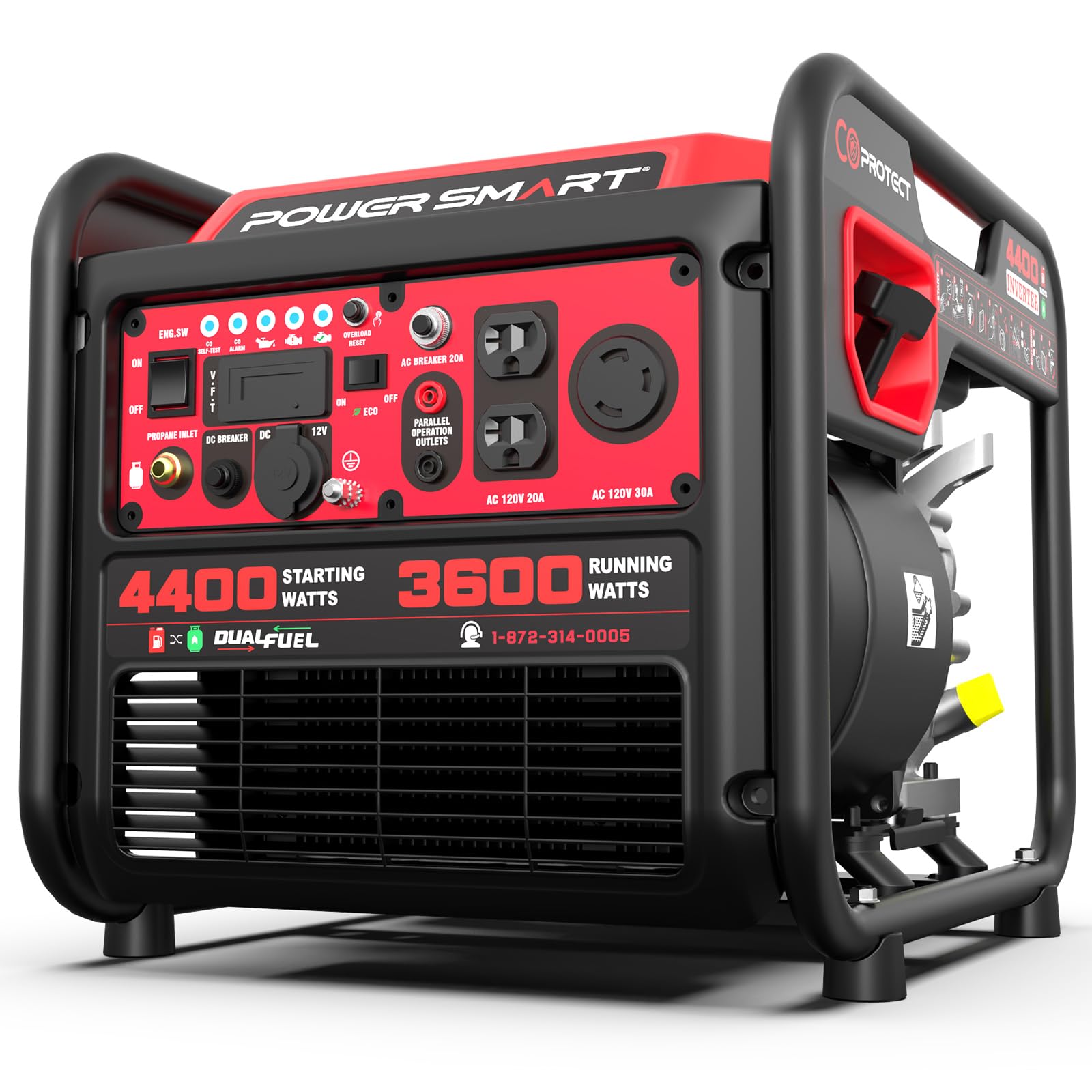
At 68 pounds this is the only generator in the group one person can carry up a step without thinking hard about it. It's rated 3,600 running and 4,400 starting watts on gasoline, 3,300 and 4,000 on propane, and the 1.6-gallon tank is good for about eight hours at a quarter load — with a claim of up to 24 hours on a standard 20-pound propane tank at the same load.

For a tailgate, a tent with a CPAP machine, or keeping the fridge, the modem and a few lamps alive through a two-day outage, this is the one we take. The inverter puts out power clean enough for laptops and phones — under 3% total harmonic distortion — and eco mode throttles the engine down when nothing is drawing, which is what makes the small tank stretch.

It also can't feed a panel. The biggest outlet is a 120-volt 30-amp L5-30R twist-lock, so there's no 240-volt side and no transfer switch in its future; this is a cord-and-outlet machine. For the right buyer that's a fair trade — you get the lightest body here and clean power, and you give up the whole-house role entirely.

Pros

  • 68 pounds, the lightest here
  • Under 3% THD for electronics
  • Up to 24 hours on a 20-pound propane tank
  • Eco mode stretches the small tank

Cons

  • No 240-volt outlet for a panel feed
  • Two-year warranty, the shortest in this group
Our verdict

The smallest and lightest unit here: 3,600 running watts, inverter-clean power and 68 pounds, for tailgates, tents and a fridge circuit during an outage.

Check Latest Price

How We Tested Dual-Fuel Generators

We started by pulling every dual-fuel portable we could find from brands with a real service network, then cut anything that couldn't run a 240-volt well pump or transfer-switch panel, whose propane derate would leave too little headroom, or whose price jumped without a clear upgrade in parts. That left eight units, which we ran for nine months.

Testing happened where generators actually live: on a concrete pad beside the garage, at the edge of a campsite, and in the slushy week after a nor'easter knocked out the neighborhood. We started each unit cold on gasoline and propane, timed how long it took to fire and how many attempts it needed, then checked remote fobs from the kitchen and the far end of the driveway. We loaded them in steps—fridge and lights first, then a space heater, then a 240-volt pump—and watched whether the engine bogged or the voltage dipped. To judge noise, we stood 25 feet away and held a normal conversation; some you could talk over, others forced us indoors. Battery life got its own check: we left each unit parked for a month between runs and noted whether the electric start still turned over or needed a trickle charger.

Ease of use came down to details: wheel size over gravel, whether one person could lift the tongue, how clearly the choke and fuel selector were marked, and whether switching from gas to propane required tools or a flashlight. We looked for fit and finish that held up after repeated moves—loose panels, melting stickers, chafed fuel lines—and compared what each unit included against what it cost, since a cheap generator that needs an expensive kit and a new battery in year one isn't a value. The eight that stayed in rotation are the ones that started without drama, carried their loads, and didn't make us dread the next outage.

How to Choose a Dual Fuel Generator

Size It on the Propane Column

Every dual fuel unit here gives up output when you switch fuels. Our top pick drops from 9,500 running watts to 8,500, the Westinghouse 5,300 from 5,300 to 4,800, and the WEN DF475T from 3,800 to 3,500 — roughly a ten percent haircut across the group. If your plan is a pair of 20-pound tanks and the supplied hose, add up your loads against the propane figure and ignore the gasoline one.

Propane earns that loss back in storage. A sealed tank sits for a year without turning, while gasoline needs stabilizer and rotation and a carburetor that gets drained. If the generator is going to wait nine months between uses, the fuel that still works in month ten is the one to size for.

Match the Outlet to Your Inlet

Home backup comes down to one connection. A 30-amp L14-30R feeds a 30-amp inlet or a small transfer switch; a 50-amp 14-50R feeds a bigger panel, and the 10,500-watt DuroMax is the unit here that really needs it. Know which one is on the side of your house before you order.

The trap is buying watts you can't deliver: a 13,000-watt generator behind a 30-amp inlet is a 7,200-watt generator, because 30 amps at 240 volts is the ceiling. If there's no inlet at all, price the electrician's work into the purchase before you pick a machine.

Open Frame or Inverter

Open-frame units are the whole-home workhorses: more watts for the money, louder, and entirely adequate for a furnace, a fridge and lights. Inverters cost more at the same output, but they produce clean sine-wave power and put the engine in a quieter enclosure — which is what you want six feet from a tent or a trailer.

In this group the WEN DF480iX and the PowerSmart are inverters, and the PowerSmart publishes distortion under 3%, which matters for laptops and phones. If the machine lives in a shed and only ever feeds the panel, an open frame is the better use of the money.

Weight and Where It Will Live

The range here is 68 pounds to 234 pounds, and that number decides more about ownership than the wattage does. Above about 150 pounds you want a permanent pad, a ramp and a second person; the 234-pound DuroMax is a shed-and-stay-put machine. Below 100 pounds — the PowerSmart at 68 and the WEN DF480iX at 78.5 — wheels and a handle make a one-person move realistic.

Measure the doorway and the shed before the crate arrives, and decide now whether it lives outdoors under a cover or in a garage. Note the second half of that: stored in the garage, run outside, always.

Start Type, Battery, and Exercise

A recoil cord always works; a battery might not. Remote fobs and push buttons are worth real money in bad weather — press the button from the doorway, then go out and plug in — but the start battery is the usual first casualty on a unit that sits for months. Put it on a maintainer and run the generator under load for half an hour every month or two.

A fuel shutoff valve, standard on both WEN inverters here, lets you run the carburetor dry before storage and spare yourself a springtime cleaning. Treat all of it as maintenance you schedule, not repair you hope to avoid.

Frequently Asked Questions

Final Verdict

The Westinghouse WGen9500DF is the dual fuel generator we recommend to most households: 8,500 running watts on propane, a 50-amp outlet for a genuine panel feed, and a fob you can press from the doorway before you step into the weather. If the inlet on your house is 30 amps, the Westinghouse WGen5300DFcv saves money without leaving you short.

And if the generator is going camping rather than guarding the house, the WEN DF480iX is the one to take — quieter, lighter, and built around a 30-amp trailer rather than a panel.