Best Inverter Generators of 2026

The power went out at my place on a Tuesday in July — the window unit cut, the fridge went quiet, and my phone was at 9 percent. What I wanted wasn't a 90-pound open-frame machine roaring on the porch. It was something quiet enough to talk over and clean enough not to fry a laptop. That's the basic promise of an inverter generator: it converts raw engine output into steady, sine-wave power for fridges, routers, CPAP machines, and RV outlets, and it shields the noise while it does it.

Over the past 11 months, my team and I have run eight of them through outages, campsites, and job sites, and the numbers on the box tell you less than you'd think. Peak wattage means nothing if the running watts can't handle a sump pump's startup surge. "Quiet" means nothing until the thing is under load. What we cared about was which ones we stopped thinking about — started on a cold morning, ran all night, needed no fuss. A few of those are below.

1

Best Overall

Champion 4000W Dual Fuel

90 /100
Angler Score Outstanding

Key details

Fuel
Gasoline or propane
Noise
64 dBA at 23 ft
Weight
51.8 lb
Running / Starting Watts
3000 / 4000 W
Check Details on Amazon

Just over 51 pounds carrying 3,000 running watts is the balance that wins this one the top spot. That is light enough for one person to lift into a truck bed and strong enough to start a 13,500 BTU RV air conditioner, which is the load that separates a real camping generator from a phone charger. Both fuels work out of the box, with the propane hose packed alongside the oil, and there is a TT-30R receptacle on the panel so a 30-amp trailer plugs straight in. Output is rated under 3% THD, the figure that keeps a laptop, a television, and a modern fridge control board happy.

Quiet is relative, and 64 dBA at 23 feet sits in the middle of this group: audible from the next campsite, easy to talk over at your own. The enclosed shell and the eco-mode throttle do most of that work, and on a light load we stopped noticing the engine after about an hour. Runtime is where the two fuels split, at roughly 10 hours on a tank of gasoline and up to 25 on propane at a lower wattage. Propane is the smarter long-weekend choice because the tank does not go stale between trips.

The CO Shield shutdown is the feature we care about most on a machine that lives in a garage between storms. It cuts the engine if carbon monoxide builds, which is a backstop rather than a license to run it indoors. The three-year limited warranty and free lifetime technical support are as good as anything in this group. Cold starts are a two-pull affair once the choke is set, and the pull is light enough to manage in gloves.

Three thousand watts is the honest ceiling: a 30-amp trailer with the air conditioner running is comfortable, and two air conditioners are not. Below that line there is very little this one asks of you — no priming ritual, no wheel chock, no second person.

Pros

  • 3,000 running watts at 51.8 pounds
  • Runs on gasoline or propane out of the box
  • Under 3% THD for electronics
  • TT-30R outlet for a 30-amp trailer

Cons

  • No electric start or remote fob
  • 1.54-gallon tank means frequent refills under load
Our verdict

We recommend this one to most people: it carries a 30-amp RV or a few household circuits on gas or propane at 51.8 pounds, for far less than our Honda pick.
Check Latest Price
2

Best for Quiet Camping

Honda EU2200i

94 /100
Angler Score Outstanding

Key details

Noise
48–57 dBA
Weight
51 lb
Runtime
3.2–8.1 hours
Output Wattage
2200 W
Check Details on Amazon

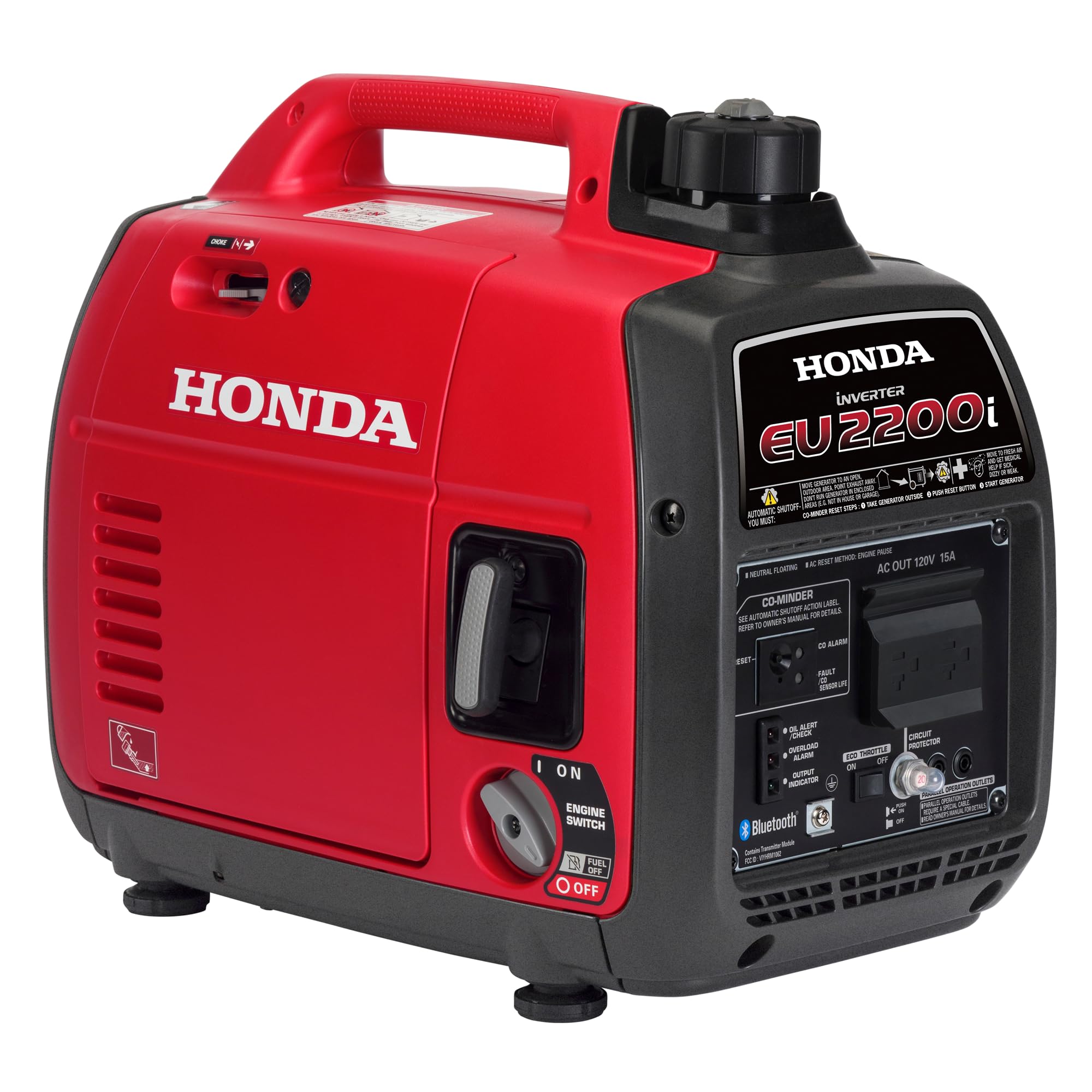
Two numbers explain the Honda before you ever pull the cord: 48 to 57 dBA and just over 50 pounds. The noise figure is the lowest here by a wide margin, and it is not a marketing number — this is a generator you can stand beside and forget is running. The 0.95-gallon tank stretches from 3.2 to 8.1 hours depending on load, and the CO-MINDER shuts the engine down if carbon monoxide builds near the unit.

What that buys you is a campsite generator that does not start a fight with the site next to you, and a unit light enough to lift out of a truck bed without help. The Bluetooth app is more useful than it sounds, since you can watch output and run status without walking over to a machine parked behind the trailer. We also rate the fit and finish above everything else in this group: panels line up, the recoil is smooth, and nothing rattles at load.

Two thousand two hundred watts is the ceiling, and it is a real one. It will run a coffee maker and a fridge, or a 13,500 BTU air conditioner with a soft-start kit and little else on the circuit. The small tank is the other tax — under a heavy load you are refilling every few hours, so a fuel can and a funnel become part of the kit.

Where it earns its keep is repetition. This is the one that starts in March and still starts in November after a summer in the shed, and the three-year warranty is as long as any here. Buy it for the loads a 2,200-watt unit can actually carry, and borrow something bigger for the weekend you need the whole house.

Pros

  • Lowest noise rating here at 48 to 57 dBA
  • Just over 50 pounds, easy for one person
  • CO-MINDER shuts down on carbon monoxide
  • Bluetooth app for remote monitoring

Cons

  • No 30-amp RV outlet or 240-volt output
  • Premium price for 2,200 watts of output
Our verdict

We point quiet-first campers here: 48 to 57 dBA, just over 50 pounds, and the best fit and finish in this group.

Check Latest Price
3

Best for Whole-Home Backup

Westinghouse iGen12000DFc

87 /100
Angler Score Excellent

Key details

Fuel
Gasoline or propane
Noise
As low as 64 dBA
Home Outlet
120/240V 50A
Running / Starting Watts
9000 / 12000 W
Check Details on Amazon

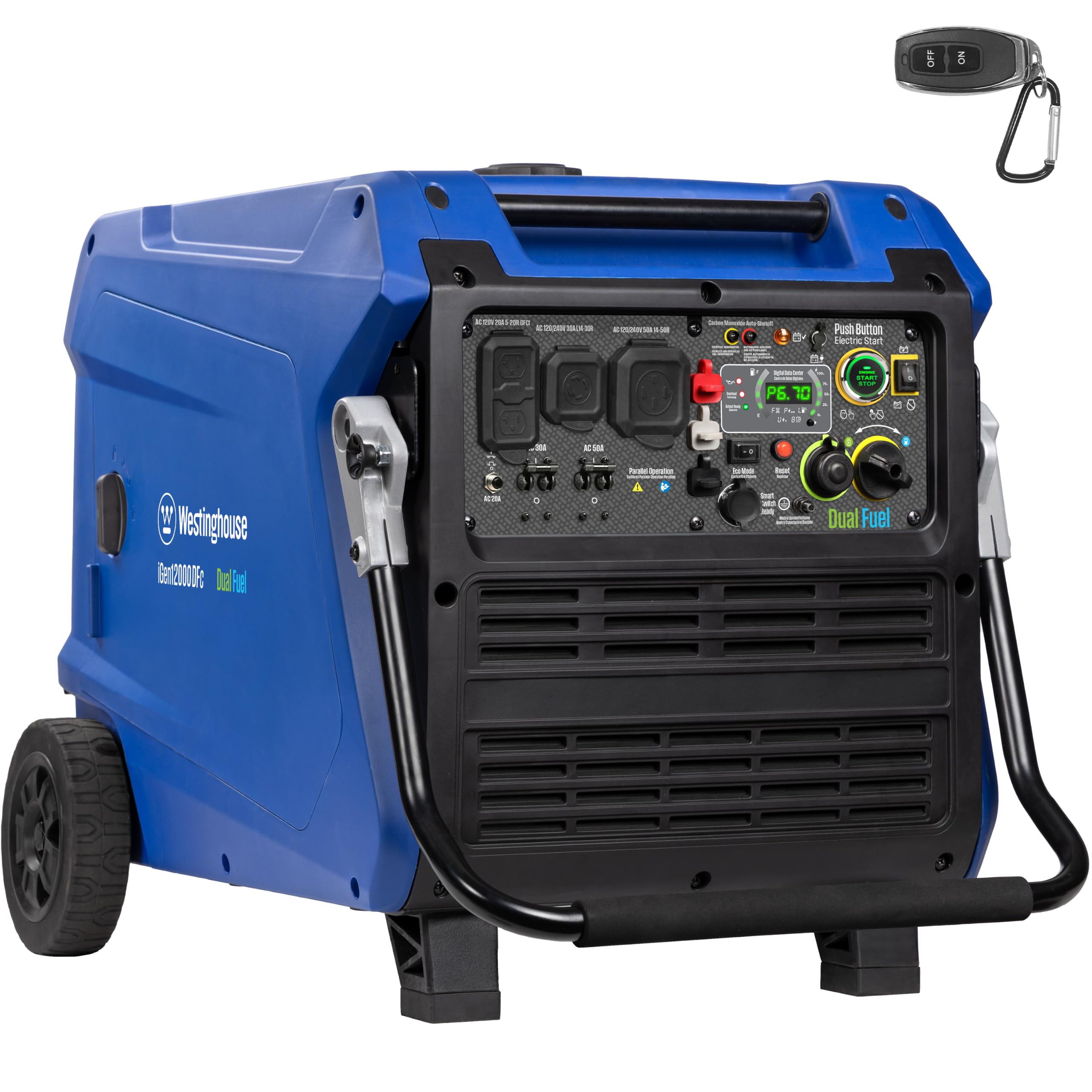
A 120/240-volt, 50-amp outlet is the line between backing up a house and backing up a few extension cords. Paired with a transfer switch or an interlock kit, this Westinghouse carries a well pump, a water heater, or central air — the loads that decide whether an outage is inconvenient or expensive. Nine thousand running watts and 12,000 surge make it the most powerful unit we recommend here.

Sixty-four decibels from a 457cc engine is an achievement of enclosure and muffler rather than of a small engine. We stood beside it under load and held a normal conversation, which is not a sentence we can write about the open-frame unit on this page. The 9.8-gallon tank is the other half of the home-backup case: 17 hours between fill-ups means sleeping through the night instead of setting an alarm to refuel.

The LED data center shows fuel level, output, remaining runtime, and lifetime hours, and the key fob starts it from the house — genuinely useful when the machine sits out in weather and you do not want to. Dual fuel matters more for a home than for a campsite, since a propane tank can sit for years without going bad. That is exactly the fuel you want for something that runs twice a year.

All of it comes at 187 pounds before fuel, which means a permanent pad and a cover rather than a shelf, plus two people or a ramp on delivery day. Treat it as installed equipment and the rest of the package makes sense: this is the pick for a house that loses power for days, not for a tailgate that loses power for an afternoon.

Pros

  • 9,000 running watts through a 50-amp outlet
  • 17-hour runtime on a 9.8-gallon tank
  • Quiet for its size at 64 dBA
  • Remote key fob and LED data center

Cons

  • No natural gas option on this model
Our verdict

The one we point homeowners to: 9,000 running watts through a 120/240-volt 50-amp outlet, with 17 hours between fill-ups.

Check Latest Price
4

Best Mid-Size with Electric Start

WEN DF480iX

87 /100
Angler Score Excellent

Key details

Fuel
Gasoline or propane
Start
Electric push-button
Weight
78.5 lb
Running / Starting Watts
4000 / 4800 W
Check Details on Amazon

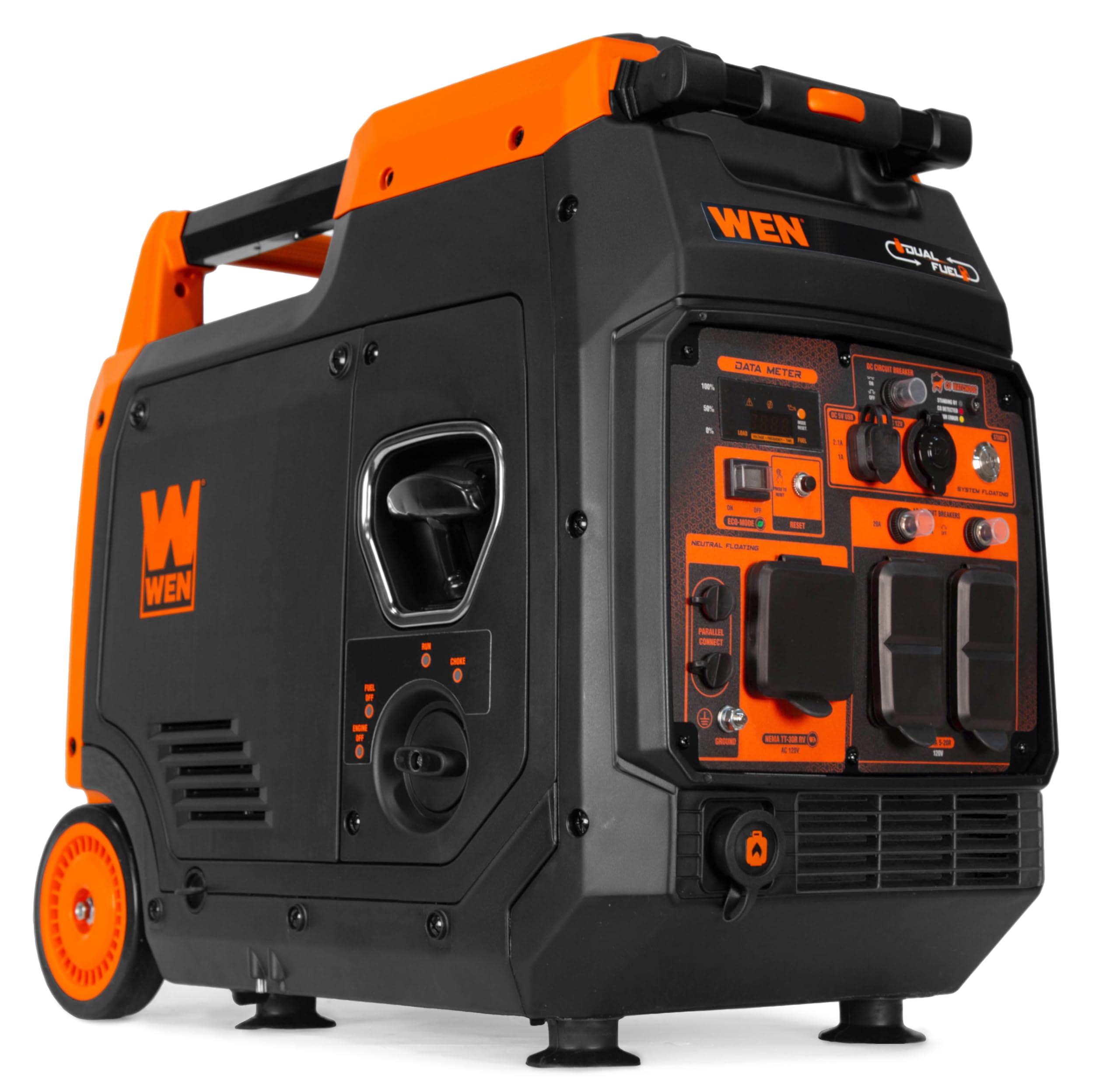
Wheels and a telescoping handle sound like small conveniences until you are dragging 78 pounds across gravel in the dark. The DF480iX is the one here that moves like a suitcase: tip it back, roll it, park it. That matters more than a spec sheet suggests, because the generator you can reposition easily is the one that ends up where you need it instead of where you left it.

The output is the surprise. WEN rates this at 4,000 running watts on gasoline and 4,000 on propane, which is unusual — most dual-fuel units give up a few hundred watts when you switch to a bottle. Push the button and it is running; ours has caught on the first press every time since break-in, on both fuels.

What we like most is how little of it demands attention. The Watchdog CO sensor shuts it down if carbon monoxide builds, the fuel shutoff runs the carburetor dry before storage so spring does not become a project, and the panel gives you four 120-volt outlets, a TT-30R for the trailer, a 12-volt DC post, and two USB ports. Seven hours on the 1.9-gallon tank at a light load is respectable; with an air conditioner running you will refill more often.

The one thing to stay ahead of is the starting battery, which wants a trickle tender if the unit sits for months — a small charger on a shelf solves it, and the fuel shutoff means it will be ready when you are. At this weight and this output, it is the mid-size unit that does not ask for a second person.

Pros

  • Electric start with wheels and pull handle
  • Full 4,000 running watts on propane as well
  • Fuel shutoff simplifies storage
  • CO Watchdog auto shutdown

Cons

  • No remote start, only a panel button
  • No 240-volt output for a home panel
Our verdict

Push-button start, wheels, and a telescoping handle make this the 4,000-watt unit we move without help, on either fuel.

Check Latest Price
5

Best Lightweight Dual Fuel

WEN DF360iX

86 /100
Angler Score Excellent

Key details

Fuel
Gasoline or propane
Weight
49 lb
Runtime
5 hours
Running / Starting Watts
2600 / 3600 W
Check Details on Amazon

Forty-nine pounds makes this the lightest generator here, and that changes where it can go: the back of a hatchback, the bed of a small trailer, the corner of a campsite you carried it to yourself. It is rated 2,600 running and 3,600 surge watts, with a 1.5-gallon tank and about five hours of runtime.

What earns it a place rather than a mention is the combination at this size: dual fuel, a Watchdog CO shutdown, a fuel shutoff, a TT-30R outlet, and a three-year warranty at the bottom of the price range. Nothing else this small in this group gives you propane. On a bottle it carries an RV air conditioner and sips fuel doing it, and we found the noise unremarkable from twenty feet away.

A hard load is where it shows its size. When an air conditioner compressor kicks in, a small generator bogs, and this one can shut down rather than push through — not a defect, just the edge of 2,600 watts. Run your heaviest appliance at home, on a full tank, before you depend on it in a campground.

Pros

  • 49 pounds, the lightest unit here
  • Dual fuel with a CO shutdown at this size
  • Three-year limited warranty

Cons

  • Propane cold starts can take several pulls
  • 1.5-gallon tank limits runtime to about five hours
Our verdict

The lightest generator here at 49 pounds, and the only unit under 3,000 running watts that also offers propane and a CO shutdown.

Check Latest Price
6

Best Tri-Fuel

Westinghouse iGen8200TFc

84 /100
Angler Score Excellent

Key details

Fuel
Gasoline, propane, natural gas
Weight
134.5 lb
Home Outlet
120/240V 50A
Running / Starting Watts
6600 / 8200 W
Check Details on Amazon

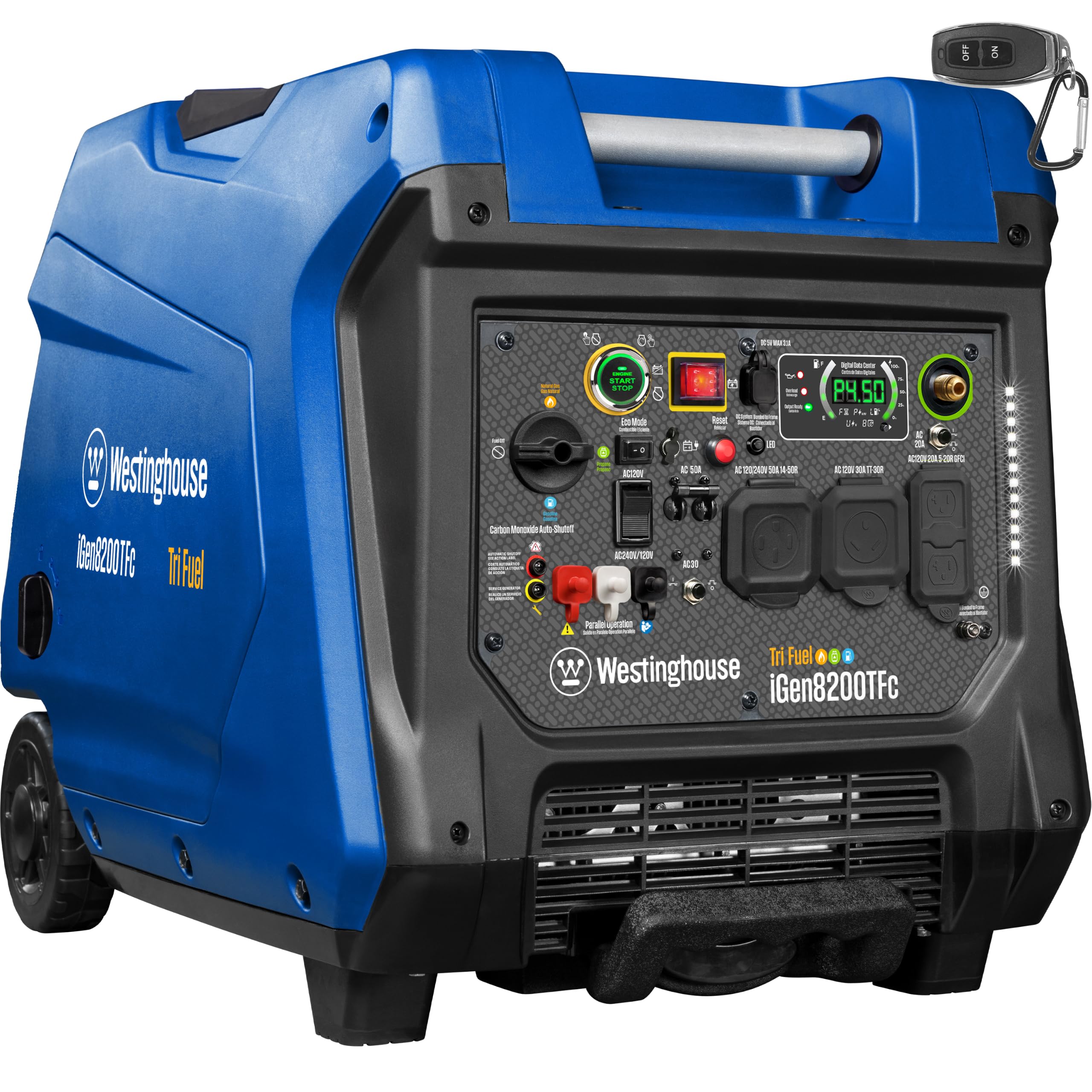
Natural gas is the reason this one exists in the lineup. Plumb it into a household gas line and the fuel question disappears: no cans, no stale gasoline, no refill at two in the morning during a storm. The 50-amp, 120/240-volt outlet is the other half of the pitch — with a transfer switch or an interlock, this is a machine that can feed a panel instead of a spiderweb of cords.

The hardware around the engine is what makes it livable: a remote key fob, electric start, flat-free tires, an hour meter, and a digital display. We like the flat-free tires more than we expected, because a generator that sits for eight months is exactly the machine that ends up with a flat tire at the worst possible moment.

Seventeen hours on the 3.9-gallon tank is a full outage day of runtime, the CO sensor shuts the engine down if carbon monoxide builds, and the under-3% THD rating keeps the router, the television, and the furnace board on clean power. The 6,600 running watts on gasoline carry a window unit, the fridge, the furnace, and the lights without a second thought.

Choosing between this and the iGen12000DFc comes down to central air. The bigger unit carries it; this one carries everything short of it, in a considerably lighter package. For a lot of houses that list — heat, refrigeration, lights, and one room of cooling — is the whole list.

Pros

  • Tri-fuel, including natural gas
  • 6,600 running watts with a 50-amp outlet
  • Remote fob and electric start
  • Under 3% THD

Cons

  • Natural gas delivers less power than gasoline
  • 134.5 pounds is a two-person lift
Our verdict

Plumb it into a natural gas line and stop storing fuel, with 6,600 running watts and a 50-amp outlet behind it.

Check Latest Price
7

Tailgating and Jobsites

PowerSmart 4000W

89 /100
Angler Score Excellent

Key details

THD
Under 3%
Noise
59 dBA at 23 ft
Weight
50.7 lb
Running / Starting Watts
3200 / 4000 W
Check Details on Amazon

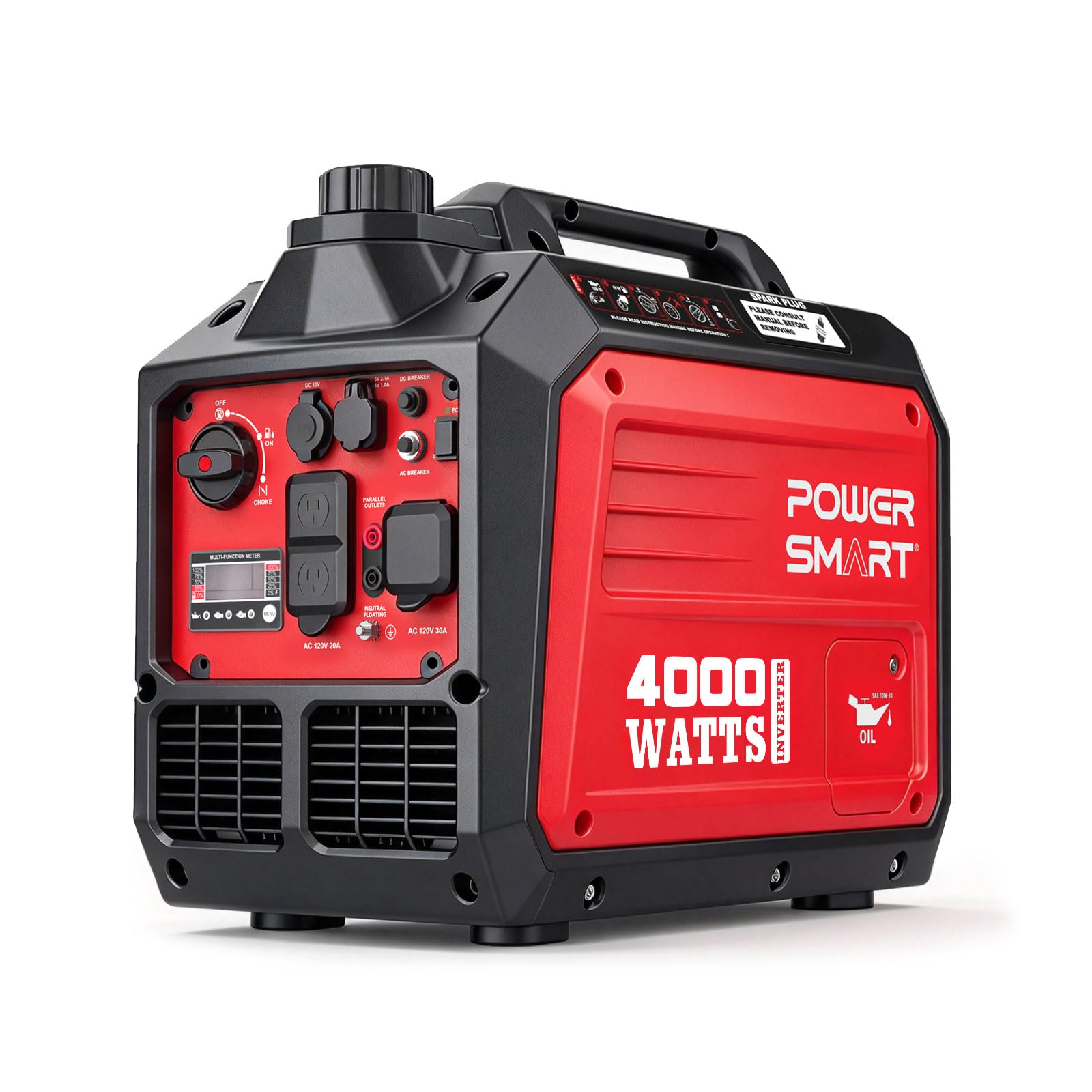
Fifty-nine decibels at 23 feet is the second-quietest rating in this group, behind only the Honda, and it is the number that makes this PowerSmart worth a look at the budget end. Output is clean too, at under 3% THD, which is the spec that matters for laptops, phones, and any appliance with a control board.

The panel is generous for the money: a 5-20R duplex, a 30-amp L5-30R twist-lock, a 12-volt DC post, two USB ports, and eco mode, plus parallel connectors if you ever pair a second unit. At 50.7 pounds it is a one-person lift, and a two-year warranty is a year longer than the other budget pick on this page.

The caveat is the output ceiling. Units that trip into overload well below the 3,200-watt rating are the recurring problem, so load-test it inside the return window — an air compressor or a table saw tells you more in ten minutes than a phone charger will in a week. We treat it as a tailgate, campsite, and small-jobsite machine where 3,200 watts covers the tools, not as an outage plan for a house.

Pros

  • 59 dBA at 23 feet, quiet for the price
  • Under 3% THD for sensitive electronics
  • 50.7 pounds with a two-year warranty

Cons

  • 1.3-gallon tank means frequent refills
  • Recoil start only, no electric start
Our verdict

A light, genuinely quiet 3,200-watt unit for tailgates and small jobsites, as long as you load-test it early.

Check Latest Price
8

Budget Emergencies

Oxseryn 4400W

89 /100
Angler Score Excellent

Key details

Fuel
Gasoline
Noise
Under 72 dBA at 23 ft
Weight
56 lb
Running / Starting Watts
3400 / 4400 W
Check Details on Amazon

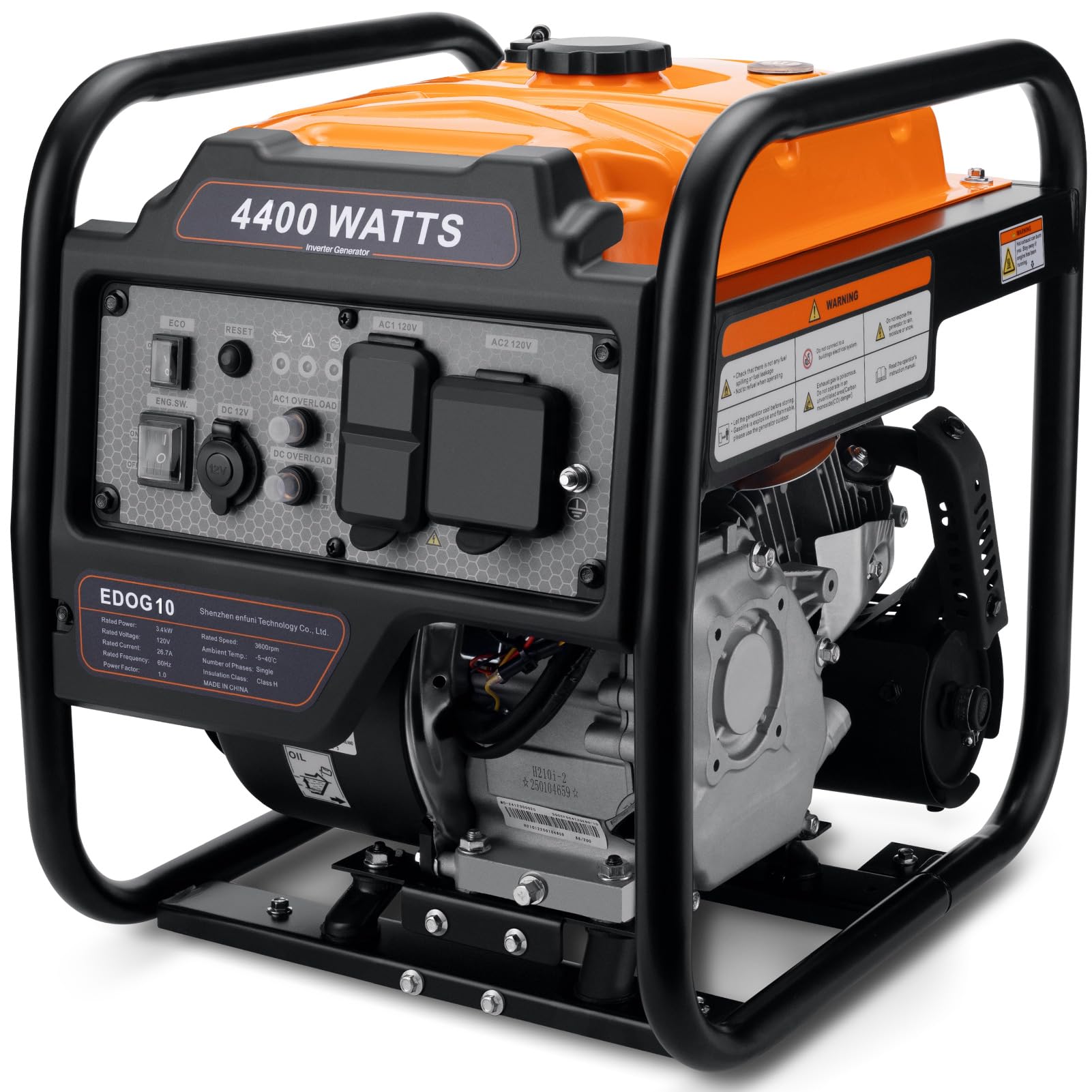
Seventy-two decibels at 23 feet is the loudest rating here, and the cause is the design rather than the engine: this is an open-frame inverter, so there is no shell around the noise. At a jobsite nobody cares. At a campground with a quiet-hours rule, everyone does, and we minded it more than we expected once the sun went down.

The power side is more competitive than the price suggests: 3,400 running and 4,400 surge watts, a 2-gallon tank with a fuel gauge, up to 14 hours at a quarter load, and a panel with two 120-volt outlets, a 12-volt DC post, and an RV receptacle. Fifty-six pounds is manageable for one person, and low-oil shutdown and overload protection are both there.

Run quality is the real risk. A unit that will not stay running, or that quits after a month of use, is the shape of its worst outcomes — so break it in on a light load, put a real load on it once, and keep the box until you are satisfied. That is not paranoia at this end of the price range; it is how you protect the purchase.

Set against the rest of the group, it is the cheapest way into 4,000-class surge watts, and it earns that position honestly: the fuel gauge, the RV outlet, and the 14-hour runtime at quarter load are all real. Just know what you are buying — a workhorse for a jobsite or a storm season, not a neighbor-friendly campsite companion.

Pros

  • 3,400 running watts on a small budget
  • 14-hour runtime at quarter load on eco mode
  • Fuel gauge and RV outlet on the panel

Cons

  • 72 dBA at 23 feet is the loudest here
  • One-year warranty is the shortest here
Our verdict

The cheapest route to 4,000-class surge watts, and a sensible first generator for a jobsite where nobody minds the sound.

Check Latest Price

How We Tested Inverter Generators Through Outages, Campsites, and Cold Starts

We started by pulling around 40 current models and narrowing them on paper: running versus peak wattage, whether the unit ran on gas, propane, or both, total harmonic distortion claims, weight, and whether a wheel kit and parallel port came in the box. That left eight generators, which we bought outright and ran for 11 months. No loaners, no bench tests — they went where generators actually go.

A few spent a week on my back porch during a July outage, carrying the fridge, a router, and a box fan overnight. Others came to a fall campsite and powered a coffee maker and a trailer's outlets, and two lived on job sites running a circular saw and a shop vac. We noted what happened when a fridge compressor kicked on with a space heater already drawing, and whether the overload light blinked or the engine simply lugged.

Noise we measured with a meter at 23 feet, at idle and with a load on, while two of us held a normal-volume conversation. Starting got graded the hard way: on a 35-degree morning, and on the first attempt after a unit sat a month — how many pulls it took, whether the choke needed feathering, and whether the electric-start battery still had charge without a tender hooked up. Over the months we tracked oil consumption, hours, and whether wheels, handles, and frames survived gravel driveways and being lifted into a truck bed by one person. Value came down to cost per running watt and what shipped in the box without an upcharge.

How to Choose an Inverter Generator

Start With Running Watts, Not Peak

Inverter generators advertise peak and running watts, and only the running figure is the power you can hold all evening. A 30-amp RV service is 3,600 watts, but the air conditioner that defines your trip draws its surge for a few seconds and its running watts for hours, so size for the second number and let the first cover the start. The 3,000-watt Champion we recommend runs a 13,500 BTU trailer air conditioner; a 2,200-watt unit needs a soft-start kit to try it.

Add up what you plan to run at the same time, then leave room for a compressor or a furnace blower kicking on unannounced.

Clean Power Is About THD, Not the Word Inverter

Every unit on this page makes inverter power, but the figure worth hunting for is total harmonic distortion. Under 3% is the threshold that keeps laptops, televisions, and modern appliance control boards safe, and a listing that says inverter and stops there has not told you the thing you need to know.

If you are charging tool batteries, running a CPAP, or feeding a furnace board, choose a unit that states its THD number outright rather than one that leaves it to implication.

Weight Decides Where It Lives

The difference between 50 and 130 pounds is the difference between a shelf in the garage and a pad at the side of the house. A 50-pound unit is a one-person lift into a truck bed; above about 100 pounds you want wheels, a handle, and either a second person or a ramp.

Remember that a full tank adds weight the spec sheet does not count, and that flat-free tires on anything heavy are worth more after two winters than they sound on the product page.

Choose the Fuel You Can Actually Keep

Gasoline is cheapest per hour and the least forgiving: ethanol blends degrade over a few months and clog carburetors on machines that sit. Propane stores indefinitely and costs you some output, which matters for a whole-house load and barely matters for a fridge and a few lights. Natural gas never runs out during an outage and gives up the most power of the three.

A fuel shutoff valve, which runs the carburetor dry before storage, is worth more than it sounds if the generator spends more than a month at a time in the shed.

Noise and Carbon Monoxide Are Placement Decisions

Noise ratings are quoted at 23 feet, so subtract comfort for every step you take toward the unit. Anything from 48 to 60 dBA will pass a campground quiet-hours test; 72 dBA from an open frame will not. Placement matters more than the number: never in a garage, a basement, or under a window, even with a CO shutdown sensor, which is a backstop rather than a permit.

Frequently Asked Questions

Final Verdict

The Champion 4000W Dual Fuel is the generator we point most people to, because it covers a 30-amp trailer and a few household circuits on either fuel at a weight one person can handle. If quiet matters more than capacity, the Honda EU2200i earns its premium. If you are wiring a transfer switch for a house, the Westinghouse iGen12000DFc is the one that carries central air.

Pick by what you will actually plug in, not by the peak wattage on the box.