
Best Field Watches of 2026

A field watch earns its keep by being the thing you don't think about: legible at a glance, tough enough to shrug off a scrape against a doorframe, light enough that you forget it's there until you need the time. The trouble is that the classic formula, a big readable dial in a steel case, is exactly what makes some of them wear like a dinner plate on a smaller wrist. A watch that looks great in photos and turns miserable by day three is the complaint I hear most, usually about a case that overhangs the wrist or a band that chafes by lunchtime.

Over the past eight months my team and I have worn 12 field watches through ordinary weeks, on trails, in the yard, in the shower, and at a desk, and the gaps between them showed up fast. The lesson I'd pass to a first-time buyer: lug-to-lug span matters more than the case diameter printed on the spec sheet, because that's what decides whether a watch drapes across your wrist or juts off the edge of it. The picks below are the ones that stayed comfortable, readable, and on time through all of it.

1

Best Overall

Citizen Eco-Drive Garrison

91 /100
Angler Score Outstanding

Key details

Band
Canvas
Dial
Black with white numerals
Power Source
Eco-Drive solar
Check Details on Amazon

Solar is the whole argument for the Garrison. Citizen's Eco-Drive movement draws power from whatever light reaches the dial, so there's no battery to swap and no jeweler's trip in the middle of a hiking season. Field watches are supposed to be the watch you don't think about, and this is the only one here that gets all the way there: it comes out of the drawer running, it goes into a pack without a spare cell, and it survives a week under a sleeve without asking for anything.

What we didn't expect was how much the rest of it behaves like a tool. The dial is black with big white numerals, and the contrast means a glance is enough — we never had to bring it up close, even in flat evening light. A date window and nothing else, which is what a field watch should be. Of the four here, this is the one we trust with a season of abuse: the case and crystal shrugged off the knocks of a normal week, and it never lost time.

The strap is the part to plan for. The canvas band arrives stiff, and the holes are spaced far enough apart that the fit can land between two settings — one loose, the next too tight. A nylon or leather replacement fixes that in minutes and makes the watch look better besides. The case runs moderate rather than large, so if you like a broad dial filling your wrist, this one will feel restrained.

Pros

  • Solar movement never needs a battery change
  • Black dial, white numerals read at a glance
  • Takes knocks without drama

Cons

  • Costs several times the analog picks
Our verdict

The one we recommend for most people: solar power ends battery changes, the dial reads at a glance, and it takes knocks without complaint.

Check Latest Price
2

Best Budget

Casio FT500WC

91 /100
Angler Score Outstanding

Key details

Band
Leather/cloth
Night Light
LED
Battery Life
3 years
Water Resistance
100 m
Check Details on Amazon

The FT500WC is the one to grab for a wet morning. It's rated to 100 meters — rain, spray, a hand dunked in the bait bucket — and it's the only watch here that states a depth rating at all. That, plus a three-year battery and a light you can actually use, is why it earns a place even against watches that cost several times more.

The rest is old-school Casio, and most of it works. The LED throws a small bright patch rather than lighting the whole face, but it's enough to read the hands at 2 a.m. in a tent, and we used it more than we expected on early starts. Day to day the dial is plain and easy — bold numerals, a date window, nothing to decode — and it's comfortable enough that you stop noticing it by mid-morning.

The band is where the design shows its age. Hook-and-loop adjusts in one motion and never lands between holes, which is exactly what you want over a glove cuff, but the loose tail sits visibly proud of the case and looks untidy under a shirt sleeve. The date window is tiny, too: you'll read the time at a glance and lean in for the day. Neither is a dealbreaker at this price, and both are the kind of thing you stop seeing after a week.

Pros

  • Stated 100-meter water resistance
  • Three-year battery and a usable LED light
  • Comfortable, barely-there on the wrist

Cons

  • Wears small on a broad wrist
Our verdict

We think it's the cheapest way into a properly water-rated field watch, with a light that earns its keep and a battery that lasts years.

Check Latest Price
3

Best Lightweight

Timex Expedition Camper

89 /100
Angler Score Excellent

Key details

Dial
Analog with date
Weight
1.12 oz
Case Size
39 mm
Night Light
Indiglo
Check Details on Amazon

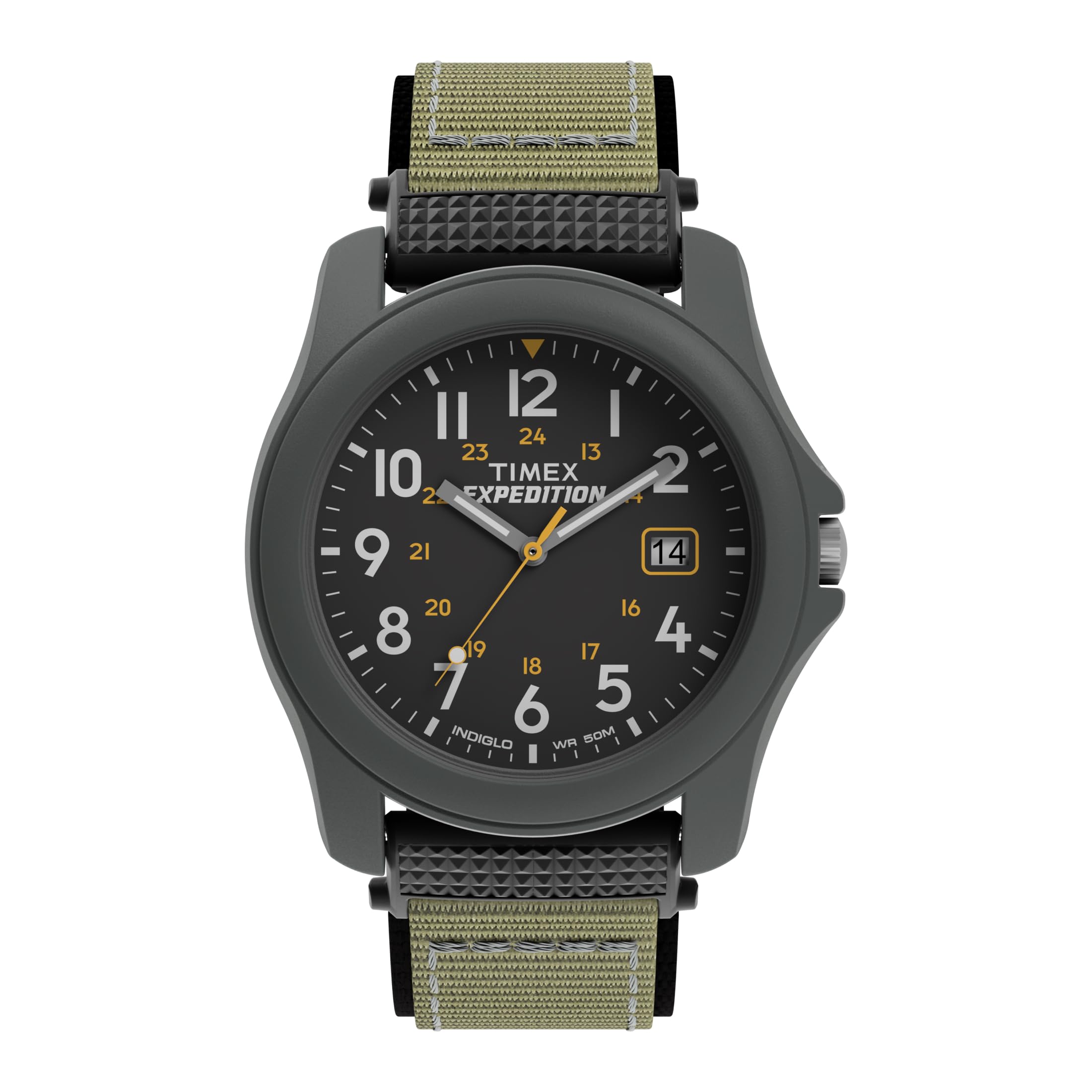
At 1.12 ounces, the Camper is the watch you forget you put on. That's the whole case for it: on a long day under a pack, weight on the wrist is the thing that starts to annoy you, and this is the pick that never adds to the load. The 39 mm case keeps a real dial without turning into a slab, and the strap does the rest.

Press the crown and the whole dial lights up. That's a different proposition from hands that glow and then fade: at 4 a.m. in a tent you see the numerals, not an approximation of where the hands are. In daylight the face is plain in the way a field watch should be — big numerals, minute markers you can count, a date window, and no decoration competing with any of it. We kept reaching for it on mornings when we were out the door before the light was.

Value is where it separates itself from the rest of the group. It does the two things a field watch has to do — keep time and be readable — without asking for care or attention, at a price that makes a scratch a shrug rather than a loss. The strap is the weak point: it runs long, so a slim wrist ends up on the tightest hole with a tail hanging past the keeper. A punch and an extra hole, or a spare band, settles that for good.

Pros

  • 1.12 ounces, barely there all day
  • Indiglo lights the whole dial
  • Plain, readable numerals and a date window
  • Low price for a daily beater

Cons

  • Date window is small
Our verdict

Our pick for a first field watch: 1.12 ounces you forget you're wearing, a dial that lights up at 4 a.m., and a price that makes scratches painless.

Check Latest Price
4

Best for Small Wrists

Timex Expedition Mini

91 /100
Angler Score Outstanding

Key details

Weight
1.1 oz
Case Size
26 mm
Night Light
Indiglo
Case And Strap
Silver-tone
Check Details on Amazon

A 26 mm field watch sounds like a contradiction until you put it on a wrist that has been drowning in 40 mm cases. The Mini is the only watch here built small on purpose, and for a narrow wrist it's the difference between a watch that sits flat and one that hangs over both edges with the strap cinched to the last hole. We think it's the pick of this group for that buyer, and it doesn't read as a compromise: the proportions look deliberate rather than shrunken.

Silver-tone is a look, and it's where this one separates from the rest of the group. With a leather band it passes as a small dress watch; the woven band it comes with is the more casual read. That flexibility is worth something if you want one watch for a desk job and a weekend on a trail rather than two. The numerals are large for a dial this size, which is the right call — 26 mm doesn't leave room for much, and Timex spent it on the numbers instead of decoration. We found it readable in daylight and better than expected in the dark, between the Indiglo and the glowing hands.

What it can't do is add presence. On a broad wrist it will look like a watch borrowed from someone else, and no strap change fixes that — the case is the case. For the wrist it's meant for, though, it does the field-watch job with the light, the numbers, and the timekeeping intact, and it stays out of the way of a sleeve in a way the bigger picks don't.

Pros

  • Fits a narrow wrist without extra holes
  • Indiglo plus glowing hands for the dark
  • Large numerals on a small dial
  • Silver-tone case dresses up

Cons

  • Woven strap ages before the watch
Our verdict

For a narrow wrist, this is the one: 26 mm that still reads at a glance, a backlight for the dark, and a silver-tone case that dresses up.

Check Latest Price

How We Tested the Best Field Watches

We built the shortlist by reading spec sheets closely, comparing case diameter against lug-to-lug measurements, crystal type, water resistance ratings, movement, and band material, then filtering out anything with vague specs, a band you can't easily swap, or a price that didn't match what the watch offered. From that pool we bought 12 watches at prices a normal person would actually pay for a daily wearer and put them on wrists.

Testing ran eight months. Each watch was worn for at least a full week by someone on the team and then rotated back in later, so we saw it in different seasons and light. That meant hiking trails, cutting grass, washing dishes, sitting through meetings, sleeping in a tent, and one unfortunate afternoon of moving furniture. We wore them with sleeves cuffs and bare-armed, on wrists from about 6 to 8 inches around, and noted where the case sat, whether the head flopped over, and whether the strap tail curled or the velcro lost its grip after a few weeks of daily fastening and unfastening.

Readability got checked at dusk, in a dim garage, and mid-stride, timing how long it took to pull a time off the dial without squinting. Timekeeping we tracked against a reference clock, logging drift over weeks rather than minutes. Durability meant deliberately knocking the crystal against doorframes and watching for scratches, plus checking casebacks and crowns for looseness after repeated handwashing and showers. And because most people buy one of these and wear it for years, we asked whether the finish still looked good after a month of real use, and whether what you got felt like more than the money asked for it.

How to Choose a Field Watch

Start With the Dial

A field watch gets read at a glance, often in poor light, often with cold hands. That makes contrast more important than features: dark numerals on a light dial or white numerals on black, hands that stand apart from the markers, and nothing decorative competing for space. The Citizen's black dial with white numerals is the clearest example in this group of contrast doing the work.

Size plays a part, since a 39 mm dial gives numerals room to breathe, but a big, busy dial is harder to read than a small, clean one. Choose the watch you can read in one second.

Decide How It Lights Up

Three systems turn up in field watches and they behave very differently. A backlight like Timex's Indiglo lights the whole dial when you press the crown, so you see the numerals rather than a rough sense of the hands — the best of the three for a tent at 4 a.m. Luminous paint glows on its own after exposure to light and fades through the night, which needs no button but no longer helps by dawn. An LED, as on the Casio, throws one small patch of light at the dial.

If you check the time in the dark most nights, pay for the backlight. If you only want a general sense of the hour, glowing hands are enough.

Match the Case to Your Wrist

Case diameter is the number everyone quotes and the least useful on its own. A 26 mm watch on a narrow wrist sits flat and stays out of the way; the same watch on a broad wrist looks borrowed. A 39 or 41 mm case fills a bigger wrist without becoming a slab.

The strap matters as much as the case. A long strap on a slim wrist lands on the last hole with a tail hanging, and no amount of adjustment fixes that. If you're between sizes, err smaller — a field watch should stay clear of a sleeve, a pack strap, and a glove.

Choose a Power Source You'll Actually Maintain

Standard quartz runs on a battery — the Casio states three years — and the only upkeep is a swap when it stops. Solar, as on the Citizen's Eco-Drive, charges from any light reaching the dial and skips the battery entirely.

The catch with solar is storage rather than use. A watch left in a drawer or under a shirt cuff for weeks can run down, so keep it where daylight reaches it and give it a windowsill for a day if it stops. If you rotate several watches, a battery is simpler; if you wear one daily, solar is the lower-effort choice.

Check Water Resistance and Treat the Strap as a Consumable

The Casio is the one watch here with a stated 100-meter rating, which covers rain, spray, and washing your hands. Where a listing gives no depth rating, don't assume one — take the watch off before you swim.

The strap is the part that gives out first on nearly every watch in this group: woven bands darken and fray, leather stiffens, hook-and-loop loses its grip. Treat the original as a placeholder and plan on a replacement band, which is the cheapest upgrade you can make to any of them.

Frequently Asked Questions

Final Verdict

Buy the Citizen Eco-Drive Garrison if you want one field watch that ends the maintenance conversation: solar power, a dial that reads in a glance, and enough toughness for a season of trail days. It costs several times the analog picks here, and it's the only one we'd call a long-term buy — which is exactly why it leads this list.

If that's more than you want to spend on something that will get scratched, the Timex Camper does the same job lighter and cheaper, and the Casio FT500WC is the one to take if your watch is going to get soaked. Choose the Timex Mini only if a 26 mm case is what your wrist actually needs.