
Best Tide Watches of 2026

A tide watch is two instruments sharing one case: a clock and a small almanac that predicts high and low water for a station you pick. Program the station and the high-water offset correctly and you can glance down mid-paddle to see whether the sandbar is still covered; get it wrong and you'll launch on a tide that has already turned. That's the whole promise, and it is genuinely useful — it puts the one number you'd otherwise chase on a phone with wet hands onto your wrist.

I've spent enough 5:45 a.m. parking-lot sessions squinting at a surf report to be picky. Over nine months, my team and I wore 12 tide watches through dawn patrols, jetty fishing, and plenty of unglamorous workdays, and what separated them had little to do with the spec sheet. The keepers held their accuracy at the edges of a swing, sat flat under a wetsuit cuff, and looked like something you'd wear past the beach — and the pricier ones didn't automatically win. What follows is what salt water and early alarms sorted out.

1

Best Overall

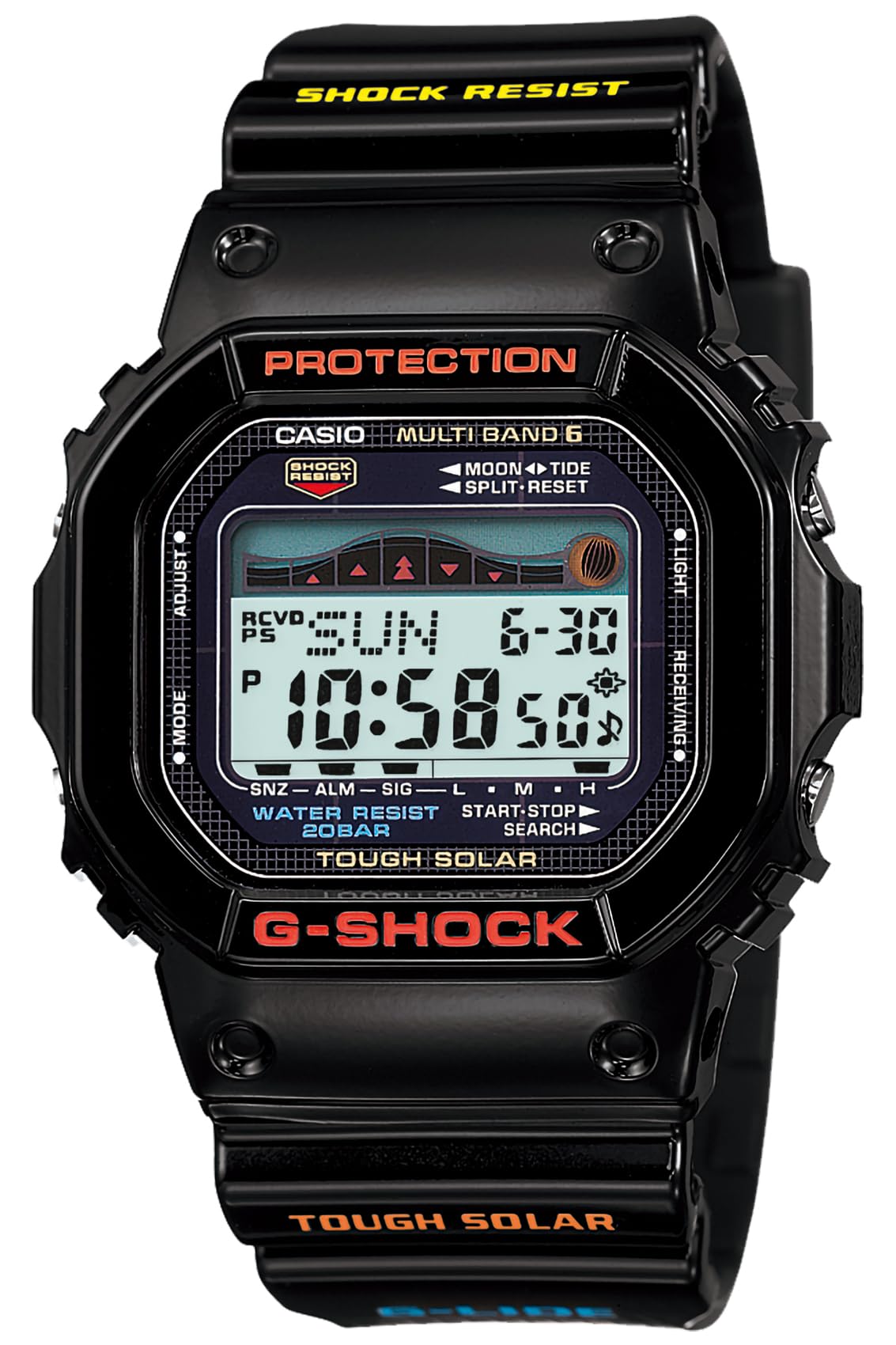
Casio G-Shock GWX-5600-1JF

89 /100
Angler Score Excellent

Key details

Model
GWX-5600-1JF, Japan market
Power
Tough Solar, radio-controlled
Weight
1.98 oz
Tide And Moon
Tide function with moon phase
Check Details on Amazon

Solar charging and radio-controlled timekeeping are the two things that make a tide watch worth trusting, and this is the only one of the three here with both. A tide graph is calculated from the clock and your home port, so a watch that drifts, or one that dies mid-season, hands you a high tide that is quietly wrong. The GWX-5600 corrects itself from the atomic signal overnight and tops up from whatever light it sits in — and that pairing is the whole reason it takes the top spot.

What surprised us is how little it feels like a G-Shock on the wrist. At 1.98 ounces with a square case, it's the compact one of the group: thin enough to disappear under a work cuff, and the gloss black bezel wipes clean instead of holding onto salt and sunscreen. The tide and moon screens sit a couple of button presses away, and the display reads cleanly rather than cramming every segment onto the screen at once.

Setup is the part nobody warns you about. You choose your home city and enter the lunitidal interval for your stretch of coast — the lag between the moon overhead and high water — and until that number is right the graph is decoration. Do it once, write the figure inside the manual, and you're done. This is the Japan-market model, which is worth knowing before you order, so buy from a seller you trust on returns.

Pros

  • Solar charging and atomic timekeeping in one watch
  • Compact 1.98-ounce case sits close to the wrist
  • Tide and moon screens a button press away
  • Gloss bezel wipes clean easily

Cons

  • Solar charging slows under winter sleeves
Our verdict

Our pick for most coastal use: solar and atomic keep the tide graph honest, and at 1.98 ounces it's the one you forget you're wearing.

Check Latest Price
2

Best for Low Light

Casio G-Shock G7900A-4

95 /100
Angler Score Outstanding

Key details

Weight
1.55 oz
Battery
Lithium metal, included
Tide And Moon
Tide and moon modes
Check Details on Amazon

Readability is where a tide watch earns its keep, and this one has the screen we trust most of the three. The digits are big and high-contrast, and the backlight makes the tide and moon screens usable well before sunrise — which matters when you're reading a tide in the dark with cold hands and no patience for a menu.

It also wears bigger than the product photos suggest. The red bezel is matte rather than glossy, it draws comments at the ramp, and the case sits tall enough that a jacket cuff catches on it now and then. Against that: a band that stays comfortable through a long day and a case that has taken knocks without complaint. The bulk is the price of that screen, and we'll take the trade.

The tide and moon modes are the ones you'll actually use, and the world-time function is a bonus if fishing takes you across a border. There's no solar panel, so the cell gets swapped every few years — that's the clearest difference between this and the GWX-5600. The moon phase earns its place too, once you start planning trips around spring tides.

Pros

  • Clearest display of the three in low light
  • Tough G-Shock case with a comfortable band
  • Tide, moon, and world time modes

Cons

  • Tide setup takes patience with the manual
Our verdict

For dawn launches, this is the most legible tide screen of the three, in a case that has already taken some knocks.

Check Latest Price
3

Best Budget

Casio WS-1300H Tide Graph

88 /100
Angler Score Excellent

Key details

Battery
Lithium metal, included
Backlight
Illuminator LED
Tide And Moon
Tide graph with moon phase
Check Details on Amazon

A tide graph, a moon phase, and a backlight for the least money of the three — the WS-1300H is a reminder that tide data was never a premium feature. It looks like a G-Shock, wears like one, and does the thing you came for without asking you to look after a solar cell.

The backlight is the part we came to rely on. It's bright and even, so the tide curve is legible on a dark beach instead of a rumor, and that alone justifies the watch on early starts. The case is chunky — on a thin wrist it sits proud and the strap takes a moment to settle — but it's light, and the band holds its adjustment instead of creeping loose over a day on the water.

The resin has the plain, functional look that makes sense on a boat, and this is the one you throw in a dry bag without a second thought. What it doesn't have is solar charging or a radio signal to lean on — the graph depends on you keeping the clock right — and for a watch that still shows you the tide, that seems a fair swap.

Pros

  • Real tide graph at the lowest price here
  • Bright backlight for dark-beach checks
  • Band holds its adjustment on the water

Cons

  • Location setup is trial and error
Our verdict

The cheapest way onto a real tide graph here, and the one to buy if you want the readout without paying for solar or atomic hardware.

Check Latest Price

How We Tested the Tide Watches

To build the shortlist, I started with every tide watch I could find that lets you set a local station and adjust for high-water time, since a tide graph you can't calibrate is decoration. From there I filtered by case size, strap material, display legibility in flat light, color options, and price, and cut anything that demanded a manual and a signal every time you crossed into a new region. Twelve made it through to testing.

I programmed each watch from scratch without instructions and timed how long it took, because a tide function you can't set on a tailgate isn't much use. Then each one went on a wrist for a full week — dawn surf checks, evening beach walks, a few 4 a.m. fishing starts, and ordinary days at a desk — and I compared its high and low readings against the published tide table for the nearest harbor, morning and evening, noting whether it drifted by minutes or by a full hour.

Salt water, sand, and a rinse in the sink came next. I strapped each watch over both a 3mm and a 5mm wetsuit sleeve, checked how the case sat under a jacket cuff, and had coworkers with smaller wrists try the ones that looked borderline on size. After a month I hunted for scuffs on the crystal and bezel, pressed the buttons with cold, wet fingers, and checked the backlight in a dark room before sunrise.

Timekeeping got checked against a reference clock every few weeks so I could catch slow drift rather than guess at it. I also wore each one to dinner at least once to see whether the finish and color held up away from the lineup. At the end, one question decided the list: did the price buy anything you'd actually notice?

How to Choose a Tide Watch

A Tide Graph Is Not a Tide Table

Every watch here works the same way underneath: it calculates the tide from its clock and a home port you enter, adjusted by the lunitidal interval — the lag between the moon passing overhead and high water at your beach. That is why a clock that drifts a few minutes shows up as a tide that is minutes out, and why a radio-controlled model is the easier one to trust over a season.

Set the port once, write the interval on the inside of the manual, and leave it alone. If a reading suddenly looks wrong, check the time and the daylight-saving setting before you redo the location — that fixes it more often than re-entering anything.

Readability in the Light You'll Actually Have

Watch displays sell on looks and fail at first light. The fashionable negative LCDs — dark digits on a dark background — photograph beautifully and go flat at dusk, which is exactly when a tide check happens. We put the G7900A-4 at the top of this group on screen legibility, with the WS-1300H's backlight close behind, and that order has nothing to do with what they cost.

Look at contrast and how evenly the backlight spreads before you look at color. A bright bezel is worth nothing if the tide curve is a gray smudge.

Solar or Battery — Which Suits Your Wrist

Solar with radio control is the lowest-effort combination going: the watch corrects its own clock and tops up from daylight, so the tide graph stays honest without you doing anything. The catch is that it needs to see light. A solar model that lives under a wetsuit sleeve or in a drawer through winter will run down, and that is the one real argument for a plain cell.

If your watch comes off between trips, buy the battery model and keep it simple. If it stays on your wrist outdoors, solar earns the extra spend.

Case Size and Wrist Fit

The listed weights barely separate the two G-Shocks here — 1.55 ounces against 1.98 — yet the heavier one is the smaller watch on the wrist, because an ounce figure says very little about how a case wears. A tall bezel catches on jacket cuffs and wader straps, and a chunky case on a thin wrist sits proud no matter how light it is.

Measure the case width of a watch you already like and compare it with the listing, rather than trusting the weight. Band comfort matters more than either once you are wearing it for a full tide.

Frequently Asked Questions

Final Verdict

We recommend the GWX-5600-1JF without much hedging. Solar charging and atomic timekeeping keep the tide graph anchored to the right clock, and at 1.98 ounces it disappears under a cuff — the two things that decide whether a tide watch actually gets worn.

If your tide check happens at dawn with cold hands and you want the biggest, clearest screen, the G7900A-4 is the better read for less money, as long as you don't mind a battery. On a tight budget, the WS-1300H still gives you a genuine tide graph.