Best GPS Watch for Hiking of 2026

The last time I got properly lost on a hike, it wasn't dramatic: a junction with a faded blaze, three forks, and a phone in my hip pocket sitting at four percent. That's the moment a GPS watch earns its keep — the thing on your wrist that still knows where you are after everything else has quit. A good one walks you back to the trailhead. A bad one leaves you squinting at a dim screen with a dead battery while something the size of a hockey puck drags at your sleeve.

My team and I spent the past eight months hiking, scrambling, and bushwhacking with 10 of these watches, and the gap between the good ones and the rest shows up fast — in a screen you can't read at noon, in buttons you can't work with gloves on. Nobody warns a first-time buyer that the battery figure on the box is a best case: a watch rated at three weeks can give you four days once GPS and an always-on display are running. Below are the ones worth the money, for a multiday traverse and a Tuesday evening loop.

1

Best Overall

Garmin Instinct 3 AMOLED

90 /100
Angler Score Outstanding

Key details

GPS
Multi-band with SatIQ
Weight
1.87 oz
Water Resistance
100 meters
Battery (smartwatch Mode)
Up to 18 days
Check Details on Amazon

Five buttons and a 1.2-inch AMOLED screen sounds like a contradiction until you are standing in rain with a rod in one hand and a pack strap in the other. The Instinct 3 lets you start a track, drop a waypoint or swing across to the compass without pulling a glove off, and the 1,000-nit display is bright enough to read at a glance in full sun. That combination, rather than any single number on the spec sheet, is why it is the safest default in this group.

The navigation hardware is the best balanced here. Multi-band GPS with SatIQ decides for itself when to pull in the extra satellite signals, so the track holds under tree cover without spending battery on it all day, while the three-axis compass and barometric altimeter take over the moment you stop moving. Battery life is rated at up to 18 days in smartwatch mode, which turns charging into something you do before a trip rather than every night. At 53 grams it disappears under a sleeve, and the 100-meter water rating covers rain, spray and a hand dipped in the water.

The case is fiber-reinforced polymer with a metal-reinforced bezel, and the display sits recessed inside it, so knocks land on the rim rather than the glass — a small thing that matters every time you swing a pack off your shoulder. We also got more use out of the built-in flashlight than we expected, from finding a knot in the dark to walking the last hundred yards back to the truck. There is 4 GB for watch faces and apps through Connect IQ, though this watch is happiest doing Garmin's own outdoor jobs rather than running a small app library.

Pros

  • Physical buttons work with gloves and wet hands
  • 1,000-nit AMOLED stays readable in direct sun
  • Multi-band GPS with SatIQ holds a track under cover
  • Up to 18 days between charges

Cons

  • No on-watch topographic maps
Our verdict

This is the hiking watch we recommend first: a bright AMOLED screen you can read in sun, physical buttons that work with cold wet hands, and multi-band GPS that holds a track under canopy.

Check Latest Price
2

Best Value

Amazfit T-Rex 3

90 /100
Angler Score Outstanding

Key details

Display
1.5-inch AMOLED, 2,000 nits
Navigation
Free global maps, dual-band GPS
GPS Battery Life
Up to 180 hours
Water Resistance
100 meters
Check Details on Amazon

The T-Rex 3 is the watch that argues for putting a map on your wrist. There is a 1.5-inch AMOLED panel running at 2,000 nits — the largest and brightest screen here — showing free global maps with topo detail, backed by dual-band positioning across six satellite systems and a 316L stainless steel bezel rated from -22F to 158F. Amazfit quotes over three weeks of typical use or up to 180 hours in GPS mode.

That tracking figure is the one that got our attention. It is the longest of any map-capable watch in this group, and it changes how you plan: a long weekend with the track running start to finish does not require a charger in the pack. The screen earns its size too, because panning a topographic map on a wrist only works if the display is big enough to show you a junction, and at 1.5 inches this one does. It is the pick we point at the hiker who wants mapping without fēnix money.

Two practical notes from living with it. The magnetic charging base in the box comes without a USB-C cable, so dig one out before the battery dies rather than after. And Bluetooth pairing is the fiddliest step in setup, so do it at home on Wi-Fi with the app already installed instead of at a trailhead with one bar of signal. Neither is a dealbreaker; both are things you only want to learn once.

Pros

  • Free global maps on a 1.5-inch screen
  • 2,000-nit AMOLED is the brightest display here
  • Up to 180 hours in GPS mode
  • Dual-band positioning across six satellite systems

Cons

  • Heart-rate readings drift during hard efforts
Our verdict

The watch that makes the case for a map on your wrist: a huge, bright screen, free global maps and dual-band positioning, with the longest tracking battery in this group.

Check Latest Price
3

Best Battery Life

Garmin fēnix 7X Pro Solar

89 /100
Angler Score Excellent

Key details

Weight
3.39 oz
Display
1.4-inch MIP, 51 mm case
Charging
Power Glass solar lens
Battery (smartwatch Mode)
Up to 37 days
Check Details on Amazon

The fēnix 7X Pro Solar is the only watch here that made us aware of it on the wrist. At 96 grams in a 51 mm case it is a serious piece of hardware, and on a smaller wrist it will look and feel like one. We think the weight is the right trade, because what you get for it is the longest battery life in this group and a screen big enough to actually navigate from.

Garmin rates it at up to 37 days in smartwatch mode, and the Power Glass solar lens tops that up whenever you are outside, so a sunny multi-day trip adds charge simply by being hiked. The 1.4-inch transflective display stays on all the time, which is what you want when a glance is all you get, and it pairs buttons with a touchscreen so you can stab at a waypoint in gloves or drag the map when your hands are free. There is 32 GB for maps, an LED flashlight, and the hill and endurance scores Garmin builds from your training data.

The MIP panel is the compromise in the deal. It is a power-sipping, sunlight-readable screen rather than a vivid one, so colors are functional and contrast sits a step behind the AMOLED watches here — you are buying endurance, not sparkle. For long weekends and day hikes the Instinct 3 does most of the same work with a good deal less on your wrist; for a week out at a time, the extra heft is the price of leaving the charger at home.

Pros

  • Up to 37 days with solar assist
  • 1.4-inch always-on screen with 32 GB for maps
  • Buttons and a touchscreen for map panning
  • Built-in LED flashlight with strobe modes

Cons

  • 96 g and a 51 mm case sit heavy on small wrists
  • The most expensive watch in this group
Our verdict

The long-trip choice: solar charging, up to 37 days in smartwatch mode and a big always-on screen, as long as you do not mind a heavy watch on your wrist.

Check Latest Price
4

Best for Anglers

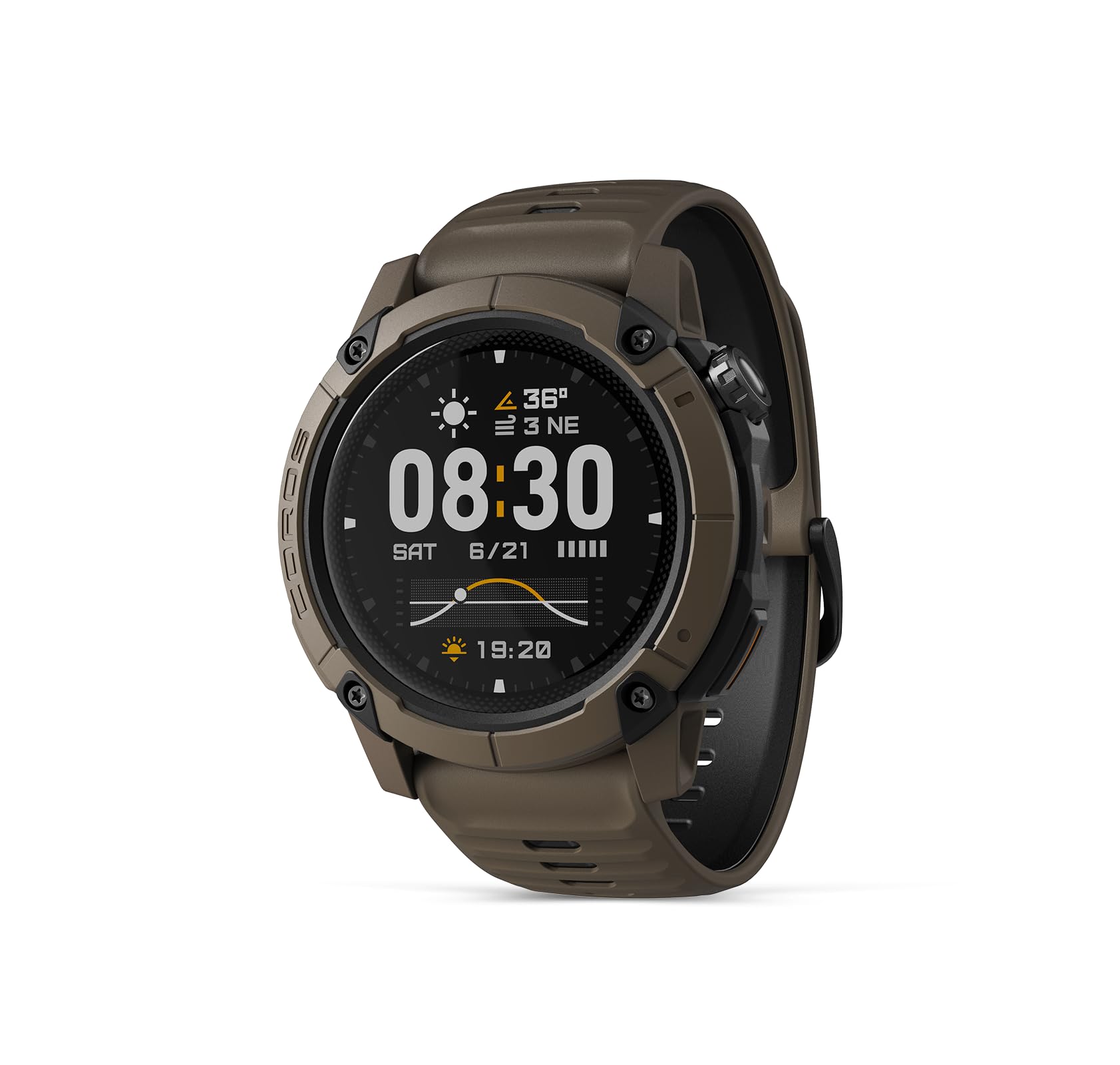
COROS Nomad

85 /100
Angler Score Excellent

Key details

Maps
Free preloaded global maps
Display
1.3-inch MIP
Battery Life
22 days
Fishing Tools
Tides, moon phase, catch log
Check Details on Amazon

Most GPS watches treat fishing as one more activity profile. The Nomad treats it as the point. Tides, moon phase and sunrise and sunset are right there on the watch, and the Adventure Journal takes voice notes during an activity, tags the location, attaches a photo and transcribes the memo to text so you can find that stretch of bank again next season.

The rest of the package is a proper hiking watch. There is a 1.3-inch memory-in-pixel screen behind a dual-layer polymer and aluminum alloy case, free preloaded global maps with street names, back-to-start navigation, safety alerts and 32 GB of storage. COROS quotes 22 days of battery, which puts it firmly in the charge-it-before-you-go camp rather than the charge-it-every-night one.

Where it gives ground is the screen. MIP is the right call for battery and it is perfectly readable in daylight, but it does not have the punch of the AMOLED panels on the Instinct 3 and the T-Rex 3, and the interface takes a session or two to learn if you are coming from Garmin. On a wet week of fishing the tide table is the screen we kept coming back to, which is the whole argument for this watch. COROS does not quote a depth rating the way Garmin quotes 100 meters, so treat the water resistance as weather protection rather than dive spec.

Pros

  • Tides, moon phase and sun data built in
  • Catch log and voice-note adventure journal
  • Free preloaded global maps with street names
  • 22-day battery life

Cons

  • MIP screen lacks the punch of the AMOLED picks
Our verdict

The angler's pick: tides, moon phase and a catch log built in, plus preloaded maps and a battery that outlasts a long weekend on the water.

Check Latest Price
5

Best for Alpine Terrain

COROS APEX 4

83 /100
Angler Score Excellent

Key details

Maps
Topographic and street maps
Build
Titanium, sapphire display
Weight
2.26 oz
GPS Battery Life
Up to 65 hours
Check Details on Amazon

Titanium, sapphire and reinforced lugs: the APEX 4 is built like a piece of climbing gear. The 1.3-inch memory-in-pixel display is always on under a sapphire crystal, the case is light enough at 64 grams to forget about, and COROS quotes 41 days of battery with up to 65 hours in all-systems GPS mode. Topographic and street maps render roughly 30 times faster than the previous generation, with turn-by-turn directions and hydro maps on board.

The build is what justifies it. Sapphire over a MIP panel is a screen meant to be read in direct sun and to survive being scraped against granite, and the dual-frequency GPS is aimed squarely at dense forest and steep couloirs where single-band tracking wanders. What it is not is an AMOLED: indoors and at dusk the display is dimmer than the T-Rex 3 and the Instinct 3, and if you mostly hike in the evening you will notice. For alpine starts and long exposed days, we take that trade.

There is a microphone and speaker for hands-free calls and voice pins — you hold a button, say what you are seeing, and it saves to the route for later. That is a genuinely useful habit on unfamiliar ground, and the kind of feature that reads as a gimmick until the third time you use it. Between the Instinct 3 and the fēnix, this is the middle path: more mapping than the Garmin, and 32 grams less on the wrist than the solar fēnix.

Pros

  • Titanium case with a sapphire display
  • Up to 65 hours in all-systems GPS mode
  • Dual-frequency GPS built for dense forest
  • Topographic maps with turn-by-turn directions

Cons

  • Dimmer indoors than the AMOLED watches here
Our verdict

Titanium, sapphire and 65 hours of GPS in a 64-gram case — the pick for rough ground and long days where the screen has to survive the route.

Check Latest Price
6

Budget First Watch

Mingdaln GPS Smartwatch

83 /100
Angler Score Excellent

Key details

Display
1.46 inches
Sensors
GPS, compass, altimeter, barometer
Battery Capacity
1,200 mAh
Water Resistance
IP68
Check Details on Amazon

On paper the Mingdaln lists what the expensive watches list: offline maps, GPS with a compass, altimeter and barometer, a 1.46-inch display, a built-in flashlight and a 1,200 mAh battery, plus AI features and more than 100 sport modes. For a day hike where you want a route on your wrist and a light for the walk out, that is the shape of a useful watch.

What the page cannot tell you is how any of it behaves. There is no satellite constellation detail, nothing about hours of tracking, and no rating beyond IP68, which is the one specification here that matters most if you wade or swim. This is the watch in the group we know least about, and that counts for more on a navigation device than on a pair of boots: a watch that drops its track two miles out is worse than no watch, because you have stopped paying attention.

Treat it as a starter or a spare. It is a sensible way to find out whether you actually use a map on your wrist before spending Garmin money, and it is cheap enough to live in a tackle box as a backup for the day your main watch dies. Just be honest about what you are buying: a spec list, not a track record.

Pros

  • Offline maps at the lowest price here
  • Compass, altimeter and barometer on board
  • Built-in flashlight for the walk out

Cons

  • IP68 only; rain-resistant, not swim-proof
  • Battery life in GPS mode is not stated
Our verdict

The least expensive way to get offline maps and a flashlight on your wrist, and a fair first watch — but not one to trust with a multi-day route.

Check Latest Price

How We Picked and Tested GPS Watches for Hiking

We started by pulling every hiking-focused GPS watch we could find that had offline maps built in, then filtered hard: a barometric altimeter, multi-band GPS, a case that wouldn't swallow a smaller wrist, and a price that made sense against the battery life it promised. That left 10 watches, which my team and I wore for eight months on local switchbacks, a three-day rainy traverse, and more ordinary workdays than any of us would like to admit.

On the trail, we watched whether each watch held a fix under dense tree cover and in a canyon, and whether the distance it logged matched the mileage of routes we already knew. We compared screen visibility at noon on an exposed ridge, in deep shade, and at 5 a.m. by headlamp, and noted whether the display washed out under a glove shadow. We also timed how long each one took to grab a signal from a cold start, and how much lag there was scrolling to the elevation profile halfway up a climb.

Battery got the least glamorous test: we ran GPS continuously from a full charge and logged the percentage drop hour by hour, then lived with each watch normally for a week to see what the smartwatch-mode claim was actually worth. We paired every watch with both an iPhone and an Android phone, walked away from the phone to find where the connection dropped, and checked whether notifications arrived readable or chopped in half. At camp we set alarms and timers in the dark with cold fingers, and at home we fiddled with watch faces and data fields to see how much customization was genuinely useful versus a menu maze.

Durability showed up in small things — scuffs on the bezel after a granite scramble, whether buttons still clicked cleanly after a muddy week, whether the band left a mark after ten hours of wear. And we kept a running note on value: what you're paying for maps, battery, and a screen you can read, versus paying for training metrics no hiker will ever open.

How to Choose a Gps Watch for Hiking

Maps, or a compass and a track

Both approaches get you home; they feel completely different on the move. A watch with topographic maps, like the Amazfit T-Rex 3 and the COROS APEX 4 here, shows you the junction, the lake edge and how far the ridge runs, which is worth a great deal when a path fades or the cloud drops. A watch without maps, like our top pick, gives you a bearing, an altitude and a breadcrumb line back to the start — plenty on marked trails and water you already know.

The trap is assuming a bright color screen means mapping. Check that the watch lists preloaded topographic maps, not just a compass page, before you pay for the feature.

Read the GPS battery figure, not the smartwatch one

An 18-day or 37-day rating describes life as a wristwatch, with the screen mostly dim and the GPS asleep. Hours spent recording a track are a separate and much smaller number, and it is the one that decides whether a long day ends with a working watch: the T-Rex 3 quotes up to 180 hours, the APEX 4 up to 65 in all-systems mode.

If a listing quotes only days, assume the tracking figure is a fraction of it and charge the night before a big push. We look up the tracking number first and treat the headline days as a tiebreaker.

Buttons, touchscreens and the glove test

Touchscreens are lovely for dragging a map around and awkward with wet hands, liner gloves or a rod in your fist. The Instinct 3 is buttons only, which is exactly why we like it in bad weather; the fēnix 7X Pro and the APEX 4 give you both; the T-Rex 3 leans on its touchscreen. Our preference is physical controls for anything done in a hurry, with touch kept for maps.

Case size follows. A 51 mm, 96-gram fēnix is a different proposition from a 45 mm, 53-gram Instinct under a jacket cuff or a wader strap.

Match the water rating to where you actually go

A rating quoted in meters or ATM is the useful marker for a watch that gets rained on, dunked when you land a fish and knocked against rock. The Instinct 3, the T-Rex 3 and the fēnix 7X Pro all quote 100 meters, which is the number to look for if your hiking involves wading or a river crossing.

IP68 sounds similar and is not: it covers dust and temporary immersion in fresh water under test conditions. Treat IP68 as rain protection and nothing more.

Frequently Asked Questions

Final Verdict

The Garmin Instinct 3 AMOLED is the hiking watch we recommend to most people, because the things that go wrong on a hike are cold hands, flat light and tree cover, and it answers all three: buttons you can work with gloves, a screen that reads in sun, and multi-band GPS that holds a line. If a map screen is the piece you are missing, the Amazfit T-Rex 3 delivers it with more tracking hours; if your trips run a week at a time, the fēnix 7X Pro Solar and its solar charging are worth the heft.