
Best Gravity Water Filters of 2026

A gravity filter does one job: water drips from an upper chamber through a filter into a lower one, no plumbing or power required. That sounds foolproof until you're standing at the counter waiting for a glass to fill while a thin trickle runs down the outside of the spigot. Most of what separates one system from another hides in those minutes — how fast the water moves, whether the seams stay dry, and how much of your counter it claims.

I've kept a countertop unit next to my sink for years, and I'm pickier about water taste than I'd like to admit. Over the past eight months, my team and I have run 12 gravity filters — stainless countertop units, collapsible bags, and bucket-style kits — through their real daily jobs. The surprise was how little tank size mattered and how much the filter itself did; a big upper chamber you can't carry to the sink one-handed isn't the convenience it looks like. The picks below earned their spots on exactly those details.

1

Best Overall

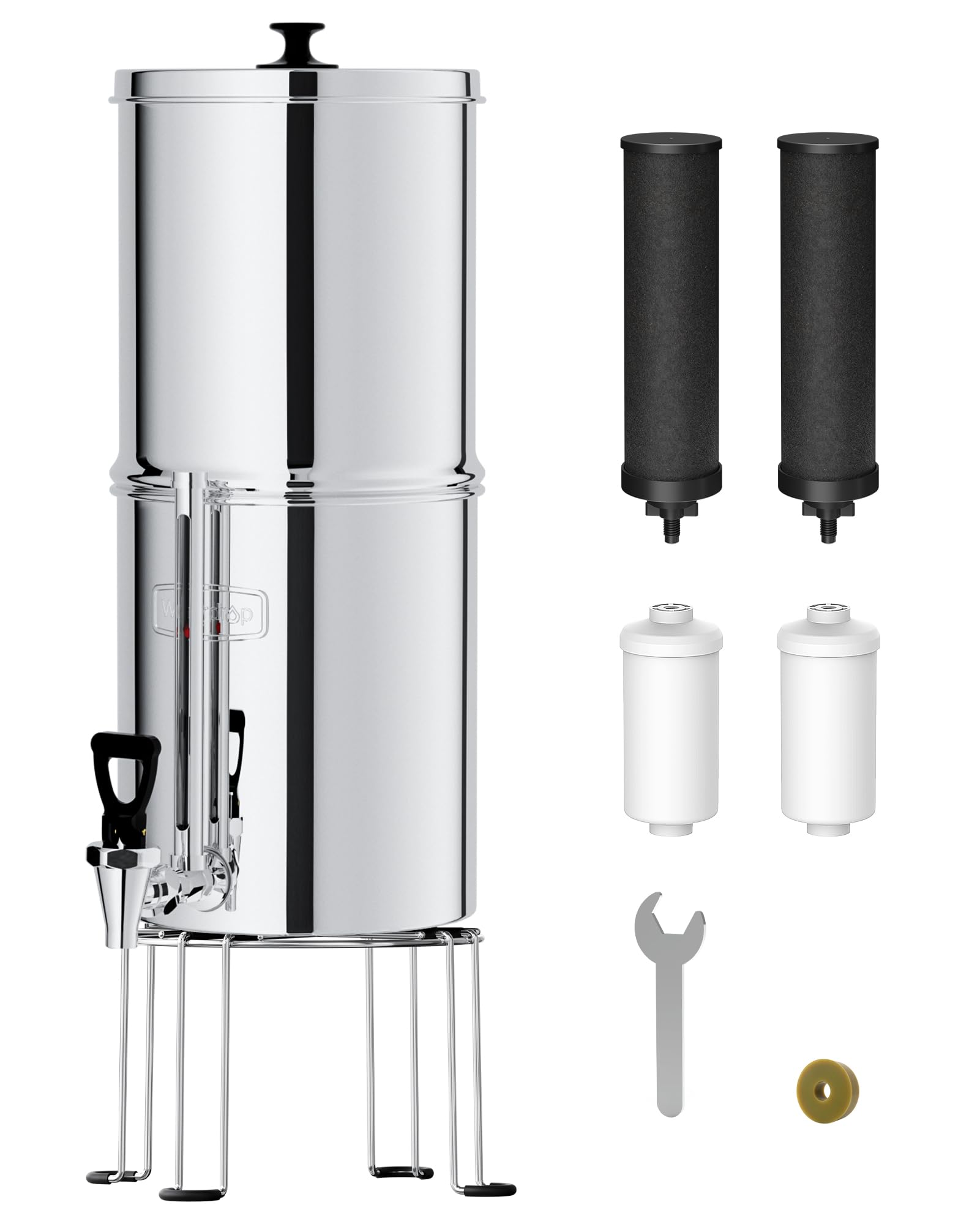
Waterdrop King Tank

89 /100
Angler Score Excellent

Key details

Height
14.4 in
Capacity
2.25 gallons
Filter Life
6,000 gal carbon, 1,000 gal fluoride
Filters Included
2 carbon, 2 fluoride
Check Details on Amazon

Four filters ship in the box — two carbon, two fluoride — and that is more filtration hardware than any other countertop system here arrives with. It is the first reason this is our default for a household: fluoride reduction is included rather than sold as an accessory, and nothing forces you to decide today whether you want it. The tank itself is 2.25 gallons of stainless, the same as the Berkey and the Purewell, and the spigot carries a sight glass, so checking the level is a glance instead of lifting the lid.

Setup is priming the elements, hanging them in the upper chamber, filling, and walking away. No plumbing, no power, no pump. The upper chamber lifts off for refills, which is the part you will do most often, and it sits squarely enough that filling it at the sink does not need a second pair of hands. Our first fill came out clean and neutral, without the chlorine edge the tap water carries.

What settled the choice was height. The Waterdrop is 14.4 inches tall; the Berkey is 19.25 and the Purewell is 20. Standard upper cabinets leave about 18 inches between counter and cabinet, so this is the only countertop system here that slides underneath. That sounds small until you picture the alternatives living on a side table or a windowsill for the next five years, and it is why we put this ahead of two tanks that are otherwise its equal.

The recurring cost is the fluoride pair, which is rated for 1,000 gallons against 6,000 for the carbon pair — if fluoride is not a concern where you live, run the carbon elements alone and the upkeep gets simpler and cheaper. Otherwise this is a kitchen appliance rather than a travel filter, and it wants a permanent spot on the counter.

Pros

  • Two carbon and two fluoride elements included
  • 14.4 inches tall, so it fits under upper cabinets
  • Sight-glass spigot shows the water level
  • No plumbing, power, or installation

Cons

  • Rated only for source water up to 500 ppm TDS
Our verdict

Our pick for most kitchens: 2.25 gallons without plumbing, four elements in the box, and a 14.4-inch body that clears standard upper cabinets.

Check Latest Price
2

Best Splurge

Big Berkey 2.25 Gal System

91 /100
Angler Score Outstanding

Key details

Body
Polished 304 stainless steel
Capacity
2.25 gallons
Max Flow
0.03 gpm
Filter Elements
2 Black Berkey, proprietary
Check Details on Amazon

The Big Berkey is the most expensive system here, by a margin wide enough that it has to justify itself. Two things do: a polished 304 stainless body that looks like it belongs in a kitchen rather than a basement, and the Black Berkey elements, which are proprietary to Berkey and the reason this system has the following it does.

Capacity is 2.25 gallons, the same as the Waterdrop and the Purewell, so the extra money is not buying volume. What it buys is the finish and the media: the elements are Berkey's own formulation, replacements come from Berkey, and the assembly goes together without tools, plumbing, or power. We think that is a fair trade for someone who wants this specific system, and a poor one for someone shopping on capacity per dollar.

Then there is the flow. The stated maximum is 0.03 gallons a minute, the lowest figure in this group by a wide margin, and it is the number that decides whether the Berkey suits your house. A quart takes minutes rather than seconds; a full tank is a background task you start an hour before you want the water. A couple who keeps it topped up will not mind. A family that empties it at breakfast will spend the morning watching it drip.

The rest is placement. At 19.25 inches tall it wants a counter with nothing above it, so measure the gap under your cabinets before you commit — standard uppers leave about 18 inches — and plan on it staying put rather than moving between kitchen and porch. Give it a permanent home and the stainless earns its keep.

Pros

  • Polished 304 stainless steel body
  • Two authentic Black Berkey elements included
  • No plumbing, power, or tools required

Cons

  • Lowest stated flow in this group at 0.03 gpm
  • Housing warranty covers only six months
Our verdict

We recommend it to buyers who want the stainless showpiece and Berkey's proprietary media, and who can live with the slowest stated flow here.

Check Latest Price
3

Best Value Countertop

Purewell 3-Stage Gravity System

88 /100
Angler Score Excellent

Key details

Capacity
2.25 gallons
Pore Size
0.01 micron
Filter Life
3,000 gal per element
Certification
NSF/ANSI 42 and 372
Check Details on Amazon

If you want stainless on the counter without Berkey money, this is the system we point to. It is 2.25 gallons in a 304 stainless body, and it arrives with two carbon elements, so you are not buying a housing and then shopping for filters on day one.

The headline number is the pore size: 0.01 microns, a tenth of the 0.1-micron hollow-fiber membranes most of this group uses. It sounds like a category jump and it is not quite one — 0.1 microns already catches bacteria and protozoa, so the tighter pore buys margin against sediment and turbidity more than a new class of protection. What it does back up is certification: NSF/ANSI 42 for taste and chlorine, and 372 for lead-free materials.

Where it lands for us is the value slot among the stainless systems. Two elements rated at 3,000 gallons each means 6,000 gallons before you are buying replacements again, and the elements are the delicate part of the kit — seat them squarely, do not overtighten, and rinse rather than scrub. Do that and this is a lot of filter for the middle of the price range.

The stand is the detail we ended up appreciating most: it lifts the spigot clear of the counter, so a quart jar or a tall glass fits under it without tipping. Two elements, a stand, and a steel body at this price is a combination nothing else here puts together.

Pros

  • 0.01-micron filtration, the tightest pore here
  • NSF/ANSI 42 and 372 certified
  • Two elements rated 3,000 gallons each
  • Stand lifts the spigot clear of the counter

Cons

  • 20 inches tall, so it will not fit under standard upper cabinets
Our verdict

The stainless system we point to when the budget is mid-range: 0.01-micron filtration, two elements and a stand, and no plumbing to sort out.

Check Latest Price
4

Best Flow Rate

Katadyn BeFree Gravity 6L

88 /100
Angler Score Excellent

Key details

Weight
8.9 oz
Capacity
6 liters
Max Flow
2 L/min
Filter Life
1,000 liters
Check Details on Amazon

The listing quoted a 10-to-11-week ship window when we looked, which is a strange thing to accept for a water filter, and the reason to accept it is on the spec sheet: two liters a minute, the fastest stated flow of any gravity system here. Flow is what makes or breaks a gravity filter. At two liters a minute you fill everyone's bottles while dinner boils; at a trickle you stop bothering, and a filter you stop bothering with is one you should have left at home.

The bag is 6 liters of collapsible composite that packs flat and weighs 8.9 ounces with the element attached. Fill it from a lake, hang it, and let it run. The EZ-Clean hollow-fiber element is cleaned by swishing it in clean water, no tools and no disassembly, which is the difference between a filter still in service on day four of a trip and one that has been demoted to backup.

Taste is the softer spot. The bag can leave a plastic note in the water, especially in the first few fills, so rinse and dry it at home rather than at camp. The bag itself is the other thing to watch: the seam where it meets the filter is the wear point, so pack it loose rather than crushed under a tent and check that joint before a long trip.

Six liters is a genuine group size — three or four people through a hot afternoon — and the bag collapses to nothing once it is empty, so the walk back is lighter than the walk in. For a family trip or a small guided group, that combination of flow and packability is what the extra money buys.

Pros

  • Fastest stated flow here at 2 liters a minute
  • Cleans by swishing in clean water, no tools
  • 6-liter bag packs flat at 8.9 ounces
  • Two-year limited warranty, the longest here

Cons

  • 1,000-liter filter life is the shortest among the bag systems
Our verdict

Worth the wait if flow is what you care about: two liters a minute from a 6-liter bag makes water duty for a group a two-minute job.

Check Latest Price
5

Best Ultralight

SimPure 3L Gravity Filter

91 /100
Angler Score Outstanding

Key details

Weight
3.2 oz
Capacity
3 liters
Max Flow
27 liters per hour
Filter Life
5,000 liters
Check Details on Amazon

The SimPure is the value end of the hanging-bag group: 3 liters of bag, a hollow-fiber element with a carbon stage behind it, and a spec sheet that reads a lot like the Katadyn's at a fraction of the price. It rolls down to roughly the size of a packed rain shell, which is the point of a bag filter in the first place.

We think it is the right buy for someone who filters a couple of liters at camp and does not want to think about it again. The element is rated for 5,000 liters — five times the Katadyn's figure — and the tree strap is in the box rather than sold separately, so hanging it is one less thing to improvise.

The element is not just a membrane, either: there is a coconut-shell carbon stage and a pre-filter in the stack, so it does taste and chlorine work that a plain hollow-fiber element does not. For water that tastes of leaf litter or creek bottom, that is a real difference and the reason this one stays in the rotation for tannin-stained sources.

What it is not is a group filter. Three liters is two people's worth of drinking, and the bag wants a branch or a post at a height you can get a bottle under. As a two-person, three-season bag that lives in a daypack, though, it is the one we reach for when the pack is already heavy.

Pros

  • 5,000-liter filter life, five times the Katadyn's
  • Carbon stage adds taste and chlorine reduction
  • Rolls down to pocket size
  • Tree strap included

Cons

  • 27 liters an hour is the slowest flow among the bags
Our verdict

We take this one when weight and filter life matter more than speed: 5,000 liters of element in a bag that packs to nothing.

Check Latest Price
6

Best Budget

Sawyer SP160 Gravity System

92 /100
Angler Score Outstanding

Key details

Capacity
1 gallon
Pore Size
0.1 micron absolute
Filter Life
Up to 100,000 gallons
Filter Weight
2 oz
Check Details on Amazon

The filter is the size of a thumb, weighs 2 ounces, and Sawyer rates it for up to 100,000 gallons — a number so far past the rest of this group that it stops being a comparison. It is the same 0.1-micron absolute hollow-fiber element that has been screwed onto bottles for years, here paired with a 1-gallon bladder and a gravity hose with adapters.

The dual-threaded cap is what makes the kit flexible: the element screws onto the included bladder, onto a standard bottle, or inline on the hose, and the cap gives you on and off without undoing anything. We ran it as a gravity setup on a picnic table and as a bottle filter when there was nothing to hang it from, and it behaved the same both ways.

For the money, this is the kit we hand to people building a car box or a shelf of emergency supplies. It is among the least expensive complete setups here, the filter genuinely disappears into a pocket, and the whole thing packed weighs less than a full water bottle. It is not a household's daily water — a gallon is a morning's drinking — but as the thing that is there when nothing else is, it is hard to beat.

Filling is the other friction: from a shallow creek the wide mouth is more scoop than funnel, and a bottle helps. Flow also drops as the element loads, which is what the included plunger and cleaning coupling are for — a minute of backflushing buys another few liters. That is the rhythm of owning this one: tiny filter, fussy bag, water anyway.

Pros

  • Filter rated for up to 100,000 gallons
  • Dual-thread cap fits bottles, bladders, and hose
  • 2-ounce filter vanishes in a pack
  • Plunger and cleaning coupling included

Cons

  • Bladder is the fragile half of the kit
Our verdict

A 2-ounce filter rated for 100,000 gallons, a gallon bladder, and a dual-thread cap that fits bottles — this is the one we keep for emergencies.

Check Latest Price
7

Best for Basecamp

Practical Survival Gravity Kit

91 /100
Angler Score Outstanding

Key details

Bags
Two 6-liter hanging bags
Weight
1.5 lb
Max Flow
0.6 gpm
Filter Life
1,800 gallons
Check Details on Amazon

Most bag filters give you one dirty bag and a bottle to fill. This kit gives you two — one for dirty water, one for clean — plus a connector, a cleaning plunger, and a carry case. That changes the routine: instead of filtering on demand, you hang the dirty bag, drain a batch into the clean one, and carry the clean bag to the tent or the truck.

We like that for hunting camp and basecamp, where the water source is a walk away and nobody wants to make the trip twice. Two 6-liter bags also mean you can leave one hanging and take the other with you, which is a flexibility the single-bag systems here do not offer.

The rest is straightforward. Setup is pushing the fittings together and hanging the bag from something solid; the filter is rated for 1,800 gallons, more than the Membrane Solutions' 1,320, and the stated flow of 0.6 gallons a minute is the highest in this group — a full bag empties in under three minutes rather than over a coffee break. The plunger and bag connector are in the box, so flow recovery does not depend on improvising.

Two bags also means two bags to rinse and dry: a damp clean bag zipped into a pack overnight will taste of it by morning, so drain and air both before you break camp. That is a small ritual compared to hauling water in bottles, which is what most of us did before kits like this existed.

Pros

  • Dirty and clean bags let you filter in batches
  • 1,800-gallon filter rating
  • Highest stated flow here at 0.6 gpm
  • Plunger, connector, and carry case included

Cons

  • Heaviest bag kit here at about a pound and a half
Our verdict

Our choice for basecamp and hunting trips: two bags let you filter a batch and carry it, and the 1,800-gallon element keeps up.

Check Latest Price
8

Group Camping

Membrane Solutions 6L Pro

91 /100
Angler Score Outstanding

Key details

Capacity
6 liters
Max Flow
0.5 L/min
Filter Life
1,320 gallons
Certification
NSF/ANSI 42, 372, 401
Check Details on Amazon

This is the only system here that claims NSF/ANSI 401 alongside 42 and 372, and the difference matters if you read certification labels closely. In plain terms: 42 covers taste and chlorine, 372 covers lead-free materials, and 401 covers a list of emerging contaminants the first two do not address. Behind the claim is a 0.1-micron hollow-fiber element with a carbon stage and dual PP pre-filters, rated for 1,320 gallons.

Six liters is the right size for three to six people, and the design is a straight hang-and-drain: fill through the wide top, hang it from the reinforced strap, and the stated flow is half a liter a minute. The TPU bag is puncture-resistant and BPA-free, the whole thing is 12.8 ounces, and it goes into a group kit without a fight.

The thing to know before you take it into the backcountry is silt. The element loads up on cloudy water — algae, glacial flour, tannin-stained creeks — and the flow drops from that half liter a minute to something you have to nurse, with backflushing only partly restoring it. Clear lake water is one thing; a silty river after rain is another, and the second one is where a group gets thirsty and cross.

We think it is a strong group filter for planned trips with decent water and a risky one as your only filter on a long route with murky sources. On clear water, the certification and the 6-liter bag make it the best-equipped bag system here. On anything cloudy, bring a second element or a cloth pre-filter, or take the Katadyn instead.

Pros

  • NSF/ANSI 42, 372, and 401 tested
  • 6 liters serves three to six people
  • Element rated for 1,320 gallons
  • Puncture-resistant TPU bag with hanging strap

Cons

  • 12.8 ounces, heavier than the Katadyn's 8.9
Our verdict

Buy it for group trips on clear water: 6 liters, three NSF standards, and a 1,320-gallon element — just do not feed it silt.

Check Latest Price
9

Packable Backup

LifeStraw Peak Gravity 3L

89 /100
Angler Score Excellent

Key details

Weight
8.04 oz
Capacity
3 liters
Bacteria Removal
99.999999%
Check Details on Amazon

The Peak's trick is that it is not only a gravity filter. The same element works as a hanging gravity system, as a squeeze bottle, as a straw, or inline on a bottle, which is why it ends up in a pack as a backup rather than the main event. If your water plan is 'a filter and whatever container I have', this is built for that.

The removal claims are the strongest stated in this group — 99.999999% of bacteria, 99.999% of parasites and microplastics — and the re-engineered membrane comes with a backwash accessory for when sand and silt load it up. Flow is the honest weak point: it runs slow, and a full 3 liters takes patience, which is the trade for a membrane this fine.

We think it is the right buy as a just-in-case filter for a truck box or a daypack. At 228 grams it is light enough to live in a pack unnoticed, and having four ways to use it means the plan can change without the filter becoming dead weight.

Taste is the weak spot, and the bladder is usually the culprit — a vinyl note that survives washing and shows up in the first liters of a trip. Rinse and air the bag at home, run a liter through and dump it, and use the filter on a bottle when you can. The element is the strong part; the bag is the part you work around.

Pros

  • Gravity, squeeze, straw, and inline use
  • 99.999999% bacteria removal claim
  • 228 grams, light enough to forget
  • Backwash accessory included

Cons

  • 3 liters is a solo or two-person capacity
Our verdict

We keep one as a backup: gravity, squeeze, or straw from the same element, in a bag light enough to forget about.

Check Latest Price

What Eight Months of Filling, Waiting, and Refilling Taught Us

We started with more than 30 gravity-fed systems and narrowed them by checking certifications (NSF/ANSI 42 and 372 on the countertop units), pore size, capacity, and whether replacement filters are sold on their own rather than bundled with a whole new housing. That left 12, which we've been living with for the past eight months.

The countertop units sat beside a kitchen sink in a two-person household and served as the only source of drinking water for a two-week stretch — kettle every morning, bottles before work, a pot of pasta on Sundays. The bag and bucket filters came on a long weekend at a cabin with no running water and got packed back into a car trunk full of gear. We also shut the water off at the main for a day to see how each one handled being the household's sole supply.

Filtering speed got a stopwatch, timed from brim-full top chamber to empty, and we counted how many glasses we could pour in a minute halfway through. Leakage was checked the boring way: a dry towel under each unit overnight after a full refill, then a look at the seams, spigot, and gaskets in the morning. We carried every filled top chamber one-handed from the sink and noted which ones needed a second trip or a second vessel to catch the output.

Filter performance went to the tongue first — blind sips against tap, tea brewed both ways, and a glass left in the fridge overnight to catch any aftertaste creeping in by morning. Durability came out of that cabin trip, where units were knocked off benches and jostled in the trunk. Value was the final calculation: system cost against the price and lifespan of its replacement filters, since a cheap unit with pricey cartridges stops being cheap.

How to Choose a Gravity Water Filter

Countertop Tank or Hanging Bag

Filtering municipal tap water for a household is a different job from filtering a lake, and the two designs barely overlap. A stainless countertop system holds 2.25 gallons, hangs from nothing, and lives where you already go for a glass of water. A bag weighs ounces, packs flat, and needs something to hang from at a height you can get a bottle under.

The trap with countertop tanks is height. Standard upper cabinets sit about 18 inches above the counter, and the stainless systems here run from 14.4 inches to 20 — so measure the gap before you choose a spot. A tank that will not slide under the uppers ends up on a side table, which is where good filters go to be forgotten.

Capacity, and the Flow Rate That Comes With It

2.25 gallons is a household day. Three liters is two people on a hike. Six liters is a group, and a group is where flow rate stops being a footnote: the bag systems here are stated anywhere from 27 liters an hour to 2 liters a minute, and that spread is the difference between filling four bottles while dinner boils and standing there watching a drip.

Our rule is to match capacity to the number of people, then check flow before you buy. A big bag with a slow element is a bigger wait, not more water.

Pore Size and What the Certifications Mean

0.1 micron is the working standard for hollow-fiber elements and enough to catch bacteria and protozoa. The 0.01-micron element in the Purewell is tighter, which buys margin against sediment and turbidity more than a new class of protection — worth having, not worth a large premium on its own.

Certifications are a separate question and worth reading closely. NSF/ANSI 42 covers taste and chlorine, 372 covers lead-free materials, and 401 covers a list of emerging contaminants. A system with 42 and 372 is doing taste work with safe materials; if the third matters to you, only one system here claims it.

Filter Life Is the Number That Sets the Cost

Look at gallons or liters per element, because that is what you will be buying again. The spread here is enormous: up to 100,000 gallons on the Sawyer element, 1,000 liters on the Katadyn, and 6,000 gallons of carbon on the Waterdrop against only 1,000 gallons of fluoride.

Proprietary elements change the math too. The Black Berkey filters come from Berkey and nowhere else, so price a pair before you commit to the tank. Standard hollow-fiber elements are the easier long-term bet.

Leaks and Storage

A seeping spigot is the classic fault on a countertop tank, and it is often an assembly problem rather than a defect: seat the washer square, do not overtighten the nut, and do not fill the upper chamber past its mark. If it still drips, replace the washer before you blame the filter.

On the bag side, the wear points are the joint where the bag meets the filter and the corners where a folded bag creases. Store bags loose and dry rather than crushed in a pack, and check that joint before a long trip.

Frequently Asked Questions

Final Verdict

For a kitchen, buy the Waterdrop. It holds 2.25 gallons, ships with four elements so fluoride is not a separate purchase, and its 14.4-inch body is the only countertop system here that clears standard upper cabinets. Nothing else in this group combines that footprint with that much filtration already in the box.

If the water is coming from a creek rather than a tap, the answer changes: the Katadyn BeFree's two liters a minute is what we take when a group is waiting, and the Sawyer SP160 is what we leave in the truck for the day we need a gallon and nothing else.