Best Hackle Pliers of 2026

The hackle goes on, the wrap starts clean, and then the quill slips out of the jaws and the feather spins loose. Every fly tyer knows that failure, and it usually comes down to the plier rather than the feather. A good one holds the tip with light, even tension so the fibers sweep back instead of twisting, and it lets you wrap one-handed while the other stays on the thread.

I've tied at the same vise for a decade, and the first pair I bought still leaves a mark on every quill. Over the past four months, my team and I have kept 16 pliers in rotation — singles and multi-packs both — and the differences aren't subtle. One thing first-timers don't expect: a serrated jaw isn't a feature so much as a liability, since it nicks the stem and a nicked stem breaks mid-wrap. The picks below are sorted by who they actually suit.

1

Best Overall

Loon Ergo Hackle Plier

88 /100
Angler Score Excellent

Key details

Tip Style
Smooth
Tip Taper
1/8 in
Unit Count
1
Primary Use
Palmering
Check Details on Amazon

Smooth tips are the whole reason the Ergo sits at the top of this group, and they're what earned it the default recommendation. The jaws taper to 1/8 inch and close flat, so they hold a feather by its stem instead of biting into it — no serrations to nick the barbs that make a dry fly float. On pheasant rump and soft hen hackle the difference shows up on the first wrap: the fibers stay intact and the hackle goes on evenly instead of collapsing into a ragged clump.

The metal handle and shaped grip are the other half of it. Long sessions don't leave the plier digging into your fingers, and the black-and-yellow body is easy to find on a bench buried in feather scraps. Opening it takes a deliberate squeeze; if you like to pop a plier open one-handed in the middle of a wrap, spring tension is the one detail to weigh, while anyone who sets the tool down between steps won't notice at all.

Where it does the most work is palmering. Running hackle up a long body — a Woolly Bugger, a soft-hackle wet — means three or four forward turns without letting the feather twist, and the Ergo's grip holds the stem steady while you rotate the hook rather than fighting the tool. That's the job it was built for, and it's why this is the one we keep closest to the vise.

Pros

  • Smooth tapered tips protect delicate feather fibers
  • Comfortable metal handle for long tying sessions
  • Secure grip on soft hen and pheasant rump

Cons

  • Sold singly at the top of this group's price range
Our verdict

We point anyone tying dry flies and soft hackle to the Loon Ergo, because its smooth tapered tips hold a stem without shearing the fibers that make a fly float.

Check Latest Price
2

Best Value Multipack

Riverruns Hackle Pliers 6-Pack

89 /100
Angler Score Excellent

Key details

Colors
Blue and black
Includes
Mini fly box
Pack Count
6
Item Weight
1.12 oz
Check Details on Amazon

Six pliers in two colors and a small fly box: this is the cheapest way here to have a plier sitting at every station on the bench. Three come in blue and three in black, so a wet fly and a dry can each keep their own without you hunting for the one you just put down.

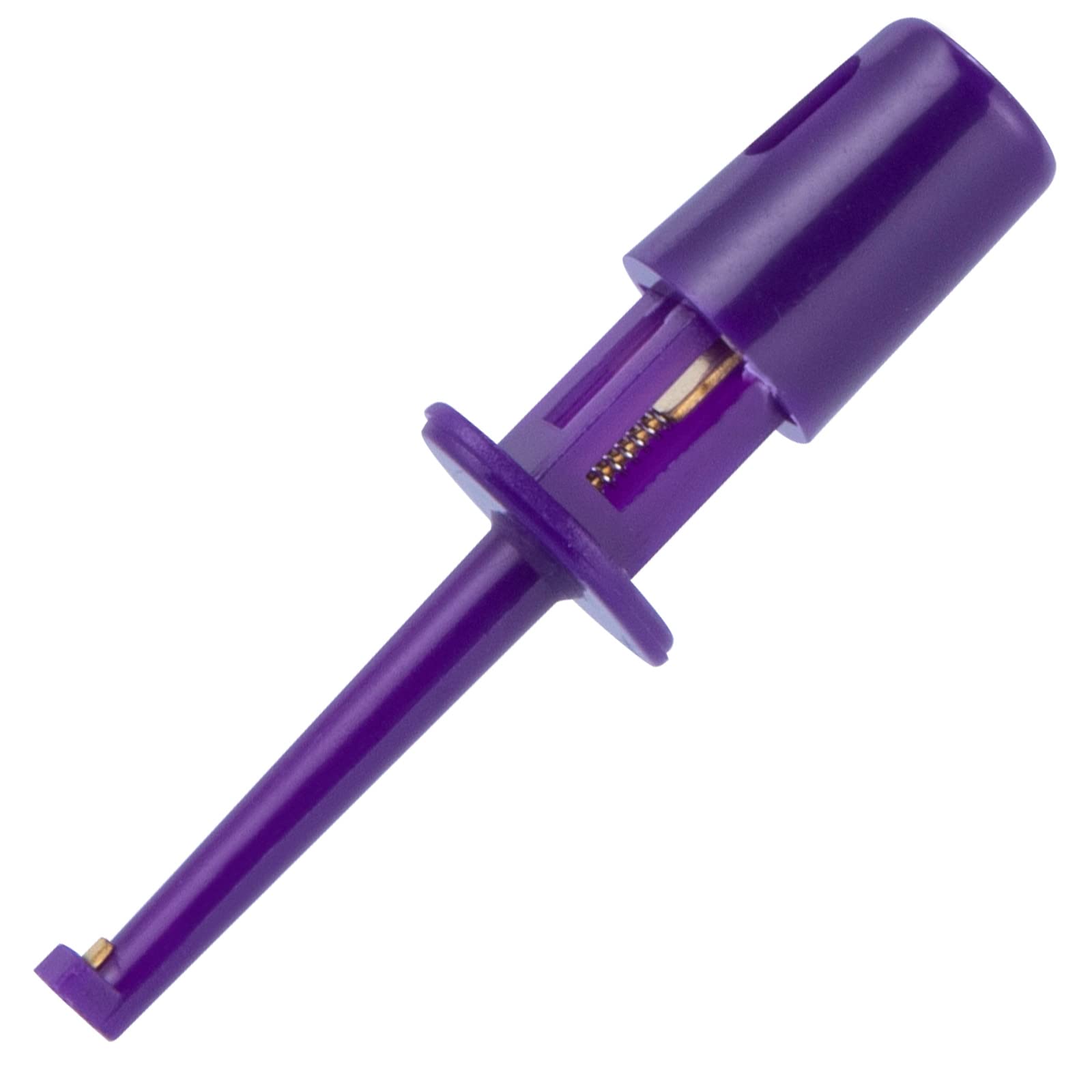
The mechanism is a spring-loaded wire loop rather than jaws. Push the base toward the tip, lay your hook or feather into the loop, release, and it clamps shut. We found it grips tiny hooks securely, which is what makes it genuinely useful for holding a fly while the head cement sets, and the jaws carry no sharp edges to cut hackle as you wrap. The included box is a small one — fine for a handful of midges on a lightweight trip, not a replacement for your working box.

Lightness is the honest caveat. Six of these and a box weigh barely more than an ounce between them, so each plier is almost nothing in the hand and the spring does most of the work of telling you how hard you're gripping. For display, drying and small hooks that's exactly right. For a delicate wrap where you want feedback through your fingertips, a metal tool like the Ergo has the edge.

Pros

  • Six pliers plus a mini fly box
  • Spring loop holds tiny hooks securely
  • Jaws grip hackle without cutting the fibers

Cons

  • Mini fly box is small
Our verdict

If you want a plier waiting wherever you're working rather than one good tool in your hand, this six-pack and its little fly box are the ones we reach for.

Check Latest Price
3

Best Bulk Pack

Leewoth Hackle Pliers 12-Pack

90 /100
Angler Score Outstanding

Key details

Colors
Blue and red
Material
Stainless steel and ABS
Tip Style
Hook-shape top
Pack Count
12
Check Details on Amazon

Twelve pliers, blue and red, for roughly what a single premium plier costs. This pack is about coverage rather than refinement, and the count is the feature: a plier per hook size, a spare within reach the moment you set one down and can't find it, and enough to keep a tying class or a club table supplied without anyone waiting.

The working end is a hook-shaped top. Push the base up to expose it, catch the hook eye or the feather stem, and let the spring snap it closed — the material is fixed quickly and firmly, which is what you want when a size 18 is spinning between your fingers. The large ring at the base is the part we appreciate most: it turns easily under a thumb and forefinger, and that's the motion that spins hackle around a shank.

Stainless steel inside an ABS housing keeps each one light, and they feel it — these are bench tools, not machined heirlooms. Nothing about them is unpleasant to use, but if you want weight and precision in the hand, the Loon or the Dr. Slick is where that money goes. What the Leewoth buys you instead is quantity at a price that makes losing one irrelevant.

Pros

  • Twelve pliers in two colors at a budget price
  • Hook-top clamps with a single push and release
  • Large base ring spins easily between fingers

Cons

  • All twelve are the same size
Our verdict

Buy the Leewoth dozen when more than one person ties at your table, or when you want a plier already sitting on every rig you've started.

Check Latest Price
4

Best Traditional Design

Dr. Slick Hackle Plier

79 /100
Angler Score Very Good

Key details

Jaw
Rubber tubing on one jaw
Finish
Brass
Length
2.25 inches
Rotation
Non-rotary
Check Details on Amazon

At 2.25 inches, the Dr. Slick is the shortest plier here and the one with the least machinery — no rotary joint, no loop, just two jaws with rubber tubing slipped over one of them. It's the traditional answer to holding a feather, and it still works because there's nothing between your fingers and the stem.

The tubing is the interesting part. It compresses slightly against a quill, so the grip comes from friction rather than a hard edge pinching down, and small dry-fly hackle goes on without the stem being crushed flat. What we liked most is how little the tool asks of you: it sits between thumb and forefinger where you can find it without looking, and wrapping is done by turning your fingers or the hook in the vise rather than by spinning a mechanism.

For tyers who wrap by feel, that directness is worth more than any feature on the fancier pliers. The brass finish has a pleasant heft for its size and the short body keeps the weight where your hand already is. It is a single, simple plier and it makes no apology for that — the ones who love it are the ones who never wanted a spinning tool in the first place.

Pros

  • Rubber tubing grips the stem without crushing it
  • Short 2.25-inch body sits naturally in the fingers
  • Simple fixed action gives direct, unmediated control

Cons

  • Short jaws give little reach on large streamers
Our verdict

Our pick for tyers who wrap by feel: the rubber-lined jaw and short body give the most direct control of anything on this page.

Check Latest Price
5

Drying Several Flies

Greatfishing Long Tip Hackle Pliers

84 /100
Angler Score Excellent

Key details

Colors
Four red, four black
Includes
Fly box
Tip Style
Long tip
Pack Count
8
Check Details on Amazon

Eight long-tip pliers, four red and four black, plus a fly box. The tips are the thing to notice: the extra length reaches around a shank and past the eye, so your fingers stay clear of the work instead of crowding the hook while you place a feather.

On a bench where several flies are in progress, that reach is what sold us. Clip a finished fly by the bend in one plier, park it out of the way, and start the next; the two colors let you split wet from dry, or your flies from a friend's, without stopping to label anything. It's the middle of this group on price, and you get more pliers in the box than the Riverruns pack for the difference.

Long tips also suit streamer and nymph work, and they hold a fly steady for a quick photograph better than a fine-tipped plier does. The whole set is light enough that leaving three or four out along the bench costs nothing in clutter or in your hand.

Pros

  • Eight long-tip pliers in two colors
  • Fly box included for drying or sorting flies
  • Long tips reach past the hook eye

Cons

  • Every plier in the set has the same long tip
Our verdict

A tidy set for a busy bench — eight long-tip pliers and a box, best if you like several finished flies hanging while the cement sets.

Check Latest Price
6

Small Hooks, Midges

Alwonder Hackle Pliers 10-Pack

78 /100
Angler Score Very Good

Key details

Colors
Eight colors
Length
1.65 inches
Material
Plastic and brass
Pack Count
10
Check Details on Amazon

At 1.65 inches end to end, the Alwonder pliers are the smallest here — short enough that the whole tool disappears between a thumb and forefinger while you work. Ten of them arrive in eight colors, which tells you most of what they're for before you open the bag.

The grip is the push-and-hook style: shove the base up to expose the little hook top, which measures 0.13 inch across, catch the eye of a hook or a feather stem, and let the spring close it. Plastic over brass keeps the weight and the cost down, and the built-in spring means there's nothing to adjust or lose.

Color-coding is where these earn their shelf space. A size 18 midge and a size 14 nymph can each get their own color, so you know at a glance what's already rigged, and the tiny tip gets in close enough to see the eye while you're placing a barb or two of hackle. We found them best treated as bench tools: keep them in a compartmented box rather than rattling loose in a vest, and the plastic bodies stay out of trouble.

Pros

  • Ten pliers in eight colors for coding hook sizes
  • Tiny 0.13-inch hook top reaches small flies
  • Built-in spring opens with a single push

Cons

  • Short body and tiny tip suit small flies only
Our verdict

Get these for midges and small dries; the tiny hook tops and eight colors make far more sense on a size 18 than on a streamer.

Check Latest Price
7

Vest and Streamside

Creative Angler Hackle Pliers

78 /100
Angler Score Very Good

Key details

Size
Medium long
Material
Metal with plastic handle
Unit Count
1
Item Weight
0.32 oz
Check Details on Amazon

The first thing to know about the Creative Angler is that it opens with two hands. That isn't a dealbreaker — plenty of tyers set the plier down between steps — but if your left hand holds thread tension while your right does the wrapping, you'll feel the interruption every single time. What you get in exchange is reach: medium-long jaws on a metal body, with a plastic handle shaped to sit in the palm.

Those jaws get around a hook shank and past the eye without your fingers crowding the work, which is the sort of thing you notice most on a size 12 nymph with a bead head in the way. The body weighs a bit over nine grams, so it feels like a tool rather than a toy, and the handle stays comfortable when you're pulling against thread.

There's a big loop at the tail end, and that's the detail that turns it into a vest tool as much as a bench tool — clip it to a retractor or a D-ring and it's already in your hand when a fly needs holding while you sort out tippet. Working with the firm spring is a matter of technique: brace the base against the edge of the bench and push, and it comes open with one hand after all.

At the vise, though, that spring is a small tax on every wrap. Where it pays you back is everything else — holding a hook while the cement dries, gripping a fly for a photograph, keeping a half-finished streamer out of the way. As a first hackle plier for someone learning to wrap small dry flies, we point people at the Loon instead.

Pros

  • Medium-long jaws reach around a hook shank
  • Big end loop clips to a retractor or vest

Cons

  • Stiff spring needs two hands to open
Our verdict

Buy it if you want a medium-jawed plier that hangs off a vest, and you don't mind opening it with both hands.

Check Latest Price

How We Tested These Hackle Pliers

We built the shortlist from fly-tying forums, a few shop counters, and spec sheets, filtering by jaw shape, spring type, overall length, and whether a model came on its own or in a multi-pack. That trimmed roughly forty candidates down to 16 pliers we bought and used ourselves. Testing ran four months, which is long enough to feel a spring go soft.

Most of the work happened at the vise in the evening, tying size 12 to 16 dries and a run of soft-hackled wets, plus one long Saturday where I tied a dozen flies back to back. For grip, I wrapped hackle with each plier and watched whether the quill held at the tip or slipped, and whether the fibers swept back cleanly or twisted around the stem. For tension, I noted whether the jaws crushed the quill or snipped my thread when I pulled a wrap snug, and whether I could work the plier one-handed with my other hand still on the thread.

Durability and portability got tested the way they actually fail. Each pair was squeezed several hundred times over the four months, dropped on a hardwood floor, and tossed loose into a bag; we tracked which springs went soft and which jaws stopped closing flush. We measured each plier against a palm and checked whether it fit a standard fly box compartment or clipped to a vest. Value came down to cost per usable plier — in the multi-packs, we counted how many were duplicates, how many had jaws that wouldn't close, and whether the free extras were worth carrying.

How to Choose Hackle Pliers

Start With How It Grips

Three designs run through this group, and they behave differently. Smooth jaws close flat on the stem and hold by pressure; they're the gentlest option for soft dry-fly hackle, and a rubber sleeve on one jaw adds friction without an edge, as on the Dr. Slick. Hook-top clips and wire loops work the other way: push the base, expose a small hook or loop, catch the material, and let the spring clamp it shut.

Clips are quick and hold a hook securely, but a tiny hook top gives a thick stem less surface to sit on. If your box is mostly size 16 and smaller, a clip is faster; if you tie soft hackle and dry flies with fragile barbs, start with smooth jaws.

Rotary or Fixed

A rotary plier spins on its own axis, so you rotate the tool between your fingers to wind hackle up the shank. Fixed pliers make you turn your wrist, or turn the hook in the vise. Rotary is quicker on long palmered bodies, and a large base ring — the Leewoth has one — makes the spin easy to control without looking.

Fixed is more direct, and plenty of experienced tyers feel the feather's tension better that way. Neither action is more accurate; pick the motion that matches how you already wrap.

The One-Hand Test

Think about how the plier opens before you buy. One of your hands is usually holding thread tension, so a spring you can work with the hand already holding the plier is worth more than any finish. A stiff spring is the fastest route to a plier that stays in the drawer, and it's the single most common letdown in this group.

Push-to-open clips dodge the problem, and so does technique: bracing the base against the edge of your bench frees a hand when the spring is firm.

Match the Tip to the Fly

Tip size decides which flies a plier is good for. A 1.65-inch body with a tiny hook top is a midge tool; long jaws are what you want for wrapping a streamer and for holding a finished fly steady for a photograph. Tapered tips such as the Loon's 1/8-inch points sit between the two and handle most trout-sized work.

Buy for the middle of your hook range rather than the extremes. If most of your box is size 18 to 22, a fine tip earns its keep. If you wrap schlappen around size 6 streamers, length and a wider grip matter more.

How Many You Need

One good plier covers a tying session, so multipacks are about workflow rather than redundancy: a plier parked on each fly while the cement dries, a color per hook size, a spare that's already open. The trade is refinement. Plastic-and-spring bodies are light and inexpensive and don't feel like a machined tool; brass and stainless do, and you pay more for a single plier.

If you tie a dozen flies a week, one good plier plus a cheap pack for drying duty is the combination that works.

Frequently Asked Questions

Final Verdict

One plier earns the default: the Loon Ergo. Its smooth, tapered tips hold a feather stem without shearing the barbs, the metal handle stays comfortable through a long session, and it's the tool we reach for when a wrap has to come out right.

If your bench runs several flies at once, the Riverruns six-pack and its mini box cover drying and display duty for less. And if you wrap by feel and want nothing rotating in your fingers, the Dr. Slick is the one to pick.