
Best Kayak Cart for Sand of 2026

The worst part of a beach launch usually isn't the paddle — it's the fifty yards between the parking lot and the waterline, when a loaded kayak turns into an anchor and every cart you've tried starts plowing instead of rolling. Sand is the great separator: hard-packed stuff flatters almost any dolly, but soft, dry beach tests whether the wheels float, the frame stays square under weight, and the straps hold a hull without slipping. A cart that saves your back on pavement can become a liability in the loose stuff. The right one fixes the whole trip: you load once, pull with steady effort, and spend your energy on the water instead of the walk.

We spent nine months testing 12 carts on pavement, packed sand, and the soft stuff, paying attention to how each one handled a loaded boat, how quickly it folded for the trunk, and whether the straps stayed put over a rough pull. The keepers were the ones that felt solid without being a chore to carry when empty.

1

Best Overall

Bonnlo Beach Wheel Kayak Cart

89 /100
Angler Score Excellent

Key details

Frame
Aluminum
Included
Pump and two ratchet straps
Load Limit
300 lb
Wheel Type
12-inch low-pressure balloon
Check Details on Amazon

The wheels are the whole argument. Bonnlo fits this cart with 12-inch low-pressure balloon tires, and on soft sand those are the difference between a haul and a wrestle: let a little air out and the tire spreads the boat's weight across a wide patch of beach instead of cutting a groove. It also happens to be the cheapest cart in this group, which isn't why we picked it but is a welcome side effect.

Pressure is the thing to stay ahead of. A balloon tire only floats when it's soft enough to squat — pump it hard and you've built a hard wheel with extra steps — and Bonnlo ships the pump, along with two ratchet straps and four foam bumpers. We check ours before a long carry, because a soft tire is the cheapest improvement you can make to a hard pull.

The frame is a fixed width, so a narrow V-hull sits on those foam pads differently than a wide flat-bottom fishing boat does. Getting the cart underneath on your own is the fiddly part: we set it upright in the shallows and slide the stern over the rear bumpers rather than lifting the boat and dropping it on. The aluminum frame is light enough that carrying it back to the truck isn't a chore.

What settles it is the arithmetic of a real trip. A 60-pound hull with a seat, a crate, a battery, and rods is a load you feel in your shoulders by the second carry, and balloon tires are what keep that load rolling instead of ploughing. Nothing else here gets the tire, the pump, and the price all pointing the same direction.

Pros

  • Low-pressure balloon tires float a loaded boat
  • Pump and two ratchet straps included
  • Aluminum frame keeps the cart manageable
  • Cheapest cart in this group

Cons

  • Ratchet straps are slower than cam buckles
Our verdict

For a launch that means soft sand, this is the cart we send people to: the balloon tires float a loaded boat, the pump comes with it, and it's the least expensive route to the right wheels.
Check Latest Price
2

Best for Rigged Fishing Kayaks

VEVOR Heavy Duty Kayak Cart

85 /100
Angler Score Excellent

Key details

Load Limit
350 lb
Wheel Type
13-inch beach tires
Cart Weight
15 lb
Width Adjustment
170–440 mm
Check Details on Amazon

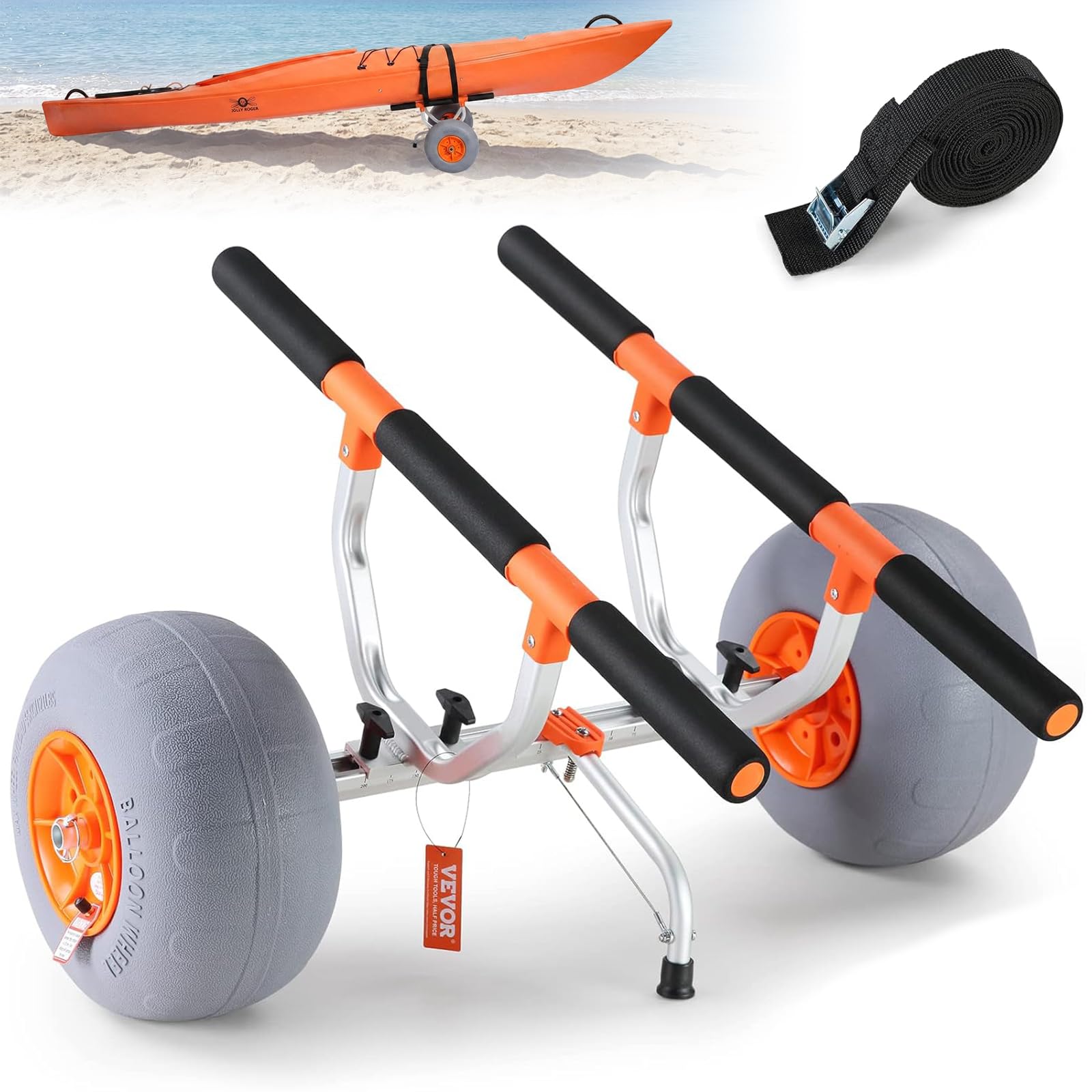
Rigged fishing kayaks are where carts go wrong. A long boat with a tackle crate, a transducer arm, and a seat sitting proud of the hull needs the frame low enough to clear the plastic and the axle far enough out that the tires don't rub. The VEVOR's 13-inch wheels are the biggest here, and with the carrier width adjustable from 170 to 440 millimeters, the pads land under the flat sections of a hull rather than on its chines. That's why it's the one we point a kayak angler at first.

A 350-pound rating is the highest in this group, and the 2mm aluminum frame is where it comes from. The support foot is the detail we noticed most: it props the frame at an angle so you can walk the bow onto the pads without a second person holding the cart steady, which is the difference between loading and negotiating.

Assembly is straightforward and the cart comes apart again for the drive home, which matters when the vehicle is already full of rods and a cooler. One care note worth passing on: fresh water is your friend. Rinse the kickstand hardware and the axle ends after a beach day, because salt sits in exactly those places and starts working on the finish.

Pros

  • 13-inch wheels give rigged hulls clearance
  • 350-pound rating is the highest here
  • Width adjusts from 170 to 440 mm
  • Support foot props the cart for solo loading

Cons

  • No pump included for the air tires
  • Wing nuts and fasteners feel cheap
Our verdict

The one we hand a kayak angler: 13-inch wheels and a 350-pound rating give a rigged fishing boat the clearance underneath and the headroom above that it needs.

Check Latest Price
3

Best for Rocky Launches

Suspenz All-Terrain Airless Cart

85 /100
Angler Score Excellent

Key details

Frame
Powder-coated steel
Load Limit
300 lb
Wheel Type
15-inch airless
Folded Size
31 x 16 x 9 inches
Check Details on Amazon

Airless wheels are a promise and a compromise. The Suspenz's 15-inch wheels can't go flat, which counts for a lot on an oyster reef, a gravel ramp, or a launch you drive to with no spare in the truck. What a firm wheel doesn't do is squat and spread the way a low-pressure balloon tire does, so deep, dry sand asks for a harder pull than our top pick does. Where the Suspenz wins is everything after the sand.

The bunker bars are the part we admire most. Five locking positions let you drop the pads under a V-hull, a tunnel or catamaran hull, or a flat-bottom boat, and each pad is oversized foam, so a loaded canoe rests on something with give rather than on a hard edge. A hull with a pronounced keel can still leave a pad sitting at an angle, but the adjustment covers more shapes than the fixed-width carts in this group.

Loading is easier here than on anything else we lined up: the kickstand holds the frame upright while you walk the bow onto the pads, and two sets of cam-buckle straps give you four tie-down points — enough to keep a long canoe from walking sideways on a cambered ramp. Those cam buckles are also quicker to work than the ratchets on the Bonnlo, which you'll appreciate with cold hands in October.

Pros

  • Airless wheels can't go flat
  • Five bunker positions fit V and tunnel hulls
  • Kickstand holds the frame upright for loading
  • Four strap points hold a long canoe

Cons

  • Heaviest cart here at 17 pounds
  • Highest price in this group
Our verdict

Buy it when your launch is rock, shell, or gravel with sand at the end of it — the steel frame and airless wheels are the toughest pairing here for that ground.

Check Latest Price
4

Mixed Terrain

JOIERW Heavy Duty Kayak Cart

90 /100
Angler Score Outstanding

Key details

Load Limit
300 lb
Wheel Type
12-inch airless
Width Adjustment
2.4 to 14.3 inches
Support Bar Length
31.8 inches
Check Details on Amazon

Two uprights slide along the axle, from 2.4 inches apart out to 14.3, over support bars 31.8 inches long. That range is why this cart can sit wide under a beamy sit-on-top and narrow enough to tuck behind a tackle crate on a leaner hull. Setting the width takes a minute with the boat beside you on the grass, and then it stays where you put it.

The 12-inch wheels are airless, so there's no pump to lose, no valve cap to find, and no slow leak waiting for you the morning of a trip. For a cart that lives in the garage between outings, that's a genuine convenience rather than a spec-sheet footnote.

What we appreciated most is how little fuss surrounds the whole thing — anodized aluminum, foam pads bolted through the bars, two long tie-down straps, nothing to inflate. It's a cart you can leave assembled in the truck bed all season and not think about. The pads are the weak spot: they don't grip a slick hull well, and until the straps take up the load the boat can shift a little on the bars.

On wet sand, packed sand, gravel, and the concrete ramp at the end of the walk, it rolls as easily as anything here. The harder the surface, the better a firm wheel suits it.

Pros

  • Width slides from 2.4 to 14.3 inches
  • Airless wheels need no pump
  • Anodized aluminum resists rust
  • Long 31.8-inch support bars

Cons

  • Firm wheels take more pull on deep dry sand
Our verdict

A no-pump, no-flat cart that widens to fit a beamy sit-on-top — our choice for packed sand, gravel, and anyone who has cursed a beach pump.

Check Latest Price
5

Compact Stowage

RAILBLAZA C-Tug with SandTrakz

84 /100
Angler Score Excellent

Key details

Frame
Plastic
Warranty
5 years
Load Limit
170 lb
Wheel Type
SandTrakz puncture-free
Check Details on Amazon

Some carts are built around the car and some around the boat. The C-Tug belongs to the second kind: a plastic frame that comes apart into a bundle you can bungee to a deck or drop into a hatch, with puncture-free SandTrakz wheels and a single tie-down strap.

The boat it suits is a light one — a 45-to-60-pound touring or recreational hull with a dry bag, not a rigged fishing kayak with a battery and a crate. Within that role, we rate it the most packable cart of this group: the one that goes with the boat rather than waiting in the car, and the one that stows under a seat when the day is over.

The SandTrakz wheels are why it made the list at all. C-Tug's claim for them is that they cut the effort of a haul roughly in half; we won't put a number on that, but they do roll over loose sand without the ploughing feel of a plain hard tire, and because they're puncture-free there's no pump riding along in your beach bag.

The catch is height. This is a low cart, and a long hull can drag its stern on the sand when you pull from the bow — slide the cart forward until the boat balances and most of that disappears. The kickstand is also short enough that the cart won't stand on its own under a loaded boat, so launching is a two-hand job at the water's edge. Neither bothers you much on the short carry this cart was designed for.

Pros

  • Puncture-free SandTrakz wheels need no pump
  • Breaks down small enough to stow on deck
  • Plastic frame won't rust

Cons

  • 170-pound limit rules out loaded fishing kayaks
Our verdict

The cart that travels with the boat rather than in the truck: light hulls, short carries, and a bundle small enough to stow on deck.

Check Latest Price

How We Tested Kayak Carts on Soft Sand

We started with a shortlist of two dozen carts sold for beach and all-terrain use, then narrowed it by wheel type, stated load capacity, frame material, folded size, strap hardware, and price. Price mattered, but only as part of the value question: a cart with a flimsy pin or a strap that slipped was not a bargain at any number. Twelve models made the cut. We tested them over nine months, on weekend launches and after-work paddles, with the same 80-pound sit-on-top kayak and, when the cart allowed, a heavier tandem.

At the parking lot, I loaded each cart alone and noted whether the frame flexed, the kayak sat level, and the straps held without me having to re-tighten. Then I pulled the loaded boat across pavement, packed sand, and a long stretch of dry, sugar-soft sand to the waterline, watching for wheel sink, side-to-side wobble, and how much effort it took to correct a drift. I also parked each cart on a side slope with the boat aboard to see if it tipped, turned it around in loose sand, and carried it folded back to the car to judge bulk and weight.

After each trip, I rinsed the carts, checked pins, welds, width locks, and tire wear, and folded and unfolded them repeatedly to catch sticking joints or bent hardware. Durability showed up in small ways: rust at scratched spots, straps that frayed at the buckle, wheels that developed flat spots. For value, I compared what each cart included against what I had to add or replace by the end. The carts that scored best were not the most complicated—they were the ones that stayed stable under a loaded hull, rolled through soft sand without constant fighting, and still felt manageable when empty.

How to Choose a Kayak Cart for Sand

Wheels and Tire Pressure Decide the Haul

Sand shifts under load, so a wheel only rolls if it spreads weight across a wide footprint instead of cutting a groove. That is the case for low-pressure balloon tires: a dozen inches or more across, run at only a few pounds of pressure, they flatten into the beach and stay on top. Pump them hard and you've built a hard wheel with extra steps, which is why a pump earns its place in the truck — let air out for the soft stuff, add it back for pavement.

Airless and puncture-free wheels never leave you walking, and they're the better choice on gravel, shell, and ramp concrete, but a firm wheel doesn't conform to sugar sand and asks for a harder pull. Choose by the surface you'll cross most, not by the one at the very end of the walk.

Size the Load Rating to the Boat You Actually Load

The number that matters isn't the bare hull weight — it's the hull plus the seat, the crate, the battery, the cooler, and the rods. A cart rated around 170 pounds is a light-touring proposition; 300 to 350 pounds is where a rigged fishing kayak belongs. Treat a high rating as headroom rather than a target, because a cart works hardest exactly at its limit on soft ground.

One more thing to watch: when a product page quotes two different payload figures for the same cart, plan around the lower one.

Fit the Bunks to the Hull, Then Strap It Down

Adjustable carrier width is the feature buyers skip and later wish they hadn't. Bars that slide from a couple of inches apart to well over a foot let the pads sit under the hull's flat sections on everything from a narrow sea kayak to a broad sit-on-top, and the foam needs to carry the boat rather than let it rock on two contact points.

Straps hold the boat down; they don't hold it on. Cam buckles are faster and don't seize the way ratchets can after a season of salt, and two straps across four points keep a long hull from walking sideways on a cambered ramp.

Loading Alone, and Where the Cart Lives

If you launch alone more than occasionally, pay for a kickstand or a support foot. Propping the frame upright turns loading into one motion instead of a balancing act with a boat on your shoulder. Weight matters here too — a 17-pound steel cart is pleasant rolling and miserable carried, and the difference shows up on the walk back.

Folded size decides whether the cart comes along at all. Something near 31 by 16 by 9 inches tucks into a trunk beside a paddle; a cart that only collapses into a long bundle takes up more room than the rest of your kit.

Frequently Asked Questions

Final Verdict

Our default for sand is the Bonnlo: 12-inch balloon tires with a pump in the box, a 300-pound rating, and a frame that folds into a trunk, all at the low end of this group's price spread. If your boat carries a crate, a battery, and a transducer arm, go to the VEVOR for the 13-inch wheels and the extra headroom.

And if the launch is rock and gravel with only a short stretch of sand, the Suspenz's airless wheels and steel frame are the tougher pairing for that ground.