Best Monoculars of 2026

A monocular is a pair of binoculars cut in half: one barrel, one eyepiece, and roughly half the weight hanging off your neck or shoved in a jacket pocket. That trade is the whole appeal — it comes up one-handed when a hawk lifts off the fence line, and it goes away before anyone notices you were looking. It only pays off if the glass is decent, though, and the difference between a crisp image and a dim, soupy one has almost nothing to do with the magnification printed on the side.

I've carried one on dog walks for years, and my team has spent the past four months with 12 of them. Here's what nobody tells a first-time buyer: more magnification isn't more detail. A 12x magnifies the tremor in your hands and narrows the view, so finding the bird takes longer than seeing it, and a steady 8x with well-coated glass beats a shaky 12x almost every time. Some of these disappear into a shirt pocket, others are built for a week in a hunting pack, and the picks below sort themselves out along that line.

1

Best Overall

Nocs Provisions Zoom Tube 8x32

90 /100
Angler Score Outstanding

Key details

Weight
8 oz
Magnification
8x
Objective Lens
32 mm
Weather Resistance
IPX4 water-resistant
Check Details on Amazon

The 8x32 formula is why the Nocs Provisions Zoom Tube is our top pick. It gives you enough magnification to pull a warbler out of a treeline without the jitter that creeps into 10x and 12x views, and the 32 mm objective leaves a 4 mm exit pupil, so the image stays usable as the light starts to go. The 384-foot field of view is generous enough to find a moving bird without hunting around.

What we kept noticing was how little fuss the Zoom Tube made of the basics. The center-focus wheel moves quickly under one finger, the three-stop twist-up eyecup works with glasses, and the 8-ounce body disappears in a jacket pocket. The view is crisp and neutral rather than warm or contrast-heavy, which we prefer for identifying plumage and reading field marks.

The Zoom Tube is rated IPX4, so it handles rain and spray but is not the one to dunk. That fits its role as a walking companion; if you regularly glass from a boat, a fully waterproof body makes more sense. The lifetime warranty is the quiet bonus: this is a monocular you can carry hard without treating it like a delicate instrument.

Birding is the obvious use, but it is also the one we pack for travel, a stadium, or a long hike where binoculars feel like extra bulk. The 32 mm lens will not match a big low-light glass after sunset, but for daylight outdoor viewing it makes fewer compromises than anything else here.

Pros

  • Wide, bright 8x32 view
  • Fast one-hand center focus
  • Light 8-ounce body
  • Lifetime no-matter-what warranty

Cons

  • 8x leaves less reach for open country
Our verdict

The Zoom Tube is our top pick for birding and travel because its 8x32 view is wide, bright, and steady in one hand.

Check Latest Price
2

Best Compact

Vortex Solo 10x25

88 /100
Angler Score Excellent

Key details

Weight
5.6 oz
Magnification
10x
Objective Lens
25 mm
Weather Sealing
Waterproof and fogproof
Check Details on Amazon

At 5.6 ounces and about the size of a small flashlight, the Vortex Solo 10x25 is the one we tuck into a coat pocket and forget about until something moves. The rubber armor gives it a secure grip, and the sealed, nitrogen-purged body means rain and fog are not an immediate problem. The lifetime VIP warranty is the other reason it stays in the conversation.

The 10x magnification gives it more reach than the 8x32 picks, but the 25 mm objective and 2.5 mm exit pupil keep it a daylight tool. In flat light or near dusk the image goes flat sooner than a 42 mm lens. That is the trade for a body this small, and for hiking, travel, or a quick look across a field it is the right trade.

What we like is how little it asks of you: pull it out, brace your elbows, and the center focus snaps the image into shape. The included lanyard and case make it feel like a complete pocket kit rather than an optic sold alone, and the rubber armor is the kind you can toss in a pack without ceremony.

Pros

  • Genuinely pocketable 5.6-ounce body
  • Waterproof and fogproof sealing
  • Lifetime VIP warranty
  • Crisp 10x view in daylight

Cons

  • Stiff focus ring slows one-handed use
Our verdict

For a true pocket monocular, we like the Solo 10x25's 5.6-ounce body, sealed optics, and lifetime warranty.

Check Latest Price
3

Best Low-Light Optics

Bushnell Legend 10x42

91 /100
Angler Score Outstanding

Key details

Weight
13.2 oz
Magnification
10x
Objective Lens
42 mm
Weather Sealing
Waterproof and fogproof
Check Details on Amazon

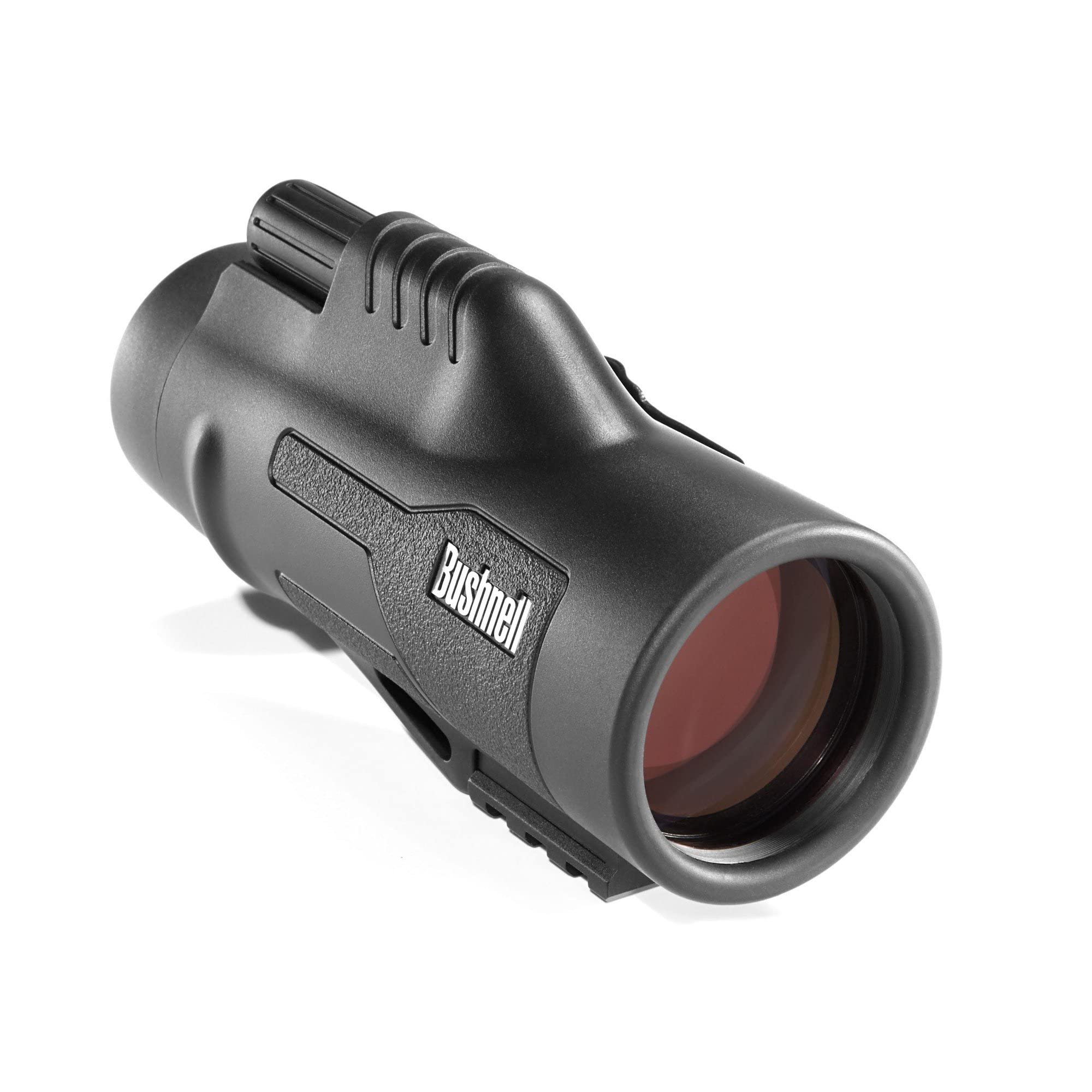
The Legend 10x42 is the one we reach for when the light is going and the view matters more than the price tag. ED Prime glass and Ultra Wide Band coating are the headline, but the practical result is a bright, color-faithful image with less fringing than the budget glass here. For dawn, dusk, and deep shade, that is the difference between identifying an animal and guessing at a shape.

The 10x42 formula is familiar for a reason: 10x pulls detail out of open country, and the 42 mm objective gives a 4.2 mm exit pupil that stays usable longer than the 25 mm compacts. The 340-foot field of view is not as wide as an 8x, so finding a moving bird takes a little more patience, but the focus knob is quick enough to recover.

We found the Legend comfortable to hold and easy to focus with one hand, and the twist-up eyecup works with glasses. The sealed, rubber-armored body is built for rough treatment. At 374 grams it is a pack or jacket optic, not a shirt-pocket one.

Pros

  • ED-glass clarity and color fidelity
  • Bright 42 mm low-light view
  • Waterproof, fogproof armor
  • Smooth one-hand focus

Cons

  • Premium price relative to the group
Our verdict

The Legend 10x42 is our low-light choice for hunters and birders who want ED-glass clarity and a big 42 mm objective.

Check Latest Price
4

Best for Hunters

Vortex Solo R/T 8x36

91 /100
Angler Score Outstanding

Key details

Weight
12.8 oz
Magnification
8x
Objective Lens
36 mm
Ranging Reticle
MRAD
Check Details on Amazon

The MRAD reticle is the reason to choose the Vortex Solo R/T over the standard Solo: it turns the monocular into a range-estimation tool, not just a way to see farther. The marked reticle lets you mil a target and do the math before you take a shot, and the utility clip keeps it on a belt or vest where you can reach it.

At 8x and 36 mm, the view is steadier than the 10x compacts and brighter than the 25 mm pocket models, with a 4.5 mm exit pupil. The large focus wheel and separate reticle focus let you sharpen the image and the scale independently, which is more control than most monoculars here offer. The 12.8-ounce body is light enough for a pack but not for a shirt pocket.

We think the Solo R/T is a specialist, and it earns its place for hunters who want to range landmarks and glass game with one compact optic. The reticle is the point, and the large focus wheel makes it usable with gloves. The rubber armor and sealed body are built for weather, and the lifetime warranty makes the specialist role easier to justify.

Pros

  • MRAD reticle for range estimation
  • 8x36 view balances steady and bright
  • Utility clip keeps it handy
  • Lifetime warranty

Cons

  • Reticle clutters general birding views
Our verdict

We recommend the Solo R/T to hunters who want a compact 8x monocular that can estimate range as well as show the target.

Check Latest Price
5

Best Budget

FEEMIC 8x42

89 /100
Angler Score Excellent

Key details

Weight
10.1 oz
Magnification
8x
Objective Lens
42 mm
Weather Sealing
Waterproof and fogproof
Check Details on Amazon

The FEEMIC 8x42 is what a budget monocular looks like when the optics are given priority over trim: an 8x view, a 42 mm objective, and enough rubber armor to survive a pack. It is not a fancy object, but the specification is the one we choose for a first all-around glass.

The 8x magnification and 5.25 mm exit pupil make it bright and forgiving, especially for a beginner who has not learned to brace a 10x view. Fully multi-coated BAK4 glass gives it a cleaner image than the price suggests, and the waterproof, fogproof body means it can stay in a pack through bad weather. At 285 grams it is light enough to carry all day.

We think it is the budget pick for a reason: the focus has some play, and the view is not as crisp at the edges as the Nocs or Bushnell. But it gets the central image right, and the included case and strap make it ready to use. For a first monocular, a spare in the truck, or a gift for someone who may not take to the habit, it is an easy recommendation.

Pros

  • Bright 8x42 view
  • Waterproof and fogproof
  • Light 285 g body
  • Strong value for a first monocular

Cons

  • No stated warranty
Our verdict

The FEEMIC 8x42 is the budget monocular we hand to first-time buyers who want a bright, sealed all-rounder.

Check Latest Price
6

Best for Long-Range Viewing

Gosky 12x55

89 /100
Angler Score Excellent

Key details

Weight
1.54 lb
Magnification
12x
Objective Lens
55 mm
Waterproof Rating
IPX7
Check Details on Amazon

The Gosky 12x55 is less a pocket monocular than a small viewing kit: the box includes a tripod and a phone adapter, and the 12x view makes sense when you use them. It is the pick for someone who wants to study a distant ridge or take a photo through the eyepiece, not for someone who wants a glass to carry loose in a jacket.

The 55 mm objective and 4.58 mm exit pupil give it a bright image for long-range work, and the IPX7 body is sealed for wet weather. At 12x, hand shake is obvious, so the tripod is not an accessory you can leave in the car; it is the way to get the detail the lens can deliver. The 352-foot field of view is wide for the magnification.

The phone adapter is useful once it is aligned, but alignment takes patience, and we found it the fussiest part of the kit. The focus is quick enough, and the included case and caps make it travel-ready.

We recommend the Gosky for long-range detail and phone photography, where the tripod turns a shaky 12x view into a stable one. If you want a monocular for quick one-handed looks on a hike, the smaller 8x and 10x picks are easier companions.

Pros

  • 12x55 bright long-range view
  • IPX7 waterproof sealing
  • Tripod and phone adapter included
  • Stable tripod viewing

Cons

  • Heavy 0.7 kg for all-day carry
Our verdict

We recommend the Gosky 12x55 for tripod users and phone photographers who need long-range detail more than pocketability.

Check Latest Price
7

Budget 10X

Usogood 10x42

86 /100
Angler Score Excellent

Key details

Weight
9.12 oz
Magnification
10x
Objective Lens
42 mm
Weather Sealing
Waterproof
Check Details on Amazon

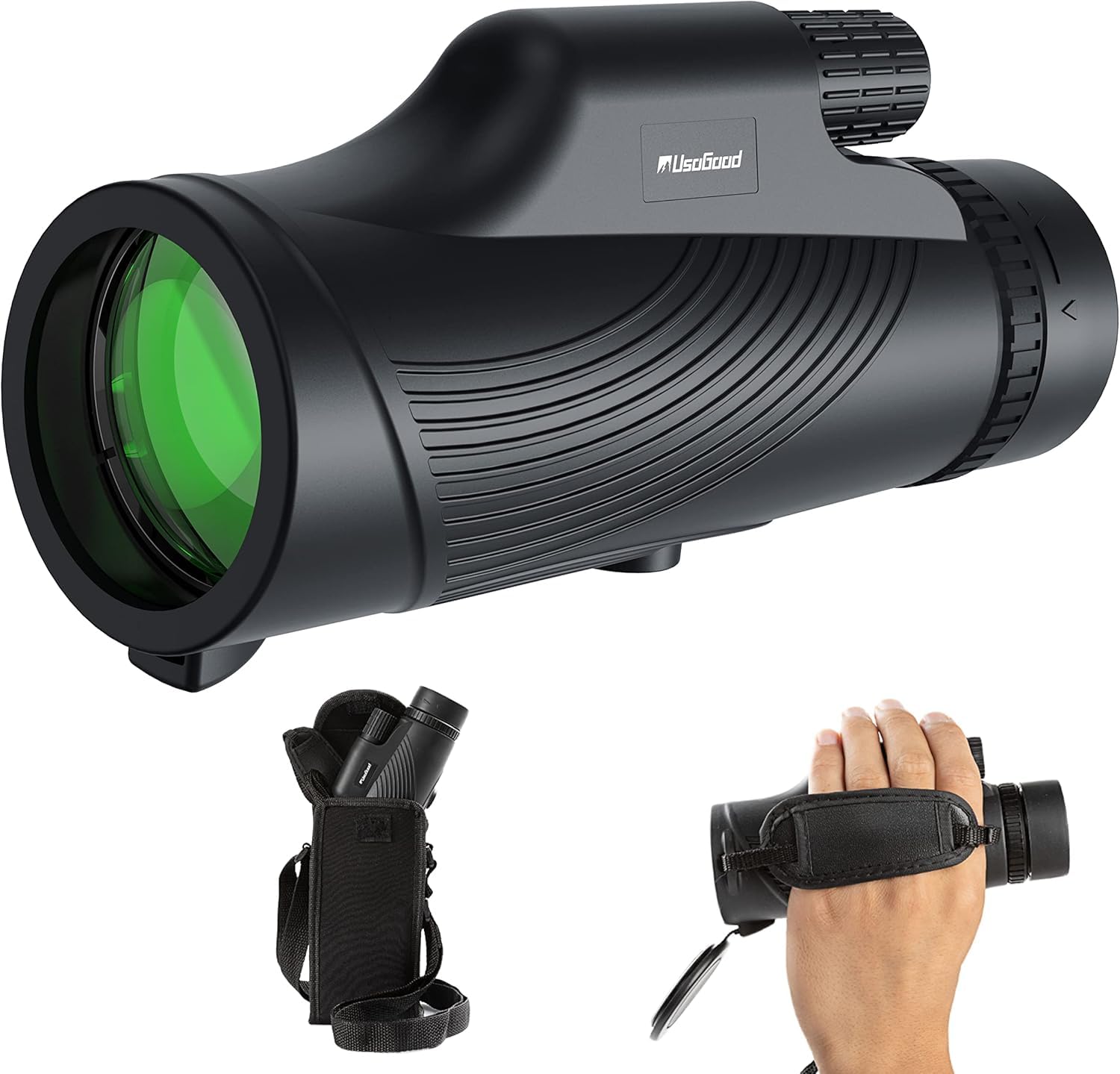
Compared with our top pick, the Usogood 10x42 trades the Nocs' wide 8x view for a narrower, more powerful 10x image and a bigger 42 mm lens. That is a real choice, not a straight upgrade: you get more reach and a brighter lens, but you give up some field of view.

At 9.12 ounces, the Usogood is light enough for a jacket pocket, and the rubber-armored body is sealed against water. BAK4 prisms and fully multi-coated lenses give it a surprisingly clean central image for the budget tier, and the 4.2 mm exit pupil is more forgiving than the 25 mm compacts. The focus is simple to work with one hand.

The 10x view is the catch. It magnifies hand shake along with the subject, so it rewards a braced stance or a monopod more than the 8x picks. The field is narrower, which makes finding a moving bird slower. We still think it is a sensible budget alternative for open-country glassing or range use.

It is a practical step-up when reach matters more than a wide, easy view, and the lifetime warranty is uncommon at this end of the group. We see it as a second-tier pick rather than a replacement for the Zoom Tube.

Pros

  • 10x42 reach and brightness
  • Light 9.12-ounce body
  • Waterproof sealing
  • Lifetime warranty

Cons

  • 10x magnifies hand shake
Our verdict

We recommend the Usogood 10x42 as a budget alternative for buyers who want 10x reach, a light body, and a lifetime warranty.

Check Latest Price
8

Ultralight Hikes

Celestron Nature 10x25

84 /100
Angler Score Excellent

Key details

Weight
6 oz
Magnification
10x
Objective Lens
25 mm
Weather Sealing
Waterproof and fogproof
Check Details on Amazon

The Celestron Nature 10x25 is the ultralight option here at 170 grams, and that is exactly where its appeal starts and its compromise shows. It disappears in a jacket pocket or a small pack, which makes it the one we are most likely to have with us on a long hike.

The 10x25 view is crisp for its size, and the nitrogen-purged, waterproof body handles rain and fog. What we noticed first was the focus ring: it is tight enough that fine adjustment takes a deliberate grip, especially with gloves. The twist-up eyecup works with glasses, and the rubber armor gives it a secure hold.

We think it is a good second monocular for a glovebox, a daypack, or travel where every ounce counts. It is not the most comfortable viewer for a long session, but it is the easiest to forget you are carrying.

Pros

  • Ultralight 170 g body
  • Waterproof and fogproof
  • Crisp 10x view in daylight
  • Twist-up eyecup works with glasses

Cons

  • 25 mm objective dims at dusk
Our verdict

We recommend the Celestron Nature 10x25 for hikers and travelers who count every ounce and want a waterproof compact.

Check Latest Price

How We Tested a Dozen Monoculars, From the Bird Feeder to the Trail

We built the shortlist by reading spec sheets and owner reviews for every monocular we could find from brands with a track record, then filtering on prism glass, lens coating, magnification, objective size, weight, and price until we had 12 units worth putting in someone's hand.

Testing ran four months, from late winter into spring. Each one went through the same rotation: a 7 a.m. bird feeder stakeout from the kitchen window, a Saturday hike with it clipped to a hip belt, a dusk sit on a deer line, and a kid's soccer game watched from the far touchline. We also packed every unit into a jacket pocket and a hip-belt pouch to see which ones disappeared and which turned into a lump against the ribs.

Clarity got the most argument. We read the same small print on a road sign at 50 yards, compared feather detail on a backlit bird against a bright sky, and stayed out past sunset to watch how quickly each image went muddy. The magnification number mattered far less than the glass behind it, and in several cases the extra money bought a heavier body rather than a sharper view.

Focusing is where these live or die. We counted how much of a turn it took to go from a butterfly at three feet to a ridge a mile out, noted whether the wheel moved smoothly or jumped in steps, and checked whether the setting held after a day in a pocket. Then we did it again one-handed with gloves on, which is how you'll actually use it. Weight and packed size we logged on a kitchen scale and against a paperback, because a monocular that's too heavy is one you leave at home.

How to Choose a Monocular

Match Magnification to Your Steady Hand

An 8x monocular is the easiest to hold steady and gives the widest view, which is why we favor it for birding and travel. A 10x pulls more detail from open country but magnifies hand shake, and a 12x really wants a tripod. Divide the objective lens by the magnification to get the exit pupil: 8x32 gives 4 mm, 10x25 gives 2.5 mm, and 10x42 gives 4.2 mm. The larger figure is brighter at dusk. For daylight all-round use, start at 8x32; for open country, a 10x42; for tripod work, 12x.

Read Past the Magnification Label

Labels such as 80x100 are a warning, not a shortcut: 80x is far too much magnification to hold steady in a handheld monocular, and the number says little about the quality of the glass. Look for a normal format such as 8x32 or 10x42, then check the prism glass and coatings. BAK4 prisms and fully multi-coated lenses are the features worth paying for. ED glass, as on the Bushnell Legend, is the next step up for color fidelity and low-light contrast.

Choose Weather Sealing for Your Ground

IPX4 keeps rain and spray out but is not meant for immersion; a nitrogen-purged, waterproof body is the better choice for wet coasts, boats, and cold-weather fogging. If you regularly glass from a kayak or in heavy rain, step up to an IPX7 body like the Gosky. For most hikers, a sealed, fogproof monocular matters more than a higher magnification.

Handle the Focus and Carry System

Focus is where compact monoculars separate. A large wheel is easier to turn with gloves or one hand; a small, tight ring can make fine focus a two-handed job. Twist-up eyecups let you set the eye relief, and a utility clip or neck strap decides whether the glass stays handy. We also look at weight last, because a monocular that stays in the pack is less useful than one you carry.

Frequently Asked Questions

Final Verdict

After comparing the view, handling, and sealing across these picks, the Nocs Provisions Zoom Tube 8x32 is the monocular we recommend first. It gives birders and travelers a bright, wide image that stays steady in one hand, and it does not make you choose between a pocketable body and comfortable viewing.

If your priority is different, the Vortex Solo 10x25 is the better pocket companion, the Bushnell Legend 10x42 is the low-light choice, and the Gosky 12x55 makes sense when a tripod and phone are part of the plan. For most outdoor viewing, start with the Zoom Tube.