Best Screen Tents of 2026

A backyard dinner is going beautifully until the sun drops and the mosquitoes arrive. A screen tent is the answer: a mesh-walled room you zip yourself into, with enough headroom to stand up and pull your chair in. The netting is rarely the problem. What separates a good one from a frustrating one is whether one person can get it upright in five minutes, whether it holds its shape in a gust, and whether it truly fits the table and chairs you promised it would.

I've spent the past six months living with a dozen of these on my patio, plus a couple of camping weekends, and the differences show up fast. The spec sheet won't tell you that one narrow door turns every trip to the cooler into a wrestling match, or that a tent rated for ten is really a comfortable six. My advice: measure your table and chairs before you buy, and treat setup time as the number that matters most, because a tent that's a hassle stays in the bag. The picks below earned their place, and a couple cost less than a dinner out.

1

Best Overall

Alvantor Pop Up Screen House

91 /100
Angler Score Outstanding

Key details

Weight
12 lb
Footprint
10 x 10 ft
Peak Height
7 ft
Sun Protection
UPF 50+ top
Check Details on Amazon

Pop it out of the bag, let the fiberglass ribs spring open, and you are standing in a hexagonal room with 10 feet of floor in every direction under a 7-foot ceiling. At a listed 12 pounds, the Alvantor is the shelter we reach for first: light enough to carry out to the yard in one hand, easy enough to talk yourself into loading into the car, and big enough that a picnic table and chairs disappear inside it.

The enclosure is where the design earns its keep. Mesh runs the full height of every wall, so air moves through and the bugs do not, and the single wide entrance makes it simple to carry a cooler in without dragging it through a zipper. There is no floor, which means no groundsheet to tear on chair legs and no puddle to sit in after a shower. You sweep it out and you are done.

Rain is the honest limitation. The top is a UPF 50+ fabric panel, not a waterproof roof, and in steady rain the flat span sags and holds water in the middle. Treat it as a shade-and-bugs shelter: take it down before a storm, or pitch it under a tarp when weather is coming. For three seasons of backyard evenings and fair-weather camping, that is a fair trade for how little it weighs.

If the shelter is going to live on a deck from May to September, buy steel legs and a warranty instead, which is exactly what the Crown Shades is for. The Alvantor is the one that goes back in the bag and comes out again next weekend.

Pros

  • Opens in seconds with no poles to feed
  • Listed 12 lb and folds to a 39-inch disc
  • Full 7-foot ceiling over a 10-by-10 floor
  • No floor to tear or puddle on

Cons

  • Folding the ribs back into the bag takes practice
Our verdict

Our top pick for most shoppers: a full-height 10-by-10 room that one person can carry in one hand and pop open in seconds.

Check Latest Price
2

Best for Fast Setup in Mixed Weather

Coleman Skylodge Screenhouse

84 /100
Angler Score Excellent

Key details

Footprint
10 x 10 ft
Shade Area
30.2 sq ft
Peak Height
7 ft
Sun Protection
UPF 50+
Check Details on Amazon

The Skylodge's frame is one piece: a central hub with telescoping legs already attached and pinch-free buttons at the joints. That sounds like a small thing until you have fed four separate poles through sleeves in the rain. Here you pull, click, and the roof is up, without a second pair of hands.

Inside, the 10-by-10 footprint holds a picnic table and chairs with room to stand, and the 7-foot center height means most adults walk in upright through a 6-foot door. Two entryways keep you from climbing over gear to get out, and the mesh walls are fine enough that the evening mosquito shift stays outside. The included rainfly is the detail we appreciate most, because it turns a fair-weather shelter into something you can leave up through a passing shower.

Coleman rates the fabric water resistant rather than waterproof and backs it with that rainfly, which is more weather cover than the mesh-only pop-ups here offer, for less money than our top pick. That combination is why it is our choice for trips where the sky could go either way.

Pros

  • One-piece hub frame sets up without loose poles
  • Rainfly and water-resistant fabric included
  • Two entryways and a 6-foot door
  • 7-foot center height

Cons

  • Shade panel covers only 30.2 sq ft of the 10-by-10 floor
Our verdict

The pick when the forecast is uncertain: a one-piece hub frame one person can pitch in about a minute, a rainfly for passing showers, and a price below our top pick.

Check Latest Price
3

Best for Car Camping

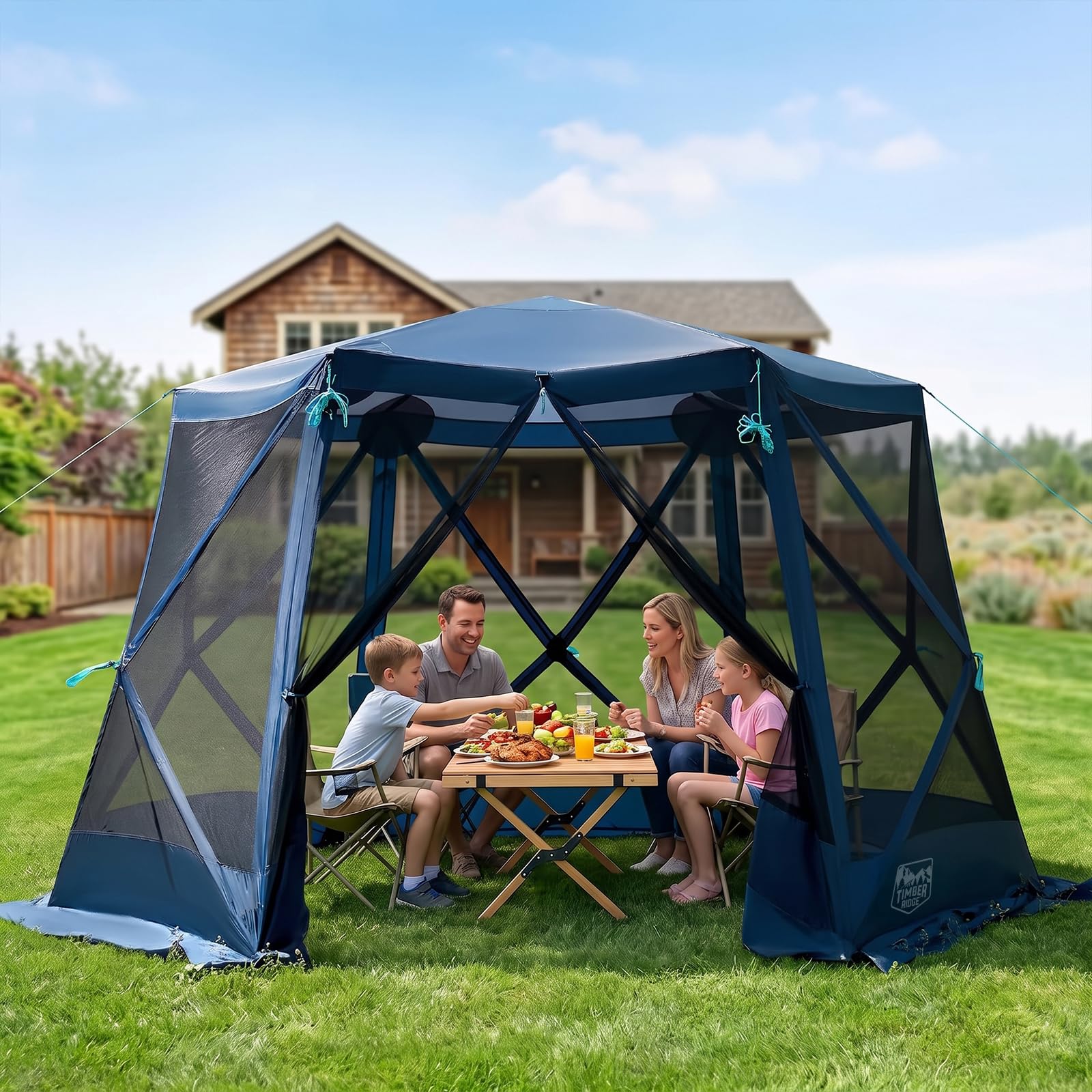
Timber Ridge Pop Up Gazebo

84 /100
Angler Score Excellent

Key details

Weight
22 lb
Footprint
11.5 x 9.8 ft
Packed Size
54 x 7.8 in
Peak Height
83 in
Check Details on Amazon

The Timber Ridge packs into a bag 54 inches long and under 8 inches across, which lies flat along the floor of a trunk instead of standing up in the middle of the cargo. That shape, plus a 22-pound carry and a frame that opens in about a minute, is why it is our pick for car camping: it loads like a duffel and pitches without a second person.

Open it up and the 11.5-by-9.8-foot floor takes a standard picnic table with chairs on both sides. The peak is 83 inches, so you can stand to serve, and the mesh walls run the full height rather than stopping at a window band. Six people around the table is realistic, which is what the listing claims.

The polyester roof is UV-treated, and the fabric is dark blue rather than reflective, so expect the interior to warm up under direct overhead sun. Site it with a tree or an awning to one side and it stays comfortable through the afternoon, which is the sort of thing you notice on the second day of a trip rather than the first.

Pros

  • Packs to 54 x 7.8 inches
  • About 60 seconds to pitch, one person
  • Fits a picnic table with chairs around it
  • 83-inch peak height

Cons

  • Water resistant only; steady rain works through
Our verdict

Our car-camping pick: a 60-second frame and an 11.5-by-9.8 footprint that swallows a picnic table, in a long flat bag that behaves itself in a trunk.

Check Latest Price
4

Best for Wet Weekends

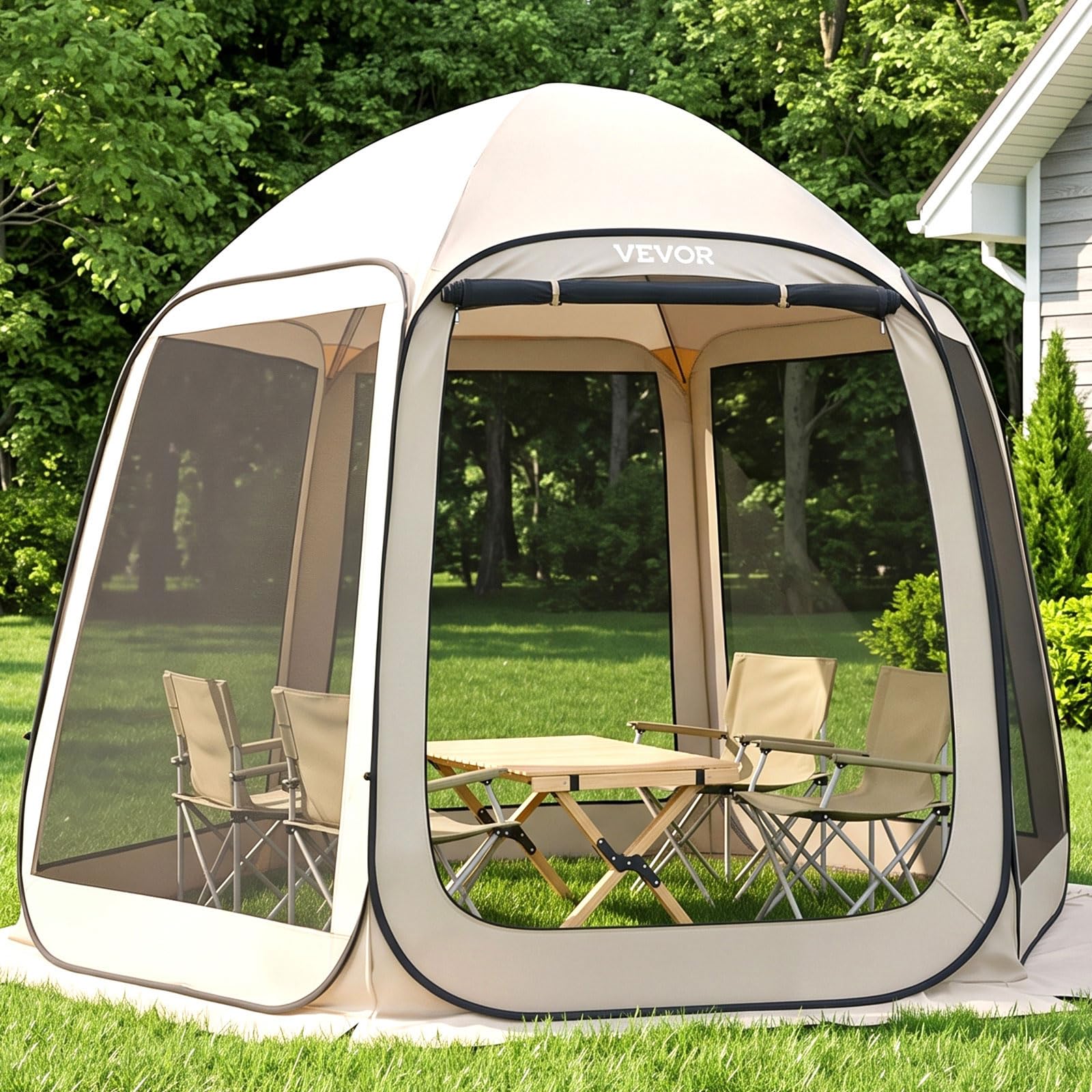
VEVOR Pop Up Screen House

83 /100
Angler Score Excellent

Key details

Weight
21.2 lb
Footprint
10 x 9.2 ft
Peak Height
7.55 ft
Water Resistance
Waterproof
Check Details on Amazon

Opening this VEVOR is the easy half. The ribs spring out in seconds and the frame is standing before you have decided where to put the chairs. Folding it back is the other half, and it is the part that decides whether the shelter rides in the car or sits in the garage: the ribs have to be walked back in sequence, and the first attempt or two usually ends in a half-collapsed bundle that springs open again. Learn it once in the driveway and takedown stops being a fight.

The payoff is a shelter built for weather. The 300D Oxford roof is rated waterproof rather than merely water resistant, the mesh wraps the full 360 degrees, and the kit includes 12 metal stakes, six guy lines and three fiberglass poles, which is enough anchor points to keep it planted through a wet weekend. Of the pop-ups here, this is the one we trust with a real forecast.

Inside, 10 by 9.2 feet under a 7.55-foot peak holds four to six chairs and a small table comfortably. The frame is light enough that the stakes and guy lines are not optional: run all of them, every time, and it stays a shelter in a gust instead of becoming a kite.

Pros

  • Waterproof 300D Oxford roof
  • 12 stakes, six guy lines, three poles
  • 7.55-foot peak over a 10-by-9.2 floor
  • Springs open in seconds with no tools

Cons

  • 21.2 pounds, so it is a two-handed carry
Our verdict

The pop-up we take when rain is likely: a waterproof 300D roof, a full stake kit, and a frame that opens in seconds.

Check Latest Price
5

Best Budget for a Crowd

CAMPROS CP Screen House

85 /100
Angler Score Excellent

Key details

Weight
13.7 lb
Footprint
13 x 13 ft
Shade Area
134 sq ft
Peak Height
86 in
Check Details on Amazon

Thirteen feet square is the biggest footprint in this group, and the CAMPROS is the least expensive way to get it. The top covers 134 square feet of shade under an 86-inch peak, enough for a large picnic table, a ring of chairs and still a path to walk behind them. If you are feeding six people at a campsite, this is the shape you want.

You pay for the size in setup rather than in dollars. This is a pole-frame shelter, with fiberglass poles, clips and guy lines, and CAMPROS's own instructions assume three people and ten minutes, which tells you it is not a one-person pop-up. Two adults who know the sequence can do better. At a listed 6.2 kg it is light for the footprint, and the carry bag is a long duffel rather than a disc.

The details that matter in bug season are there: mesh walls that reach the ground, a short skirt at the base where the fabric meets the grass, and a floorless design that lets you sweep out crumbs and sand instead of hauling a groundsheet home. We rate it the value pick of the group for dry-weather camping, the kind of shelter that turns a picnic table into a room.

Pros

  • 13 x 13 ft footprint with 134 sq ft of shade
  • 86-inch center height
  • 6.2 kg, light for the size
  • Skirted hem and floorless design

Cons

  • Water resistant top, not for steady rain
Our verdict

The budget answer for a crowd: 13-by-13 feet of shade and room to walk around the table, for less than any other shelter here.

Check Latest Price
6

Best for Hands-Free Entry

DMH Outdoors Screen House

84 /100
Angler Score Excellent

Key details

Doors
Two magnetic doors
Weight
27.8 lb
Footprint
13 x 9 ft
Peak Height
7.5 ft
Check Details on Amazon

Carrying a plate of food through a zipped door is a two-elbow job, which is why the DMH's magnetic doors matter more than they sound. Walk at them and they part; step through and they close behind you on their own. With one at each end of the 13-by-9-foot floor, you get a through-path from the grill to the table without a single free hand.

That door is the reason this one is here, but the rest holds up. The peak is 7.5 feet, mesh runs the full walls, and a hanging projection screen is included, a gimmick until the third night of a camping trip, when it becomes the best part of the evening. We like that the screen is a separate hanging panel rather than a printed wall, because it stays out of the way when nobody is watching anything.

One thing to handle at setup: the hems under the two doorways sit above the ground, and that gap is exactly the size a mosquito looks for. Stake the corners tight and run a rolled towel or a gear bag along the sill and the seal is fine. The long, low shape also fits an eating area better than a square does, since the table can run down the middle with a walkway at each end.

Pros

  • Magnetic doors close themselves behind you
  • Doors at both ends for a through-path
  • 7.5-foot peak over 120 sq ft
  • Hanging projection screen included

Cons

  • 27.8 pounds keeps it close to the car
Our verdict

Our pick for serving meals outdoors: magnetic doors that open under a full tray, a 7.5-foot peak, and a 13-by-9 layout that suits a long table.

Check Latest Price
7

Patio Season

Crown Shades Pop Up Gazebo

89 /100
Angler Score Excellent

Key details

Frame
Alloy steel legs
Weight
45.2 lb
Footprint
10 x 10 ft
Sun Protection
UPF 50+
Check Details on Amazon

Most of the shelters here are tents with a frame; this one is a canopy with walls. The difference shows in the build: alloy steel legs with a corrosion-resistant bronze coating, a hub that locks all four corners at once, and a wheeled bag instead of a shoulder strap. Set beside the pop-ups, it reads as patio furniture that learned to travel.

We appreciate that the mesh sidewalls unzip and come off, which gives you two shelters for one purchase: a screened room for bug season and an open canopy for a party. Dual vents at the top of the roof deploy on their own and keep air moving, and the silver-coated 150D top is rated UPF 50+ and carries a fire-resistance rating, details that matter when something lives outdoors for months.

Steel legs do not shiver the way fiberglass ribs do, but they still need anchoring. The canopy is the part that takes the load in a gust, and the included eight stakes, four sandbags and four guy ropes are there to be used every time rather than saved for a stormy day. The two-year parts warranty is the longest coverage in this group.

Buy it for a patio, a pool deck or a seasonal site where it can stay up, and where the wheeled bag only has to travel as far as the garage. For a weekend campsite, the lighter pop-ups are the better answer.

Pros

  • Steel legs with a four-corner locking hub
  • Mesh walls unzip to convert to an open canopy
  • 8 stakes, 4 sandbags, 4 guy ropes included
  • Two-year parts warranty

Cons

  • 45.2 pounds rules out carrying it far
Our verdict

For a deck or a seasonal site, this is the shelter to buy: steel legs, detachable mesh walls and the longest warranty here, at a weight that stays home.

Check Latest Price
8

Yard and Deck

Ouwxim Screen House Tent

77 /100
Angler Score Very Good

Key details

Weight
10 lb
Footprint
12 x 12 ft
Peak Height
82.67 in
Water Resistance
1000 mm rating
Check Details on Amazon

This is not a pop-up, and it does not pretend to be. The Ouwxim is a pole-frame screen house that goes together the old way, with fiberglass poles, clips and guy lines, and the payoff is 12 feet of floor in each direction in a package listed at 10 pounds. It is the cheapest route here to a big screened room that still fits in a hatchback.

The trade is time and hands. Plan it as a leave-it-up shelter rather than something you move twice a day, because the frame rewards patience at the first pitch and then stays where you put it. Once it is standing, the 82.67-inch peak and the wide mesh walls make the interior feel generous, and a picnic table plus chairs fits with room to walk behind them.

On paper the fabric is the strongest part: 210D Oxford with a 1000 mm water-resistance rating and a rainfly, which is more rain protection than the pop-ups at this end of the price range offer. The mesh walls let air through on a hot afternoon, and the whole kit, poles, ropes, hooks and bag, packs back into a single carry bag.

Where it lands for us: the value pick for a yard, a deck or a site you are staying at for a week. If you want a shelter that opens in seconds and folds into a disc, the pop-ups above earn their extra cost. If you want the most floor for the least money and do not mind working for it, this is the one.

Pros

  • 12 x 12 ft floor with an 82.67-inch peak
  • 210D Oxford with a 1000 mm water-resistance rating
  • Around 10 pounds packed
  • Rainfly, guy lines and hooks included

Cons

  • Pole frame takes about 15 minutes to pitch
Our verdict

The budget route to a 12-by-12 room: a pole frame, rain-rated coated fabric, and a pack weight around 10 pounds for the floor space.

Check Latest Price

How We Chose and Tested 12 Screen Tents

The shortlist started as a spreadsheet of every screen tent we could find with at least 90 square feet of floor space, a peak high enough to stand in, and a packed weight one person could reasonably haul from the car. That narrowed the field to roughly 30 models, and we bought 12 of them: the ones that kept surfacing in customer reviews plus a few whose specs looked too good to be true. Testing ran six months, from late April through September, mostly on my backyard patio, with two camping weekends and a long lakefront picnic mixed in.

Every tent got the same first test: one person, a stopwatch, and no instructions. I noted how long it took to get the frame locked and how many restarts it needed; a couple never went up solo at all. Once standing, we pushed on the walls and roof from the outside, staked each one the way its maker recommended, and left them up through a windy afternoon and a five-minute hose spray to see whether water beaded off, pooled on the roof, or ran down a seam and dripped inside. Screens that flapped hard enough to bow the poles lost ground right there.

Inside, we set out two camp chairs and a folding table and measured usable space at the center and into the corners, since some tents that claim eight people comfortably seat four. We opened and closed every door a dozen times, including one-handed with an armful of plates, and watched whether the zipper tracked cleanly and whether the mesh stayed sealed at the floor. The last step was always the same: fold it back into the carry bag and time it. A pop-up that fights you for ten minutes at pack-up isn't a value, whatever it cost.

How to Choose a Screen Tent

Start with how the frame goes up

Pop-up frames with fiberglass ribs open in seconds and fold into a flat disc, which is what most campers want. Pole-frame shelters take ten minutes, usually two people, cost less for the same floor, and pack into a long duffel, which suits a yard or a site you are staying at for a week. Decide how often the shelter travels and who will be packing it up alone, and the choice usually makes itself.

Match the footprint to the table, not the headcount

Occupancy ratings assume people standing shoulder to shoulder. A 10-by-10 shelter covers a standard picnic table with chairs on both sides; 13-by-13 leaves room to walk behind them, and a long 13-by-9 rectangle suits a table better than a square does. We pay more attention to peak height than to the seat count, because 7 feet lets most adults stand while 6 feet means ducking at the door. Every extra foot of floor adds weight and wind load.

Look at the door and the hem, not just the mesh

Mesh is easy to specify and hard to judge from a listing. What actually decides whether you stay bite-free is how the enclosure closes: a door zipped on both sides shuts flush, a magnetic closure like the DMH's lets you walk through with full hands, and a skirt or a staked-down hem closes the gap at the ground where crawlers walk in. A floorless design is easier to keep clean, but only if the hem meets the grass.

Treat sun and rain as separate questions

A UPF rating describes the roof's sun block and says nothing about rain. Most shelters in this group are water resistant at best, and a flat top holds water in the middle instead of shedding it, which is how frames bend and fabric tears in a storm. If rain is likely, look for a coated Oxford roof rated waterproof or a model with an included rainfly, and take the shelter down before a real blow rather than testing it.

Plan your anchoring before you pick a spot

Every shelter ships with stakes; the ones that hold are the ones where you use all of them, plus the guy lines and sandbags. Fiberglass and steel frames flex in gusts, and an unanchored pop-up can lift and snap open. Our rule: if you cannot drive a stake, weight all four corners, and on a deck where neither works, plan on taking it down when wind is forecast.

Frequently Asked Questions

Final Verdict

Buy the Alvantor if you want one shelter for the yard, the campsite and the parking lot by the beach. It is the lightest full-height pop-up here, one person can put it up in seconds, and the mesh does its job, as long as you do not ask it to keep out rain.

If your trips run into weather, the Coleman's rainfly and one-piece frame are worth the smaller roof. If you need to seat a crowd on a budget, the CAMPROS gives you thirteen feet for less than anything else here.