Best Tent Stakes of 2026

It usually starts around 2 a.m., when a gust lifts the fly, one corner goes slack, and you're outside in your socks looking for the stake that just pulled free. Stakes are the cheapest part of a camp setup and the first thing to fail — the thin wire hooks that come in the box bend on the first rock, and cheap plastic snaps when the temperature drops. A stake worth carrying holds through a windy night, comes out of packed ground without a fight, and doesn't add noticeable weight to your pack.

I've been through enough of those nights to be fussy about what goes in my stake bag, and over the past four months our team has driven 16 different sets into lawns, sand, and rocky ground to see which ones stay put. The lesson that surprised me most is that material matters less than matching the stake to the ground: a wide sand stake is useless in hardpack, and a 12-inch steel peg is more than a suburban canopy needs. The picks below cover both ends of that, plus everything in between.

The Best Tent Stakes

1

Cheardia 20-Pack Tent Stakes Best Overall

96 /100
Angler Score Outstanding

Key details

Length
9.75 inches
Material
Galvanized iron
Pack Size
20 stakes
Shaft Diameter
7 mm
Check Details on Amazon

Nine and three-quarter inches long and 7 mm across the shaft does not sound like much until you have spent a windy night re-driving a bent 4 mm peg. That combination is why this is the set we tell most people to buy: long enough to reach past loose topsoil, thick enough that a buried root turns the tip instead of folding the stake in half.

The head is the part we appreciate in practice. The T-shape gives a mallet a flat, wide target, and the hook below it catches the guy line before the stake disappears into soft ground. There is a hole through the head as well, sized for a claw hammer's claw or a loop of cord when the ground grips hard. Twenty stakes covers a family tent's corners and guy-outs and still leaves four or five for a canopy.

Where it stops suiting is the hike-in trip. Twenty steel stakes of this length are a car-camping kit, and a pack that already weighs what it weighs does not need them. Ground type sets the other limit: 9.75 inches is a fine all-rounder in grass, dirt, and soft soil, but where the site is more rock than soil, the forged 12-inch RIY pegs are the better tool. What the count really changes is the way you pitch, since doubling the windward corners becomes a two-minute decision instead of a rationing exercise.

Pros

  • 7 mm shaft resists bending
  • T-head and hook give a mallet a target
  • 20 stakes cover a tent and a canopy

Cons

  • Deep-set stakes can be hard to pull
Our verdict

For most campers this is the set to buy: 9.75 inches and a 7 mm shaft hold in ordinary dirt, and 20 stakes cover the tent and the canopy.

Check Latest Price
2

RIY 12-Inch Forged Steel Stakes Best for Rocky Ground

95 /100
Angler Score Outstanding

Key details

Length
12 inches
Material
Forged S45C steel
Shaft Diameter
0.31 inch
Weight Per Stake
4.43 oz
Check Details on Amazon

There is a particular sound a thin stake makes when it hits a buried stone: a tick, then a bend, then a swing that goes nowhere. Forged steel is the answer to that sound. These pegs are 12 inches long and 0.31 inch across, with a wide flat head and a point shaped to start in compacted ground rather than skate along the top of it.

They are the set we reach for when the site is gravel, clay, or rock and the tool in hand is a hammer. A forged shaft with a broad head is the combination that survives being hit, and the same head comes back out easily, with a hole that takes a claw hammer or a hook. If you have ever had a stake fold on the first swing and then had to dig the stub out with a trowel, this is the fix.

Soft ground is not really their job. A 12-inch peg drives deep and stays, but in beach sand the grip comes from surface area rather than a steel point, and that is where the plastic Hikemax set makes more sense. The count matters too: eight is enough for a four-person tent's corners and a couple of guy lines, not enough to double-stake a windward corner, and at 4.43 ounces a stake the whole set is a truck-and-canopy purchase rather than a backpacking one.

Pros

  • Forged steel resists bending and snapping
  • Sharp point starts in hard, compacted ground
  • Wide head is easy to hit and to pull

Cons

  • Black finish disappears in grass and low light
Our verdict

Buy these for gravel, clay, and rocky ground where thin stakes fold; the forged 12-inch shaft takes a hammer and comes back out straight.

Check Latest Price
3

Eurmax 10-Pack Canopy Stakes Best for Canopies

94 /100
Angler Score Outstanding

Key details

Length
10 inches
Included
Four 10-foot ropes and a stopper
Material
Galvanized steel
Set Weight
2.3 lb
Check Details on Amazon

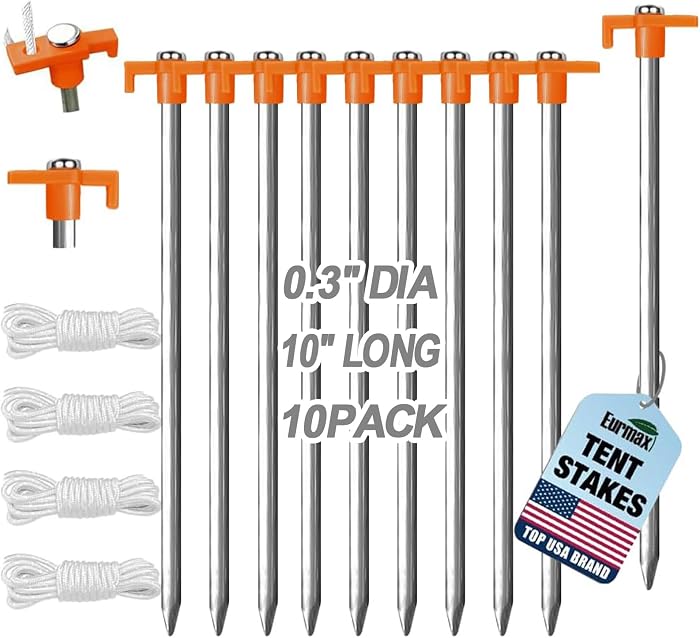
Most stakes turn up on their own. This box turns up with ten 10-inch galvanized pegs, four 10-foot ropes, and an orange stopper, and if your canopy came with a frame and nothing to tie it down with, that is the entire job in one purchase.

The stakes themselves sit closer to a length of rebar than to the wire pegs in a tent bag: 10 inches of steel with a broad head, 2.3 pounds for the set. That weight is the point. They hammer in without the shaft whipping, and the wide top gives a mallet something to land on squarely instead of glancing off the edge.

For a pop-up canopy, a tailgate, or a car-camping pitch where the shelter is bigger than a tent, this is the kit we recommend, and the ropes are the reason: four 10-foot runs are what a canopy frame actually needs, and cord is the fiddly thing to buy separately. Ten stakes gives a four-leg frame a spare or two for the guy lines you add when the wind gets up.

Pros

  • Stakes and ropes in one box
  • Heavy steel drives in without whipping
  • Broad head is easy to hit and pull

Cons

  • Too heavy for anything but car camping
Our verdict

If your canopy arrived without ropes, this kit finishes the job: ten 10-inch steel stakes, four 10-foot cords, and a stopper in one box.

Check Latest Price
4

OK5STAR 25-Pack 9-Inch Stakes Best Bulk Set

93 /100
Angler Score Outstanding

Key details

Length
9 inches
Material
Galvanized steel
Pack Size
25 stakes
Shaft Diameter
5 mm
Check Details on Amazon

Twenty-five stakes in one bag changes how you pitch. Instead of counting out four corners and hoping, you can double-stake the windward side, pin the guy lines at full extension, and still have a handful left for a tarp.

Each one is 9 inches of 5 mm galvanized steel with a tapered point and a one-inch hook at the top. The taper is what we noticed first: it starts in clay and gravel with fewer blows than a blunt-cut peg, and the hook is a big enough target that you are not chasing the top of a stake around with a mallet.

The galvanized coating matters more than it sounds. Stakes get pulled out wet, thrown in a bag, and forgotten until spring, and that zinc layer is what keeps them from coming out of storage rough and pitted. These wipe clean with a thumb, and they stay bright enough to spot in short grass without a painted head.

Where this set earns its place is coverage: 25 is more than any one tent or canopy needs, and that margin is what makes it right for a group site, a season of yard decorations, or a camp where several shelters share one kit. It is also a cushion against the thing that actually retires a stake, which is being left in the ground at a site you drove away from.

Pros

  • 25 stakes cover several shelters
  • Tapered point starts in clay and gravel
  • One-inch hook is an easy mallet target
  • Galvanized coating resists rust

Cons

  • 5 mm shaft flexes sooner in hard ground
Our verdict

Twenty-five 9-inch stakes make this the pick for a group site, where coverage matters more than the last millimetre of shaft thickness.

Check Latest Price
5

Hikemax 9-Inch Plastic Stakes Best Lightweight for Sand

92 /100
Angler Score Outstanding

Key details

Length
9 inches
Material
ABS plastic
Pack Size
10 stakes
Weight Per Stake
0.99 oz
Check Details on Amazon

Ten of these weigh under ten ounces in total, which is less than three of the forged steel pegs in this guide. That is the whole case for the Hikemax set: it is for the trip where every ounce gets argued over, and it is the only stake here that makes that argument convincingly.

The shape is a T-beam, a plastic web down the length of the stake that gives it stiffness without steel's weight, under a wide curved head that catches a guy line and gives your fingers something to pull on. In sand and loose dirt that profile grips better than a smooth steel shaft, and the high-visibility finish is the sort you can pick out from across a campsite.

Hammering is the wrong move. The failures that come up are from mallet blows rather than from the ground, so drive these by hand or with a boot and keep the mallet for the steel. Cold is the other thing to respect, since plastic gets brittle in a hard frost, and a stake cracked at the head is one you cannot pull. Ten at 9 inches is a shelter's worth for one or two people, and the bundle is small enough to live in a daypack.

Pros

  • Under an ounce per stake
  • T-beam profile grips loose sand
  • No rust, even in wet sand

Cons

  • Plastic gives up on rocky, hard-packed ground
Our verdict

Backpackers and beach campers should start here: under an ounce per stake, a T-beam that grips sand, and nothing to rust.

Check Latest Price
6

FEED GARDEN 18-Pack 7-Inch Stakes Best for Tarps and Yard

91 /100
Angler Score Outstanding

Key details

Length
7 inches
Material
Hot-dip galvanized steel
Pack Size
18 stakes
Shaft Diameter
4 mm
Check Details on Amazon

Seven inches and a 4 mm shaft is the size where a stake stops being a tent anchor and becomes a general-purpose pin, and that is the honest way to read this pack. Eighteen of them, hot-dip galvanized, with a hooked top, in a box you keep in the garage and dip into.

Where it earns a place is the work around the tent rather than the tent itself: garden fabric, netting over a raised bed, a tarp over firewood, an inflatable on the lawn. For a small tent on grass in settled weather, seven inches is enough. For an exposed pitch or hard soil it is not, and that is the boundary to buy it with.

One-piece steel is the detail we like. There is no plastic cap at the head to snap off when a stake gets levered out, which is where a lot of cheap pegs fail, and the hook holds a guy line without the knot sliding over the top. The point starts by hand in soft ground. Eighteen is also enough that losing three does not end the set.

Pros

  • Eighteen stakes in one pack
  • One-piece steel, no plastic head to snap
  • Hooked top holds a guy line
  • Hot-dip galvanized coating

Cons

  • Thin 4 mm shaft flexes in hard or rocky soil
  • Plain steel finish is easy to lose in grass
Our verdict

Keep this 18-pack in the garage for fabric, tarps, and yard inflatables; seven inches of galvanized steel is plenty on soft ground.

Check Latest Price
7

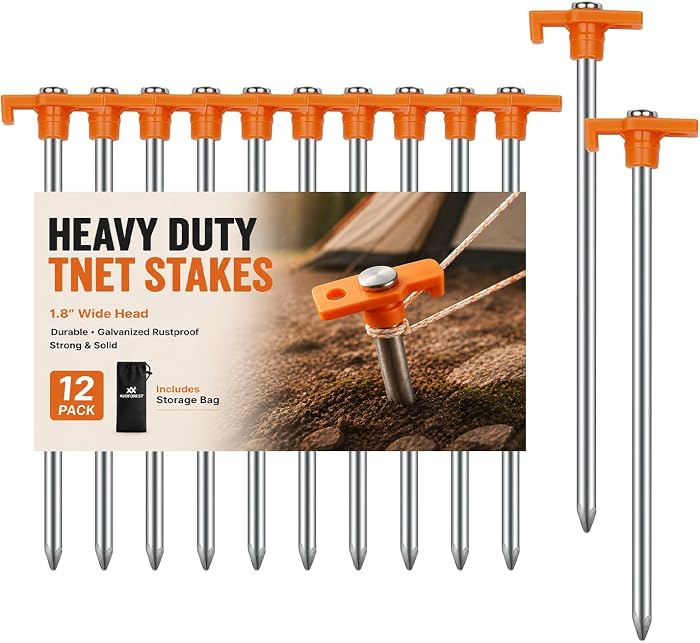
AVOFOREST 12-Pack 7.1-Inch Stakes Best for Inflatable Displays

90 /100
Angler Score Outstanding

Key details

Length
7.1 inches
Material
Galvanized steel
Pack Size
12 stakes
Weight Per Stake
1.12 oz
Check Details on Amazon

Set one of these beside our top pick and the difference is in your hand straight away: the AVOFOREST stake is a lighter, thinner piece of steel, 1.12 ounces each against a 7 mm shaft. That is not automatically a fault, since it is why a twelve-pack is cheap enough to buy for a single season of decorations, but it sets what the stake can and cannot do.

Visibility is the design's real strength. The orange coating is the point of the thing: against grass, bare dirt, or a leaf-covered lawn in November, an orange head is the difference between finding all twelve at the end of the day and finding nine. The galvanized steel resists rust, the included bag keeps them together in a garage, and the point pushes into soft ground by hand without a mallet.

These are the stakes we hand to someone pinning down inflatables, garden edging, or a tarp over a woodpile, and they will hold a small tent in fair weather on soft ground. Ringing an inflatable takes six or eight of them, which is where the twelve-count earns its keep: enough for the display and still a spare for the edging at the side of the house.

Pros

  • Orange coating is easy to spot
  • Light enough to push in by hand
  • Storage bag keeps twelve together

Cons

  • Thin shaft bends under hard hammering
Our verdict

For a dozen orange-tipped stakes to pin inflatables and edging, these are the ones we hand out: light, visible, and cheap enough to lend.

Check Latest Price

How We Tested Tent Stakes in Sand, Rock, and Wet Grass

To build the shortlist, we read through customer reviews across a dozen brands and looked for the complaints that repeat: shafts that bend on the first strike, hooks that straighten under tension, coatings that flake after a season, and packs that arrive short a few pegs. We narrowed by length (7 to 12 inches), material, coating, and how each stake is meant to be driven, then bought 16 sets at retail so nothing came free from a manufacturer.

Testing ran four months and followed the stakes rather than a lab bench. Each set went into the ground on a backyard lawn, holding a canopy and guy lines through a run of thunderstorms; on a beach where the sand was soft to the ankle; and at a high-country campsite where the ground was half rock and half dust. We drove every stake by hand, with a mallet, and with a boot heel, noting which ones bent, which took three tries to find purchase, and which hooks opened once the line came taut.

We also weighed each set on a kitchen scale, packed it into its bag, and checked whether the bundle slid into a standard tent stake sleeve — the gap between 7- and 12-inch pegs is bigger in a pack than it sounds. Every stake went in and came out at least a dozen times; we tracked which shafts stayed straight, which coatings survived wet grass, and how many came up bent after a hard pull. The sets that made the list held their shape and their grip, which is most of what value means in this category.

How to Choose Tent Stakes

Match the Stake to the Ground

Soft sand and loose loam give a stake almost nothing to grip, so length and surface area do the work: a 9- to 12-inch stake with some width to it, driven deep and angled, holds where a short smooth peg slides straight back out. Hard-packed dirt, gravel, and rock are the opposite problem. There the stake has to start without skidding and take a hammer without folding, which is a job for a sharp point and a thick shaft rather than extra length.

Ordinary campsite grass sits between those two, and it is where a 7- to 9-inch galvanized steel stake earns its keep. Be honest about the sites you actually book: a box of light 7-inch pegs bought for a grassy state park will disappoint on a gravel platform.

Shaft Diameter and Steel Type

Diameter is the number most listings bury, and it predicts whether a stake survives its first trip better than any adjective. A 4 mm shaft is really a pin: fine for garden fabric, quick to bend in clay. Five millimetres is the practical middle. Seven millimetres and up is where stakes stop flexing, and a forged shaft turns in the hole where a coated one creases.

Treat heavy duty in a title as a claim to check against the diameter, not a substitute for it. We would rather buy a plainly described 5 mm stake than a mystery-thickness one with a bold label.

Packed Weight: Backpack or Truck

Per-stake weight is easy to ignore until you multiply it by the number you carry. Plastic runs around an ounce, thin aluminium less, and forged steel over four ounces; eight steel pegs is well over two pounds in a pack, and twenty is a small anchor. We think of the category as two kits rather than one.

The light set lives in a backpack and gets used on soft ground. The steel set lives in the car, gets hammered into whatever the campsite offers, and is the one you lend to a friend with a canopy.

Heads, Hooks, and Finding Them Again

The head does three jobs: gives the mallet a target, keeps the guy line from sliding off the top, and gives your fingers something to pull. A wide T-head or a generous hook beats a bare wire top, and a hole through the head lets you pull a deep-set stake with a claw hammer or a loop of cord.

Colour is not cosmetic. Orange and high-visibility heads are the reason a stake gets pulled at the end of a trip instead of left in the ground, and plain steel against dry grass is how a twelve-pack becomes a nine-pack.

Count, Spares, and Storage

Count the stake points on your shelter before you buy. Most tents want one at each corner plus the guy-outs, which is eight to twelve for a family tent, and a canopy needs four at the legs plus rope anchors when the wind gets up. Buy a handful more than the shelter needs; the stakes that go missing are always the ones you needed.

Dry steel before it goes back in the bag. A wet stake in a closed sack is how rust starts, and a stake that sat in mud all winter is one you end up replacing rather than wiping down in spring.

Frequently Asked Questions

Final Verdict

The Cheardia 20-pack is the set we point most campers to. At 9.75 inches with a 7 mm shaft it is long enough for soft grass and thick enough that roots and gravel do not fold it, and twenty stakes cover a tent and a canopy without rationing.

Rocky, hard-packed sites change the answer: the forged RIY pegs take a hammer and come back out straight, and they are worth the weight in the truck. Backpackers should go straight to the plastic Hikemax set, which weighs almost nothing and grips sand better than steel.