
Best Transom Mount Trolling Motors of 2026

A morning of flat water and willing fish is the picture most of us buy a trolling motor for. The reality shows up around noon, when the wind comes up, the battery starts to fade, and the tiller handle becomes the only thing keeping you off the rocks. A transom mount is the simplest fix there is: clamp it to the back of a johnboat, an inflatable, or a kayak, run the leads to a battery, and steer at a walking pace without oars or a gas kicker.

We've spent the past eight months running 12 of these motors through full fishing days, and one thing kept repeating: the thrust number on the box tells you less than the speed steps, the clamp, and the battery gauge do. Running a motor at half throttle for six hours drains a battery nothing like a few wide-open sprints does, and how efficiently it uses whatever is left is what you feel by mid-afternoon. The picks below held up to that kind of day.

The Best Transom Mount Trolling Motors

1

Minn Kota Endura C2 40 Best Overall

91 /100
Angler Score Outstanding

Key details

Speeds
5 forward / 3 reverse
Thrust
40 lb
Battery
12V, not included
Shaft Length
36 in.
Check Details on Amazon

Forty pounds of thrust on a 36-inch shaft is the pairing we come back to for most of the boats we see at a freshwater ramp: a 12- to 16-foot aluminum hull, a two-person jon boat, a canoe loaded for a weekend. Thirty pounds moves that weight on a still morning and labors once the wind stands up; 55 is more motor than a hull that size can use and spends battery on speed you won't hold. The 40 lands in the gap between them.

What we appreciate most is how little there is to fight. The 10-position Lever Lock bracket releases with one lever and locks into ten angles, so tilting the prop clear for the drive home and setting depth at the launch both take a second rather than a wrestle. The shaft is composite, which is the part Minn Kota builds its durability story around, and the six-inch telescoping tiller slides out far enough that you steer with a relaxed arm instead of leaning over your own knee.

The power prop is cut for pushing through cover, with a 3-1/4-inch hub and blades meant for heavy vegetation, and it does that without loading up and bogging down. At trolling settings the motor is quiet enough to talk over, which matters more than any number on the box when you're working a shoreline. There's no control on it that needs a second trip to figure out.

The line we won't cross is salt. This is a freshwater motor, and its hardware isn't built for a rinse-and-repeat saltwater routine — if your launch is tidal, the Newport picks below are the better bet.

Pros

  • 40 lb thrust suits most 12-16 ft aluminum boats
  • Ten-position bracket tilts and locks in seconds
  • Quiet enough to talk over at trolling speed
  • Power prop handles heavy vegetation

Cons

  • Stepped five speeds leave gaps between settings
  • Push-to-test battery gauge, not a live readout
Our verdict

The transom motor we recommend to most small-boat anglers: 40 pounds of thrust and a 36-inch shaft suit 12- to 16-foot aluminum hulls, and it's quiet and simple to mount.
Check Latest Price
2

Newport Kayak Series 55 Best for Kayaks and Canoes

90 /100
Angler Score Outstanding

Key details

Thrust
55 lb
Battery
12V, not included
Shaft Length
24 in.
Battery Leads
5'6"
Check Details on Amazon

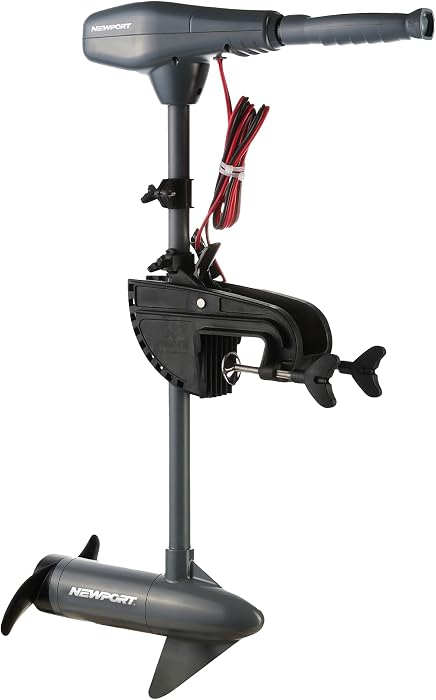
Five and a half feet of battery cable is the most useful thing on this motor, and it's the detail that tells you who Newport built it for. On a kayak, where the battery sits decides how the boat floats; long leads let you push it forward in the hull to balance your own weight at the stern instead of bolting it beside the motor.

The 24-inch shaft is the second good decision. A kayak or canoe sits low, so a short shaft drops the prop under the surface without standing a column of aluminum in your field of view, and the head stays clear of your paddle stroke.

Fifty-five pounds of thrust is a lot of push on a 70-pound hull, and we spent most of our time in the lower half of the range. The corrosion hardware — magnesium, zinc, and stainless steel — is what earns the saltwater rating, and it's the pick for anyone launching a kayak into tidal water. A five-point LED meter on the head takes the guesswork out of the last hour.

What to know before you order: some of these quit outright, with reverse gear and total failures both showing up, and the two-year warranty is what keeps that from being a total loss. Register the motor the day it arrives.

Pros

  • Long battery leads let you balance weight in a kayak
  • 24-inch shaft keeps the head clear of the paddle
  • Saltwater-rated magnesium, zinc, and stainless hardware
  • Five-point LED meter on the head

Cons

  • Short shaft won't reach a tall transom
Our verdict

For kayaks, canoes, and other low transoms, this is the transom motor we reach for: saltwater hardware, long battery leads, and a shaft length that keeps the head out of the way.

Check Latest Price
3

Minn Kota Endura Max 55 Best for Fine Speed Control

86 /100
Angler Score Excellent

Key details

Thrust
55 lb
Battery
12V, not included
Shaft Length
42 in.
Speed Control
Variable, digital
Check Details on Amazon

The difference between this motor and the five-speed Enduras isn't the 55 pounds of thrust — it's what happens between the settings. Stepped control gives you five forward notches. The Endura Max gives you a continuous range, so you can add a little power to hold a line against a crosswind instead of jumping to the next gear and over-correcting.

We noticed the value of that the first time we had to hold a slow, even crawl along a windblown bank: small corrections, no lurching. For working a weed edge or a drop-off at the speed the fish want rather than the speed the motor happens to offer, it's a different experience from the stepped motors.

Minn Kota claims up to five times the run time on a charge from its Digital Maximizer. The mechanism is easy to believe — a variable-speed motor draws closer to what the setting asks for than one running at a fixed notch — and our days ended with battery left over. The 42-inch shaft and 55 pounds of thrust make this the biggest Minn Kota here, which is what you want for a heavier glass boat or a tall transom.

Stock comes and goes on this model, so check before you plan a trip around it. The 10-position Lever Lock bracket carries over from the rest of the line, so mounting is the same one-lever routine, and the composite shaft takes the same abuse.

Pros

  • Continuous speed control instead of five notches
  • 55 lb and a 42-inch shaft for heavier boats
  • Variable draw stretches battery run time

Cons

  • Costs a good deal more than the stepped-speed Enduras
Our verdict

If you troll at a set speed for hours, the continuous control is worth the extra money — this is the most refined transom motor here, and the biggest Minn Kota in the group.

Check Latest Price
4

Intex 40 lb Trolling Motor Best for Inflatable Boats

85 /100
Angler Score Excellent

Key details

Speeds
5 forward / 3 reverse
Thrust
40 lb
Tiller
6 in. extension, 8 tilt positions
Weight
17 lb
Check Details on Amazon

The feature most inflatable owners will end up using is the weed escape button. Press it and the prop cycles quickly between forward and reverse to shed a wrap of milfoil or algae — the kind of thing you need on a shallow pond and can't do by hand from a soft-sided boat.

That's the pattern with this motor: it's designed around the constraints of an inflatable rather than scaled down from a bass boat. The tiller extends six inches and tilts through eight positions, so you can steer from a seated position instead of kneeling. The control head carries a battery meter plus dry-operation and overload lights. And the mount is made for Intex's own transoms.

That compatibility list is the reason it's here: Challenger 3, Seahawk 2 through 4, Excursion 4 and 5, Mariner 3 and 4. The alternative is guessing whether a generic bracket and 40 pounds of motor will sit right on a soft transom. Forty pounds is enough to push a loaded inflatable at displacement speed, and at 17 pounds the motor carries down a bank separately from the boat.

The plastic housing and light fittings are where the corners were cut, so handle the mount gently and don't expect it to shrug off being dropped on a launch ramp. Everything else about the package is aimed squarely at the boat it's going on.

Pros

  • Built for Intex inflatable transoms
  • Weed escape cycles the prop to shed vegetation
  • Tiller tilts through eight positions for seated steering
  • 17 lb, so it carries separately from the boat

Cons

  • No manufacturer warranty at all
Our verdict

For an Intex inflatable, this is the motor built to fit it — the weed-escape function and tilting tiller make a soft-sided boat usable, as long as you accept there's no warranty.

Check Latest Price
5

Newport X-Series 55 Best for Deeper Transoms

84 /100
Angler Score Excellent

Key details

Speeds
5 forward / 3 reverse
Thrust
55 lb
Battery
12V, not included
Shaft Length
36 in.
Check Details on Amazon

Twenty-four inches of shaft is right for a kayak and wrong for a 16-foot aluminum boat, which is the gap the X-Series fills. Thirty-six inches puts the prop deep enough to stay buried when the bow rises, and that extra reach is what you want on a hull with real freeboard.

It's rated for salt water, with the same magnesium, zinc, and stainless hardware as the rest of Newport's line, and the LED battery meter on the head stays readable in direct sun — a small thing that stops being small when you're squinting at it from the tiller.

Where it gives ground is the bracket. There's more flex in the mount than in the Minn Kota's, and on a curved or angled transom the motor can shift under load. Set it on the flattest section of transom you have and check the fasteners after the first run, and it behaves; hang it on a rounded stern and you'll be tightening it all day.

Fifty-five pounds of thrust is the same as the Kayak Series, so what you're paying extra for is the foot of shaft and the saltwater finish. If your transom is low, the Kayak Series does the same work for less money; if it's high, this is the Newport that reaches.

Pros

  • 36-inch shaft reaches deeper transoms
  • Saltwater-rated hardware throughout
  • LED meter readable in direct sunlight

Cons

  • Gear changes can skip if the lever moves fast
Our verdict

The Newport to buy when your transom sits high or the water is salt: 36 inches of shaft and corrosion-resistant hardware, with a mount that wants a flat landing spot.

Check Latest Price
6

BODIOO 68 lb Trolling Motor Budget Thrust

82 /100
Angler Score Excellent

Key details

Speeds
5 forward / 3 reverse
Thrust
68 lb
Weight
20.7 lb
Shaft Length
30 in.
Check Details on Amazon

Sixty-eight pounds of thrust for less than our top pick is the kind of number that makes a listing look like a typo. It isn't. The motor is real, it moves a loaded 14-foot boat with two adults aboard, and it does it on one 12-volt battery.

What the money buys beyond thrust is a set of details that suggest someone thought about storage: the handle collapses, the bracket rotates 90 degrees and locks into 10 positions, and a collar releases the shaft for depth changes. At 20.72 pounds with a 30-inch shaft, it's a motor one person can move from the truck to the transom and stow in a tankwell.

On the water, the gearing is smooth, fifth has real punch, and the LED voltage readout tells you what the battery is doing without a separate gauge. We came away thinking it performs like a motor that cost more.

The reservation is the paperwork. Six months of coverage is the shortest warranty in this group, the motor isn't rated for salt water, and a budget motor with a 68-pound claim deserves realistic expectations about year four. As a first motor, a spare, or the power for a second boat, the arithmetic works.

Pros

  • 68 lb of thrust for the least money here
  • Collapsible handle and rotating bracket stow small
  • Strong top speed with smooth gearing

Cons

  • Six-month warranty is the shortest here
  • Not rated for salt water
Our verdict

Budget thrust that actually delivers: 68 pounds on a 30-inch shaft for less than our top pick, provided you can live with six months of coverage and freshwater only.

Check Latest Price

How We Tested 12 Transom-Mount Trolling Motors

To build the shortlist, I worked through spec sheets and years of owner complaints, then filtered by thrust class (40 to 68 pounds), shaft length for a standard 15- to 20-inch transom, freshwater versus saltwater-rated construction, and whether replacement parts and service were actually available. Anything with a shaft too short for a tiller-steered boat, or a clamp that drew the same complaint again and again, got cut before we ever plugged it in. We also weighed what each motor cost against its thrust class and how it was built, which trimmed a few that charged more for the badge. That left 12 motors, tested over eight months.

Each one went on the same two boats — a 14-foot aluminum johnboat and a sit-on-top kayak — with the same freshly charged deep-cycle batteries, so the comparisons stayed honest. We recorded top speed by GPS, then ran the full ladder of forward speeds in order to see how much control sat between a slow crawl and wide open. A decibel meter held at the operator's ear caught the whine from the lower unit at trolling speed and at full throttle, and a hand on the shaft at the transom showed how much vibration traveled into the hull.

For battery life and gauges, we logged voltage every two hours across a full day and compared each LED indicator against a multimeter, which is how we found the ones that stay green long after they shouldn't. Clamps got twisted by hand under load, shafts got bumped off stumps and dock pilings, and every motor made a saltwater run to see what the finish did after a plain rinse.

How to Choose a Transom Mount Trolling Motor

Match Thrust to the Boat, Not the Budget

The ranges that hold up: 30 pounds for canoes, kayaks, and the smallest jon boats; 40 to 55 for a 12- to 16-foot aluminum hull with two anglers and gear; 55 and up for heavier glass boats and loaded inflatables. Thrust costs battery drain and motor weight as well as money, so size for the windy afternoon you'll actually fish rather than the glass-calm morning you're picturing.

Our top pick is 40 pounds for exactly this reason. It's enough for a loaded 14-footer and not so much that a single deep-cycle is spent by lunch. If you're between two ratings, take the smaller one and spend the difference on a better battery.

Shaft Length Is the Spec Buyers Get Wrong

Too short and the prop breaks the surface every time the bow lifts, which costs you control and sounds like an engine revving at nothing. Too long and the head sits where you want to cast, and the prop drags in the shallows. Roughly: 24 inches for kayaks and canoes, 30 for a low jon boat, 36 for a typical aluminum boat, and 40 to 42 when the transom sits well above the waterline.

Measure from the top of your transom to the water and add about a foot. When you're between sizes, take the longer shaft — it can be raised in the collar, and a short one cannot be made to reach.

Stepped Speeds or Variable Control

Most transom motors give you five forward speeds and three reverse. That's fine for running from the ramp to a flat, and the settings repeat exactly from trip to trip. Variable control is for the angler who wants a specific speed — a slow crawl along a weed edge, or just enough push to hold a line against a crosswind — and it generally draws closer to what the setting asks for than a motor running flat out at a notch.

We think variable is worth the premium if you troll. If the motor mostly repositions you between spots, five notches will do the job and the money is better spent on the battery.

Batteries, Voltage, and the Rest of the Bill

None of these motors arrive with a battery, and the battery is a real line in the budget. A single 12-volt deep-cycle runs everything up to about 55 pounds of thrust; the 86-pound class needs two batteries wired for 24 volts, plus the charger and locker space for both. Factor that in before you talk yourself into more thrust than the hull needs.

Fit a circuit breaker or fuse in the positive lead, close to the battery, and mount it where you can reach the reset without unloading the boat. Several motors here ship with a manual-reset breaker; if yours doesn't, buy one rated for the motor's draw.

Salt Water and the Mount

Saltwater-rated motors use magnesium, zinc, and stainless hardware; the Minn Kota Endura line is freshwater only, and no rinsing routine turns it into a salt motor. If you launch in tidal water, pay for the rating rather than saving on the price.

The mount matters just as much. A transom motor needs a flat, solid landing pad, and the bracket should be checked after the first run. On a rounded or angled stern, expect to shim the bracket or move it to a flatter section — that's the difference between a motor that stays put and one you tighten all day.

Frequently Asked Questions

Final Verdict

Buy the Minn Kota Endura C2 40 if your boat is a 12- to 16-foot aluminum hull and your water is fresh. Forty pounds of thrust on a 36-inch shaft is the fit most people need, the bracket makes a short-handed launch easy, and it runs quiet enough to talk over.

Change the answer when the boat changes. A kayak or canoe with a low transom wants the Newport Kayak Series 55, an inflatable wants the Intex 40, and anyone who trolls at a set speed for hours gets more from the Endura Max 55's continuous control than from another few pounds of thrust.