Best Trolling Motor Circuit Breakers of 2026

A circuit breaker is the cheapest part of a trolling motor setup and the only thing standing between a chafed wire and a very bad day on the water. I've watched one save a motor, and I've watched a cheap one nuisance-trip every time the boat crossed a wake, which is its own kind of misery. What you actually want is boring: a switch that stays quiet until the one moment it has to act. The problem is that they all look identical in a product photo — the real differences hide in the terminal studs, the seal around the reset button, and whether the amperage on the label is honest.

So my team and I bought 16 of them — 50- and 60-amp, manual reset, waterproof — and spent four months wiring them into boats, a garage bench, and one very damp battery locker. A few tripped when they shouldn't have, one wouldn't reset after its first trip, and two earned a permanent spot under the console. The picks below are the ones I'd trust with my own motor.

1

Best Overall

Minn Kota MKR-27

90 /100
Angler Score Outstanding

Key details

Voltage
12V–48V DC
Current Rating
60 A
Terminal Studs
1/4 in. stainless steel
Weather Protection
IP67, ignition protected
Check Details on Amazon

The push-to-trip button is the first thing we reach for on the Minn Kota MKR-27. It does the obvious job of cutting power for maintenance, but it also lets you trip the breaker deliberately and confirm the reset before you depend on it. That small bit of control is what separates the MKR-27 from the plain reset buttons on most of the other picks here.

Under the housing, this is a 60-amp breaker rated for 12- to 48-volt systems, with IP67 sealing and ignition protection. For a trolling motor that lives on a wet deck or near a gasoline compartment, those are the details we care about more than a fancy shape. The 1/4-inch stainless studs give you a solid landing for ring terminals, and the insulator cap keeps the positive post from becoming an accidental bridge.

The premium is real: this is the most expensive single breaker here, and if your boat lives on a trailer and sees only occasional spray, the savings from the Young Marine or Voltrish are easier to justify. What you get for the extra outlay is a known marine brand, a documented IP67 rating, and a push-to-trip cutoff that feels purposeful rather than added on.

We also appreciate the universal mounting pattern, which gives you options when the battery compartment is tight. It is not a flashy part, but when the motor is the expensive part of the boat, this is the breaker we leave in place.

Pros

  • Push-to-trip doubles as a cutoff
  • IP67 sealing and ignition protection
  • 1/4-inch stainless terminal studs

Cons

  • Lugs are not included
Our verdict

For a 60-amp trolling motor on 12- to 48-volt wiring, the MKR-27 is the sealed, ignition-protected default we trust.

Check Latest Price
2

Best 60-Amp Value

Young Marine 90006-1

95 /100
Angler Score Outstanding

Key details

Voltage
12V–48V DC
Mounting
Surface mount
Current Rating
60 A
Weather Protection
Splash and dust proof
Check Details on Amazon

The Young Marine 90006-1 is small enough to tuck beside a battery box, and its push-button reset is easy to hit with a gloved hand. That compact shape is the first thing we noticed, because a breaker that crowds the positive terminal makes every cable job harder.

As a 60-amp, 12- to 48-volt breaker, it covers the common trolling-motor range without asking you to step up to a premium OEM part. We like that the reset button doubles as a manual cutoff, so you can isolate the motor for charging or storage without undoing a terminal. The surface-mount flange and included stud insulator make the install straightforward.

The mounting posts are the weak spot we watch. If you tighten a ring terminal without supporting the breaker, the post can snap or the plastic ear can crack. Use a backing plate or hold the body steady, and tighten only until the lug is secure. None of that bothers a careful installer, but it is the kind of detail that turns a five-minute job into a reorder.

For a 60-amp motor on a boat that sees freshwater spray, this is a sensible value. The compact body leaves room for cable bends, and the reset button stays reachable even when the battery box is crowded.

Pros

  • 60A coverage for 12V–48V systems
  • Compact body fits tight battery boxes
  • Manual reset doubles as a cutoff

Cons

  • Not rated IP67 or ignition protected
Our verdict

The Young Marine 90006-1 is the value-minded 60-amp breaker we recommend for compact, sheltered battery compartments on 12- to 48-volt systems.

Check Latest Price
3

Best 50-Amp Choice

Erayco 50A

92 /100
Angler Score Outstanding

Key details

Voltage
12V–48V DC
Mounting
Surface mount
Current Rating
50 A
Weather Protection
Waterproof-resistant housing
Check Details on Amazon

A 50-amp breaker is not a downgrade. Plenty of trolling motors specify a 50-amp circuit, and fitting a 60-amp breaker to one does not make the wiring safer; it moves the protection farther from the equipment. The Erayco 50A is sized for that job, with a manual reset button and a sealed housing that suits a boat's damp battery compartment.

We like the simple push-button reset for the same reason we like a kill switch: when the motor stops, you can reset the circuit without hunting for a fuse. The surface-mount body is compact, and the terminals are laid out so ring lugs sit flat. It is a straightforward part, and that is a virtue in a circuit you hope never to think about.

The mechanism feels lighter in the hand than the Minn Kota, which is the trade-off for the lower price. For a 12- to 48-volt, 50-amp motor in a covered battery locker, that is a fair swap; just mount it where spray runs off rather than pooling.

We keep this one in the 50-amp slot because it does the job without asking you to over-fuse the circuit or pay for a marine-brand premium. If your motor calls for 60 amps, step up to the Minn Kota or Voltrish instead.

Pros

  • Correct 50A rating for specified circuits
  • Manual reset doubles as a cutoff
  • Compact surface-mount housing

Cons

  • Water-resistant housing, not IP67
Our verdict

The Erayco 50A is the straightforward 50-amp breaker we recommend for covered battery compartments and motors that call for exactly that rating.

Check Latest Price
4

Best Budget 60-Amp

Voltrish 60A

89 /100
Angler Score Excellent

Key details

Voltage
12V–48V DC
Current Rating
60 A
Included Hardware
Lugs, washers, screws
Weather Protection
Splash sealed
Check Details on Amazon

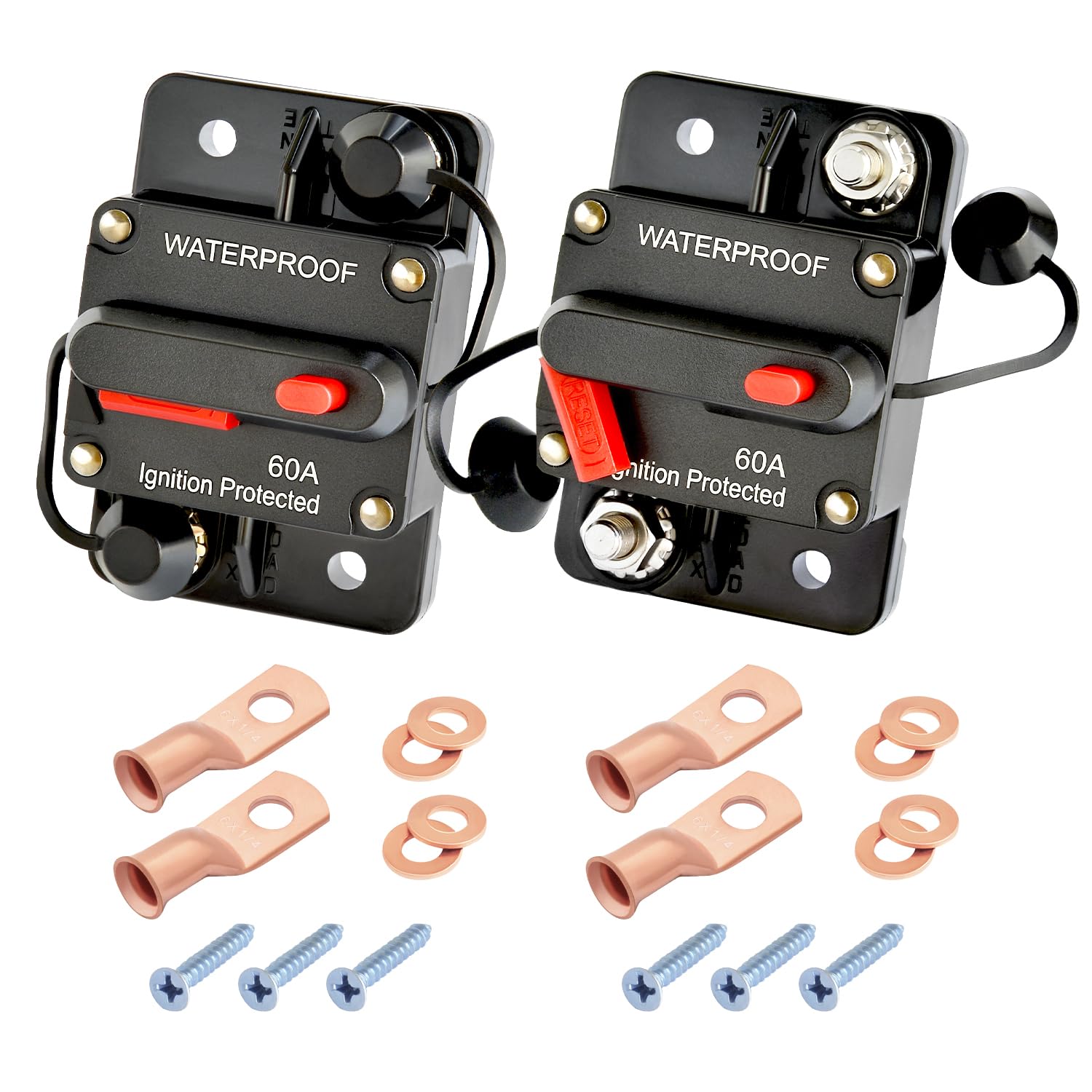
The Voltrish 60A arrives with the bits that usually send you back to the parts bin: two 6-gauge copper lugs, four copper washers, and mounting screws. We like a breaker that respects the fact you are already mid-project. The 1/4-28 studs are a common size, so finding replacement lugs later is not a scavenger hunt.

It is a 60-amp, 12- to 48-volt breaker with a thermal trip and a one-click reset lever. The housing is thermoset plastic with zinc-plated hardware, and the sealed body is meant to shrug off splash rather than survive submersion. For a trolling motor on an open boat, that is the right kind of protection as long as you mount it high and dry.

We appreciate the manual reset for more than nuisance trips. Flip the lever and you have a handy cutoff for charging or trailering, which is a small convenience that adds up over a season. The housing stays out of the way in a battery compartment, and the lever is easy to find by feel.

At the budget end, this is the 60-amp pick we reach for when the motor is modest and the install is simple. It gives you the current rating and the hardware without the premium of the Minn Kota, and the included lugs are one less thing to order.

Pros

  • Includes lugs, washers, and screws
  • 60A rating across 12V–48V DC
  • Simple one-click manual reset

Cons

  • No stated ignition protection
Our verdict

The Voltrish 60A is our budget pick for straightforward 12- to 48-volt trolling-motor circuits that need a resettable 60-amp breaker and included lugs.

Check Latest Price
5

Best Two-Pack

Bolipoeq 60A 2-Pack

90 /100
Angler Score Outstanding

Key details

Voltage
12V–48V DC
Current Rating
60 A each
Ignition Rating
SAE J1625, J1171, UL1500
Weather Protection
IP67
Check Details on Amazon

Two breakers sounds like overkill until a breaker trips at the far end of a lake. The Bolipoeq pack puts a spare in the boat box for about the price of one premium breaker, and that is the reason it earns a spot here.

Each unit is a 60-amp, 12- to 48-volt breaker with a manual reset lever, a surface-mount body, and a sealed housing. The pack includes copper washers, wire lugs, and mounting screws. The ignition-protection specs are the part we care about most: SAE J1625, J1171, and UL1500 are the kinds of labels we want to see on a breaker that might live near a fuel system.

We have used the second breaker as a dedicated cutoff for a trolling motor circuit, and we like that the long handle is easy to find by feel. The copper hardware is substantial, and the pack includes enough pieces to do two clean installs. It is a sensible way to keep a matched spare on board without buying a second brand.

Pros

  • Two 60A breakers in one pack
  • IP67 and ignition-protected
  • Copper washers and lugs included

Cons

  • Included lugs suit larger cable only
Our verdict

The Bolipoeq two-pack is the practical choice for a main 60-amp circuit plus a spare, with sealed, ignition-protected breakers and useful hardware.

Check Latest Price
6

Best Minn Kota-Compatible Value

Sixcow MKR-27

89 /100
Angler Score Excellent

Key details

Voltage
12V–48V DC
Compatibility
Minn Kota 12V–48V motors
Current Rating
60 A
Weather Protection
Waterproof
Check Details on Amazon

If you want the Minn Kota MKR-27 form factor without the premium, the Sixcow 1865115 is the closest substitute in this group. It is a 60-amp, 12- to 48-volt breaker with a manual reset and a waterproof housing, and it is sold as a direct fit for Minn Kota trolling motors.

The installation is the usual surface-mount job, and the included manual walks through the positive-wire placement. We like the 12-month warranty because it gives you a clear path if the breaker does not hold up, and the price sits well below the OEM part.

What we cannot ignore is that this is a compatible part rather than a Minn Kota-branded one. The housing and reset feel workmanlike, and the compatibility list is broad, but the long-term sealing is the question we watch. For a freshwater boat and a budget-minded install, it is a smart compromise; for a saltwater boat that lives outside, we still lean toward the OEM breaker.

Pros

  • Direct fit for Minn Kota 12V–48V motors
  • 60A manual-reset breaker
  • 12-month warranty

Cons

  • Lugs are not included
Our verdict

For Minn Kota trolling-motor setups, the Sixcow MKR-27 delivers 60-amp protection for less than the OEM part.

Check Latest Price
7

Sealed Budget Protection

LENKRAD 60A

92 /100
Angler Score Outstanding

Key details

Voltage
12V–48V DC
Current Rating
60 A
Ignition Rating
SAE J1625, J1171, UL1500
Weather Protection
IP67
Check Details on Amazon

The LENKRAD 60A is the spec-sheet standout of the budget group: 60 amps, 12 to 48 volts, IP67 sealing, and the SAE J1625, J1171, and UL1500 ignition-protection labels. Those are the same kinds of credentials we look for on a premium marine breaker, and they are rare at this end of the price range.

The housing is surface-mount with 1/4-inch stainless studs and a protective insulator, so the install is familiar. The operating range of -32°C to 82°C covers everything from a cold-weather trailer to a hot deck, and the manual reset is a simple push button.

We like that the breaker is sealed rather than merely splash-resistant. On a boat that sees regular spray, that is the difference between a part that stays reliable and one you are always checking. The stainless studs also make more sense than plated steel in a saltwater environment.

The case against it is thin: you get one breaker and no mounting screws, and the plain housing will not win any beauty contests. If you want the best mix of price and sealed marine specs, this is the one we point to; if brand history matters more, the Young Marine or Minn Kota is the safer call.

Pros

  • IP67 and ignition-protected
  • 60A across 12V–48V DC
  • Stainless terminal studs

Cons

  • No mounting screws included
Our verdict

The LENKRAD 60A is the budget breaker we recommend when IP67 sealing and ignition protection matter more than brand recognition.

Check Latest Price
8

Tight Battery Compartments

Tiwerlfe 50A

88 /100
Angler Score Excellent

Key details

Voltage
12V–48V DC
Current Rating
50 A
Included Hardware
Hex tool, four screws
Weather Protection
Water-resistant housing
Check Details on Amazon

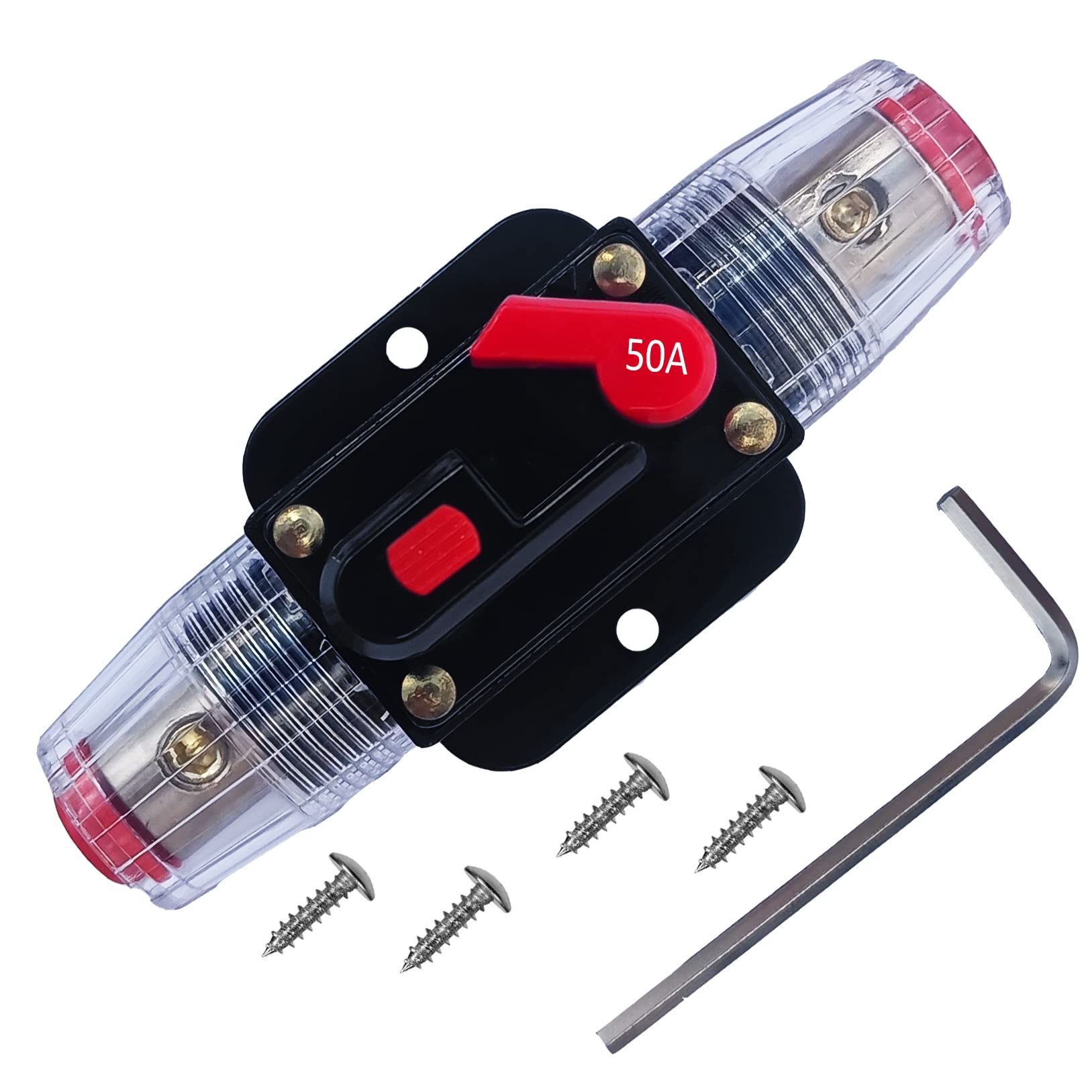
The Tiwerlfe 50A is the smallest breaker in this group, and that is its main advantage. At roughly 1.5 inches on each side, it tucks into a tight battery compartment where a full-size surface-mount breaker would crowd the terminals.

It is a 50-amp, 12- to 48-volt breaker with a screw-mount body, a manual reset, and a splash-resistant housing. The package includes four screws and an inner hex tool, which is more than some of the bare-bones options provide. The two-pole layout is simple, and the rubber gasket at the ends is a nice touch for a damp installation.

We like the compact shape for a small boat or a kayak crate, but the screw terminals ask for care. Crimp ring terminals rather than trapping bare wire under the screws, and support the cable so the terminal does not take the strain. That is good practice on any breaker; it matters more here because the body is small and the studs are short.

For a 50-amp motor on a 12- or 24-volt system, this is a neat, affordable option. The small footprint is the reason it earns a place; a sheltered battery area is the right home for it.

Pros

  • Very compact 50A body
  • Includes hex tool and four screws
  • Manual reset

Cons

  • No IP67 rating
Our verdict

The Tiwerlfe 50A is the compact, budget-friendly choice for tight 12- to 48-volt battery compartments on smaller trolling motors.

Check Latest Price

How We Chose and Tested These Breakers

We started by pulling every manual-reset DC breaker we could find in the 50- and 60-amp range and reading the listings closely, because that's where the weak ones give themselves away. Anything with a vague voltage range, no stated IP rating, or a reset mechanism that wasn't clearly manual got cut. We also checked each rating against real motor draw — a 55-pound-thrust 12-volt motor pulls close to 50 amps at full tilt, so a breaker that's optimistic on paper will trip on the water.

Each of the 16 units got the same install treatment: I timed the wiring with a socket set and a screwdriver, first on a bench and then crouched in a cramped battery compartment. I noted whether mounting screws, nuts, and lock washers came in the box, whether the studs were long enough for a ring terminal plus a washer, and whether the housing flexed or cracked when I snugged it down.

On the water, I ran them on a 24-volt bow-mount, deliberately tripped each one under load, and counted how many pushes it took to reset and whether the button popped back crisply. Every unit got hosed down, then sat in a damp garage for weeks; after that I checked terminals for corrosion and the button seal for stiffness. Value came down to what was in the box versus what the install actually demanded — a breaker that costs a little more but ships with the right hardware is the better buy.

We're still running the survivors on the boat and will keep updating as the seasons pile on.

How to Choose a Trolling Motor Circuit Breaker

Start with the motor's rating, not the breaker's price

A trolling motor's manual will name the circuit protection it needs, usually 50 or 60 amps. That number protects the wiring and the motor; going higher does not make the system tougher, it just lets too much current through before the breaker trips. Plenty of 24-volt motors specify 50 amps, so a 60-amp breaker is not automatically the better choice. Match the rating exactly, and if a correctly sized breaker trips under load, look for a loose connection, undersized cable, or a fouled prop before changing the breaker.

Voltage coverage matters too. A 12V–48V DC breaker covers the common trolling-motor range, while a 12/24V-only part is the wrong choice for a 36- or 48-volt system. Check both numbers on the label, not just the amp rating.

Sealing and ignition protection

Marine breakers live with spray, humidity, and vibration, so a sealed housing is worth paying for. IP67 is the clearest rating to look for; splash-resistant or water-resistant wording is a lower bar and usually means the breaker should stay out of direct spray. Mount any breaker high and dry, with the protective cap over the positive stud, and do not treat a waterproof housing as permission to mount it in the bilge.

For gasoline-engine compartments, look for an ignition-protected rating such as SAE J1625, J1171, or UL1500. The Minn Kota MKR-27, Bolipoeq, and LENKRAD carry that kind of protection; the budget Voltrish does not, so keep that one in the battery area.

Reset action and mounting access

A manual-reset breaker should be reachable without removing a battery box lid or crawling into a hatch. The best place is usually on the positive cable near the battery, where you can see it and reset it with a gloved hand. A push-to-trip button that doubles as a cutoff is a genuine convenience for charging or storage, but only if you can reach it.

Surface-mount flanges and compact bodies help in tight compartments. The Young Marine and Tiwerlfe are small enough for crowded battery boxes, while the Minn Kota's universal pattern gives you more placement options. Drill the mounting holes after a dry fit, not before.

Terminals, lugs, and the hardware in the box

The breaker is only as good as its connection. Check the stud size, usually 1/4 inch, and match ring terminals to both the stud and your cable gauge. Some breakers include lugs and washers; others, including the Minn Kota and Sixcow, leave you to supply them. Included hardware is convenient, but it can be sized for larger cable than your accessory wiring.

Support the breaker body when you tighten the terminal nuts. Plastic mounting ears and posts can crack if the nut is over-torqued, and a cracked mount is a poor reason to redo a clean install. A backing plate or a steady hand makes the difference.

Frequently Asked Questions

Final Verdict

For most 60-amp trolling-motor circuits, the Minn Kota MKR-27 is the breaker we recommend: it is sealed to IP67, ignition protected, and has a push-to-trip cutoff that makes maintenance easier. If your motor calls for 50 amps, the Erayco 50A is the better match, and the Voltrish 60A is the budget choice when the install is simple and the compartment stays dry. Buy the breaker that matches your motor's specified rating; the best one here is the one that fits the circuit you actually have.