Best UV Lights for Fly Tying to Cure Resin of 2026

A UV flashlight is about as simple as gear gets: an LED behind a filter, a battery, a switch. What separates the ones worth owning is the wavelength and how well the beam holds it. A 365-nanometer light cures resin fast and makes fluorescent floss flare, but it throws a dimmer, more purple beam; a 395 runs brighter and cheaper and can overcook a thin resin coat if you hold it close. Either way the payoff is the same: you catch the head cement you smeared past the eye, and the resin goes hard before you tie off the thread.

I keep one clipped to the far side of my vise and use it most nights, so I'm fussy about the details that never make it onto a spec sheet. Over four months we ran 16 of these lights through ordinary tying work, and the pattern was clear: beam shape matters more than raw brightness, and battery life matters more than whatever the box promises. The picks below are the ones that earned a permanent spot within reach.

1

Best Overall

ULTRAFIRE 395–405nm UV

91 /100
Angler Score Outstanding

Key details

Beam
Adjustable zoom
Weight
3.36 oz
Battery
Rechargeable lithium polymer
Wavelength
395–405 nm
Check Details on Amazon

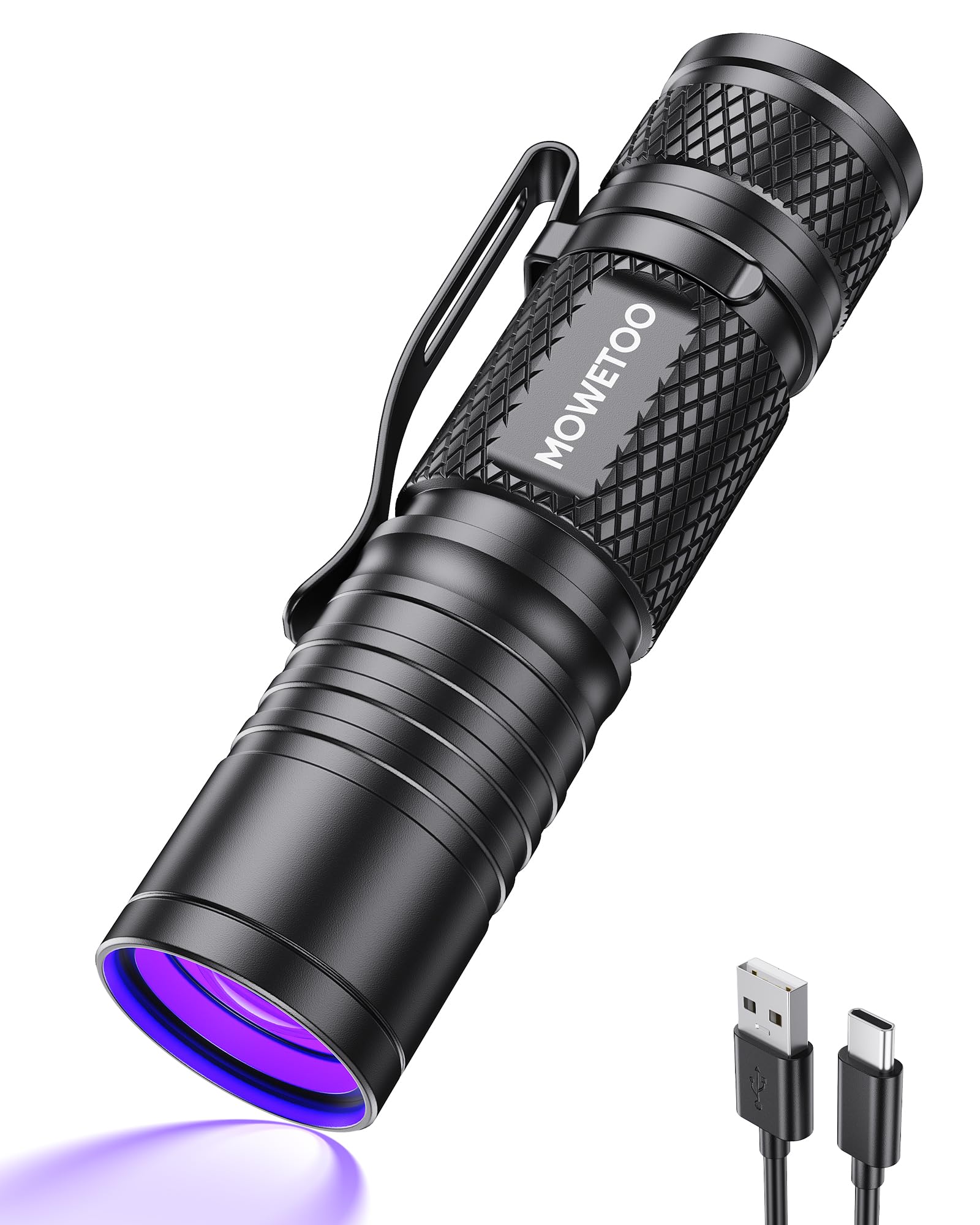
The zoom head is what earns the ULTRAFIRE its place at the vise. Twisting the bezel narrows the 395–405nm beam into a tight spot, which is what you want when a bead of resin sits between a hook shank and a clump of bucktail. Left wide, the same light becomes a bench inspection lamp for stray resin or fluorescent materials. That flexibility is why we reach for it first when a pattern has several small cure points.

The light is 5.24 inches long and 3.36 ounces, so it sits in the hand without dragging. A pocket clip and IP65-rated aluminum body make it easy to park on a shelf or clip to a tying apron, and the rechargeable lithium-polymer cell avoids a last-minute AAA run. The included charger means it is ready to work, though you should keep the charging routine simple: top it up after a session rather than waiting for a dead battery.

The beam is marked 395–405nm, and the adjustable focus lets you concentrate it on a small area. That range covers a lot of the resins and adhesives used at a tying bench, and the wide setting is useful for checking a finished pattern. It works as a general bench UV tool rather than a single-purpose resin lamp, which is the role it plays in our kit. The pocket clip is the small detail that keeps it within reach when the bench gets crowded.

Pros

  • Zoomable beam switches from spot to flood
  • 395–405nm output for UV resin
  • Rechargeable with charger included
  • IP65 aluminum body with pocket clip

Cons

  • Not a 365nm light
Our verdict

For fly tyers who want one compact light to cure resin and inspect a bench, the ULTRAFIRE's zoomable 395–405nm beam is the most practical default here.
Check Latest Price
2

Best 365Nm

TrixHub 365nm UV

91 /100
Angler Score Outstanding

Key details

Power
30 W
Runtime
4 hours
Charging
USB-C
Wavelength
365 nm
Check Details on Amazon

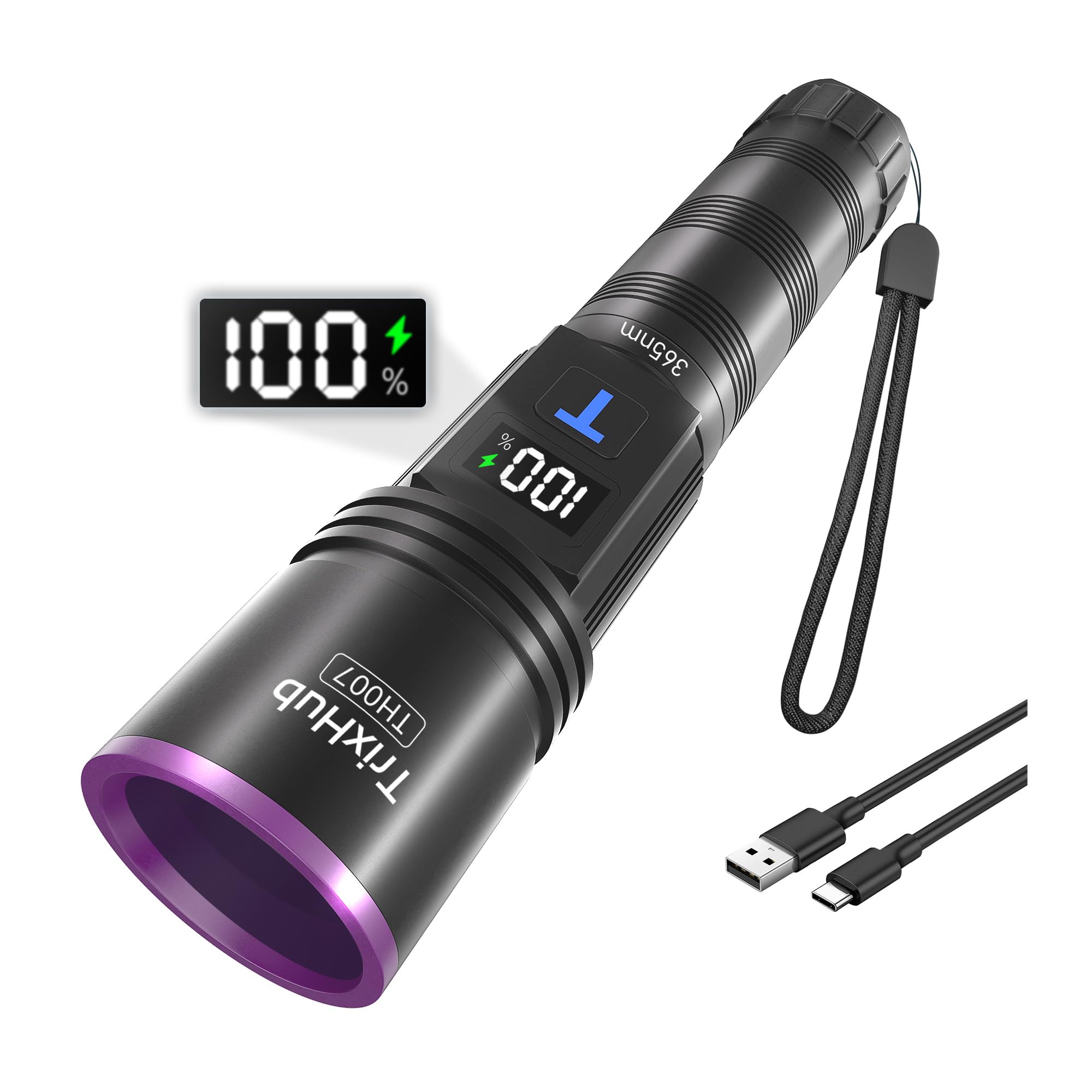
A 365nm emitter is the reason to look at the TrixHub. That wavelength is the safer match for resins that do not spell out a longer-wave cure, and it produces less of the visible purple wash that can make it hard to judge how a bead is setting. The USB-C port and digital battery display are useful extras rather than the main event: you can see the charge level before a session and top it up from the same cable you use for other bench gear.

We think the TrixHub is the 365nm value in this group because it pairs that wavelength with a four-hour listed runtime and a readable charge gauge. The 30W emitter gives it enough punch for a thick dab of resin, and the 5.8-inch aluminum body feels substantial without being clumsy. It is not a zoom light, so the beam is wider than the ULTRAFIRE's; that suits sweeping over a finished fly or curing a row of small patterns, but it takes more care to isolate a single tiny bead.

The 5.8-inch body is small enough to hold over a vise but too long for a shirt pocket, and the aluminum shell has a solid, planted feel. We like the display most at the bench: it removes the guesswork that leads to a dead light halfway through a wing case. The fixed beam is wide enough to sweep a whole fly in one pass, and the TrixHub is the 365nm light we keep close when a resin label is specific.

Pros

  • True 365nm wavelength
  • USB-C charging with battery display
  • Four-hour listed runtime
  • Solid aluminum body

Cons

  • Wider beam is less precise for tiny beads
Our verdict

If your resin calls for 365nm, the TrixHub gives you that wavelength, a visible battery gauge, and four hours of listed runtime in a compact bench light.

Check Latest Price
3

Best Two-Wavelength Kit

DARKBEAM 365/395nm 2-Pack

91 /100
Angler Score Outstanding

Key details

Weight
2.02 oz
Runtime
1 hour
Charging
USB-C
Wavelengths
365 nm and 395 nm
Check Details on Amazon

Two lights in one box sounds like overkill until you have a shelf of resins with different labels. The Darkbeam set pairs a filtered 365nm V4 with a 395nm V5, so you can match the light to the bottle instead of guessing. Both are 3.5-inch aluminum minis with USB-C charging, and the 365nm unit has a black filter that cuts the visible purple wash.

The 365nm light is the one for resins that demand the shorter wavelength, and the filter makes the fluorescence easier to read on a small fly. The 395nm light is brighter to the eye and handy for quick checks. Each is rated at 10W and 1,300mW radiant intensity, which is enough for a focused cure, but neither is a long-throw searchlight; they are built to sit close to the vise.

We appreciate the lack of guesswork most. A tyer who uses one resin can buy a single light; a tyer who experiments can keep both in the kit and stop wondering whether the wrong wavelength is the reason a bead stays tacky. The pair is small enough to live in a pocket, so the second light is not a storage problem. That makes the set a practical way to cover both common resins without turning the bench into a flashlight collection.

Pros

  • Filtered 365nm and 395nm in one kit
  • USB-C rechargeable
  • Pocketable 3.5-inch bodies
  • Clear wavelength matching for different resins

Cons

  • One-hour runtime per light
  • Not water resistant
Our verdict

The Darkbeam pair is the smart choice if your bench sees both 365nm and 395nm resins: one light for each wavelength, both pocketable and USB-C rechargeable.

Check Latest Price
4

Best High-Output

uvBeast V3 365nm

92 /100
Angler Score Outstanding

Key details

Weight
13.3 oz
Runtime
4 hours
Wavelength
365 nm
Beam Distance
60 ft
Check Details on Amazon

At 8.66 inches and 377 grams, the uvBeast V3 365nm is the one light here that feels more like a duty flashlight than a bench tool. The anodized aluminum body is built to be knocked around, and the triple 365nm LEDs sit behind a filter that suppresses visible purple light. That filter is the detail that matters: it lets the resin's fluorescence do the talking instead of washing the fly in a violet haze.

We think the uvBeast earns its premium price when a tyer cures large streamers or thick resin builds. The 365nm output is strong, the beam reaches further than the minis, and the four-hour listed runtime gives it more staying power than the one-hour Darkbeam pair. At a vise, the long body and 377-gram weight call for a two-handed grip or a bench rest rather than a pocket carry.

The 60-foot beam distance is more useful outdoors than over a tying desk, which is the honest boundary of this pick. If your work stays in a size 12 hook and a small drop of resin, the TrixHub or ULTRAFIRE is easier to aim and easier to live with. If you cure big saltwater patterns or use a 365nm resin that needs a deep, powerful dose, the uvBeast has the headroom the smaller lights lack.

Pros

  • Filtered 365nm beam
  • Four-hour listed runtime
  • Rugged waterproof aluminum body
  • Long throw for large flies

Cons

  • Long, heavy body at 377 g
  • Premium price tier
Our verdict

The uvBeast is the high-output 365nm choice for a tyer who cures large resin builds and wants a filtered, long-throw beam, provided the size and premium price suit the bench.

Check Latest Price
5

Budget Touch-Ups

BEIKE 12-LED UV

90 /100
Angler Score Outstanding

Key details

Weight
2.2 oz
Battery
3 AAA
Wavelength
395 nm
Light Sources
12 LEDs
Check Details on Amazon

The BEIKE is the light we treat as a spare, and that is meant as praise. It is small enough to live in a tying bag or a truck console, and its 12 LEDs throw a broad 395nm wash that will find a dropped hook or show whether a thin resin coat has set. For a beginner who is not ready to spend much on a dedicated curing light, it is an easy way to get a UV source into the kit.

The 3.8-inch aluminum body weighs 2.2 ounces, has an IPX4 rating, and comes with a lanyard and battery holder. The 12-LED head throws a wide wash, which covers a thin film or a row of flies in one pass. That makes it better for thin films, quick checks, and emergency use than for a thick bead that needs a fast, deep cure.

The broad wash is the reason it stays in the bag rather than on the bench. When a finished fly looks tacky in one corner, a wide pass from the BEIKE is often enough to set it, and the lanyard keeps it from disappearing into a pocket. For a thick resin build, use a focused light first; the BEIKE is the backup that gets you out of a jam, not the tool that replaces a proper curing beam.

Pros

  • Very affordable spare
  • Broad 12-LED 395nm wash
  • Small 2.2-ounce aluminum body
  • IPX4 water resistance

Cons

  • Requires three AAA batteries
Our verdict

The BEIKE is the cheap spare that earns a drawer slot: a 12-LED 395nm light for quick touch-ups, not the main curing tool for thick resin.

Check Latest Price
6

Pocket Short Sessions

Evteck Mini UV

91 /100
Angler Score Outstanding

Key details

Weight
0.24 lb
Runtime
2 hours
Charging
USB-C
Wavelength
395 nm
Check Details on Amazon

The Evteck mini disappears into a shirt pocket, which is the reason it ends up in a tying bag rather than on a shelf. It measures 3.62 inches, weighs 0.24 pound, and has a zoomable 395nm head that can be tightened onto a small resin drop. The belt clip and USB-C charging make it easy to keep with the rest of the kit.

The zoom is the useful part. At a vise, you can narrow the beam to a spot small enough for a size 16 hook, then widen it to check a whole fly. The two-hour listed runtime is fine for short passes, and USB-C charging means you can top it up from a power bank or laptop. The body is aluminum and feels more substantial than the pocket size suggests.

We think the Evteck is the right pocket backup for a tyer who cures a few flies at a time. The zoom head is more useful at the vise than a fixed wide beam, and the clip keeps the light within reach when bench space is tight. It is a travel-friendly second light, not a replacement for a larger 365nm model when a thick stream needs a deep cure.

Pros

  • Pocket-size 3.62-inch body
  • Zoomable 395nm beam
  • USB-C rechargeable
  • Belt clip included

Cons

  • Gets warm during extended use
  • Two-hour runtime is short for batch work
Our verdict

The Evteck mini is the pocket rechargeable for short curing passes, with a zoom lens, USB-C charging, and enough light for small resin drops.

Check Latest Price

How We Tested UV Lights for Fly Tying

We started by rounding up every flashlight sold as UV — dozens of listings — then cut anything that wouldn't survive a tying bench: no stated wavelength, a body so wide it blocked my view of the fly, a proprietary charger, a switch that needed two hands to work. That left 16 lights, which we used for four months at the vise, at the drying rack, and on the floor under the bench.

We timed how long a half-pea of UV resin took to go tack-free, and noted whether the glow from a fluorescent floss read from across a lit room, not just in the dark. We also watched beam spread — whether the light flooded the whole fly or dropped a coin-sized dot I had to chase around the hook. For detection, we smeared head cement past the eye on purpose, dripped resin onto the desk, and dropped hooks onto a patterned rug to see which beams actually found them.

Heat and battery life came next. Each light ran continuously for three minutes, long enough to cure a wingcase, and I felt the head afterward; the hot ones got marked down, because a light you can't set down on the bench is a nuisance. We recorded whether batteries came in the box, ran each one until the beam visibly dimmed, and noted which models held steady instead of fading over the session.

Durability was a bench-height drop onto concrete and a few dozen twists of the zoom ring, watching for cracks, rattles, or a switch that stopped clicking cleanly. Value shook out on its own: the lights that did all of the above for the least money are the ones still sitting within reach of my vise.

How to Choose a Uv Light for Fly Tying

Match the wavelength to the resin first

Start with the resin bottle, not the flashlight. A 365nm light is the more versatile default because it covers resins that specify the shorter wavelength and produces less visible purple wash. A 395nm or 395–405nm light is often cheaper and easier to see, but it is not the universal match. If you keep both types of resin, a two-light kit such as the Darkbeam pair saves you from swapping heads or guessing. Do not assume a stain detector's floody 395nm beam will cure a thick bead just because it makes the carpet glow.

A focused beam beats a wide wash

At the vise, a tight spot cures one bead without washing the whole fly in purple light. A zoom head such as the ULTRAFIRE's lets you switch from spot curing to a wider inspection beam, which is more useful than raw output alone. Fixed wide beams are better for sweeping over a finished pattern or curing a row of small flies. A 51-LED pet-stain light is the wrong shape for a size 14 hook, even if its brightness number looks impressive.

Plan for runtime and heat

Curing is stop-start work, so a light that runs an hour is fine if you switch it off between flies; a four-hour light gives more slack during a batch. USB-C charging simplifies the bench, while AAA models need a spare-battery habit. Small aluminum bodies can warm up during extended use, so set the light down between passes rather than leaving it running against the fly. A battery gauge is a small luxury that prevents a dead light halfway through a wing case.

Size and handling around a vise

You will hold the light in one hand and the fly in the other, so weight and length matter. A 3.5-inch mini is easy to maneuver around a vise; an 8.66-inch light is better rested on the bench or held with a full grip. None of these lights is a hands-free curing station, so plan your setup around holding or propping the light safely. A pocket clip or lanyard helps keep a small light within reach when the bench gets crowded.

Frequently Asked Questions

Final Verdict

For most fly tyers, the ULTRAFIRE is the easy recommendation. Its zoomable 395–405nm beam is flexible enough for a single resin bead and for checking a finished fly, and the rechargeable body is small enough to live on the bench. If your resin specifies 365nm, move to the TrixHub. If you keep both 365nm and 395nm resins, the Darkbeam pair is the tidier solution.