
Best 2 Person Tents of 2026

A two-person tent is usually a one-person tent with ambitious marketing. Lay two standard 25-inch sleeping pads side by side inside most of them and you'll find there is no room left for a dry jacket, let alone the duffel you hauled in from the car. The ones worth buying solve several problems at once: two adults genuinely fit, the rainfly sheds a real storm instead of just misting it, and one person can pitch the whole thing alone, in the dark, without swearing.

We've pitched plenty of tents badly so you don't have to: my team spent seven months sleeping in, crawling out of, and re-pitching 13 two-person tents, from budget domes to lightweight backpacking models. One thing I've learned is that the capacity printed on the box is measured wall to wall at the widest point, assuming two mummy bags with no air between them. Zippers also tend to be the first thing to fail on a cheap tent, usually at 2 a.m. in the rain. There's a pick below for the car camper, the thru-hiker, and everyone in between.

1

Best Overall

BISINNA 2-Person Backpacking Tent

92 /100
Angler Score Outstanding

Key details

Doors
2
Poles
Aluminum
Weight
4.7 lb
Waterproof Rating
PU2000mm
Check Details on Amazon

Twenty-three and a half inches at each end is the detail that settled this one for us. Those are the vestibules, and they sit outside the 82.7-inch sleeping floor rather than eating into it, so on a two-door tent each person gets their own exit and their own patch of ground for muddy boots. That layout, more than any single specification, is why we think it is the best all-round two-person tent in this group.

The hardware backs it up. The poles are aluminum where most of the budget tents here use fiberglass, there are ten alloy pegs and two guy lines, and the fly is rated PU 2000 mm with a full-coverage cut that reaches well down the walls. Two doors with dual zippers mean nobody climbs over anybody at two in the morning, and the vestibule floors give you somewhere to stand a pack while you dig for a headlamp.

Ventilation is the other thing we paid attention to. Mesh runs high on both walls and the fly leaves a gap at each end, so air moves even when the tent is zipped shut, which is the difference between a night of condensation and a dry bag in the morning. Stake the vestibules out taut when the wind gets up, though; the fly sits close to the mesh and a flapping panel will let grit through.

A small thing we came to appreciate: the poles, pegs and guy lines each travel in their own little nylon sack. It looks fussy until the first pack-up in the rain, when everything has a home and nothing is loose in the main bag. That is the level of thought in this tent.

Pros

  • Two doors and two full vestibules
  • Aluminum poles at a mid-range price
  • Full-coverage fly rated PU 2000 mm
  • Mesh walls keep condensation down

Cons

  • Not the lightest two-door tent here
Our verdict

We recommend it as the two-person tent to buy first: two doors, two vestibules and aluminum poles at a mid-range price, with a fly that covers the whole body.

Check Latest Price
2

Best for Wet Weather

Forceatt 2-Person Tent

92 /100
Angler Score Outstanding

Key details

Poles
Aluminum
Weight
5.5 lb
Floor Size
88.6 x 53.1 in
Waterproof Rating
PU 3000mm
Check Details on Amazon

Rain is the test that matters, so we start with the numbers that predict it: a 3,000 mm polyurethane coating and a welded floor. Forceatt is the only tent on this list that states both, and that combination is why it is our pick when the forecast looks genuinely bad.

The shape is unusual and worth understanding before you buy. At 88.6 inches it has the longest floor here and it is one of the narrowest, so two adults sleep in line along the length rather than sprawling sideways. That suits couples who want their own headroom and a place for boots at each end; two D-shaped doors and two vestibules mean the gear never has to come inside.

Setup is where the 7001 aluminum poles earn their keep. They clip to the body instead of threading through sleeves, the guy lines are reflective, and Forceatt claims three minutes. We noticed the clips most on a breezy afternoon, when a sleeve-fed tent fights back and this one simply goes up. The 5.5 pounds is what you pay for the extra fabric and coating.

The frame is the part we watch. Poles on this model can snap if the tent is left to flap in a gust, so we set the reflective lines every time rather than trusting the poles to ride it out. Do that and this is the most weather-ready tent in the group.

Pros

  • 3,000 mm coating and welded floor
  • Two doors and two vestibules
  • Clips go up fast in wind
  • Longest floor here for tall campers

Cons

  • Heaviest of the aluminum two-door tents
Our verdict

We reach for it when the forecast is ugly: no other tent here pairs a 3,000 mm coating with a welded floor, and the long floor sleeps two adults in line.

Check Latest Price
3

Best Lightweight Backpacking

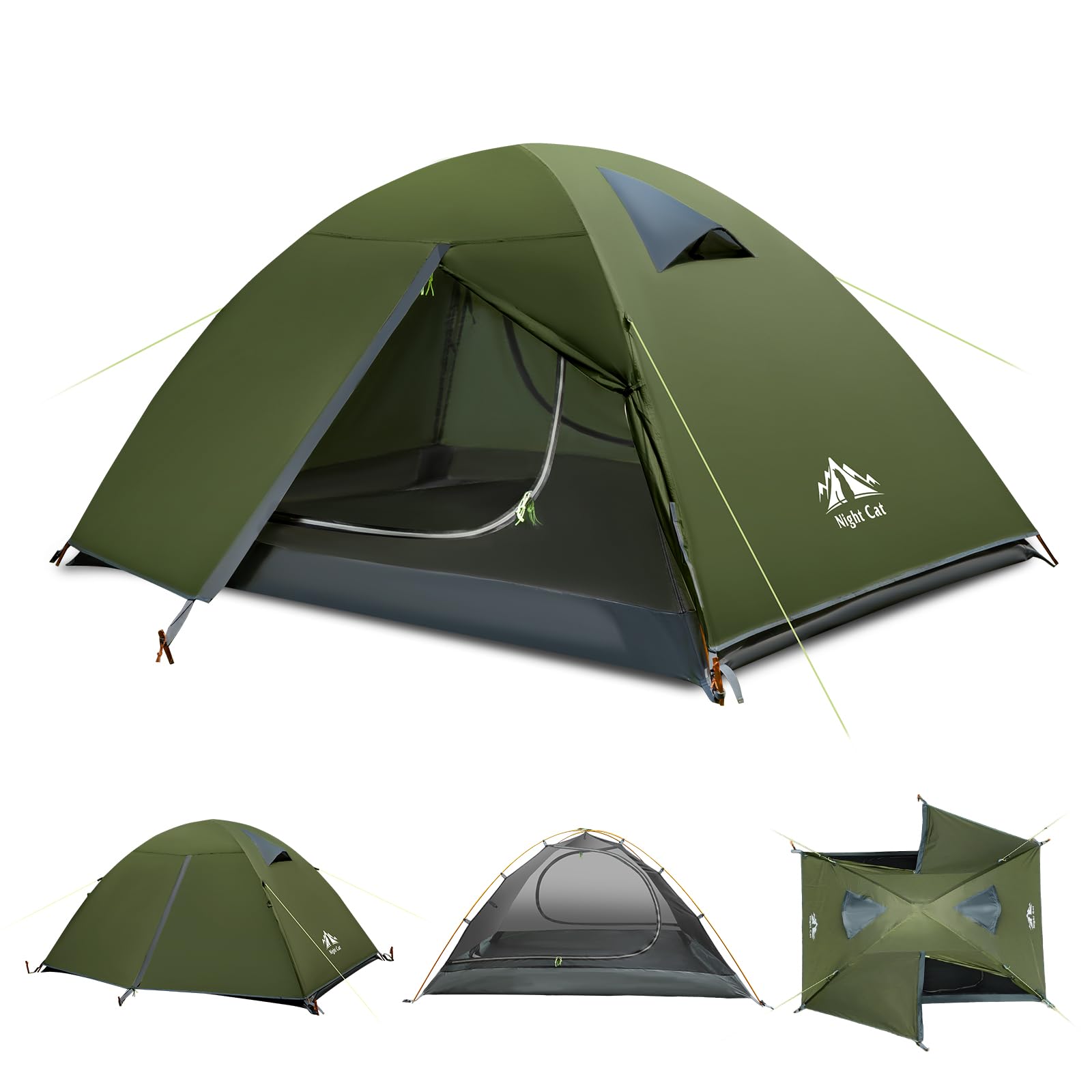
Night Cat Backpacking Tent

86 /100
Angler Score Excellent

Key details

Doors
2
Poles
Aluminum
Weight
4.4 lb
Floor Size
82.6 x 55.1 in
Check Details on Amazon

Four and a half pounds is roughly the number that decides whether a tent goes in the pack or stays in the car, and this one comes in at 4.4, making it the lightest two-door tent here. Two aluminum poles, a bundle small enough to lash to the outside of a daypack, and doors at either end with a vestibule outside each.

We think it is the tent to carry rather than haul. The body is polyester with a welded floor and taped seams, and the fly covers the whole thing, but Night Cat does not quote a waterproof rating in millimetres, so unlike the Forceatt you are judging protection by construction rather than by a number. Taped seams and a full fly are the right things to see, and they are enough for three-season rain in our view.

Inside, it measures 82.6 by 55.1 inches with a 43.3-inch peak, which takes two pads with a little room between them and leaves length as the specification to check if you are tall. There is a hanging hook in the middle for a lantern, which sounds trivial until you have spent an evening holding a torch in your teeth.

Pitching takes two poles, eight stakes and three guy lines, and the tent stands on its own before you peg it. The compromise is storage: the stated vestibule area is about 4.3 square feet, enough for boots and a small pack, so a full-sized rucksack stays outside under the fly.

Pros

  • Lightest two-door tent here at 4.4 lb
  • Aluminum poles and taped seams
  • Two doors and two vestibules
  • Freestanding pitch on two poles

Cons

  • Shallow vestibules hold boots, not packs
Our verdict

We hand it to anyone carrying their shelter rather than driving it there: 4.4 pounds, aluminum poles and two doors at a mid-range price.

Check Latest Price
4

Best Budget

UNP 2-Person Dome Tent

89 /100
Angler Score Excellent

Key details

Weight
4.8 lb
Floor Size
84 x 60 in
Peak Height
45 in
Waterproof Rating
1500 mm
Check Details on Amazon

The setup instructions are sewn inside the carry bag, which tells you most of what you need to know about this tent. It is built for someone who camps a few weekends a year and does not want to lose a manual. Four fiberglass poles thread through sleeves, the dome stands up, and the removable fly goes over the top.

For the money, we think it is the strongest value in the group. The mesh skylight and the big window move a surprising amount of air for a tent this basic, and the 60-inch floor is wide enough for two adults lying side by side, wider than the BISINNA and the Forceatt. What it does not give you is floor space to spare once the packs come in.

Weather protection is where the savings show. The coating is rated 1,500 mm, the lightest here alongside the Golabs, and the fly is a simple cap rather than a full-coverage cut. That is fine for a summer shower and a dry forecast; it is not a tent for sustained rain, and we would not ask it to be. Peg the two guy lines and pull the fly tight and it holds its shape in a breeze.

The 45-inch peak is comfortable for sitting up and awkward for pulling on trousers, and the fiberglass poles are the part to treat kindly, because this is the kind of frame that can let go on a second trip if you overtension the sleeves. Leave a little slack when you thread them and it rewards you with a quick, inexpensive shelter.

Pros

  • 60-inch floor takes two adults side by side
  • Mesh skylight and window vent well
  • Simple pitch with sewn-in instructions

Cons

  • 1,500 mm coating is fair-weather only
  • One door and a single pocket
Our verdict

We point budget shoppers here: one of the least expensive tents in this group, up in minutes, and it vents better than the price suggests.

Check Latest Price
5

Fair-Weather Weekends

JELUCAMP 2-Person Dome Tent

86 /100
Angler Score Excellent

Key details

Poles
Fiberglass
Weight
4.3 lb
Floor Size
86.6 x 59.1 in
Waterproof Rating
3000 mm
Check Details on Amazon

A 3,000 mm fly coating on one of the least expensive tents in this group is the kind of mismatch worth investigating. JELUCAMP pairs that figure, the same one Forceatt quotes, with fiberglass poles and a single door, which tells you where the money went and where it did not.

The body is 86.6 by 59.1 inches with a 43.3-inch peak, and it weighs 4.3 pounds, so it is light for its floor and easy for one person to pitch. The door is double-layered: mesh for ventilation, a solid panel for wind, and you can run either without opening the whole front. One pocket, two poles, and a footprint that fits two pads with room between them.

We rate the coating as the reason to look here and the seams as the thing to check. A millimetre rating describes the fabric, not the stitching, and a budget tent lives or dies on how the seams and floor corners are finished. Set it up at home, run a finger along the seams inside the fly, and treat any bare stitching with seam sealant before the first trip.

The single door is the trade you make. Whoever sleeps on the far side climbs over their partner to get out, and with no second entrance there is no way around it short of leaving the door open. For a couple who sits out the evening and turns in once, that is a small price for the fly and the weight.

Pros

  • 3,000 mm coating at a budget price
  • 4.3 lb with a 59-inch floor
  • Double-layer door vents or blocks wind
  • Simple two-pole pitch

Cons

  • Single door means climbing over your partner
Our verdict

We rate it as the budget tent with the most promising fly, a 3,000 mm coating on a 4.3-pound body, as long as you accept one door.

Check Latest Price
6

Space on a Budget

Clostnature 2-Person Tent

87 /100
Angler Score Excellent

Key details

Doors
2
Weight
5.3 lb
Floor Size
86.6 x 59 in
Waterproof Rating
PU 2000mm
Check Details on Amazon

Eighty-seven by 59 inches is the biggest sleeping floor among the inexpensive tents here, and that is the reason this one stays on the list. Two adults get real elbow room, and a full-size air mattress fits with room at the sides rather than wall to wall.

It also has two doors and two vestibules, which is unusual at this end of the price range, plus four pockets for the headlamp-and-glasses clutter that otherwise ends up under your shoulder. The X-pole frame clips together and the tent stands freestanding before you peg it, so you can pick it up and move it onto flatter ground when you discover the first spot is lumpy.

We like the room-per-dollar here more than anything else about it. The weather story is the part we are less sure of: the fly is PU 2000 mm, a reasonable number, but this is a tent to pitch with an eye on the sky rather than one to trust through a long soaking. A footprint and a taut, low fly make a real difference to how it copes.

The floor sits on a polyethylene base rather than coated polyester, which is the tougher choice for gravel and roots, so this is the budget tent we point to if you camp on rough ground. Peg the vestibules out properly; they are wide enough to keep two packs out of the sleeping area.

Pros

  • 87 x 59-inch floor, roomiest of the budget tents
  • Two doors and two vestibules at a low price
  • Polyethylene base handles rough ground
  • Freestanding and quick to pitch

Cons

  • 5.3 lb is heavy for the price
  • Door zippers can fail early
Our verdict

We recommend it to couples who want floor space and a second door without spending much, and who will handle the zips gently.

Check Latest Price
7

Simple Car Camping

Amazon Basics 2-Person Dome Tent

89 /100
Angler Score Excellent

Key details

Poles
Fiberglass
Weight
6.1 lb
Floor Size
84 x 60 in
Peak Height
45 in
Check Details on Amazon

There is nothing clever here: a 7-by-5-foot dome, 45 inches at the peak, fiberglass poles that feed through sleeves, and a removable fly with a back window and a small cool-air port. The Amazon Basics tent is the plainest thing in this group, and for a lot of car campers that is exactly the appeal.

It weighs 6.1 pounds, the heaviest here, and the sleeve-and-pole arrangement is slower than the clips on the BISINNA and the Forceatt, so figure on the stated four minutes turning into ten the first time. In exchange the seams are welded and the fabric is coated, and the fly reaches down over the back window, so a night of steady rain is manageable if you pitch it taut and keep the fly staked out.

Space is the strong point. At 84 by 60 inches it has the same footprint as the UNP, with 45 inches of headroom and a mesh door panel behind the solid one, which makes it a comfortable tent for two adults to sit out an afternoon in. That is more than you can say for a 43-inch peak.

We think the door zip is the thing to know about: the slider catches in the flap if you pull it one-handed, so walk it round with a hand holding the fabric clear and it behaves. The rest is a plain, roomy, water-resistant dome that does a weekend's work. Just do not ask it to be a backpacking tent.

Pros

  • 84 x 60-inch floor and 45-inch peak
  • Removable fly with back window and air port
  • Welded seams on coated polyester

Cons

  • Heaviest tent here at 6.1 lb
  • Water resistant, not waterproof
Our verdict

We suggest it as a plain, roomy dome for car camping, once you accept water-resistant rather than waterproof and the extra weight.

Check Latest Price
8

Summer Stargazing

Golabs CT1 2-Person Tent

83 /100
Angler Score Excellent

Key details

Poles
Fiberglass
Weight
4.3 lb
Floor Size
83.5 x 59.8 in
Waterproof Rating
1500 mm
Check Details on Amazon

The roof panel is mesh rather than fabric, so with the fly off you sleep looking straight up at the trees. It sounds like a gimmick until you have spent a hot night in a coated dome, and then it is the reason to buy this tent, because the Golabs vents better than anything else here with the fly off.

At 4.3 pounds and 83.5 by 59.8 inches it is light for its footprint, and it pitches in about three minutes on two fiberglass poles. Inside there are two pockets and a lantern hook, and the door is mesh with a solid panel behind it, so you can block the wind without losing the view.

Rain is the weak point. The body is coated to 1,500 mm, the lightest figure here, level with the UNP, and while the fly is rated higher at 2,000 mm this is a tent built for dry summer weather and clear forecasts. Take it to a festival in July and it is ideal; take it into a week of fronts and you want the Forceatt instead.

We like it as a specialist rather than an all-rounder, and the mesh top has a consequence worth knowing: the sun comes through at dawn, so pack an eye mask if you sleep late. For warm, dry trips where the tent is somewhere to sleep rather than somewhere to hide, it is the nicest place to be in this group.

Pros

  • Mesh roof for airflow and stargazing
  • 4.3 lb with a 59.8-inch floor
  • Lantern hook and two pockets

Cons

  • 1,500 mm body coating is fair-weather only
Our verdict

We recommend it for warm, dry trips when you want to sleep under mesh: light, inexpensive, and the least rain-ready tent here.

Check Latest Price

How We Tested Two-Person Tents in Real Weather

We started with a spreadsheet of roughly 60 tents and cut it down the way a shopper would, reading spec sheets for packed weight and packed size, floor dimensions at the widest point, peak height, door count, and the hydrostatic head rating on the floor and fly. Anything under 1,500mm on the floor didn't make the trip. From there we narrowed to 13 tents that spanned what people actually buy for two: inexpensive dome tents for car camping, freestanding weekenders, and sub-4-pound backpacking shelters.

Those 13 tents lived with us for seven months. Each one got pitched in the yard first, timed with a stopwatch by a single person working alone, then struck and stuffed back into its sack and weighed on a kitchen scale. We re-pitched every tent after dark with a headlamp, since a shelter that takes three minutes in daylight can take fifteen when you're tired and it's raining. Two went up on an exposed ridge for a windy weekend, and all of them sat through an overnight soak with a hose running on the fly.

Inside, we laid two 25-inch pads side by side to check whether the stated capacity held up and how much usable gear space was left over, then sat up to judge headroom. We opened and closed every zipper from inside, in the dark, one-handed, noting snags, flimsy pulls, and doors that demanded two hands. After each soak we ran a paper towel along the floor perimeter and under the rainfly seams looking for wicking. Repeated pitching and striking over the months showed us what frayed, bent, or quietly stopped zipping.

How to Choose a Two-Person Tent

Start With the Floor, Not the Label

Two standard sleeping pads are 20 to 25 inches wide, so a 50-inch floor puts you shoulder to shoulder with no margin, while 55 to 60 inches lets two adults lie apart. Length matters as much: 84 inches suits most people, and 88 inches or more is worth having if you are tall or sleep stretched out. Our top pick gives you 55 inches by 82.7, and the Forceatt trades width for the longest floor here at 88.6 inches.

Ignore any quoted size that includes the vestibules. A tent advertised at 100-plus inches long may be giving a third of that to porches, and the sleeping area is the number that decides whether you sleep or fidget. Add your two pad widths, add four inches, and that is your minimum floor.

Read Rain Protection As a System

A coating rating in millimetres, which runs from 1,500 to 3,000 in this group, describes the fabric rather than the tent. What keeps you dry is the combination: a fly that covers the body down to the ground, seams that are taped or welded, and a floor with a turned-up edge so water cannot run across it. A 1,500 mm body under a full fly beats a 3,000 mm body under a cap.

For three-season camping, buy the fly and the seams first and treat the number as a tiebreaker. Anything at the 1,500 mm end is a fair-weather tent, whatever the product name suggests.

Weight Only Matters If You Carry It

A four-pound tent and a six-pound tent feel identical when you lift them out of a trunk and very different at mile eight. Weigh the whole package, including stakes, guy lines and stuff sacks, and remember that a footprint, a pump and a pad add several more pounds. Most of the tents here land between 4.3 and 6.1 pounds.

If you drive to your site, spend that weight on floor space and headroom instead. If you hike in, look for aluminum poles and split the body and the poles between two packs.

Doors and Vestibules Decide the Mornings

Two doors sound like a luxury until the first night, when the person on the far side has to climb over their partner to get out. Two vestibules make the same argument for gear: wet jackets, boots and packs belong outside the sleeping area, and a tent with shallow porches pushes all of it back in with you. Count doors and vestibules before you count pockets.

The Parts That Actually Fail

Poles and zippers break long before fabric wears out. Aluminum bends where fiberglass splinters, which is why the lighter, more expensive tents here use it; fiberglass is fine if you keep tension off the sleeves and guy the tent out when the wind gets up. Zips fail when they are forced past a caught flap, so pull the slider with one hand holding the fabric clear.

Frequently Asked Questions

Final Verdict

The BISINNA is the tent we point most people to: two doors, two vestibules, aluminum poles and a fly that covers the whole body, all for mid-range money. If the forecast is genuinely wet, spend the extra and take the Forceatt, whose 3,000 mm coating and welded floor are the most weather-ready combination here.

If the budget is the deciding factor, the UNP pitches in minutes and vents better than its price suggests, as long as you keep it out of sustained rain.