Best Canopy Tents of 2026

A cooler, a folding table, and a patch of shade — that's the whole recipe for a good afternoon outside, and the shade is the part that always goes wrong. I've watched a flimsy canopy fold sideways in a gust at a kids' soccer tournament while three adults clung to the legs, and I've wrestled a so-called one-person setup for twenty minutes in a parking lot while everyone else waited. A good canopy tent fixes both problems: it pops open before anyone loses patience and stays planted once the wind picks up, so the day keeps going instead of turning into a wrestling match.

The differences between models show up faster than you'd expect. Weight matters more than the spec sheet lets on — a tent you can carry from the trunk in one trip is a tent you'll actually bring — and water resistance usually comes down to the roof seams and how the fabric feels when you press a damp hand against it. Color isn't pure vanity either; a dark roof bakes noticeably hotter underneath in direct sun. Over the past six months my team and I have raised, hauled, and re-staked 12 of these, from lightweight pop-ups to commercial-grade shelters with walls, and the ones below earned their place on setup speed, durability, weatherproofing, and whether the price made sense for what came in the box.

1

Best Overall

Crown Shades 10x10 Pop-Up

93 /100
Angler Score Outstanding

Key details

Setup
One-push center lock
Peak Height
9 ft
Packed Weight
36 lb
Shade Footprint
10 x 10 ft
Check Details on Amazon

One push at the center hub locks the four legs, and the top clips on before the canopy folds away, so setup is mostly a matter of rolling the bag out and opening the frame. That combination is why this Crown is our default 10-by-10: it removes the two chores that make people dread a canopy, and it does not ask for a second person. The fabric stays attached in storage, which means you are not wrestling a 100-square-foot top over the frame every time.

The size suits a tailgate, a beach camp, or a backyard party: 100 square feet of shade, a peak over 9 feet, and room for about 10 people. At 36 pounds it is not a one-hand carry, but the wheeled bag and the one-piece fold make the trip from car to grass manageable. We also like the 2-year limited warranty, which is longer than several canopies here.

The caveat is wind. The steel truss and coated top are fine for normal use, but this is not a canopy to leave up in a gust or overnight; stake it or weight all four legs, and take it down when the weather turns. We think that is a fair trade for a canopy this easy to live with, and it keeps the Crown as the strongest all-around choice in this set.

Pros

  • One-push hub locks all four legs
  • Top stays attached in the wheeled bag
  • Full 100 square feet with a 9-foot peak
  • Two-year limited warranty

Cons

  • Water-resistant top, not waterproof in steady rain
Our verdict

For most buyers, this is the canopy to get: one-push setup, a full 100 square feet, and a 36-pound package that one person can manage.

Check Latest Price
2

Best Lightweight Full-Size

Eagle Peak 10x10

89 /100
Angler Score Excellent

Key details

Warranty
1 year
Canopy Fabric
150D, UPF 50+
Packed Weight
32.8 lb
Shade Footprint
10 x 10 ft
Check Details on Amazon

At 32.8 pounds, this Eagle Peak is the full-size straight-leg canopy we choose when the setup is a solo job. It opens to the same 10-by-10 footprint and 100 square feet as our top pick, but it asks less of your back, a difference you notice on the walk from the parking lot to the field.

The Peak Push center lock does the heavy lifting, and the 150D silver-coated top has heat-sealed seams and a UPF 50+ rating. The wheeled bag is a real help, and the straight-leg frame gives you a clean 10-by-10 footprint without the bulk of a commercial kit. We like that it keeps full-size shade in a package one person can move.

The lighter build is the trade-off. This is not the canopy to leave up in a gust, and the one-year warranty is shorter than the Crown's two years. The 150D top is lighter than the 300D fabric on the commercial Crown, so keep an eye on the seams in sustained rain and re-stake it if the wind picks up.

Pros

  • 32.8 pounds, light for a full 10x10
  • One-push Peak Push center lock
  • Heat-sealed seams and UPF 50+ top
  • Wheeled bag for transport

Cons

  • Water-resistant top can leak at seams in sustained rain
Our verdict

This is the full-size canopy for solo setup: 32.8 pounds, a straight-leg 100-square-foot footprint, and a one-push frame.

Check Latest Price
3

Best for Beach

E-Z UP Sierra II

90 /100
Angler Score Outstanding

Key details

Warranty
2 years
Footprint
10 x 10 ft
Packed Weight
32 lb
Shade Coverage
64 sq ft
Check Details on Amazon

The Sierra II's 10-by-10 measurement describes the footprint, not the shade. The top is 8 by 8, so you get 64 square feet of coverage, enough for a blanket and a couple of chairs but not a vendor booth. That distinction matters more than the headline size, because a slant-leg frame trades shade for stability and a smaller packed package.

We like that trade for beach days and tight patios. At 32 pounds it is easy to carry, and the roller bag plus spike kit make the walk across sand or grass less of a chore. Setup is quick with the folding frame, and the 2-year warranty is a meaningful cushion for a canopy that lives in a car trunk.

What you give up is area and weather protection. The 64-square-foot top is not the one for a market booth, and the frame wants stakes or weights whenever the wind has any push. The fabric is water-resistant rather than waterproof; a passing shower is one thing, a soaked afternoon another. For a beach-first canopy, that is the right set of compromises.

Pros

  • 32 pounds makes it easy to carry
  • Folding frame sets up without tools
  • Two-year warranty
  • Roller bag and spike kit included

Cons

  • No sidewalls included
Our verdict

For beach shade and patios, this is the easy-carry pick: 32 pounds, a two-year warranty, and a realistic 8-by-8 top.

Check Latest Price
4

Best Heavy-Duty Kit

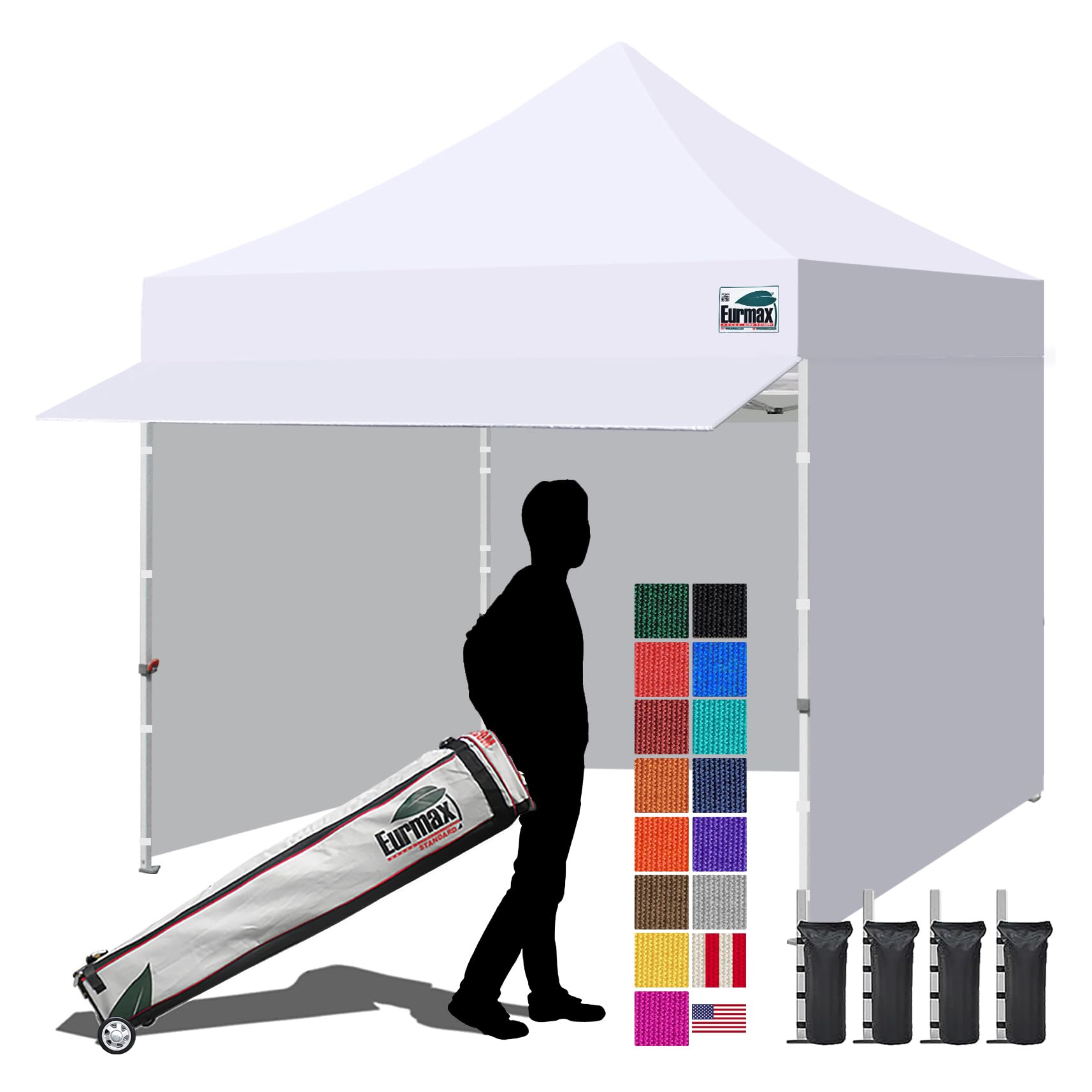
Eurmax 10x10 Commercial

88 /100
Angler Score Excellent

Key details

Awning
30 sq ft
Packed Weight
61 lb
Walls Included
Three side plus door
Shade Footprint
10 x 10 ft
Check Details on Amazon

At 61 pounds, the Eurmax is the canopy here that announces itself as a booth kit before you open the bag. The frame, the four zippered walls, the awning, and the roller bag add up to a two-person load, and you will want a cart if the setup is more than a few steps from the car.

We think that weight buys something useful for vendors: a 10-by-10 booth with three sidewalls, a door wall, and a 30-square-foot awning, all in one package. The top is PU-coated and seam-sealed, and the frame has three height positions, so you can set the clearance for a table or a standing display. The walls zip on and off, which makes the same canopy work as an open shelter or a windbreak.

The limitations are the ones that come with a commercial kit. The fabric is water-resistant, not waterproof in a driving rain, and the seams are the first place to watch. The one-year warranty is shorter than the Crown commercial's two years, and the awning is a bonus rather than a reason on its own. For a weekly booth with help, it is still a serious package.

Pros

  • Three sidewalls plus a door wall
  • 30-square-foot awning adds shade
  • Seam-sealed PU-coated top
  • Three height positions

Cons

  • Walls and awning add setup time
Our verdict

A full vendor kit for buyers who need walls, an awning, and a sealed top, and have a helper for the 61-pound load.

Check Latest Price
5

Best with Sidewalls

Crown Shades Commercial 10x10

89 /100
Angler Score Excellent

Key details

Warranty
2 years
Canopy Fabric
300D, UPF 50+
Walls Included
4
Shade Footprint
10 x 10 ft
Check Details on Amazon

The commercial Crown starts with a better top than the standard 10-by-10: 300D silver-coated polyester with taped seams, rated UPF 50+ and flame resistant. That heavier fabric is the part you notice when the canopy is up in weather, and it is why this one is aimed at booths and long event days rather than a quick beach setup.

Four sidewalls are included, along with the one-push center lock and a steel truss frame. The interior clears 9 feet 4 inches, enough for tall displays and standing adults, and the package carries a 2-year limited warranty, better than the one-year coverage on several picks here. Two legs have integrated wheels, which helps when the bag is loaded.

We choose this over the Eurmax when we want walls without an awning, and when a two-year warranty matters more than the Eurmax's 61-pound kit. It is not a solo beach carry, but it is a straightforward booth for two people. For a vendor who leaves it up for the day, that is a fair exchange.

Pros

  • 300D silver-coated fabric with taped seams
  • Four sidewalls included
  • Two-year limited warranty
  • One-push lock and wheeled legs

Cons

  • Four walls take longer to hang than an open canopy
Our verdict

For a weather-ready booth, this is the cleaner walled package: 300D fabric, four walls, and a two-year warranty.

Check Latest Price
6

Best Budget

Oneofics 10x10

86 /100
Angler Score Excellent

Key details

Footprint
10 x 10 ft
Canopy Top
8 x 8 ft
Canopy Fabric
190T Oxford
Packed Weight
22 lb
Check Details on Amazon

The Oneofics is the canopy for the person who needs shade a few weekends a year, not a booth every Saturday. It is the budget pick here, and the build reflects that: a 190T Oxford top, a 22-pound frame, and a simple carry bag. That is enough for a picnic table or a pair of chairs, as long as you are not expecting commercial duty.

Setup is straightforward with the push-button legs, and the 22-pound package is easy to carry across a park or a beach. The top is rated UPF 50, and the adjustable legs let you drop a corner when the sun moves. We like it as a second canopy for the yard or a first one for tailgates.

The limits show up in wind. The light frame and 190T fabric are fair-weather gear, and this is not the canopy for a weekly market. We see it as an occasional-use canopy, where the savings are real and the setup is simple enough to keep in the car.

Pros

  • 22 pounds, easy to carry
  • Push-button adjustable legs
  • UPF 50 top
  • Lowest price tier in this set

Cons

  • 8 x 8 ft top gives less shade than a full 10 x 10
Our verdict

For occasional shade on a budget, this is a light, simple canopy; do not expect it to hold up as a weekly booth.

Check Latest Price
7

Markets and Storage

Tunbne 10x10 Sidewall

87 /100
Angler Score Excellent

Key details

Included
4 sandbags, 8 stakes, 4 ropes
Sidewall
1 with six pockets
Packed Weight
38.6 lb
Shade Footprint
10 x 10 ft
Check Details on Amazon

The sidewall is the reason to look at this Tunbne: a single panel with six pockets and a lanyard, so the shaded side doubles as a place to stash sunscreen, keys, and small gear. That is a small idea, but it is the kind of detail that makes a market stall or a beach camp feel less cluttered.

The canopy itself is a 10-by-10 with 100 square feet of shade, a vented roof, and a one-push center lock. At 38.6 pounds it is heavier than the lightweight picks but lighter than the commercial walled kits, and the package includes four sandbags, eight stakes, and four ropes. The sidewall attaches along the frame edge, which is simple enough but adds a step when you are setting up alone.

The fabric and frame are midweight, not commercial-grade. That is fine for weekend markets and family trips, but this is not the canopy to leave up in a gust or trust as a permanent booth. The vented roof helps with heat, and the sandbags are useful on pavement where stakes cannot go.

We see this as the middle path: more shelter and storage than a bare canopy, without the weight and cost of a four-wall commercial kit. If you want one wall for privacy or low sun, it is a sensible upgrade; if you need a full enclosure, go with the Crown or Eurmax.

Pros

  • Sidewall with six pockets and a lanyard
  • 100 square feet with a vented roof
  • Four sandbags, eight stakes, four ropes included
  • 38.6 pounds balances shade and portability

Cons

  • Single sidewall only; not a full enclosure
Our verdict

A practical middle pick if you want one wall and built-in pockets without moving up to a four-wall commercial booth.

Check Latest Price

How We Tested Canopy Tents

We started with the 10x10 footprint, since that's the size one person can reasonably handle alone and still fit a table, four chairs, and a couple of dogs underneath. From there we filtered by frame material, canopy fabric and coating, bag type, and whether the manufacturer published any wind or water rating at all — a spec sheet that dodges both is usually telling you something. Twelve tents made the cut.

Testing ran for six months, and it followed the tents around rather than parking them in a yard. We set each one up alone with a stopwatch running, on grass, asphalt, and hard-packed dirt, and noted where a frame pinched fingers or a leg really needed a second person. Every tent got loaded into and out of a trunk and then carried from the parking lot to the field, which is where weight claims stop being abstract. We also checked packed size against a full trunk and timed the takedown, since folding a canopy back into its bag is where most of them lose their charm.

For sun and rain, each canopy spent full days in direct summer light while we felt the underside temperature, then took ten minutes of hose spray across the roof while we watched for drips at the seams and along the valance. One tent from each style got packed away damp to see what it smelled like two days later. On gusty afternoons we re-staked them and watched whether the legs stayed vertical and the frame stayed square, and at the end we checked stitching and whether the fabric had worn along the same fold lines. Value was judged last, by whether walls, sandbags, and stakes came in the box or were sold separately.

How to Choose a Canopy Tent

Measure the shade, not just the footprint

Canopy listings lead with a 10-by-10 measurement, but that number can describe the base rather than the roof. A straight-leg 10-by-10 gives you the full 100 square feet; a slant-leg model with an 8-by-8 top gives 64 square feet on the same footprint. We treat the footprint as a parking-space measurement and the top as the shade measurement. If you need to cover a booth or a picnic table end to end, choose a straight-leg canopy. For a beach blanket or a small patio, the lighter slant-leg version can be the smarter buy. Headroom matters too: a 9-foot peak keeps tall guests comfortable in the middle; the valance at the edge is what you feel near a wall.

Decide whether setup is a solo job

One-push center hubs and clip-on tops have made a 10-by-10 canopy a realistic solo setup, but walls change the math. A bare canopy with the fabric left attached in the bag is the quickest routine; adding two or four walls takes more hands, especially in a breeze. If you set up alone every weekend, prioritize a center-lock frame and a bag that stores the top attached. If your booth needs walls, plan for a second person and a few extra minutes. The Crown and Eagle Peak show how little effort a bare canopy can take; the walled kits are a different job.

Match packed weight to how far you carry it

Packed weight is the number that decides whether a canopy stays in the car or becomes a chore. A 22-pound canopy is a carry; a 36-pound canopy is a roll-and-lift; a 61-pound commercial kit wants a cart and a helper. Wheels help on pavement and packed grass, but they do not solve soft sand or a flight of stairs. Before you buy, think about the longest carry between your vehicle and the setup spot, not the drive. If that distance is more than a short walk, choose the lighter canopy even if it costs you some shade.

Treat water resistance as a range

Most canopies here are water-resistant, not waterproof. A coated top and sealed seams shed a passing shower; sustained rain finds the seams, the vent, and any place where a wall meets the frame. For sun protection, look for UPF 50+ fabric and a vented roof that lets heat escape. For rain, look for taped or heat-sealed seams and accept that no pop-up canopy in this set is a storm shelter. Anchor all four legs before you raise the frame, and lower or take the canopy down when the wind builds. Sidewalls help with low sun and blowing rain, but they also add setup time.

Look at fabric, frame, and warranty together

Fabric weight is a rough guide to how much abuse a top can take. A 150D or 190T top is fine for occasional shade; a 300D top with taped seams is the better choice for a booth that goes up every week. The frame matters just as much: a steel truss with through bolts resists twisting better than a light folding frame, and a center lock should catch firmly without forcing. We put fabric and frame ahead of extras when the canopy is a weekly tool. Warranty length is the maker's own bet on the build: the two Crown canopies carry two years, while the Eagle Peak carries one.

Frequently Asked Questions

Final Verdict

The Crown Shades 10x10 is our default for most buyers because it makes the two hardest parts of canopy ownership, setup and transport, feel manageable without giving up full-size shade. The one-push hub, the top that stays attached in the bag, the 100-square-foot roof, and the 36-pound package add up to a canopy you can use often without dreading it.

If your use is a weekly booth, step up to a walled commercial kit: the Crown commercial for 300D fabric and a two-year warranty, or the Eurmax if you want an awning in the package. If you are carrying shade across sand, the lighter E-Z UP Sierra is the better fit. Buy for the setup you repeat, not the one you imagine.