Best Canvas Tents of 2026

Most people convert to canvas on a bad morning: you wake at six, the nylon walls are dripping condensation onto your sleeping bag, and by seven the tent is too hot to stay in. Cotton canvas behaves differently — the fibers swell in damp air, so the inside stays drier, and the fabric breathes rather than trapping your breath on the ceiling. The tradeoff is real: these tents are heavy, slow to pitch, and priced like furniture. What you get back is a shelter you can stand in, heat with a stove, and keep for a decade.

We've lived with six of them over nine months, from a low dome to a 16-foot bell, and the difference between a good one and a frustrating one almost never shows in the photos. It shows in the fabric weight, the zipper pulls, and whether the floor is sewn in or clipped. Nobody warns a first-time buyer that canvas must be bone dry before it goes back in the bag, or that it will stretch and need re-tensioning in the first hard rain. The picks below held up to all of it.

1

Best Overall

White Duck Regatta Bell Tent

90 /100
Angler Score Outstanding

Key details

Floor Area
132.67 square feet
Peak Height
10 feet
Packed Weight
60.6 lb
Stated Capacity
6 people
Check Details on Amazon

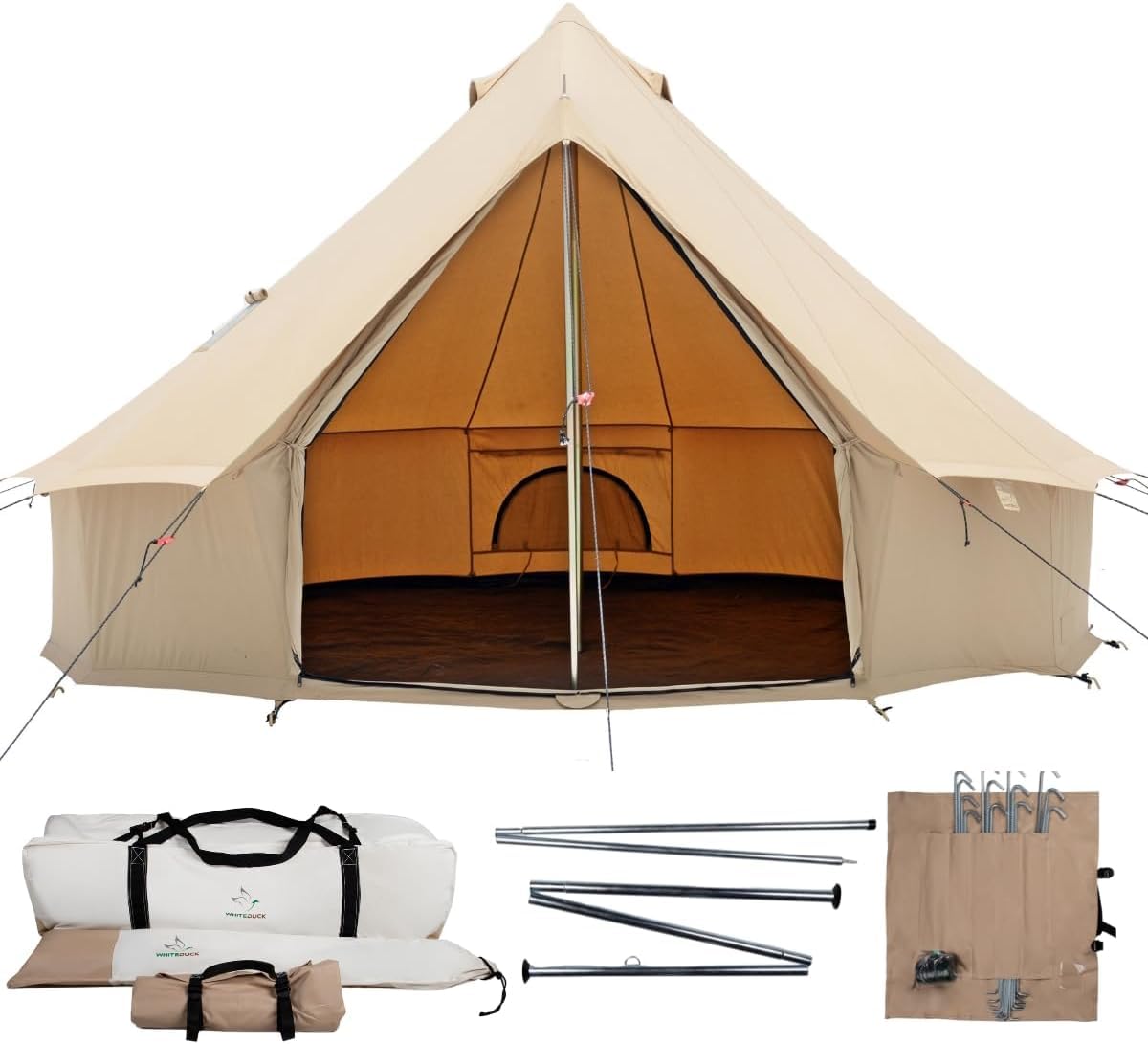
Space is the first thing that strikes us about the Regatta. The 13-foot bell opens to 132.67 square feet with a 10-foot peak, so two adults can sleep on cots with room left for bags and a stove. The vertical wall section keeps more of that space usable near the edges, which matters when you're arranging cots around a center pole.

White Duck uses a PFC-free water-repellent finish on the cotton canvas rather than a plastic coating, so the fabric stays breathable and resists condensation. The stove jack is sewn in, and the package includes a polyethylene groundsheet, steel poles, and a tool kit. Setup is listed at 10 minutes; our own pitch was straightforward with two people, and the frame is conventional enough that one person can manage it with practice.

Where the Regatta earns our top spot is the balance of space and weather protection. It has two doors and three mesh windows for cross-ventilation, a heavy canvas shell for shoulder-season trips, and a limited lifetime warranty that backs up the construction. We paid attention to the door placement: the second door keeps the sleeping area from becoming a hallway when someone comes in wet.

Pros

  • 132.67 square feet and a 10-foot peak
  • Breathable cotton canvas with PFC-free water repellent
  • Sewn-in stove jack and included groundsheet
  • Limited lifetime warranty

Cons

  • 60.6-pound packed weight
  • Must be completely dry before storage
Our verdict

We recommend the Regatta as our top canvas tent for vehicle-based campers who want a roomy four-season bell with a stove jack and genuinely breathable fabric.

Check Latest Price
2

Best Budget Hot Tent

VEVOR Canvas Bell Tent

85 /100
Angler Score Excellent

Key details

Diameter
9.8 feet
Peak Height
6.5 feet
Packed Weight
37.7 lb
Stated Capacity
4 people
Check Details on Amazon

The VEVOR is the least expensive way into a four-person bell with a stove jack in this group, and it does not feel like a stripped-down toy. The 9.8-foot diameter gives you about 76 square feet and a 6.5-foot center height, with a TC cotton-poly blend shell, PVC floor, ten guylines, and twenty stakes. The stove jack has a flame-resistant flap, and the mesh windows keep the interior from turning into a sauna in mild weather.

We think the value case is strong for a first hot tent. The fabric breathes, the layout is simple, and the 37.7-pound package is manageable for one person to load and pitch. Heat retention is one of the better parts of the design: the TC shell holds warmth without the clammy feel of a coated synthetic tent. The limits sit in the hardware and the pitch rather than the layout.

A 6.5-foot center height is fine for most adults in the middle and a crouch at the edges, and the four-person rating is realistic for two adults with gear or a small family on mats. We recommend it to campers who want a stove-ready bell without moving up to a heavier canvas model, and who will take the time to stake it out properly.

Pros

  • Four-person bell with a 3-inch stove jack
  • 37.7-pound pack is light for its size
  • Ten guylines and twenty stakes included
  • TC cotton blend breathes and limits condensation

Cons

  • 6.5-foot peak limits standing room for tall campers
  • Pole and tab connections need watching over time
Our verdict

For a first stove-ready bell tent on a budget, the VEVOR is our pick: four-season layout, a 37.7-pound pack, and enough room for a small family.

Check Latest Price
3

Best Cabin Tent

Kodiak Flex-Bow Deluxe

92 /100
Angler Score Outstanding

Key details

Floor Size
9 x 8 feet
Peak Height
6 feet 1 inch
Packed Weight
57.8 lb
Stated Capacity
4 people
Check Details on Amazon

The Flex-Bow's 6-foot-1 ceiling is the detail that changes a cabin tent from a place you crawl into to a place you move around in. The 9-by-8 footprint holds two cots along the edges with gear between them, and the two D-shaped doors mean nobody has to climb over a sleeping partner for a midnight exit.

Hydra-Shield cotton duck canvas is the reason to pay for this tent. It breathes, it sheds water, and it feels like fabric that will keep its shape rather than a lightweight shell that needs replacing in a few seasons. We also appreciate the ten pockets; small storage is one of those things you miss only after you've camped without it. A taut pitch matters with the flat roof, so take an extra minute on the ridge and guylines.

For a couple or small family that camps from a vehicle, the Kodiak is the cabin we point to first. It is simpler and more enclosed than a bell tent, with better storage and two doors, and the limited lifetime warranty adds confidence. It is a tent you can live in comfortably at a drive-in site, and the two-door layout keeps the entry from becoming a traffic jam.

Pros

  • 6-foot-1 ceiling and near-vertical cabin walls
  • Hydra-Shield 100% cotton duck canvas
  • Two D-shaped doors with YKK zippers
  • Limited lifetime warranty

Cons

  • 57.8-pound packed weight
  • Tight for four adults with gear
Our verdict

The Kodiak earns our cabin-tent recommendation for car campers who want 6-foot-1 standing height, two doors, and traditional cotton-duck weather protection.

Check Latest Price
4

Best Removable Floor

WaldZimmer Canvas Bell Tent

86 /100
Angler Score Excellent

Key details

Diameter
10 feet
Peak Height
6.6 feet
Packed Weight
39.7 lb
Stated Capacity
2 to 3 people
Check Details on Amazon

A removable floor is the kind of feature that sounds minor until you've swept out a tent on your hands and knees. On the WaldZimmer, the PVC groundsheet unclips so you can shake it out, hose it down, or leave it home for a summer trip. The 10-foot bell gives you a 6.6-foot center height and room for two or three campers, with four double-layer windows and a stove jack for cold nights.

The cotton canvas breathes well, and the four windows roll open for cross-ventilation, which we appreciate on warm afternoons. The stove jack is a useful addition for shoulder-season trips, and the simple center-pole design is easy to understand the first time you pitch it.

At 39.7 pounds, it is lighter than the big canvas shelters here, and that makes it easier to handle solo. The stake kit is minimal, with three guylines and four stakes, so plan to add more for exposed sites; that is the kind of detail that separates a calm pitch from a wrestling match.

Where this one earns its place is the combination of the removable floor and the lighter pack. We recommend it for a couple or small family that wants the bell-tent experience without the bulk of a premium model, and who will treat it as a fair-weather and shoulder-season shelter.

Pros

  • Removable PVC floor simplifies cleanup
  • 10-foot bell with 6.6-foot center height
  • Four double-layer windows and stove jack
  • 39.7 pounds, lighter than the big canvas picks

Cons

  • No manufacturer warranty
Our verdict

Our budget bell pick is the WaldZimmer: a removable floor, four windows, and a stove jack make it a practical, lighter alternative to the big canvas shelters.

Check Latest Price
5

Best Family Cabin

Teton Sports Mesa Canvas Tent

87 /100
Angler Score Excellent

Key details

Floor Size
10 x 10 feet
Packed Weight
71 lb
Stated Capacity
6 people
Waterproof Rating
1,500 mm
Check Details on Amazon

The first thing you notice about the Mesa is the doors. Teton gives this tent oversized front and rear entries with windows, and the rear door is more than a convenience: it lets you move gear in without dragging it across the sleeping area, and it gives kids a second exit without stepping over adults. The 10-by-10 floor is rated for six campers, and the awning over the front entry adds a useful buffer in rain or sun.

We like the storage touches: two lofts and four pockets keep headlamps, layers, and small gear off the floor, and the power port makes it easier to run a cord inside. The canvas carries a 1,500 mm waterproof rating and a PVC floor, with mesh panels for ventilation. We think this is a strong family layout because the two doors and open floor plan cut down on traffic jams.

Setup uses a steel frame and is straightforward for two people. The payoff is a cabin that gives you standing room, two entries, and a place to sit outside the door without sitting in the rain.

Pros

  • 10-by-10 floor rated for six
  • Oversized front and rear doors with awning
  • 1,500 mm waterproof canvas and PVC floor
  • Two lofts, four pockets, and a power port

Cons

  • 71-pound packed weight
  • Gets very warm in direct summer sun
Our verdict

We point families to the Mesa when they want a 10-by-10 cabin with two big doors, an awning, and a weather-ready canvas shell for drive-in camping.

Check Latest Price
6

Best for Large Groups

MC TOMOUNT Canvas Bell Tent

83 /100
Angler Score Excellent

Key details

Diameter
16.4 feet
Peak Height
9.2 feet
Packed Weight
55 lb
Stated Capacity
10 people
Check Details on Amazon

Sixteen feet of diameter is not a tent size so much as a small venue. The TOMOUNT is the outlier here: 16.4 feet across, 9.2 feet at the center, and a 218-square-foot floor rated for ten campers. The top is TC cotton for breathability, while the walls are 210D Oxford and the floor is PU-coated Oxford. Eight doors and windows let you open it up like a pavilion in summer or close it down when the weather turns.

The stove jack and four-season claim are useful for cold-weather group trips, and the 55-pound packed weight is modest for this much space. We see it as a glamping or event shelter rather than a backpacking tent; the hybrid construction does not have the same all-canvas feel as the White Duck or Kodiak, but it saves weight and packs smaller than its footprint suggests.

The layout is the draw. Eight openings give you flexible airflow and multiple ways to move a crowd in and out, and the tall center makes it easy to hang a light or stand around a table. The trade-offs sit in the hardware and weatherproofing rather than the floor plan, so a careful pitch and a sheltered site matter.

For a camp that wants a dining tent, a party tent, or a big family gathering with room to stand and move, the TOMOUNT is the obvious choice in this group. It is not the tent we recommend for a remote backcountry trip, but it is a lot of shelter for the money and it packs smaller than its footprint suggests.

Pros

  • 218-square-foot floor rated for 10
  • 16.4-foot diameter and 9.2-foot peak
  • TC cotton roof with eight doors and windows
  • 55 pounds for its size

Cons

  • Zippers can stick or separate
  • Water resistance is limited in steady rain
Our verdict

The TOMOUNT is our choice for group camps and events: 218 square feet, a 9.2-foot peak, and eight doors and windows make it a genuine pavilion.

Check Latest Price
7

Lightweight Camping

ShinHye Canvas Bell Tent

82 /100
Angler Score Excellent

Key details

Diameter
9.8 feet
Packed Weight
27 lb
Stated Capacity
2 people
Waterproof Rating
5,000 mm
Check Details on Amazon

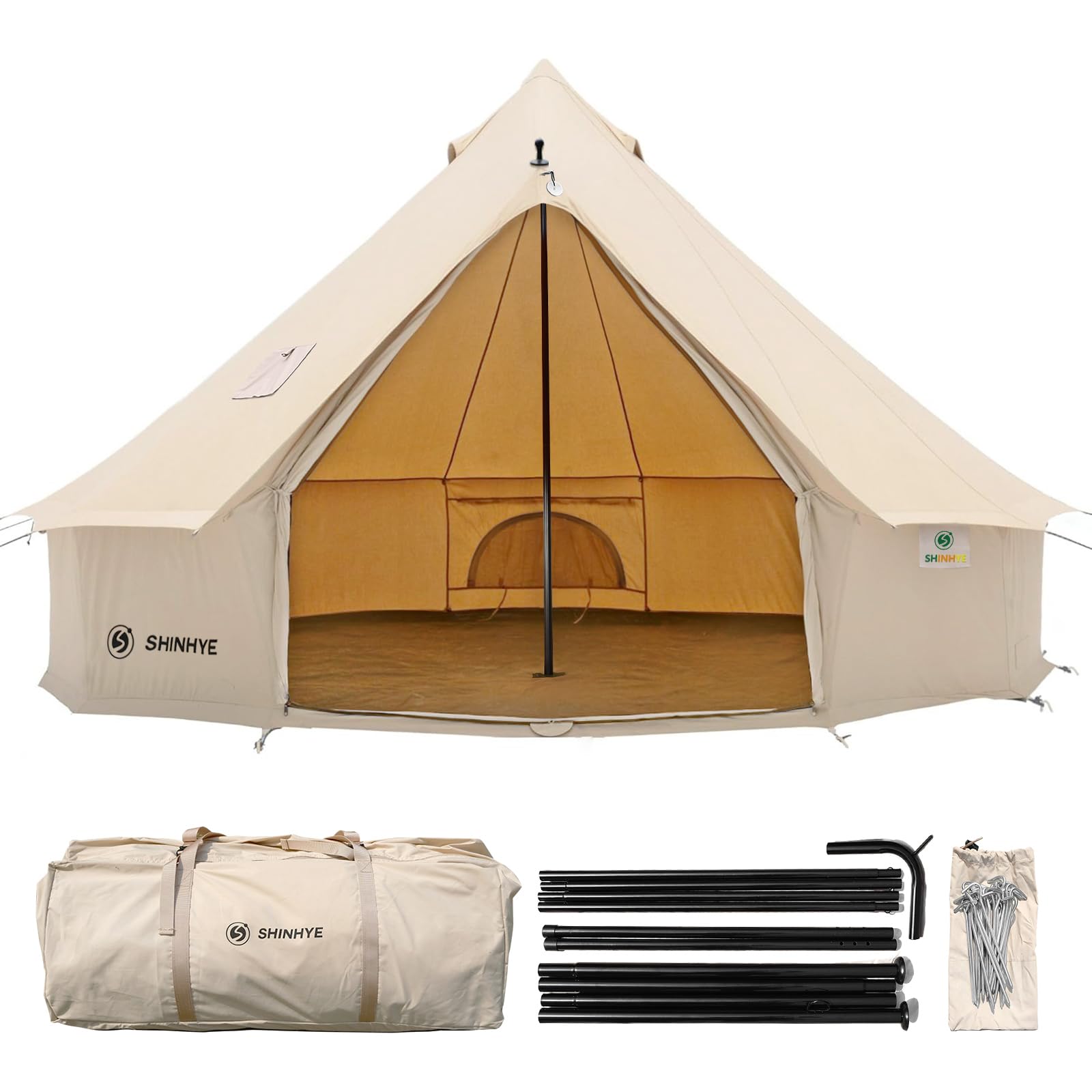
The ShinHye is the lightest tent in this group at 27 pounds, and that is the reason to consider it. A 9.8-foot bell with a 7.22-foot peak goes up with one center pole and a ring of guylines, so one person can manage it without a wrestling match. The cotton shell carries a 5,000 mm waterproof rating and a PE floor, and the stove jack gives it a second life in cold weather.

We like the 13 guylines, the three windows, and the 365-day warranty; those are the details that make a budget tent feel less like a compromise. The PE floor is a practical choice for damp ground, and the cotton walls should breathe better than a coated synthetic shell. Setup is listed at 15 minutes, which is realistic for a bell of this size.

Water resistance is the area to watch. The coating is there, but a seam seal and a footprint are sensible before a wet trip, and the groundsheet is the first place to check after rain. That is not a reason to skip the tent; it is the maintenance a lightweight canvas shelter asks for.

Where it fits is a couple or solo camper who wants a cold-weather-capable bell without the weight of a family model. It is the lightest route here into a stove jack, and for the right camper that is enough.

Pros

  • Lightest at 27 pounds
  • 5,000 mm waterproof-rated cotton shell
  • Stove jack, 13 guylines, and three windows
  • 365-day warranty

Cons

  • Stated capacity is only two people
Our verdict

For solo campers and couples, the ShinHye is the lightest stove-ready bell here, and its 5,000 mm shell and 365-day warranty make it a sensible small-tent buy.

Check Latest Price

How We Tested Canvas Tents, From Backyard to Base Camp

We started with two dozen canvas tents sold in the U.S. and cut the list using spec sheets: fabric weight (8.5-ounce versus 10-ounce cotton), footprint and peak height, whether the stove jack was pre-cut or sold as an add-on, sewn-in versus clipped-in floors, and packed weight. Anything advertising canvas but shipping a poly-cotton blend came off, as did tents with no published weight. Six made the cut.

Testing ran nine months, and it wasn't lab work. One tent stayed pitched in my backyard from spring into the first frost, taking whatever rain and wind came through, while the others went out on a windy ridge weekend, a frosty October trip, and a family car-camping week with four people and a dog moving in and out all day. I timed every solo pitch with a stopwatch, stakes and guy lines included, and weighed each packed bag on a bathroom scale before hauling it to the car.

Water resistance got the garden hose: ten minutes of steady spray over the roof and one wall, then a check of the seams, the stove jack collar, and the line where the walls meet the floor. For stability I leaned my weight into the walls and shook the frame at the peak to see how much the poles flexed and which guy lines went slack. Zippers got used the way you actually use them, from inside at night with a headlamp, watching whether door fabric caught in the teeth. To judge size, I taped the floor and laid out a queen air mattress, two duffels, and a camp chair. Durability showed up in the small things: scuffed stake loops, seams that stayed taut after a wet night, and how the canvas smelled after a deliberately damp pack-down.

How to Choose a Canvas Tent

Pick the shape around the trip

Bell and yurt tents shed wind and rain well, and their single peak makes them efficient to heat with a stove; the trade-off is sloped walls that limit furniture and headroom at the edges. Cabin tents give you vertical walls, more usable floor space, and often better storage, but they are heavier and can catch wind. We reach for a bell when a stove and a simple pitch matter most, and a cabin when the trip is about cots, gear, and standing room. The Regatta and Kodiak show the difference clearly.

Read the fabric before the waterproof label

Canvas is not one material. Cotton duck, like the Kodiak's Hydra-Shield shell, breathes and gets stronger when wet but is heavy; TC cotton-poly blends, like the VEVOR and TOMOUNT, dry faster and cost less, while an Oxford wall is a synthetic panel rather than canvas. We treat a hydrostatic rating as a starting point, not a promise: seams, floor zips, and the gap between the wall and ground are where water usually enters. Plan to seam-seal a new tent and use a footprint; if you expect days of rain, choose a tent whose floor and seams are as considered as its shell.

Weight and setup decide how often you use it

Canvas tents are heavy because the fabric and poles are heavy. A 27-pound bell is a solo camper's tent; a 60- to 71-pound cabin is a vehicle-camping tent and should be treated that way. The same goes for setup: one strong person can raise a small bell, but a large cabin with a steel frame is easier with two. Before you buy, decide how far you'll carry the bag from the car and whether you'll pitch it alone in the rain. That answer rules out more tents than the capacity label does.

Stove jacks are only the beginning of cold-weather use

A stove jack makes a tent stove-compatible; it does not make it warm, safe, or condensation-free on its own. Check the jack's diameter and flame-resistant flap against your stove and flue, keep the required clearance from canvas, and use a carbon monoxide alarm every time. Ventilation matters even in freezing weather: a roof vent or window cracked open lets moist air escape. We think of a breathable cotton shell and a sealed floor as helpers, but the stove, the pitch, and your habits do most of the work.

Capacity is not the same as livable space

Person ratings assume sleeping mats and nothing else. Two campers with cots, a stove, and gear need more room than four people on pads, and a 10-by-10 cabin feels different from a 9.8-foot bell even when both are rated for a family. Compare floor area, peak height, and door placement, then think about where the stove or gear will go. If you want a dining table or a group gathering, the TOMOUNT's 218 square feet is a different category of shelter from a four-person cabin.

Frequently Asked Questions

Final Verdict

For most campers, the White Duck Regatta is the canvas tent we point to first. It has the size to work for a couple or small family, the breathable cotton shell and stove jack to stretch the season, and the weather protection to handle a wet weekend without turning into a sauna. Choose the Kodiak if you want a cabin with two doors and vertical walls, the VEVOR if budget and lighter weight matter more than exposed-site toughness, or the TOMOUNT if you're sheltering a group. Those are the decisions that change the pick.