Best Electric Knife Sharpeners of 2026

An electric sharpener promises a usable edge in under a minute, and the quiet fear is that it gets there by shaving years off your favorite knife. That tradeoff, speed against how much steel disappears, runs through every model in this category. What a good one actually fixes is more mundane: a drawer of knives that skate off tomato skins and crush instead of cut, brought back without you learning to hold a 15-degree angle by hand.

I keep a drawer of hard-used knives, including a boning knife, a bread knife, and the cheap paring knife that opens packages, and over eight months my team ran 12 electric sharpeners against all of them. The ones worth owning share a few habits: they hold the blade steady instead of letting it chatter, they tell you plainly which slot does what, and they stay put while the motor runs. The thing first-time buyers rarely account for is that a fast, aggressive edge is not the same as a good one. It feels impressive for a week, then leaves you with a thin, tired blade. The picks below are the ones I would still hand to someone with a good knife and no patience.

1

Best Overall

Work Sharp MK2

95 /100
Angler Score Outstanding

Key details

Motor
Two-speed
Warranty
3 years
Also Sharpens
Scissors, axes, garden tools
Sharpening Method
Flexible abrasive belts
Check Details on Amazon

Flexible abrasive belts are the reason the Work Sharp MK2 is the pick at the top of this list. Rather than dragging a blade through a fixed slot, you rest it in the edge guide and let a moving belt wrap the edge, so the same machine takes a chef's knife, a serrated bread knife, a pair of scissors and an axe. Nothing else here covers that spread, and the two-speed motor is what makes it practical: slow for a thin kitchen blade, fast for a mower blade that needs grinding.

In use it's quick and forgiving. Set the blade against the guide, switch on and draw it through in a single pass, and the belt holds the angle so your hand doesn't have to. The edge that comes off the fine belt bites into a tomato instead of skating across the skin, and a full block of kitchen knives is one sitting rather than an afternoon.

The one thing a belt asks of you is a light hand at the tip. There's real room for beginner mistakes, so watch the sharpening videos before the first knife and keep your passes short. Changing grits is a matter of seconds, and ours lives in a drawer between sessions — it's smaller than the photos suggest and easy to move with one hand.

Pros

  • Sharpens kitchen knives, scissors and garden tools
  • Flexible belts follow serrated and curved edges
  • Two speeds for delicate blades and heavy grinding
  • Three-year warranty

Cons

  • Replacement belts are an ongoing cost
Our verdict

If you want one powered sharpener for kitchen knives, pocket knives and garden tools, the MK2 is our pick: fast, forgiving, and backed by a three-year warranty.
Check Latest Price
2

Best for 15-Degree Edges

Chef'sChoice 15XV

93 /100
Angler Score Outstanding

Key details

Stages
3
Weight
4.2 lb
Abrasives
100% diamond
Edge Angle
15 degrees
Check Details on Amazon

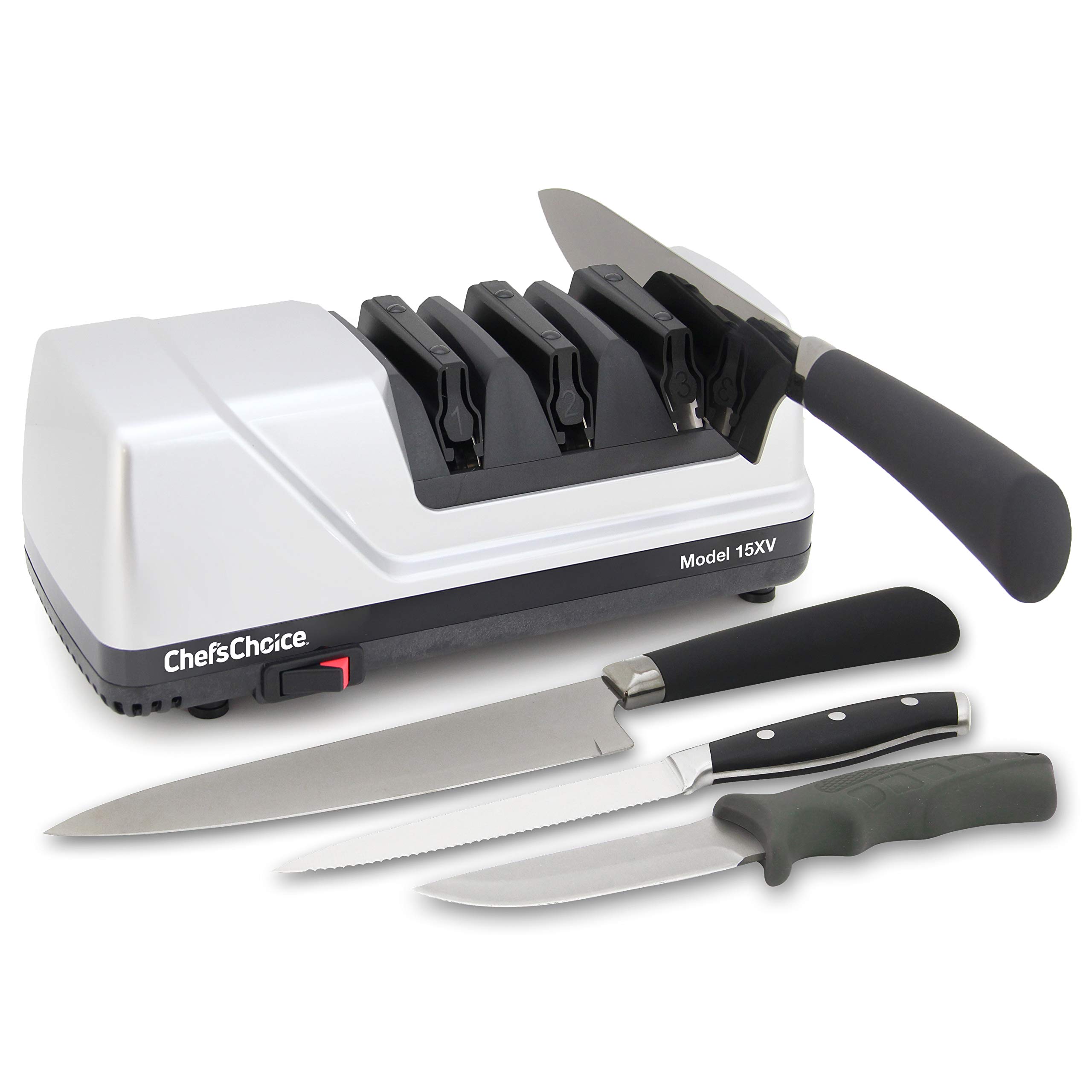
Chef'sChoice builds the 15XV around one promise: it takes the 20-degree factory edge on European and American knives and recuts it at 15 degrees, the shallower angle Japanese blades are ground to. Three stages do the work, two diamond abrasive wheels and a flexible stropping disk, and spring-loaded guides adjust themselves to hold the blade steady as you pull it through.

For a kitchen where the knives are the point, this is the sharpest edge we got out of a guided-slot machine, and it's the one to buy if you never intend to sharpen anything but knives. The conversion isn't a marketing line: a 15-degree edge meets food differently, and once a block has been through all three stages the change shows up on tomatoes, on raw fish, on anything that used to squash before it cut.

At 4.2 pounds it's the heaviest machine here, and it feels built for a session: set it up, work through the drawer, put it away. The manual is better than this category usually gets, telling you which stage each knife needs, and that matters because the wrong stage on a good blade is how edges get chewed up.

The stropping stage is the part we keep coming back to. A few seconds per knife in stage 3 takes an edge from sharp to polished, and it's the step that separates this from a two-stage machine that only grinds.

Pros

  • Three diamond stages leave a polished edge
  • Sharpens serrated as well as straight blades
  • Self-adjusting guides hold the angle for you

Cons

  • Can scuff the flat of the blade
  • Rubber feet can work loose and leave it rocking
Our verdict

The 15XV is the kitchen specialist: it converts a whole block to a polished 15-degree edge and asks only that you follow the manual.

Check Latest Price
3

Best for Adjustable Angles

Work Sharp Ken Onion Mk2

90 /100
Angler Score Outstanding

Key details

Motor
Variable speed
Weight
2 lb
Warranty
3 years
Angle Range
15 to 30 degrees
Check Details on Amazon

The dial is the whole point of the Ken Onion Mk2. It sets the bevel anywhere from 15 to 30 degrees, which makes it the only machine here that can give a thin fillet knife and a thick hunting blade the angles they each want. If your sharpening pile includes outdoor gear, this is the one we point you to.

Underneath the dial it's the same belt system as the MK2: quick-change abrasives you swap in seconds, an edge guide that supports the blade, and a variable-speed motor that slows for a delicate finish and speeds up to reprofile a chipped edge. Scissors, shears, serrated blades and garden tools are all in scope, and the whole unit weighs around two pounds.

For a pure kitchen it's more machine than you need. The MK2 sharpens a chef's knife for less, and a fixed angle is one fewer decision every time you pick the thing up. Where the Ken Onion earns its price is a drawer of mixed blades, where one setting never fits all of them.

The variable speed takes a session or two to get used to. We ran everything slow at first and only sped up once we trusted our hand at the tip, and that's the order we suggest: slow until the motion is boring, then faster.

Pros

  • Dial sets any bevel from 15 to 30 degrees
  • Variable speed for finishing and reprofiling
  • Belts swap in seconds between grits

Cons

  • Costs considerably more than the fixed-angle MK2
  • Belts wear and need replacing
Our verdict

The Ken Onion Mk2 is the one we hand to hunters and anglers: its 15-to-30-degree dial is the only adjustable bevel in this group.

Check Latest Price
4

Best Budget

Presto 08800 EverSharp

91 /100
Angler Score Outstanding

Key details

Stages
2
Weight
3 lb
Wheels
Sapphirite
Warranty
1 year limited
Check Details on Amazon

Two Sapphirite wheels, one coarse and one fine, plus a pair of guides that hold the blade at the right angle. That's the entire Presto 08800, and it's the budget pick here.

It works, and it works fast. A couple of passes on each wheel brings a neglected kitchen knife back to cutting, the job is over in about two minutes, and there's no angle for you to hold or stage sequence to remember. For someone who has never sharpened a knife and doesn't want a new hobby, that simplicity is the feature.

The edge it leaves is a good working edge rather than a showpiece. It goes through a tomato and takes the fight out of an onion, but it won't feel like a knife that just came back from a professional. You do hold the blade flat against the guides yourself, and that's the one skill the machine asks for.

At three pounds it moves easily from cupboard to counter and back, and it doesn't claim the counter space of the bigger Chef'sChoice machines. Ours goes back in the cupboard once the drawer of knives is done.

Pros

  • Two stages take a dull blade to a working edge
  • No angle to hold or stages to sequence
  • Light enough to store in a cupboard

Cons

  • No serrated-blade support
  • One-year limited warranty
Our verdict

The 08800 is our budget pick: two stages, nothing to learn, and a workable edge on a drawer of kitchen knives in minutes.

Check Latest Price
5

Compact 20-Degree Edges

Chef'sChoice Hybrid 250

91 /100
Angler Score Outstanding

Key details

Stages
3, electric and manual
Weight
2.7 lb
Abrasives
Diamond
Edge Angle
20 degrees
Check Details on Amazon

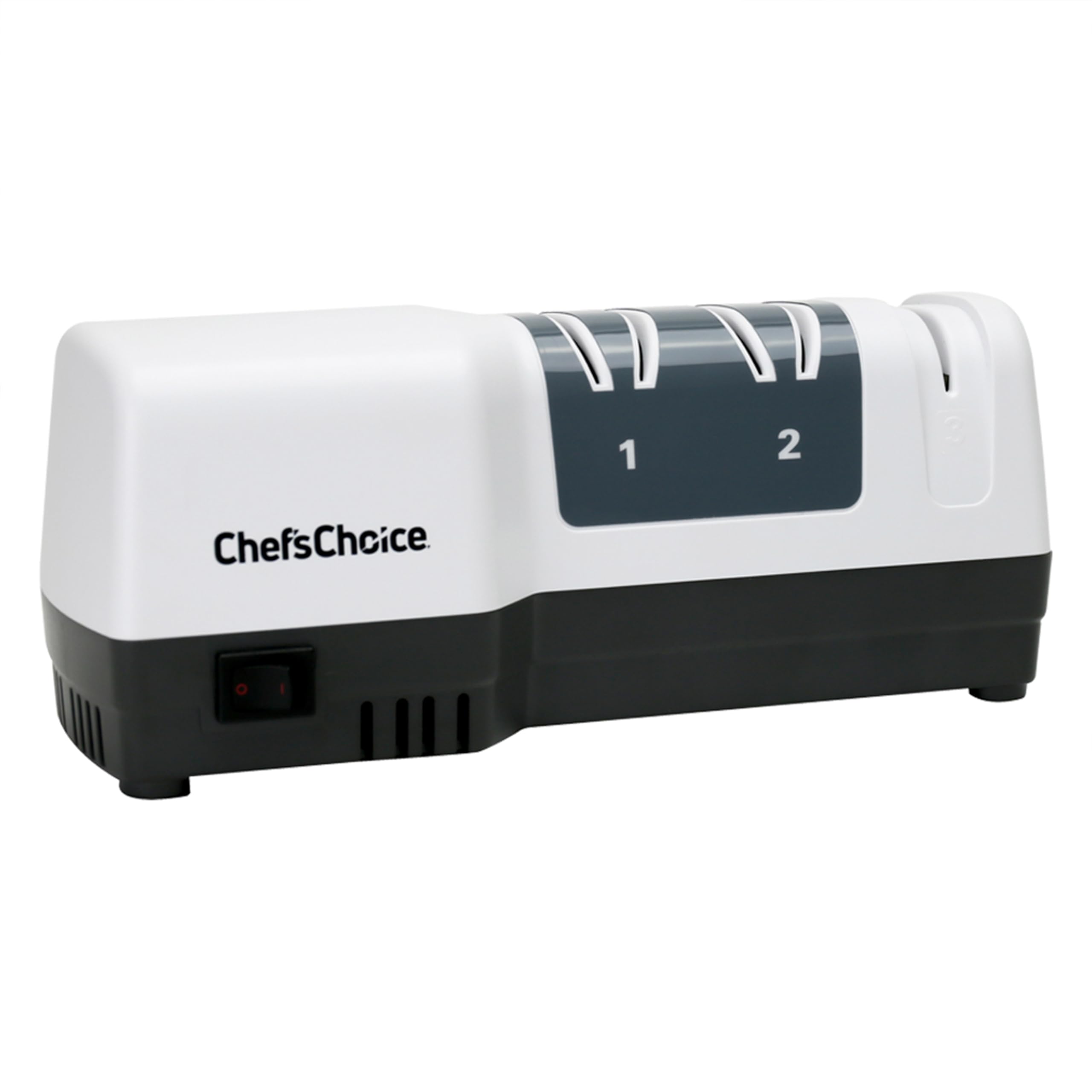
Most electric sharpeners do all their work with the motor running. The Chef'sChoice Hybrid 250 splits the job: the first two stages are powered diamond abrasives, and the third is a manual stropping stage you work by hand.

That last stage is the interesting one. Finishing the edge yourself, a few strokes at a time, gives you the last word on how polished it gets, which is more control than a machine that decides for you. It's also a small thing at 2.7 pounds and under nine inches long, so it sits on a crowded counter without an argument.

It cuts a 20-degree edge, the angle most European and American knives are ground to, and it takes serrated blades as well as straight ones. For a block of German steel this is the sensible middle of the range: far less than the 15XV and enough machine for a home kitchen.

One thing to guard against: the failures that happen come early, in the first few sessions. Run the whole block through it while the return window is still open, and you'll know quickly whether you got a good one.

Pros

  • Manual stropping stage for a controlled finish
  • Compact footprint for a crowded counter
  • Diamond abrasives in the powered stages

Cons

  • Cuts a 20-degree edge only
Our verdict

The Hybrid 250 is our pick for a block of 20-degree European knives, with a manual finishing stage that gives you the last word on the edge.

Check Latest Price
6

Small-Space Touch-Ups

Narcissus QN-M866

89 /100
Angler Score Excellent

Key details

Motor
30-watt DC
Stages
2
Weight
1.6 lb
Also Sharpens
Scissors
Check Details on Amazon

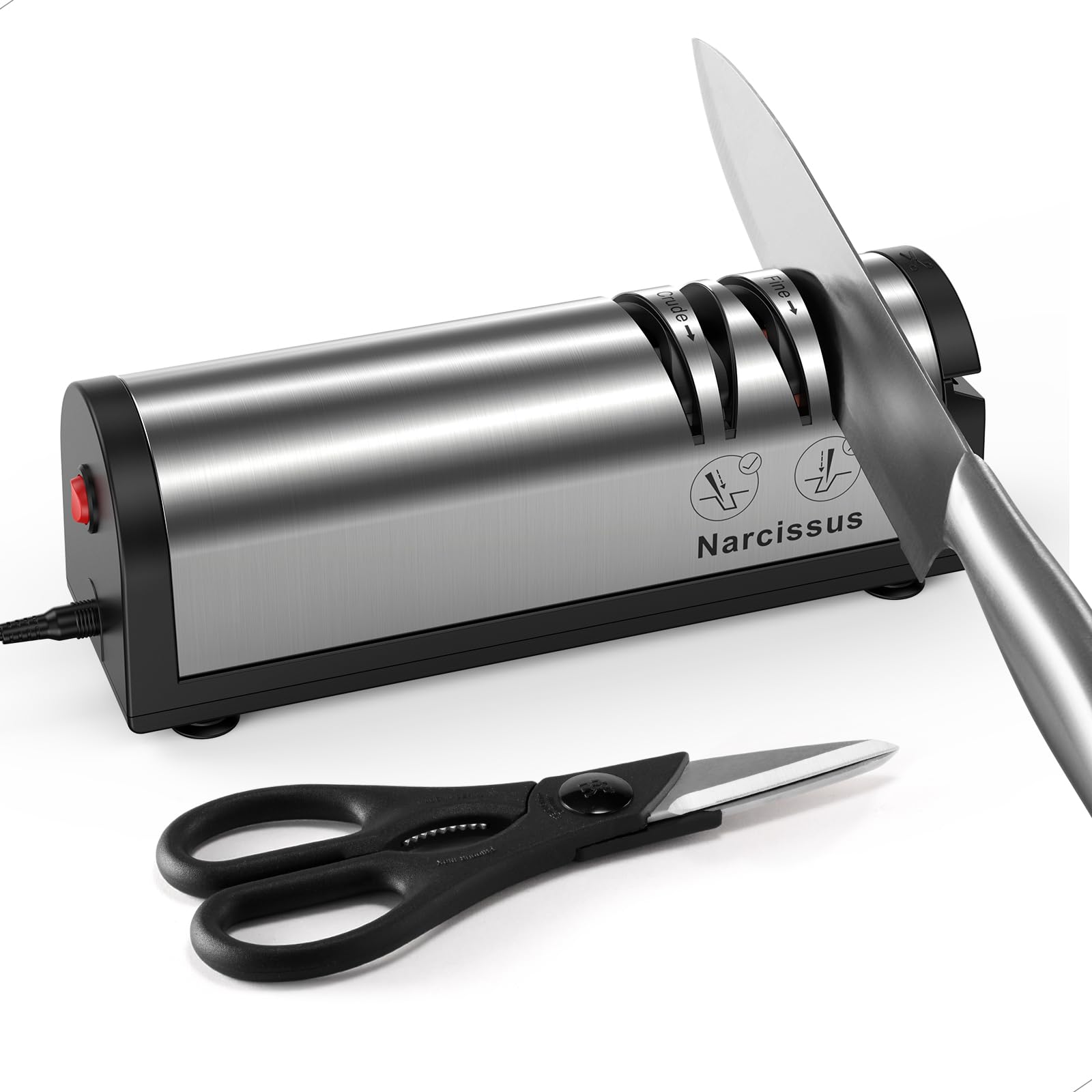
At 1.6 pounds and under nine inches long, the Narcissus is the only sharpener here that genuinely disappears into a drawer, and the only one with a metal-dust collection box sitting under the wheels.

The details are what we noticed first: a scissors slot on the side, a dust box that catches the filings instead of leaving grey powder on the counter, and a 30-watt motor rated to run continuously for over an hour, long enough to work through a drawer without stopping to let it cool.

Where it fits is as a touch-up machine. A mildly dull knife comes back sharp and a pair of kitchen scissors gets a second life, but results get uneven once a blade is properly neglected, so this isn't the machine to hand a drawer of abused knives.

It's the sharpener we leave out at a cabin or a second kitchen, where a full-size machine would be more than the job deserves.

Pros

  • Fits in a drawer between uses
  • Metal-dust box keeps the counter clean
  • Scissors slot adds a second job
  • Motor runs continuously for over an hour

Cons

  • Some units fail within a few uses
Our verdict

The Narcissus earns its place as the compact, low-cost option: a scissors slot, a metal-dust box and a footprint that fits a drawer.

Check Latest Price

What We Put These Sharpeners Through

We started with roughly 30 models on paper, comparing stage count, abrasive type, whether the angle was fixed or adjustable, what replacement belts and wheels cost, and whether the maker published any real guidance at all. That narrowed the field to 12 units, which we bought at retail like anyone else, and we ran them for eight months.

Testing happened in a normal kitchen, sometimes on a dampened towel and sometimes straight on the counter, with three knives that started out equally dull: a chef's knife, a serrated bread knife, and a six-dollar paring knife. Each session we timed how long it took to get from crushing a tomato to slicing one cleanly and counted the passes it took to get there. Then we turned the blade under a bright light to look for scratches near the bolster and a wavy, over-ground edge.

We also paid attention to the things that make a sharpener annoying rather than bad. Someone rested a hand lightly against the base to see if the unit crept across the counter mid-pass, and we ran each one at counter height to note whether we had to raise our voice over the motor. I read every manual cold before touching the machine and followed it exactly as written, which is how we learned that several assume you already know how much pressure to apply to the blade. And we kept feeding the same three knives back in, session after session, to see whether the edge held and whether belts or wheels wore out inside the test window. Anything that needed a replacement part before eight months, or left a blade worse than it found it, did not make the cut.

How to Choose an Electric Knife Sharpener

Abrasives: what actually cuts the steel

Every machine here removes steel with an abrasive, and the choice comes down to diamond wheels or moving belts. Diamond is the hardest cutting material in these machines and shows up across the Chef'sChoice line; the Work Sharp models use flexible belts that wrap the edge, which is why they reach into serrations and follow a curved blade.

The practical difference is upkeep. Belts are a wear item you replace, and the fine grit goes first; diamond wheels are part of the machine. If you sharpen a whole block once a month, price the belts into the decision instead of being surprised by them.

Angle: match the machine to your knives

Most European and American knives are ground at 20 degrees, most Japanese knives at 15, and a machine that only cuts one will fight the other. The Chef'sChoice 15XV converts a 20-degree block to 15, the Hybrid 250 cuts 20, and the Ken Onion dials anything from 15 to 30.

The trap is converting a whole block on impulse. Re-cutting a bevel takes several passes per knife, so decide deliberately whether you want a 15-degree kitchen and commit to it, rather than mixing angles until nobody can remember which knife wants which slot.

Guided slots or an open belt

A slot machine holds the angle while you hold the blade flat and pull. A belt machine puts the abrasive on a moving surface with an edge guide, which leaves pressure and the tip in your hands.

That's the real dividing line for buyers. If you want to think about nothing, a two-stage slot machine like the Presto 08800 produces a working edge with no technique at all. If you'll spend a few minutes learning, a belt gives you more control on a bad edge and more reach into a serrated one.

Motor, weight and where it lives

Power shows up on heavy blades. A motor that bogs down when you press turns a two-minute job into five, so let the abrasive cut rather than leaning on the knife. Two-speed or variable-speed control lets you slow the abrasive for a thin blade and speed it up for a chipped edge.

Weight and footprint decide where the machine lives. Anything around four pounds stays on the counter; the compact models go in a drawer. Check that the base grips before you commit, because a sharpener that walks across the counter is one you stop using.

Frequently Asked Questions

Final Verdict

For most households the Work Sharp MK2 is the answer. One machine covers the kitchen knives, the scissors and the tools in the shed, the two speeds keep a thin blade from being over-ground, and a three-year warranty backs a tool you'll use for years.

If the knives are the whole point and you want a polished 15-degree edge across the block, the Chef'sChoice 15XV is the specialist and worth the step up. On a tight budget, the Presto 08800 does the basics on straight-edged kitchen knives with nothing to learn.