Best Rolling Knife Sharpeners of 2026

The pull-through sharpener in my drawer lasted about a year before it started scraping more than it sharpened. What replaced it was a stone rolling across a magnetic angle guide, and I never went back — the blade stays put, the angle stays fixed, and a dull chef's knife is slicing tomatoes again in a few minutes instead of costing me an evening. That's genuinely all a rolling sharpener does: it removes the guesswork of holding a consistent angle, which is the entire difference between a knife that cuts and a knife that smears.

We've spent the last six months with 11 of them on the counter, running everything from hard Japanese steel to the flimsiest paring knife in the drawer. The gap between a good one and a maddening one comes down to two things you can't see in product photos: how firmly the magnet grabs the blade and how smoothly the disc rolls. Get those right and the rest — price, included extras, cleanup — mostly sorts itself out. Here's what held up.

1

Best Overall

HORL 3 Cruise

91 /100
Angler Score Outstanding

Key details

Discs
Diamond and stainless steel
Footprint
5.2 x 4.7 x 2.6 in
Magnetic Holder
Grip pad angle support
Sharpening Angles
15° and 20°
Check Details on Amazon

The HORL 3 Cruise puts both the 15° and 20° seats on one magnetic support, so the blade stays put while the roller travels across the diamond disc and then the stainless steel honing disc. That two-disc sequence is the whole appeal: the diamond does the cutting, and the steel disc cleans up the burr instead of leaving a toothy edge. Switching from a European chef's knife to a thinner Japanese blade is a matter of moving to the other seat, not finding a second holder.

What makes this our top pick is how little ceremony it asks for. The grip pad holds the blade firmly enough that the roller can do the work, and the angle stays consistent without you clamping your wrist. We found it easy to explain to someone who has never used a whetstone: set the blade, roll, switch discs, hone. The two-step abrasive sequence is short enough that the whole job feels like a routine rather than a project.

Against the HORL 2 Walnut, the Cruise is the simpler, less expensive way into the system. You give up replaceable discs and the walnut body, and you get the same two angles with less to think about. For most home cooks, that is the right trade; the Cruise has stayed within reach on our counter rather than being buried in a drawer.

Pros

  • Two angles on one magnetic support
  • Diamond and steel honing discs
  • Grip pad holds the blade steady
  • Simple routine for first-time sharpeners

Cons

  • Premium price for a compact kit
Our verdict

We recommend the HORL 3 Cruise first because its magnetic two-angle support makes a consistent edge easy to repeat, even if you have never sharpened on a stone.

Check Latest Price
2

Best for Small Blades

HONE Rolling Sharpener

87 /100
Angler Score Excellent

Key details

Body
Aluminum and stainless steel
Plates
Dual-sided diamond plates
Sharpening Angles
15° and 20°
Small-blade Support
Dedicated small-knife slot
Check Details on Amazon

The HONE's small-knife slot is the feature that makes it worth its space in a crowded drawer. Most rolling sharpeners assume a broad chef's knife with a flat section long enough to grab the magnet; the HONE adds a dedicated slot for paring and utility blades, so the tip and heel have somewhere to register. The diamond plates are double-sided, and the ball-bearing roller turns with a light, even feel.

We were struck by how much more controlled the HONE feels than the wood-bodied kits here. The aluminum and stainless body feels solid, the rubber base grips the counter, and the magnetic holder keeps a chef's knife from skating. The dual-sided plates are easy to remove and reseat, which matters if you want to keep the abrasive clean instead of letting compacted steel sit on the surface. It is a more mechanical object than the HORL 3, and that suits anyone who likes to see how the tool works.

Where it gives ground is speed on a neglected edge. A knife that has gone months without attention needs patience, and the HONE rewards light, repeated passes rather than pressure. Against the HORL 3, it is the better pick when small blades matter and the less obvious pick when you want the simplest possible routine. We kept it for the paring knives and reached for the HORL when a chef's knife needed a quick refresh.

Pros

  • Dedicated slot for small knives
  • Dual-sided diamond plates
  • Smooth ball-bearing rolling action
  • Solid aluminum and stainless body

Cons

  • Pricier than our top pick
Our verdict

We reach for the HONE when small blades are in the mix: its dedicated slot and smooth ball-bearing roll make paring knives easier to sharpen than most rolling kits manage.

Check Latest Price
3

Best Adjustable

Parkway Adjustable Rolling Sharpener

86 /100
Angler Score Excellent

Key details

Plates
#400 and #800 diamond, #1000 ceramic
Included
Travel case
Angle Range
10° to 40°
Height Adjustment
For cleavers and butcher knives
Check Details on Amazon

The Parkway Home base is the adjustable one: a knob sets any angle from 10° to 40°, and the holder rises so a tall cleaver or butcher knife clears the abrasive. That is a different approach from the fixed 15°/20° blocks most rolling sharpeners use. If your drawer runs from a thin slicer to a heavy cleaver, the Parkway is the one that can meet those blades where they are instead of asking them to fit two preset angles.

The three plates give you a useful sequence: #400 and #800 diamond for shaping, then a #1000 ceramic for finishing, and the whole kit packs into a travel case. We found the height adjustment especially practical for large knives, where a low holder can leave the edge sitting at an awkward height. The trade is that the Parkway asks you to think about the setting; it is not a grab-and-roll tool in the way the HORL 3 is.

For a mixed collection that includes cleavers, outdoor knives, or unusual bevels, the adjustability is worth the extra attention. For a standard set of kitchen knives, the simpler two-angle kits are easier to live with. The Parkway's real appeal is range, not speed, and it earns its place when no single pair of angles covers your knives.

Pros

  • Adjustable from 10° to 40°
  • Raised holder clears tall cleavers
  • Three plates from #400 to #1000
  • Travel case keeps the kit together

Cons

  • Magnet can be marginal on narrow blades
Our verdict

Choose the Parkway if your knives do not fit a 15° or 20° assumption; its adjustable angle and height make cleavers and mixed collections far less awkward.

Check Latest Price
4

Best Long-Term Buy

HORL 2 Walnut

91 /100
Angler Score Outstanding

Key details

Body
Natural walnut
Discs
Replaceable diamond and ceramic
Weight
1.74 lb
Sharpening Angles
15° and 20°
Check Details on Amazon

The HORL 2 Walnut is the version to choose if you want the abrasives to be replaceable. Its diamond and ceramic discs come off the roller, so the sharpener can be refreshed rather than retired when the surface eventually wears. The walnut body is a genuine pleasure to handle, warm and solid without feeling precious, and the two angle seats cover the same 15° and 20° ground as the Cruise.

We kept coming back to the feel of the roll: the ball bearings are smooth, the magnetic holder sets the blade cleanly, and the ceramic disc leaves a finer edge than the diamond alone. That combination makes it the most satisfying HORL to use, even though it is not the fastest way to sharpen a very dull knife. It is also the one we choose when we want a single tool to live on the counter for years, because the wear parts can be changed.

Compared with the Cruise, the differences are the replaceable discs and the walnut body rather than the angles or the sharpening motion. If you like the idea of keeping a sharpener rather than replacing a sealed unit, this is the HORL to get. If you mainly want a simple two-angle kit and don't care about swapping discs, the Cruise is the more straightforward choice.

Pros

  • Replaceable diamond and ceramic discs
  • Smooth ball-bearing roll
  • Natural walnut body looks good on the counter

Cons

  • Premium price for the same two-angle range
Our verdict

We choose the HORL 2 Walnut when we want a sharpener we can keep and refresh, thanks to replaceable discs and a beautifully made walnut body.

Check Latest Price
5

Best Budget

AIERLIAN Rolling Sharpener

88 /100
Angler Score Excellent

Key details

Magnets
Four N42 magnets
Included
Leather strop and gift box
Abrasives
#400 diamond, #3000 ceramic
Sharpening Angles
15° and 20°
Check Details on Amazon

The AIERLIAN kit is the budget pick we keep recommending because it includes the pieces that make rolling sharpening click: a 15°/20° magnetic support, a #400 diamond disc, a #3000 ceramic disc, and a leather strop. You get the full sequence in one box, and the wooden holder looks more considered than the price suggests. For a household with ordinary stainless knives, it covers the job without asking for a big commitment.

The four N42 magnets hold a chef's knife well enough for controlled passes, but the support is not as sure with a narrow paring blade; keep a finger behind the spine and use lighter pressure on thin stock. The roller turns smoothly, and the diamond disc removes material at a useful rate without feeling aggressive. The leather strop is a nice extra: a few passes after the ceramic disc make the edge feel cleaner on tomatoes and herbs.

Against the HORL 3, the AIERLIAN feels lighter and less precise, and the finish is more gift-shop than heirloom. Even so, it sharpens, it includes a strop, and it leaves room in the budget for a decent honing steel. That is a sensible trade for a first kit, especially if you are upgrading from a pull-through and want to learn what a consistent angle feels like.

Pros

  • Complete kit includes a leather strop
  • #400 diamond and #3000 ceramic discs
  • Four strong N42 magnets

Cons

  • Abrasive disc can work loose from roller
Our verdict

We see the AIERLIAN as the budget pick for a normal kitchen: it covers both angles, includes a strop, and keeps the whole routine affordable.

Check Latest Price
6

First-Time Sharpening

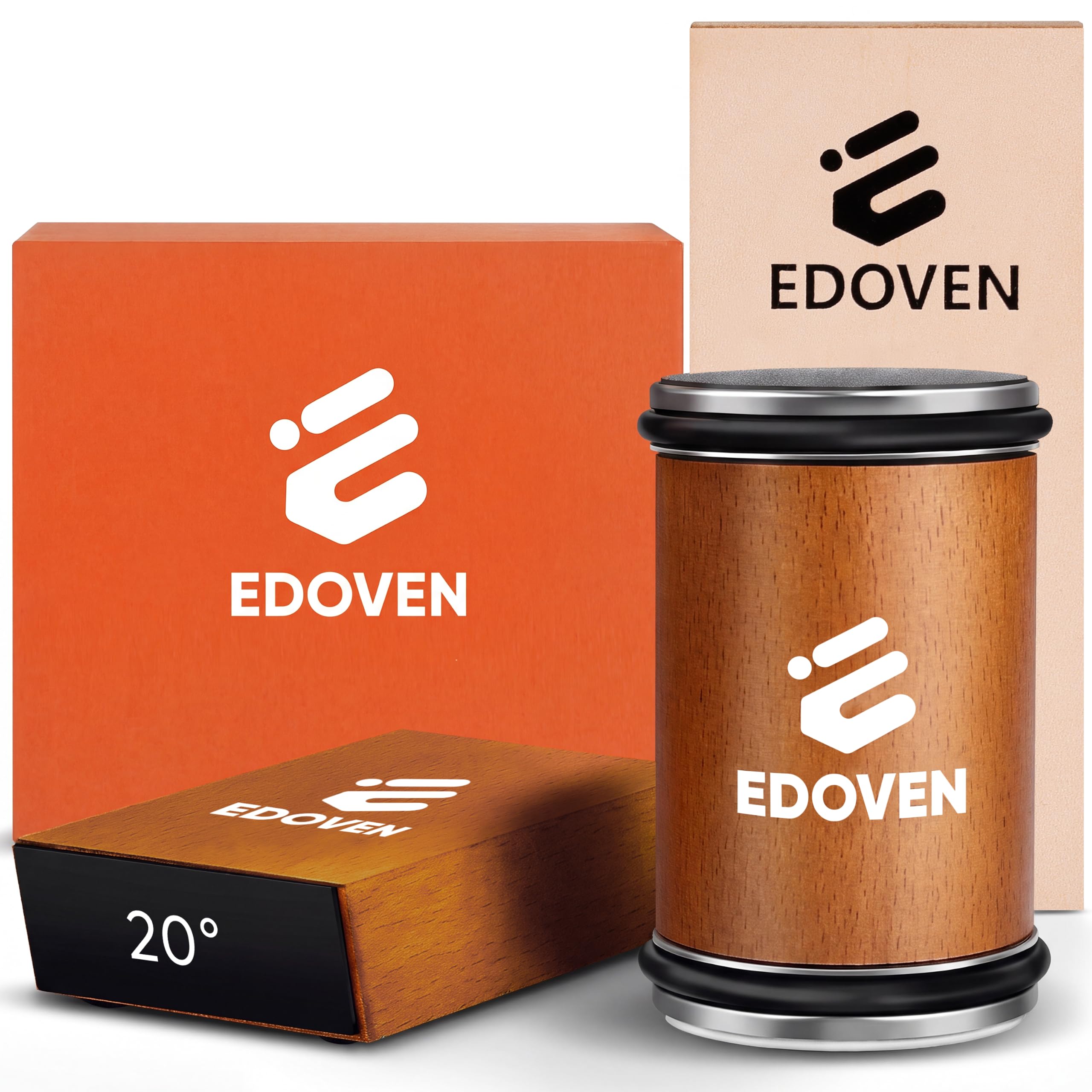
EDOVEN Rolling Sharpener Kit

86 /100
Angler Score Excellent

Key details

Included
Leather strop
Abrasives
400-grit diamond, 6000-grit ceramic
Dimensions
2.5 x 2.5 x 3.5 in
Sharpening Angles
15° and 20°
Check Details on Amazon

The EDOVEN kit's leather strop is the detail that separates it from the other budget sharpeners here. After the 400-grit diamond disc and the 6000-grit ceramic disc, you draw the blade across the strop to clean up the edge; it is a small extra step that makes the finish feel more deliberate. The 15° and 20° magnetic guide is fixed, so there is no adjustment knob to learn.

We found the compact roller easy to control, and the holder has enough surface for a chef's knife without crowding the counter. The 6000-grit ceramic is finer than most kits at this level, which makes it pleasant for maintenance and leaves a smooth finish after the diamond. The strop is the part that earns its place: a few light passes after the ceramic leave the edge feeling cleaner than the ceramic alone.

For a first rolling sharpener, the EDOVEN is a low-risk way to learn the motion and the sequence. It is not the tool we reach for when a knife needs real repair, and the fixed two-angle guide will not suit a drawer full of unusual blades. But if you have a standard set of kitchen knives and want to stop paying for professional sharpening, this kit gives you the habit without the learning curve of a stone.

Pros

  • Leather strop adds a finishing step
  • Fine 6000-grit ceramic disc
  • Compact 15°/20° magnetic guide

Cons

  • Thin blades can slide on the magnet
Our verdict

We like the EDOVEN for a first kit because the added leather strop turns a basic two-disc sharpener into a more complete finishing routine.

Check Latest Price

How We Tested Rolling Knife Sharpeners (and Kept Re-Testing Them)

We started with more than 20 rolling sharpeners pulled from retailer listings and knife-forum threads, then narrowed by three filters: does it offer both a 15- and a 20-degree guide, can the abrasive plates be replaced once they wear, and does the price make sense against what actually ships in the box. That left 11 units, which we ran for six months on the same rotation of kitchen knives — a chef's knife, a santoku, a couple of paring knives, and one hard-steel blade that tends to shrug off soft abrasives.

Most of the work happened on a Sunday afternoon counter, sharpening whatever had gone dull during the week. We counted rolling passes until a burr came up that we could feel with a fingernail, flipped the blade, and repeated the count on the other side, then finished by slicing a ripe tomato and shaving a sheet of paper. A good sharpener broke the tomato skin under the blade's own weight; a poor one needed pressure and left a ragged, bruised cut.

The magnet got its own test. We set each blade on the holder, turned the whole thing upside down over the sink, and gave the knife a nudge to see whether it slid. We also timed setup from unboxing to first pass, swapped discs and plates by hand, and cleaned them the way a normal person would — a damp cloth and no ceremony.

Because six months is long enough to expose weak parts, we re-sharpened the same three knives every couple of weeks and kept notes on the bearings (grinding or glass-smooth), the magnet (still flush, or drifting out of alignment), and the housing (hairline cracks at the seams). We tallied what came in each box, too, since a sharpener that throws in a strop and spare plates is a very different value than one that charges for them separately.

How to Choose a Rolling Knife Sharpener

Match the angles to your knives

Start with the knives you actually own. A fixed 15°/20° support covers most Western kitchen knives at 20° and thinner Japanese or specialty blades at 15°, and it removes a decision every time you sharpen. An adjustable base such as the Parkway Home's 10° to 40° range is the better call if you also sharpen cleavers, outdoor knives, or unusual bevels. More angles only help if you will use them; otherwise they add setup. Check that the guide is marked clearly and that you can switch seats without re-reading the instructions.

Look for a shaping and finishing sequence

One abrasive cannot do everything well. A diamond disc removes steel and sets the edge; a ceramic, steel, or leather step refines it and removes the burr. The HORL 3 uses diamond followed by a stainless steel honing disc, while the AIERLIAN pairs #400 diamond with #3000 ceramic and a strop. Don't chase the highest grit number on its own: a very fine ceramic will polish an edge but won't rescue a dull one without a coarser diamond step. A complete sequence is more useful than a single impressive grit rating.

Test the hold before you trust the angle

The magnet is what keeps the blade from skating, and it is the first place a rolling sharpener feels cheap. A strong hold matters most with narrow paring knives, thin fillet blades, and any knife with a short flat section; a broad chef's knife can feel secure on a holder that lets a smaller blade shift. The HONE addresses this with a dedicated small-knife slot, while most other kits expect you to keep a finger behind the spine. Before a full pass, set the blade on the holder and press gently; if the edge lifts or the tip drifts, adjust your position.

Decide whether you want to replace the abrasive

Rolling sharpeners wear at the disc, not the handle. A fixed-disc model such as the HORL 3 is simpler and has fewer parts to lose, but when the abrasive dulls you replace the unit rather than the disc. The HORL 2 Walnut uses removable diamond and ceramic discs, which makes more sense if you plan to keep one sharpener for years and want to refresh the wear parts. Check whether replacement discs are part of the design before you pay for a premium body; wood and metal look nice, but they don't sharpen.

Frequently Asked Questions

Final Verdict

The HORL 3 Cruise is the rolling sharpener we recommend first because it makes the angle the easy part: the blade sits on one magnetic support, and the diamond and steel discs handle the rest. If your knives include cleavers or unusual bevels, the Parkway Home's adjustable base is the better fit; if paring knives dominate, the HONE's small-blade slot earns the space. For a first kit on a tight budget, the AIERLIAN covers the essentials.