Best Knife Sharpeners of 2026

A dull knife is more dangerous than a sharp one — every cook hears it eventually, right after a slip. What gets discussed less is the trade-off built into sharpeners themselves: the tools that restore an edge fastest tend to chew through the most steel, and the ones gentlest on your blades demand patience and a steady hand. Get it wrong and you're left with a drawer of knives quietly losing their edges, or a sharpener that stays in the cupboard because it's a chore. Over the past eight months, our team has worked through 12 of them — pull-through gadgets, electric multi-stage machines, water stones, and pocket field sharpeners — on a rotating pile of kitchen and camping knives.

The surprise, for me, was how little price predicted results. A cheap pull-through and a bench-top electric can both leave you with a tomato-slicing edge; what separates them is how much steel they remove getting there and whether you'll actually reach for them. One thing first-time buyers rarely hear: a consistent angle matters more than grit numbers or wattage — wobble at fifteen degrees and a fine stone won't save you. The picks below are the ones that held their angle and didn't wreck a blade along the way.

1

Best Overall

Work Sharp Guided Field Sharpener

96 /100
Angler Score Outstanding

Key details

Weight
4.6 oz
Warranty
Limited lifetime, abrasives excluded
Abrasives
220/600 diamond plates, ceramic rods, leather strop
Angle Guides
Built-in 20° and 25°
Check Details on Amazon

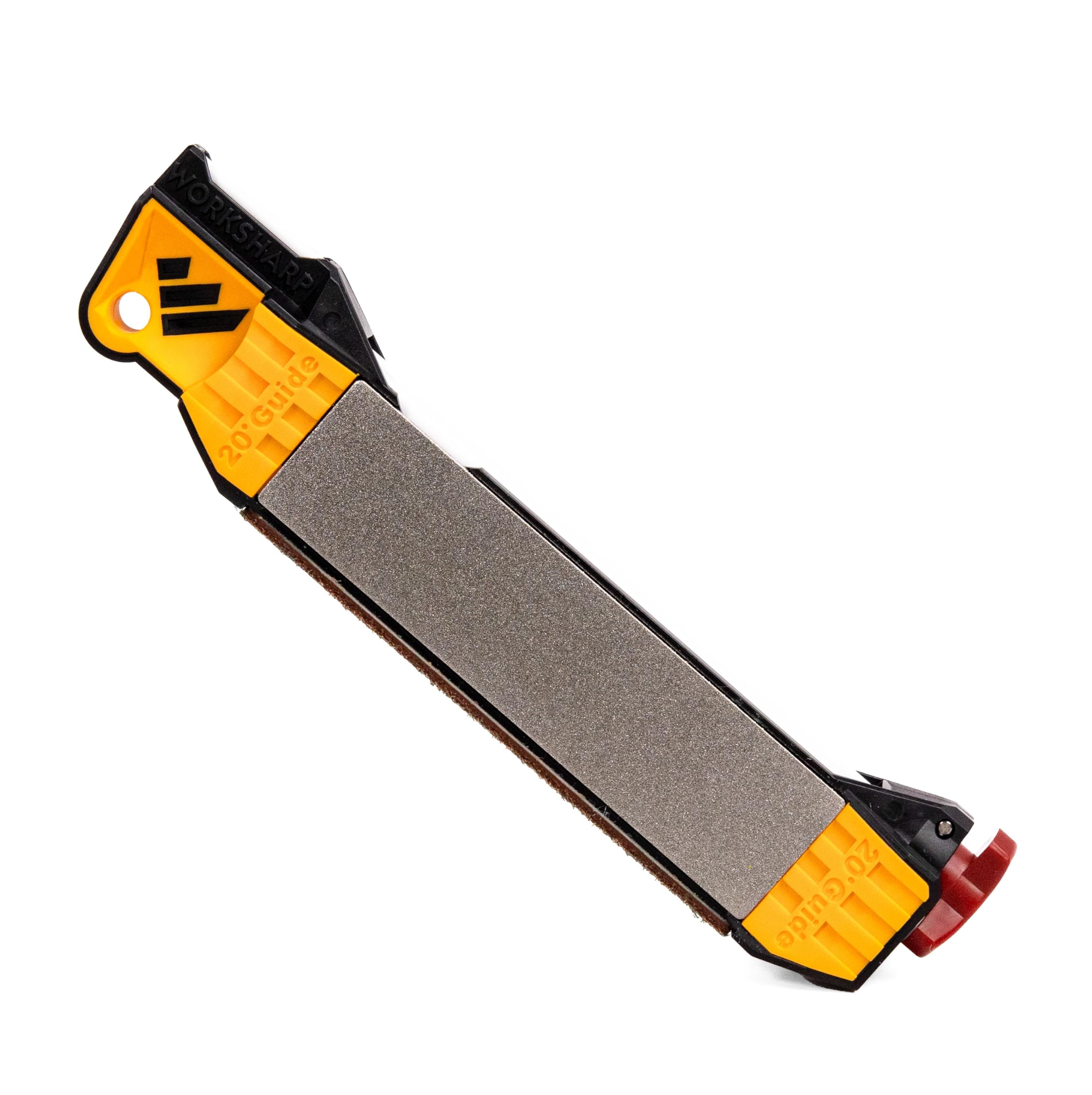
Most sharpeners make you choose: a pocket hone that touches up an edge, or a bench setup that rebuilds one. The Work Sharp Guided Field Sharpener does both. Five surfaces run from a 220-grit diamond plate through a 600-grit plate, ceramic rods, and a leather strop, so a nicked fillet knife and a tired chef's knife both get the full treatment. That range is why we recommend it first — it packs the longest progression of any portable sharpener here.

Two built-in guides hold the blade at 20 or 25 degrees, which is the part that decides whether you cut a bevel or round one over. We paid close attention to that on thin blades, where the angle drifts if you are not watching. The ceramic rod carries a hook groove for fish hooks, and there is a broadhead wrench built into the body — details that only make sense on a tool designed for hunting and fishing, and the reason this one earns a permanent spot in a pack instead of a drawer.

The plates are small. A long chef's knife gets worked in sections and a badly chipped edge takes patience, so it is slower than a bench stone over a pile of kitchen knives. Neither is a dealbreaker when you are sharpening one blade at a time, which is what a pack sharpener is for.

Pros

  • Five surfaces from 220 grit to leather strop
  • Built-in 20 and 25 degree angle guides
  • Hook groove and broadhead wrench for field use
  • 4.6 ounces with no cord or batteries

Cons

  • Lifetime warranty excludes the abrasives
Our verdict

This is the sharpener we tell most people to buy: five surfaces that take a dull or damaged blade from repair to polish, angle guides that keep the bevel honest, and 4.6 ounces of kit.

Check Latest Price
2

Best Budget

AccuSharp Knife Sharpener

95 /100
Angler Score Outstanding

Key details

Stages
One V-slot
Weight
1.28 oz
Warranty
2 years
Abrasives
Diamond-honed tungsten carbide
Check Details on Amazon

Ten seconds is the claim on the package, and it is close enough that we stopped counting. Two or three pulls through the carbide slot and a tired paring knife slices tomatoes again. Nothing else here is that fast, and nothing else is that indifferent to technique.

The speed comes from geometry rather than cleverness: two carbide blades set in a V, scraping a fresh edge out of the steel with every stroke. That makes it the right answer for a drawer of workhorse knives — the ones bought to be used hard and replaced eventually — and it is why this is our budget pick. A working edge in a few seconds is what most people actually want on a Tuesday night.

The body weighs 1.28 ounces and the handle is shaped so either hand fits, with a guard between your fingers and the blade. Replacement blades are available, which matters because carbide dulls. What it will not do is rebuild a chipped edge or straighten a blade that has been sharpened badly for years; that needs a coarse stone or a belt.

Pros

  • Working edge in a few strokes
  • Fits either hand with a finger guard
  • Replacement blades available
  • Light enough to disappear into a drawer

Cons

  • Takes off more steel than a stone
  • One slot, so no refining pass
Our verdict

Buy it if you want a usable edge in seconds and do not mind a tool that takes steel off fast; it is the best value here for workhorse kitchen knives.

Check Latest Price
3

Best Whetstone Kit

Sharp Pebble 1000/6000 Whetstone

93 /100
Angler Score Outstanding

Key details

Base
Non-slip bamboo
Grits
1000 and 6000
Weight
2.1 lb
Includes
Angle guide and instruction manual
Check Details on Amazon

Stones put people off for one reason: the angle. Hold a blade a couple of degrees off and you spend the session polishing a bevel you did not mean to cut. Sharp Pebble answers that with a clip-on angle guide, a written walkthrough, and a short ebook of tips — the difference between a whetstone that gets used and one that lives in a cupboard.

The stone itself is a 1000/6000 combination: 1000 to bring a dull edge back, 6000 to polish it into something that pushes through paper. It is a water stone seated in a bamboo base with a non-slip foot, and we found the base does its job on a granite counter — the stone stays put while both hands are busy on the blade.

This is the pick if you want the sharpest edge on the page and you are willing to spend the time. Nothing else here finishes an edge like a 6000-grit stone, and the trade is that it is the slowest method in this guide: a session takes real minutes, and the result lives or dies on your hands, guide or no guide.

Where it earns its keep is kitchen steel — a chef's knife, a paring knife, the kitchen scissors. A fillet knife benefits from the 6000 side too. A heavy camp knife does not need that polish, and the 1000 side is slower than a file on a garden tool.

Pros

  • Angle guide makes freehand approachable
  • 6000-grit finish sharper than any other pick
  • Bamboo base holds the stone steady

Cons

  • Needs soaking and eventual flattening
  • 2.1 pounds is bench weight, not pack weight
Our verdict

Choose the Sharp Pebble if the sharpest possible edge matters more to you than speed — the angle guide makes a stone learnable, and the 6000 side finishes like nothing else here.

Check Latest Price
4

Best Electric

Chef'sChoice 15XV EdgeSelect

93 /100
Angler Score Outstanding

Key details

Type
Electric, three-stage
Weight
4.2 lb
Abrasives
100% diamond in stages 1 and 2
Edge Angle
15° Trizor XV
Check Details on Amazon

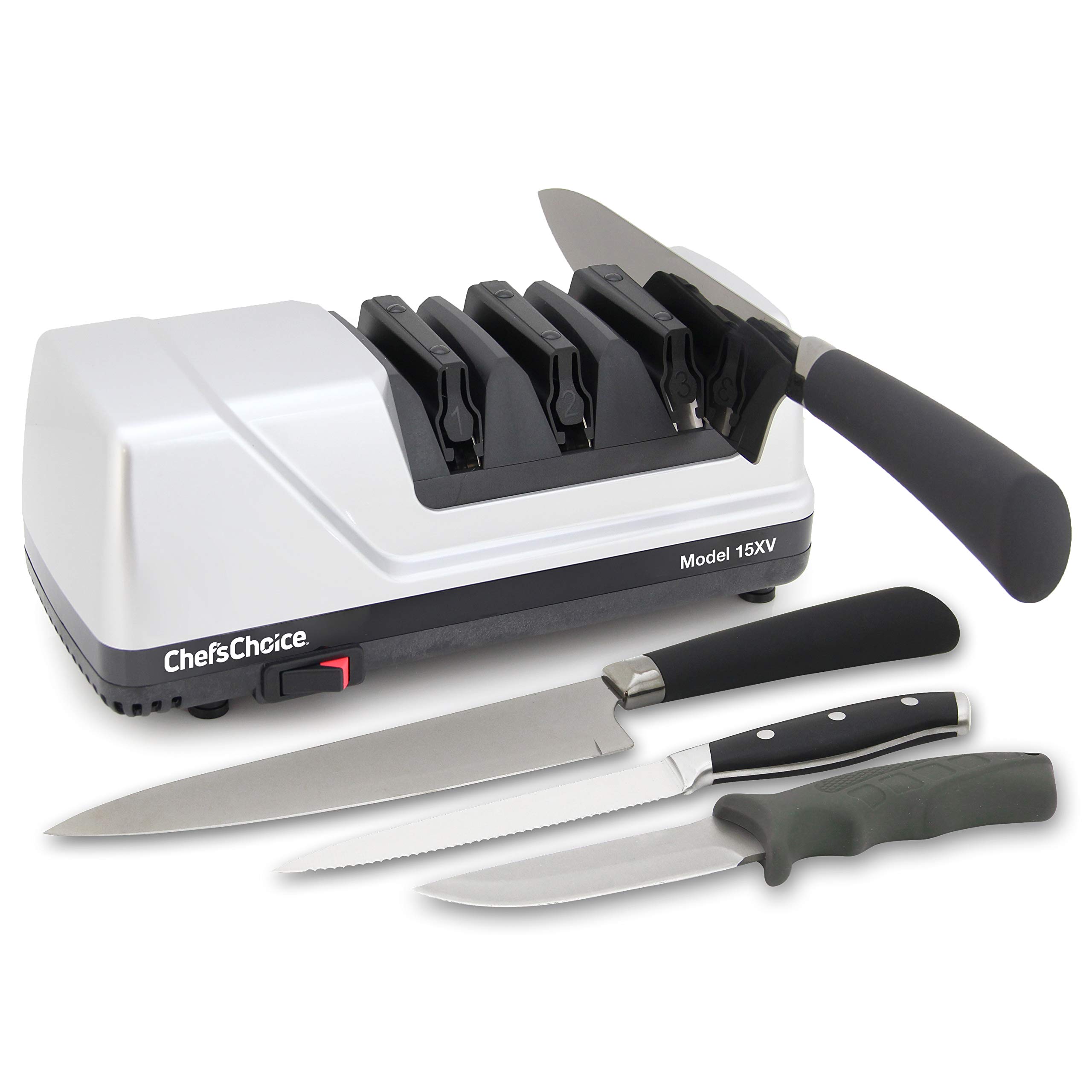
The 15XV is the most expensive thing in this guide, and it buys one thing above all: it holds the angle for you. Three stages, two of them diamond, plus a stropping stage, with spring guides that adjust to the blade as you draw it through the slot.

If you own a block of decent knives and know you will never practice on a stone, this is the one to buy. It reprofiles a standard 20-degree factory edge into a 15-degree Trizor edge, and doing that to a whole drawer at once would take a stone and a steady hand far longer.

A 15-degree edge is keener than the factory grind most knives ship with, and it is more delicate, which is worth knowing before you put a cleaver through chicken bones or frozen stock. The geometry is the point: you are trading a little durability for a blade that bites.

Whether it is worth the money comes down to volume. For someone with a full block who has been paying to have knives sharpened, it earns its place quickly. For two paring knives and a bread knife, it is a lot of machine.

Pros

  • Holds a consistent angle with no technique
  • Reprofiles a whole block to 15 degrees
  • Handles straight and serrated blades

Cons

  • Can leave marks on the flat of blades
  • Needs counter space and an outlet
Our verdict

For anyone who wants consistent 15-degree edges without learning to hold an angle, the 15XV delivers — provided you can live with counter space and marks on blade faces.

Check Latest Price
5

Best for Tools and Damaged Edges

Work Sharp MK2 Electric

95 /100
Angler Score Outstanding

Key details

Type
Electric belt sharpener
Motor
Two-speed
Warranty
3 years
Abrasives
Flexible abrasive belts
Check Details on Amazon

Every other sharpener here works a blade against a stone, a rod, or a wheel. The MK2 runs an abrasive belt, and that changes what the tool is for: the belt conforms to the edge, cuts fast, and does not care whether the steel belongs to a chef's knife or a lawn mower blade.

An edge guide and a two-speed motor give you a coarse pass for reshaping and a finer one for finishing, backed by a 3-year warranty. Where it earns its keep is the work a stone will not touch: axes, pruners, mower blades, scissors, and kitchen knives that have been neglected for years.

We think of it as the reset button for a whole house — buy it once and every edge you own is usable again. The caveats come with the belt. It takes metal off fast enough that a careless pass can round a tip, and there is real room for rookie mistakes, so practice on something you do not love.

Set against the cost of sending a dozen knives out to be sharpened, the arithmetic works in its favor. Set against a whetstone, it is more money, more counter space, and one more thing to plug in.

Pros

  • Belts reshape chipped edges and blunt tools
  • Two speeds give coarse and finishing passes
  • 3-year warranty, the longest stated coverage here

Cons

  • Belts wear, the fine grit fastest
  • Needs an outlet and counter space
Our verdict

If your dull edges come with chips, or your shed is full of blunt tools, this belt machine earns its price; just budget for belts and practice on a cheap blade first.

Check Latest Price
6

Best for Thin Straight Blades

Rada Quick Edge (2-Pack)

95 /100
Angler Score Outstanding

Key details

Pack
Two sharpeners
Origin
Made in the USA
Weight
1.6 oz
Wheels
3.5 x 2 in hardened stainless steel
Check Details on Amazon

Two sharpeners come in the pack, which sounds like a gimmick until you decide where the second one goes. One lives in the kitchen drawer; the other rides in the boat box, the glove compartment, or the range bag. Neither takes up space you would notice.

The mechanism is as simple as it gets: two hardened, high-carbon stainless steel wheels set in a V in a nylon body. Draw a straight-edged blade between them and each wheel puts a bevel on one side. A handful of pulls is the whole job, and there is nothing to adjust, soak, or plug in.

Thin blades get the most out of it — fillet knives, paring knives, a hunting knife that sees a few trips a year. It does nothing for serrations, and there is no grit to choose: the wheels are what they are, so a chipped edge needs a different tool before this one can help.

What we like most is how little there is to get wrong. Keep one in the kitchen and one in the fishing kit, and dull knives stop being something you notice.

Pros

  • Two sharpeners for kitchen and boat
  • Hardened steel wheels need no setup
  • 1.6 ounces and small enough to stash

Cons

  • Straight-edge blades only
Our verdict

The Rada two-pack is the simplest good answer for thin straight blades, and the second unit means the boat or the truck gets one too.

Check Latest Price
7

Best Pocket Backup

Smith's PP1 Pocket Pal

91 /100
Angler Score Outstanding

Key details

Length
3.24 in
Warranty
3 years
Abrasives
Carbide, ceramic, diamond-coated rod
Attachment
Lanyard hole
Check Details on Amazon

A fillet knife and a fish hook have the same problem: an edge in a place a flat stone cannot reach. The Pocket Pal's fold-out diamond rod handles both. It is tapered, so it gets into a gut hook, a serration, or the bend of a hook, and it is the reason this one earns a place in a fishing kit rather than only in a kitchen drawer.

The body carries two preset slots as well: coarse carbide for a quick edge on a dull blade and fine ceramic to smooth it, both reversible and replaceable. The whole tool is about 3 inches long with a lanyard hole, so it hangs off a pack strap or disappears into a pocket.

Expect a working edge, not a polished one. The two preset slots set the ceiling, and it is a low one: a knife comes back sharp enough to cut bait, rope, and line. On the water that is the entire point. At the bench you will want more.

It is the one we keep in the boat bag, because a two-minute touch-up where you are standing beats a perfect edge you left at home. The rod is what earns that spot; the slots are the bonus.

Pros

  • Tapered diamond rod for hooks and serrations
  • Fits a pocket or a lanyard at about 3 inches
  • Carbide and ceramic stones reverse and replace

Cons

  • Carbide slot removes metal quickly
Our verdict

A pocket tool for people who sharpen where they fish and hunt: the diamond rod handles hooks and serrations, and the slots handle everything else in a pinch.

Check Latest Price
8

Budget Stone Practice

Keenbest 400/1000 Whetstone

94 /100
Angler Score Outstanding

Key details

Base
Non-slip rubber
Grits
400 and 1000
Weight
16 oz
Stone Size
7 x 2.2 x 1.1 in
Check Details on Amazon

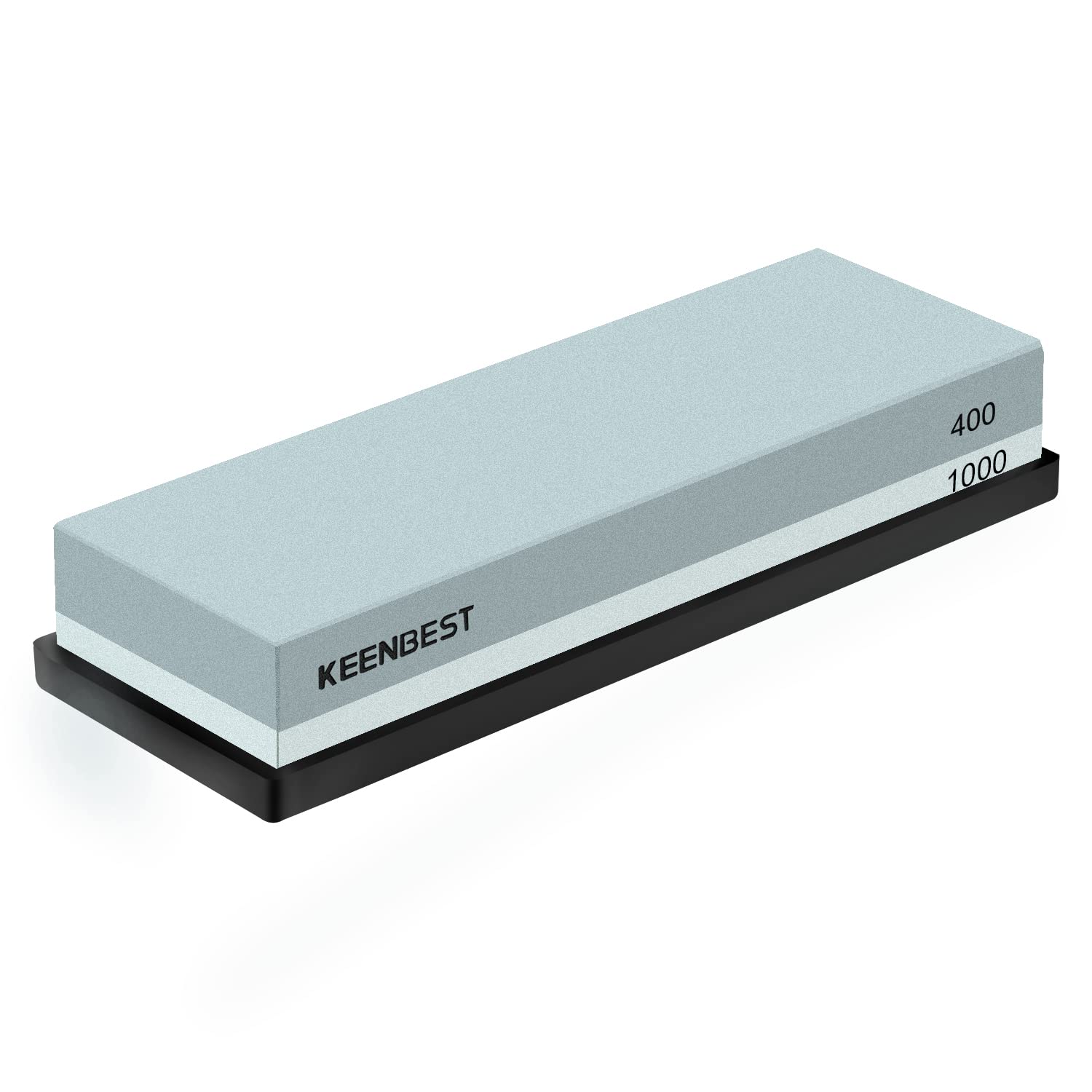
The cheapest way to find out whether you like sharpening on a stone is this one. Two grits, a rubber base, and enough stone for a chef's knife, for less than the price of most of the sharpeners here. If you are curious and not ready to commit, start here — the money you save buys the practice.

Four hundred grit on one side for a dull or lightly damaged edge, 1000 on the other to finish. It is silicon carbide and white corundum, and it is a water stone: ten to fifteen minutes of soaking before the first pass, then a splash or two as you work so the surface keeps cutting.

The rubber frame is the part cheap stones usually get wrong, and it does its job — the stone sits still on a counter instead of skating. The 1000 side finishes a kitchen knife well enough that you stop noticing the difference between it and a much more expensive stone.

What you get is honest and nothing more: a stone that cuts and a base that grips. Set beside the Sharp Pebble kit, you are giving up the extras and saving real money. If you already know how to hold an angle, that is a fine trade.

Pros

  • Two grits for very little money
  • Rubber base holds the stone still
  • Good size for standard kitchen knives

Cons

  • No angle guide included
  • Short stone for long chef's knives
Our verdict

The Keenbest is the low-risk way into stones: it cuts, it stays put, and if you decide freehand sharpening is not for you, you have lost very little.

Check Latest Price

What Eight Months of Deliberately Dulling Knives Taught Us

We started by gathering sharpeners that each took a genuinely different route to an edge — carbide pull-throughs, ceramic rods, diamond plates, two-sided water stones, and electric multi-stage machines — then narrowed by price, whether the tool guided the angle for you, and whether abrasives or stones could be replaced. Twelve made the cut, and we ran them for eight months, roughly three or four sharpening sessions a week.

Every model faced the same beaters: a stained chef's knife I kept deliberately dull, a serrated bread knife, a paring knife, and a pocket folder hauled out before a camping weekend. Sharpness got checked the crude way first — slicing a ripe tomato to see whether the skin split under the blade's own weight — then we counted how many passes or minutes each tool needed to get there. Pull-throughs were counted stroke by stroke, electrics were timed, and stones got a set number of strokes per side.

Two things we watched closely were scratching and stability. Each blade got examined under a bright lamp afterward for scuff marks on the face, and every countertop model took a hard pull to see if it walked or rocked on the granite. Durability meant coming back to the same abrasive over and over: by the end, we could tell which carbide slots had gone smooth and which stones had dished. Value came down to how fast the abrasive wore and whether it could be swapped out, and ease of use showed up before we even sharpened — a stone that needs a long soak or a machine buried at the back of a cupboard tells you how often it'll get used.

How to Choose a Knife Sharpener

How Much Steel You're Willing to Lose

Every sharpener works by removing metal, and the fast ones remove the most. A carbide pull-through or a coarse belt will bring a cheap knife back in seconds and shorten the life of a good one, because the steel it takes off does not grow back. If your knives are the ones you cook with every night, choose a sharpener with a grit progression — coarse to repair, fine to finish — and keep the aggressive stage for damaged edges rather than routine upkeep. The AccuSharp in this guide is a good kitchen-drawer tool precisely because it aims at knives you are not sentimental about.

Match the Abrasive to the Blade

Flat stones and V-slots cannot reach into a scalloped edge; serrations need a tapered rod, ceramic or diamond, that follows each groove. The same goes for gut hooks, fish hooks, and anything curved. If one tool has to cover kitchen knives and fishing gear, get one that carries a rod as well as a slot — the Smith's Pocket Pal and the Work Sharp Field Sharpener both do. Scissors want a flat abrasive or a dedicated slot, and broadheads are their own small problem, usually handled with a diamond plate.

Angle Control Is the Whole Skill

A sharpener either holds the angle for you or asks you to hold it. Preset slots, spring guides, and clip-on guides remove the guesswork; a bare stone does not. If you will practice, freehand on a stone gives you the best edge and the most control over the bevel. If you will not, buy the guide or buy the machine — a 20-degree edge held consistently beats a perfect angle you cannot repeat. That is the real choice between the Sharp Pebble kit and the Chef'sChoice, more than the money.

Where It Will Live, and What It Costs to Keep

Counter space, an outlet, a drawer, or a tackle box — answering that settles more of this decision than any specification. An electric machine needs a permanent spot and a cord; a 4.6-ounce field sharpener goes in a pack and never asks for power. Then budget for consumables: belts wear, replacement carbide blades dull, stones need flattening, and water stones need water. A sharpener with a steady appetite for parts is not the cheap one.

Frequently Asked Questions

Final Verdict

The Work Sharp Guided Field Sharpener is the one we point most people to. It repairs, refines, hones, and strops a blade in a 4.6-ounce package, and the built-in 20- and 25-degree guides make the result repeatable whether you are standing at a cutting board or a cleaning table.

If you will never learn an angle and own a block of good knives, the Chef'sChoice 15XV does the thinking for you — just keep polished blades away from its guides. And if all you want is a working edge in ten seconds, the AccuSharp is the one to grab.