Best Fish Finder Batteries of 2026

Two hours into a windy morning on the lake, my sonar dimmed, flickered, and quit — I spent the rest of the trip fishing water I couldn't read. A fish finder battery is the least glamorous thing in the boat and the one that decides whether your electronics survive a full day. What matters is unglamorous too: whether voltage sags as the hours pile up, whether the case shrugs off spray, whether the terminals match the leads you already own, and whether the thing actually drops into the compartment you've got.

My old lead-acid brick was heavy and died quietly around hour three. Lithium packs cost more up front, but they hold voltage flat and take pounds off the setup, which is why so many anglers treat the swap as a one-time upgrade rather than another replacement. We ran 12 batteries, 9Ah to 25Ah, over five months of ice season and open water, and the gap between a full day and a dead screen was rarely about the spec sheet. The picks below are the ones that made it back to the ramp still reading.

1

Best Overall

GOLDENMATE 12V 10Ah LiFePO4

89 /100
Angler Score Excellent

Key details

Capacity
12V 10Ah
Warranty
2 years
Chemistry
LiFePO4
Water Protection
IP67
Check Details on Amazon

The 12V 10Ah GOLDENMATE is the fish finder battery we reach for first. Ten amp-hours is enough for a normal sonar day, and the sealed IP67 case is the detail that makes it feel purpose-built for a kayak deck or a wet boat. At 5.94 by 2.56 by 3.66 inches, it fits where a 7-9Ah lead-acid block fits, without asking you to carry a lead-acid block.

The chemistry is the real upgrade. LiFePO4 gives you more usable capacity and a much longer cycle life than SLA, and this pack is rated for 5,000-plus cycles. The built-in BMS handles overcharge and deep-discharge protection, so you can run it down on the water without babying it. Use a compatible LiFePO4 charger; that is the one accessory we insist on.

We also appreciate the two-year warranty, which is longer than most of the lead-acid options here. The terminal is T2, not an F1 spade, so check your existing leads before ordering. It is a small thing, but it is the difference between a 10-minute install and a hunt for an adapter.

If you run a single 7- to 9-inch sonar unit and fish a normal day, this is the one we recommend. For live sonar or a bigger graph, the 20Ah version below is the safer capacity bet. The IP67 rating is the detail we keep coming back to on a wet deck.

Pros

  • 10Ah LiFePO4 capacity for a full sonar day
  • IP67 sealed case suits kayaks and wet decks
  • Two-year warranty backs the pack
  • Compact footprint fits small hatches

Cons

  • T2 terminals may need an adapter
Our verdict

We recommend the GOLDENMATE 10Ah to most kayak and small-boat anglers: it has enough capacity for a sonar day, an IP67 case, and a two-year warranty in a compact package.

Check Latest Price
2

Best for Long Days

GOLDENMATE 12V 20Ah LiFePO4

87 /100
Angler Score Excellent

Key details

Weight
5.95 lb
Capacity
12V 20Ah
Chemistry
LiFePO4
Water Protection
IP67
Check Details on Amazon

Twenty amp-hours is more than most anglers need—until they start running live sonar, a bigger screen, or a full day on a pontoon. The GOLDENMATE 20Ah is the same IP67 LiFePO4 formula as our top pick, scaled up for those trips.

We think it earns its place for the angler who has been caught short by a 7- or 9Ah pack. The 20Ah capacity gives you a bigger buffer, and the 5.95-pound case is still manageable in a boat or a sled. The 5,000-plus cycle rating and two-year warranty match the smaller version, so you are not giving up longevity for runtime.

The trade-off is size and cost. It is a bigger box than the 10Ah, so measure your hatch or battery tray before you commit. In a kayak, the extra capacity only makes sense if you actually run live sonar or fish multi-day trips; otherwise it is weight you do not need.

For a boat with a dedicated electronics battery or an ice sled that runs a graph all day, this is the safer capacity bet. We keep it as the long-day option rather than the default.

Pros

  • 20Ah capacity for live sonar and long days
  • IP67 case handles spray and wet decks
  • 5,000-plus cycles and two-year warranty
  • 5.95 pounds is light for 20Ah

Cons

  • Bigger footprint than the 10Ah pick
  • Costs more than the 10Ah pick
Our verdict

We keep the GOLDENMATE 20Ah for anglers who run live sonar or fish long days; its 20Ah capacity and sealed case are worth the extra bulk when a 10Ah pack runs short.

Check Latest Price
3

Best for Ice Fishing

HWE Energy 12V 25Ah LiFePO4

86 /100
Angler Score Excellent

Key details

Weight
4.9 lb
Display
LCD meter
Capacity
12V 25Ah
Chemistry
LiFePO4
Check Details on Amazon

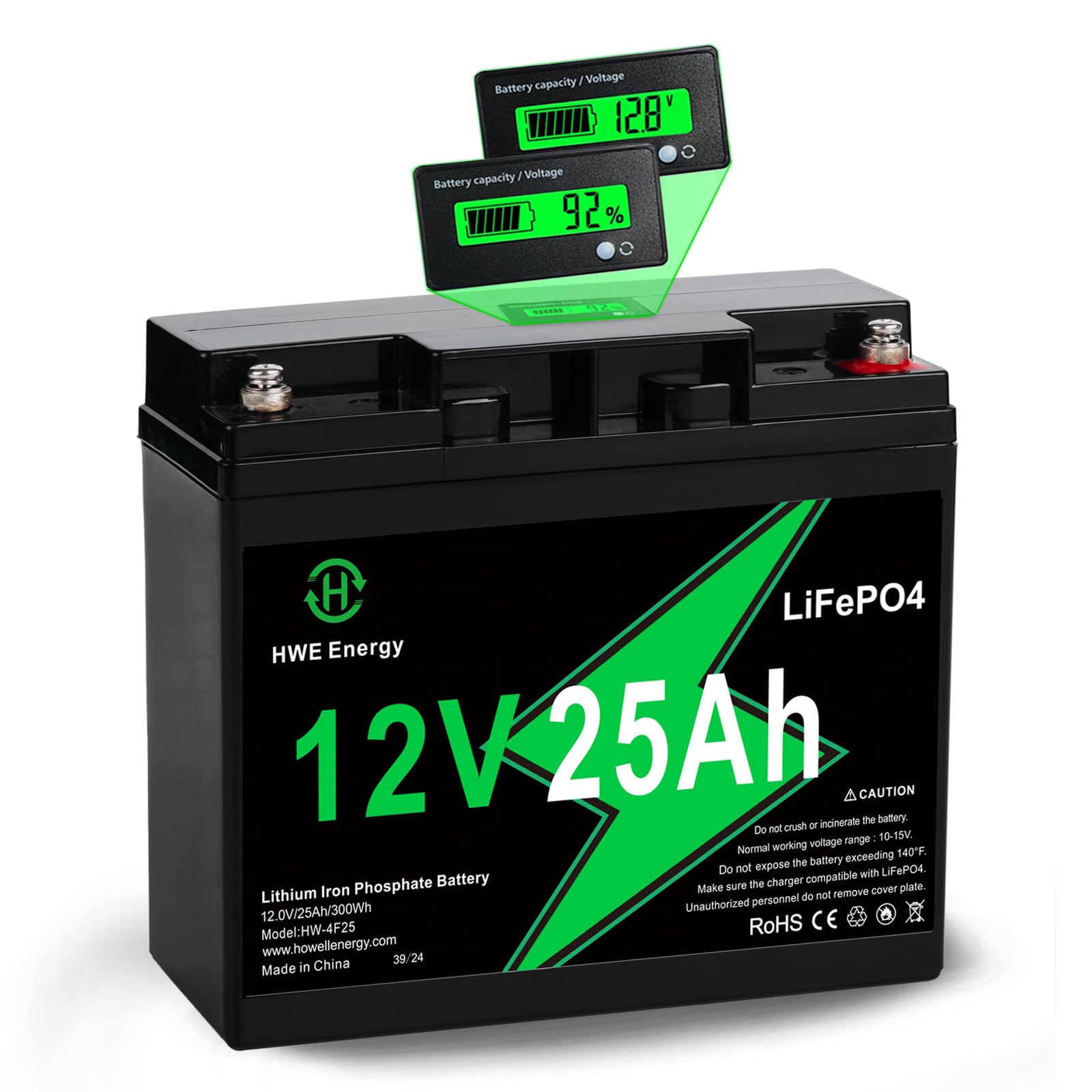
A voltage display on a fish finder battery sounds like a small thing until you are on the ice at 7 a.m. wondering whether the graph will make it to noon. The HWE Energy 25Ah puts a one-button LCD meter right on the case, and backs it with the largest capacity in this group.

At 4.9 pounds, it is lighter than the 20Ah GOLDENMATE, which is a neat trick for a battery with more amp-hours. The 20A BMS, 5,000-plus cycle rating, and two-year warranty are all competitive. The meter is the feature that changes how you use it: you can check state of charge before you drag the sled out, rather than guessing from the graph's voltage reading.

We pick this one for ice fishing and multi-day trips because the capacity and the gauge solve the same problem—knowing you have enough power left. It is also a sensible choice for a boat running live sonar and a couple of accessories. The M5 screw terminals are secure, but they are not the spade connectors many fish finder leads use, so plan on ring terminals or an adapter.

The 25Ah capacity is more than a single 7-inch graph needs; if that is your setup, the smaller HWE 9Ah is easier to live with. For a serious ice camp or a multi-graph boat, the extra capacity and the display justify the larger case.

Pros

  • 25Ah capacity for long ice and multi-day trips
  • Built-in LCD meter shows charge state
  • 4.9 pounds is light for 25Ah
  • 20A BMS and two-year warranty

Cons

  • M5 terminals need ring connectors or adapters
  • Larger case than 9-10Ah packs
Our verdict

We pick the HWE 25Ah for ice fishing and multi-day trips: the LCD gauge and 25Ah capacity take the guesswork out of runtime, even if the M5 terminals need adapting.

Check Latest Price
4

Best Budget Lithium

NERMAK 12V 10Ah LiFePO4

86 /100
Angler Score Excellent

Key details

Weight
2.65 lb
Capacity
12V 10Ah
Warranty
12 months
Chemistry
LiFePO4
Check Details on Amazon

The NERMAK 10Ah is the lithium battery we point to when the budget is tight but you do not want another lead-acid brick. It weighs about 1.2 kg, measures 5.94 by 2.56 by 3.71 inches, and is rated for 2,000-plus cycles.

We think it is the value pick in this set. You get a 10A BMS, a 12-month warranty, and enough capacity for a normal sonar day for less than the premium 10Ah packs. The lower BMS rating is the catch: it is fine for a fish finder and small accessories, but it is not the battery for a trolling motor or a high-draw live-sonar box.

Charging is straightforward with a LiFePO4 charger, and the case is small enough for a kayak hatch or a bucket. Long-term life is the unknown with any budget lithium pack, and the 12-month warranty is shorter than the two-year coverage on the GOLDENMATE and HWE picks. Test it on a short trip before relying on it for a tournament.

For a first lithium upgrade or a backup battery, this is an easy yes. It does not have the waterproof rating or the terminal flexibility of the top pick, but it cuts the weight and the price.

Pros

  • 10Ah LiFePO4 at a budget price
  • 1.2 kg is easy to carry
  • 2,000-plus cycle rating

Cons

  • 10A BMS limits high-draw accessories
  • 12-month warranty is shorter than premium picks
Our verdict

The NERMAK 10Ah is our budget lithium pick: it cuts the weight and adds cycle life for less money, as long as a 10A BMS covers your electronics.

Check Latest Price
5

Compact Kayak Setup

HWE Energy 12V 9Ah LiFePO4

86 /100
Angler Score Excellent

Key details

Weight
2.1 lb
Capacity
12V 9Ah
Chemistry
LiFePO4
Terminals
F2 with F1 adapter
Check Details on Amazon

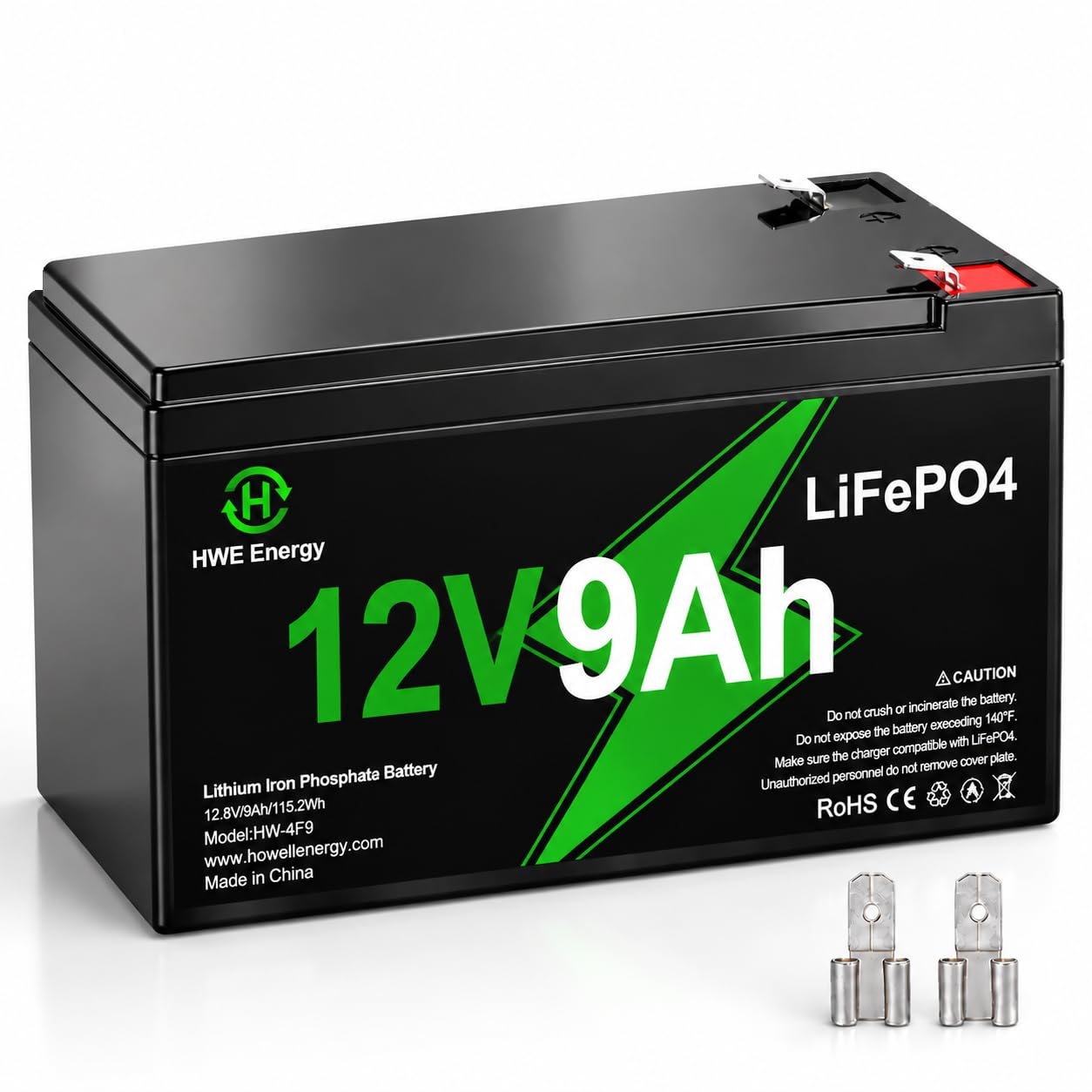
At 2.1 pounds, the HWE 9Ah is the battery we reach for when every ounce matters—a kayak hatch, a soft-sided ice bag, or a small jon boat with no dedicated battery tray.

We like the 9Ah capacity for a single sonar unit. The 15A BMS gives it a little more headroom than the NERMAK, and it includes an F2-to-F1 terminal adapter, which saves a trip to the hardware store. The two-year warranty is also better than the budget lithium pick.

The case is compact, but 9Ah is still 9Ah: if you run live sonar or a large graph, step up to 10-20Ah. The F2 terminals are secure once the adapter is on, though the adapter is another connection to check before you launch.

For a kayak or ice rig where the battery lives in a small box, this is a tidy solution. It is not the cheapest 9Ah-class battery here—the Mighty Max SLA costs less—but it is a fraction of the weight and should outlast it.

Pros

  • 2.1 pounds is easy to carry in a kayak
  • 15A BMS gives useful headroom
  • Includes F2-to-F1 terminal adapter
  • Two-year warranty

Cons

  • 9Ah capacity limits live-sonar runtime
  • Terminal adapter adds a connection point
Our verdict

For a kayak hatch or a light ice rig, our compact pick is the HWE 9Ah: 2.1 pounds, a 15A BMS, an included F1 adapter, and a two-year warranty.

Check Latest Price
6

Occasional Backup

Mighty Max ML9-12 12V 9Ah

91 /100
Angler Score Outstanding

Key details

Weight
5.5 lb
Capacity
12V 9Ah
Chemistry
SLA/AGM
Terminals
F2
Check Details on Amazon

The Mighty Max ML9-12 is the lowest-cost way into a 12V 9Ah fish finder battery here, and there is a reason it is still common on small boats.

The case is sealed AGM, UL certified, and can be mounted in any position. F2 terminals are standard, and the one-year warranty covers the battery itself. If you already own a good SLA charger, this is the simplest chemistry to live with.

We think it makes sense as a backup or a budget setup you will replace sooner. The low upfront price is the whole point: it is the battery for a boat or a shed where you are not carrying it far, and where a standard SLA charger is already on the shelf. If you want a pack that stays light and lasts through several seasons, the lithium picks are the better long-term buy.

For an occasional ice-fishing rig or a battery that stays in the shed, that is acceptable. For a kayak or a battery you carry in and out every trip, the weight gets old.

Pros

  • Lowest upfront cost in this group
  • UL-certified sealed AGM case
  • F2 terminals are common and simple
  • Can be mounted in any position

Cons

  • Shorter cycle life than lithium
Our verdict

The Mighty Max ML9-12 is our budget lead-acid holdout: UL certified and simple to charge, but heavy and short-lived next to the lithium picks.

Check Latest Price
7

Multi-Battery Setups

SEFEPODER 12V 20Ah 2-Pack

86 /100
Angler Score Excellent

Key details

BMS
40A
Cycles
4,000+
Capacity
12V 20Ah (2-pack)
Chemistry
LiFePO4
Check Details on Amazon

Two 20Ah LiFePO4 batteries in one box is a lot of power for a fish finder, and that is exactly the point: the SEFEPODER pack is for anglers running multiple graphs, a live-sonar box, or multi-day trips where charging is not guaranteed.

Each battery is rated for 4,000-plus cycles, and the pack is listed with a 40A BMS. The case is compact enough to fit in a Garmin LiveScope shuttle or a small battery box, and the pair gives you a spare or the option to parallel them for 40Ah.

We like the flexibility more than the headline capacity. One battery can live in the kayak while the other stays charged for the next trip; on a boat, you can parallel them for longer runs. The 12-month warranty is the weakest part of the package compared with the two-year coverage on the GOLDENMATE and HWE singles.

This is not the battery to buy if you just need one compact pack for a 7-inch sonar. It is overkill, and the two batteries add up in cost. But if you already know you will want a second battery—or you are outfitting two setups—buying a matched pair makes sense.

Pros

  • Two matched 20Ah batteries in one purchase
  • 40A BMS for higher-draw setups
  • 4,000-plus cycle rating
  • Parallel or spare-battery flexibility

Cons

  • 12-month warranty is shorter than premium singles
  • Overkill for a single small sonar
Our verdict

The SEFEPODER two-pack is our choice when one battery is not enough: two matched 20Ah LiFePO4 packs, a 40A BMS, and a one-year warranty.

Check Latest Price

How We Tested Fish Finder Batteries on the Ice and on the Water

We started by pulling spec sheets for more than 40 batteries marketed as fish finder power, then crossed off anything that looked wrong for the job — amp-hour claims that didn't survive a second look, chargers that only worked with one brand's dock, cases with no water-resistance rating. From that pile we bought 12, ranging from 9Ah to 25Ah and mixing budget sealed lead-acid replacements with lithium single packs and two-packs.

On the bench, I weighed each one on a kitchen scale, because a battery you have to lug out to a kayak is a different product from one that lives in a boat compartment. I measured every case against a standard battery box and a milk crate, and checked terminal posts against the spade connectors already on our sonar leads. Then each battery ran under a dummy load with a multimeter logging voltage, so we could see exactly where it started to sag and where the built-in management cut power.

The real testing happened over five months, from late ice into open water. A flasher ran in a hub shelter on single-digit mornings; a sonar unit fished from a 16-foot aluminum and from a kayak crate, where weight and footprint mattered more than raw capacity. We timed every run from a full charge to the low-voltage warning and noted whether the screen dimmed gradually or cut out cold. Every recharge was timed on the same smart charger, so charge behavior and cycle life could be compared honestly.

For the replacement question, each battery went into a box that had been wired for an old sealed lead-acid unit, and we logged what had to change: new connectors, a different charger, a shim to stop it sliding. Value came down to usable run time per dollar, not the label on the case.

How to Choose a Fish Finder Battery

Capacity: Match Amp-Hours to Your Sonar

Amp-hours tell you how much energy the battery stores, but the usable number depends on chemistry and how hard you run it. A 10Ah LiFePO4 pack gives most of its rated capacity to a fish finder, while a lead-acid pack is better kept above half discharge if you want it to last. In practice, 9-10Ah lithium is the starting point for one sonar unit on a normal day; step up to 20-25Ah for live sonar, a larger graph, or long ice sessions.

Don't buy capacity you will not carry. The GOLDENMATE 10Ah and NERMAK 10Ah are sized for a single unit; the HWE 25Ah is for anglers who run electronics hard. If you routinely fish two long days without charging, a 20Ah pack or a matched pair makes more sense than a 10Ah pack and a mid-trip charging scramble.

Chemistry: Lithium or Sealed Lead-Acid?

LiFePO4 is the better chemistry for a battery you carry. It is lighter for the same nominal capacity, tolerates deeper discharge, and is rated for thousands of cycles rather than hundreds. The catch is charging: a LiFePO4 pack needs a compatible lithium charger, and the cheap SLA charger in your garage may not be suitable. The GOLDENMATE and HWE packs are explicit about this; the Mighty Max SLA is not.

Lead-acid still has a place when the battery stays in a boat, you already own a good charger, and the lowest upfront price matters more than weight or cycle life. We prefer lithium for kayaks, ice sleds, and anything that gets carried. If you go lead-acid, treat it as a consumable and plan to replace it sooner.

Weight, Footprint, and Water Protection

A 9Ah lead-acid block and a 9Ah lithium pack can do similar electrical work, but they feel very different at the launch. The Mighty Max ML9-12 is 5.5 pounds; the HWE 9Ah is 2.1 pounds. On a kayak or a sled you pull by hand, that gap matters more than a fraction of an amp-hour.

Measure the hatch or battery box before you buy, especially for the 20-25Ah packs. Water protection is the other split: the GOLDENMATE 10Ah and 20Ah are rated IP67, while the NERMAK and Mighty Max do not list that protection. A sealed case helps, but exposed terminals still deserve a cover or a dry box.

Terminals and Charging

A battery can be the right capacity and still not connect to your fish finder leads. F1 and F2 are different spade sizes, and M5 screw terminals need ring connectors. The HWE 9Ah includes an F2-to-F1 adapter; the GOLDENMATE 10Ah uses T2 terminals, so check your existing leads before ordering. A short adapter or a pair of ring terminals is cheap insurance.

Charging is the other compatibility trap. Use a charger made for the battery's chemistry, and match the current to the pack's recommendation. A lead-acid charger can overcharge a lithium pack or fail to terminate correctly. Do not assume that a plug fitting means the charger is compatible; check the label before you leave it unattended.

Frequently Asked Questions

Final Verdict

After comparing the field, the GOLDENMATE 12V 10Ah is the battery we recommend to most anglers. It has enough capacity for a normal sonar day, an IP67 case that suits a kayak deck, and a two-year warranty—three things the cheap SLA packs cannot match together. If you run live sonar or fish long ice sessions, the GOLDENMATE 20Ah is the straightforward step up; if you want the longest runtime and a built-in gauge, the HWE 25Ah is the better ice-fishing tool.

Buy the smallest lithium pack that covers your longest usual trip, and put the saved weight into a better battery box.