
Best Fly Tying Hackle of 2026

A single dry fly can live or die on one feather. Hackle is the collar wrapped around the hook — it's what keeps the fly floating, what suggests legs and motion, and what a trout sees first. Buy carelessly and you get a bag of stiff, webbed barbs that splay sideways, all cut to the same useless length; buy well and one cape ties hundreds of flies with fibers that taper and spring the way the pattern calls for. The gap between a fly that rides high through an entire drift and one that starts sinking on the third cast is usually just the feather in your hand.

Over the past eight months, my team and I have tied with 12 different hackle packs, half capes, and strung saddles, ranging from introductory mixed packs to long feathers cut for streamers. Here's what nobody tells a first-time buyer: you almost certainly don't need the most expensive cape in the shop. What matters is whether the feather length and barb stiffness match the size of fly you actually fish, and whether a single pack gives you enough color range to cover the patterns you'll tie all season. That's exactly what these picks were sorted around.

1

Best Overall

Whiting Introductory Hackle Pack

91 /100
Angler Score Outstanding

Key details

Colors
Grizzly and brown, plus dun, black, or cream
Hook Sizes
Wide hook size range
Feather Type
Four half capes, dry-fly grade
Check Details on Amazon

A half cape is a working piece of neck hackle, and the feathers on it grade from fine at the tip to broad at the base, so one cape alone spans several hook sizes. This pack gives you four of them: grizzly and brown in every pack, plus two more drawn from dun, black, or cream. Whiting builds them for dry-fly work, and that grading is the first thing to understand about what you are buying.

That span is why we put this one first. Dry-fly hackle has to do a job no streamer feather can: the barbs need enough stiffness to stand out from the hook and hold a fly up, in fibers fine enough to wrap behind the eye of a size 18. Whiting's dry-fly capes are the strongest dry-fly material in this group, and four half capes in the right two colors is a better buy than chasing single capes down one at a time.

There is a catch in the color lineup. Grizzly and brown are guaranteed; the other two come from dun, black, or cream, and you don't get to choose which. Tie a lot of black beetles or cream cahills and that is a real gap in the pack, so it is worth checking whether the two guaranteed colors cover most of your box before you commit.

Where it pays off is repetition. One feather wraps a fly, so a cape that keeps giving you the same size and stiffness at every tier is the difference between a dozen Adams in an evening and a fight with the material. Buy the graded pack once and you stop thinking about hackle for a season.

Pros

  • Four half capes cover a wide hook range
  • Grizzly and brown guaranteed in every pack
  • Graded for dry-fly tying

Cons

  • Priciest pack in this guide
Our verdict

This is the pack we recommend for anyone tying trout dry flies: four half capes with the size range and stiffness to cover a whole box of patterns.

Check Latest Price
2

Best for Beginners

Whiting Fly Tier's Variety Pack

88 /100
Angler Score Excellent

Key details

Colors
Grizzly, brown, dun, black
Feather Size
Large
Feather Types
Assorted natural hackle
Check Details on Amazon

If you are new to tying and can't yet say whether you are a dry-fly person, this is the pack we hand over first. Grizzly, brown, dun, and black in one bag cover most of the classic trout palette, and it is the least expensive way into Whiting material here.

The feathers lean large. Most of the hackle in the pack sits around size 8 and up, which we found is exactly right for woolly buggers, poppers, bass bugs, and streamer collars — and the wrong end of the scale if your heart is set on size 20 midges. Whiting names warmwater and streamer patterns as the target, and the material matches that billing.

There is enough material in one pack to tie a few hundred flies, since a fly takes a feather or less, so this is a starter supply rather than a sampler. The mixes mean you can pull tails for a streamer, a palmered body for a bugger, and a wrapped collar for a dry fly out of the same bag without opening anything else.

What it isn't is a graded cape, and the day you know what you tie, a specific cape or saddle serves you better. Until then, the pack answers the question — you find out fast which feathers your hands reach for.

Pros

  • Four colors cover the classic palette
  • Enough material for a few hundred flies
  • Least expensive Whiting pack here

Cons

  • Feather quality varies inside the bag
Our verdict

We think this is the best first pack a new tier can buy: four colors, a broad mix of feathers, and enough material to tie through a season of experimenting.

Check Latest Price
3

Best for Streamers and Buggers

Hareline Strung Chinese Saddle

85 /100
Angler Score Excellent

Key details

Color
Chartreuse
Length
5–7 inches
Feather Type
Strung Chinese saddle
Check Details on Amazon

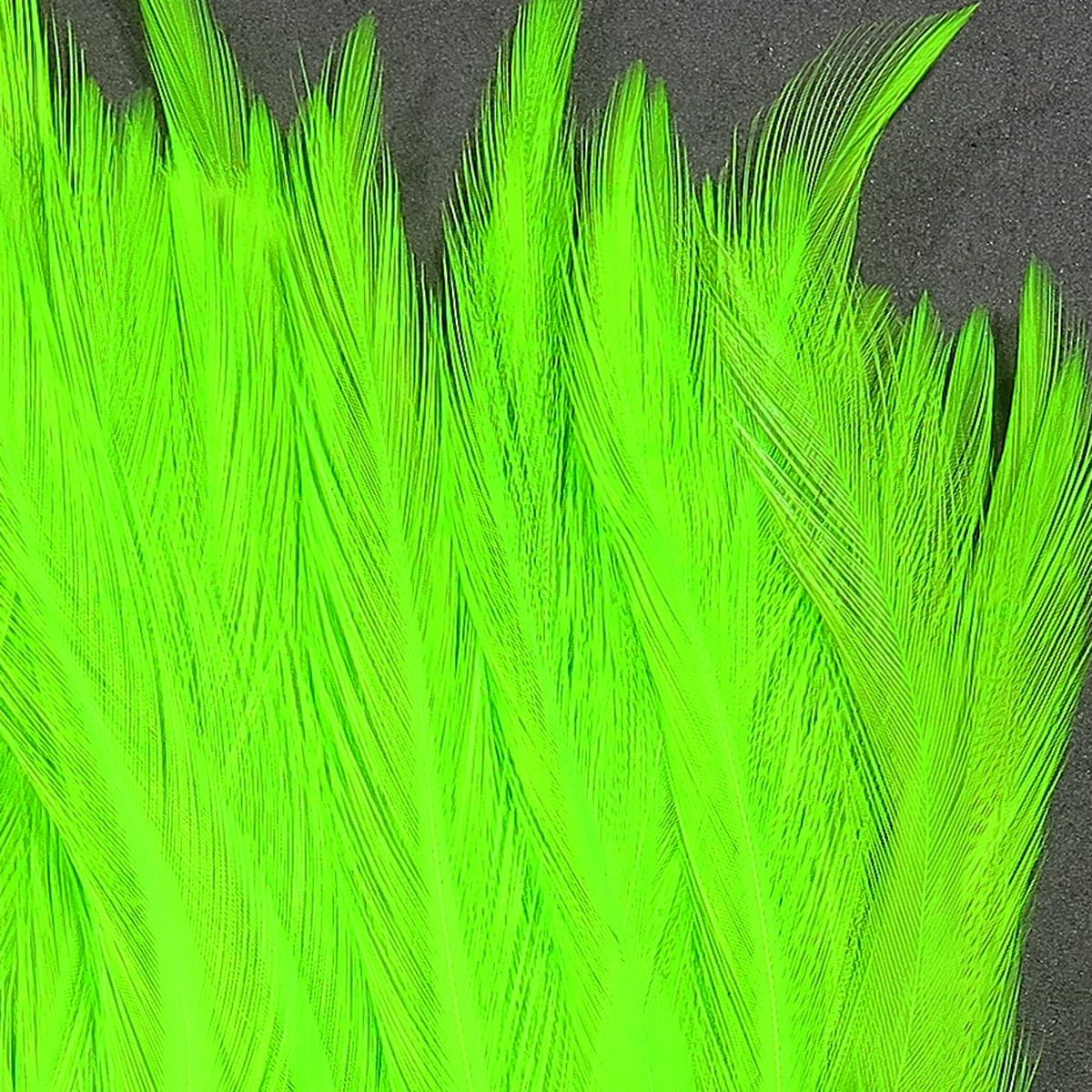
Five to seven inches of feather is a different tool from a dry-fly cape. Fibers that long wrap a size 6 bugger body in two or three turns instead of ten, and there is enough length left on the same feather to cut a wing or a tail section.

That is the case for the Hareline strung Chinese saddle, and it is why it is our pick for streamers and buggers. The fibers are long, soft, and full of movement in the water, and the quills take a palmered wrap without snapping — which is what you want when you are winding feather between a marabou tail and a conehead.

One thing about how it is sold: a strung saddle is a bundle of feathers in a single color, and the current listing is chartreuse. That is a superb color for bass and off-color water and no use at all on a black bugger, so plan on one pack per pattern rather than expecting a palette.

For the price it is the most generous bundle here, and a bundle goes further than the count suggests: a long saddle feather wraps a body and still gives up a tail. Ours lives with the streamer materials, not the dries.

Pros

  • Five- to seven-inch fibers palmer big hooks fast
  • Soft fibers with plenty of movement in the water
  • Durable quills hold up to wrapping

Cons

  • Soft, webby fibers are not dry-fly hackle
Our verdict

For woolly buggers and big streamers, we reach for this one: long five- to seven-inch fibers that wrap in a couple of turns and cover a lot of hook.

Check Latest Price
4

Barred Streamer Patterns

Tigofly Barred Grizzly Hackle

80 /100
Angler Score Excellent

Key details

Color
Natural white with black barring
Length
5-6 inches (13-15cm)
Quantity
30 feathers
Feather Type
Barred grizzly rooster hackle
Check Details on Amazon

Thirty feathers, one pattern, five to six inches apiece. That is the whole proposition of the Tigofly pack, and for a streamer tyer it is a useful one: barred grizzly sits behind a lot of classic streamer wings, and buying it as a bundle means the feathers on the bench look like they came off the same bird.

Length does the work here. Five to six inches is enough to cut a full wing from a single feather with a throat or a tail left over, so you are not splicing two short feathers to reach the bend of the hook.

Where it lands for us is as a stock-up bag for one pattern rather than a starter pack. It is the least expensive way here to keep barred grizzly on hand, and if your box leans on streamers it earns its place on that alone. Come to it expecting a graded dry-fly cape or a color range and you will be disappointed.

The feathers are also more useful than the count suggests. A single barred feather splits into two or three tail sections on smaller streamers, so 30 of them stretches well past 30 flies — the sort of arithmetic that keeps a single-pattern bag on the shelf instead of at the bottom of a drawer.

Pros

  • Thirty matched barred grizzly feathers
  • Five- to six-inch fibers cover streamer wings
  • Lowest price among these picks

Cons

  • One barred pattern in one length only
Our verdict

We keep this bag for one job: barred grizzly streamers, where thirty long matched feathers cost less than any other pick here.

Check Latest Price

How We Tested Fly Tying Hackle

We built the shortlist the way most tiers shop: reading grading descriptions and sizing charts from more than a dozen suppliers, then filtering by price per usable feather rather than price per pack. A pack that looks cheap but yields forty feathers in one awkward size is more expensive than a cape that ties three hundred flies. We also weighted how many distinct colors and feather types each option covered, and whether the seller specified cape versus saddle, since the two behave very differently at the vise. Twelve packs made the cut, and we tied with each one for eight months.

Every pack went onto a vise before it earned an opinion. We measured individual feathers against a hackle gauge and sorted them into size bins, counting how many usable feathers fell in sizes 12 through 16 — where most of our dry flies live. Barbs got rolled between thumb and forefinger to feel for stiff, webbed fibers, and quills were flexed to check for splits and brittleness. Then came the real work: wrapping collars on Adams and Elk Hair Caddis, palmering buggers, and tying streamers with the longer saddles, noting how many flies each pack actually produced before the good feathers ran out.

On the water, we fished those same flies on a spring creek and a tailwater through the season, counting drifts before a fly needed floatant and watching whether hackle tips collapsed or held their shape after a few trout. Color got its own pass: every shade was laid out under a daylight lamp and matched against standard patterns, and we noted whether two feathers from the same pack barred the same way. Consistency, it turns out, separates a pack you'll tie from for years from one that leaves you digging for the two good feathers.

How to Choose Fly Tying Hackle

Capes, Saddles, and Packs Do Different Jobs

Three forms turn up in every hackle listing, and they are not interchangeable. A cape is the neck skin, and its feathers grade from tiny at the tip to broad at the base — that spread is what lets one cape dress hooks from a size 20 up to a size 10. A saddle is long and narrow, with fewer sizes but fibers long enough to palmer a whole body. A strung saddle or hackle pack is a bundle of feathers in a single color.

Buy a cape for small dries and a saddle for buggers and streamers, and expect to own both eventually. If you are only buying one thing this season, buy for the box you are shortest on.

Match Feather Length to the Hooks You Actually Tie

Fiber length is the quickest test of whether a pack suits you. Five- to seven-inch fibers wrap a size 6 bugger in two or three turns and leave material for a wing; short, broad cape feathers are what you want behind the eye of a size 16. If most of your box is small dries, a streamer pack will frustrate you no matter how good the feathers are.

Count the hook sizes you tie most before you buy, then check the listed length against them. Buying by feather count alone tells you nothing about whether those feathers fit your vise.

Stiffness Separates Dry-Fly Hackle From Wet-Fly Hackle

A dry fly floats on its hackle, so the barbs have to be stiff enough to hold the fly up and dense enough to carry the weight. Soft, webby fibers collapse in the water and the fly rides low. On a woolly bugger or a streamer that same softness is exactly what gives the fly movement and life.

Neither is better — they are for different jobs. When a listing does not say which it is, look at the patterns it names: buggers and streamers on one side, dries and emergers on the other.

Buy Colors for Your Pattern List

Write down the hackle colors called for by the ten patterns you tie most, and buy for that list rather than the widest assortment. Grizzly and brown cover a large share of classic trout flies; dun carries the Adams and the Hendricksons; black and cream handle beetles, ants, and cahills.

Assortments usually guarantee two or three colors and fill the rest at random, so a mixed pack is not a substitute for the one color you keep running out of. Two packs you use beat a rainbow you don't.

Pay for Usable Feathers, Not Feather Count

A big bag of feathers is only a bargain if most of them reach a hook. Short, misshapen, or webby feathers get sorted out and thrown away and you end up buying again before the season ends. Judge a pack by how many feathers you can actually tie with, not by how many come in the bag.

A graded cape where nearly every feather has a job is worth more than a larger bag you cull by half. For a first purchase, one good pack in two colors beats three cheap ones.

Frequently Asked Questions

Final Verdict

For dry flies, the Whiting Introductory Hackle Pack is the buy. Four half capes in the two colors trout patterns lean on, graded from small to large, cover a whole box of hooks that no streamer pack can reach. It costs more than anything else here, and it is the only pick doing that specific job.

If your streamers and buggers outnumber your dries, take the Hareline strung Chinese saddle instead — long fibers, one color at a time, easy to buy per pattern. And if you are still deciding what kind of tier you are, the Whiting Variety Pack is the cheaper way to find out.